What Is a Telegram Channel? The Complete 2026 Guide
What is a Telegram channel and how does it work? This guide explains channels vs groups, setup, growth, and the analytics needed for marketing and research.

Telegram is no longer just a chat app. It's a broadcast system, and channels are what make that possible.
A Telegram channel is a one-to-many publishing tool: admins post, subscribers receive. No back-and-forth, no member flood. That simplicity is the point.
The scale context: Telegram hit 950 million monthly active users by July 2024 and 1 billion by March 2025, per Telegram usage statistics. At that size, channels are how news breaks, products launch, and narratives spread. Our State of Telegram 2025 analysis gives broader context on audience behavior, and the core benefits of Telegram for channel operators breaks down which advantages are actually measurable.
How a Telegram Channel Works
The best analogy is a radio station. Admins are the hosts. Subscribers are the audience. They can't take the mic.
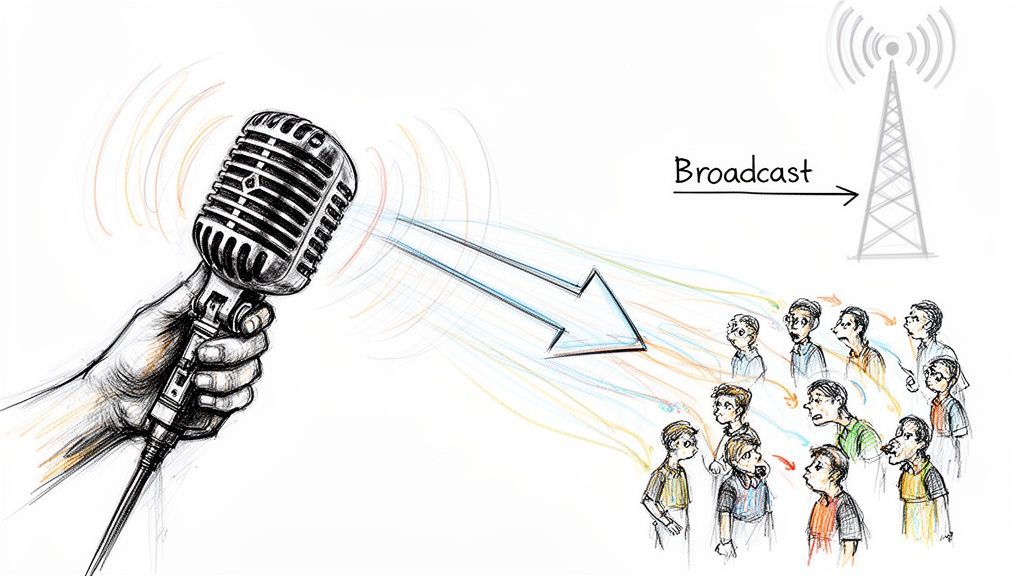
Channels support unlimited subscribers and store content in the cloud, synced across devices. Subscribers see admin posts, post view counts, and optional reactions or comments — nothing else. No member list, no social map of who else is following.
That privacy model reduces friction for people following sensitive topics or niche interests. For operators, it means you gain scale but lose community texture unless you deliberately build it in.
Practical rule: Use a channel when you want to control the publishing surface. Use something else when you want members to shape the conversation.
Channels vs Groups vs Bots
These three tools do different jobs. Confusing them leads to bad setup decisions.
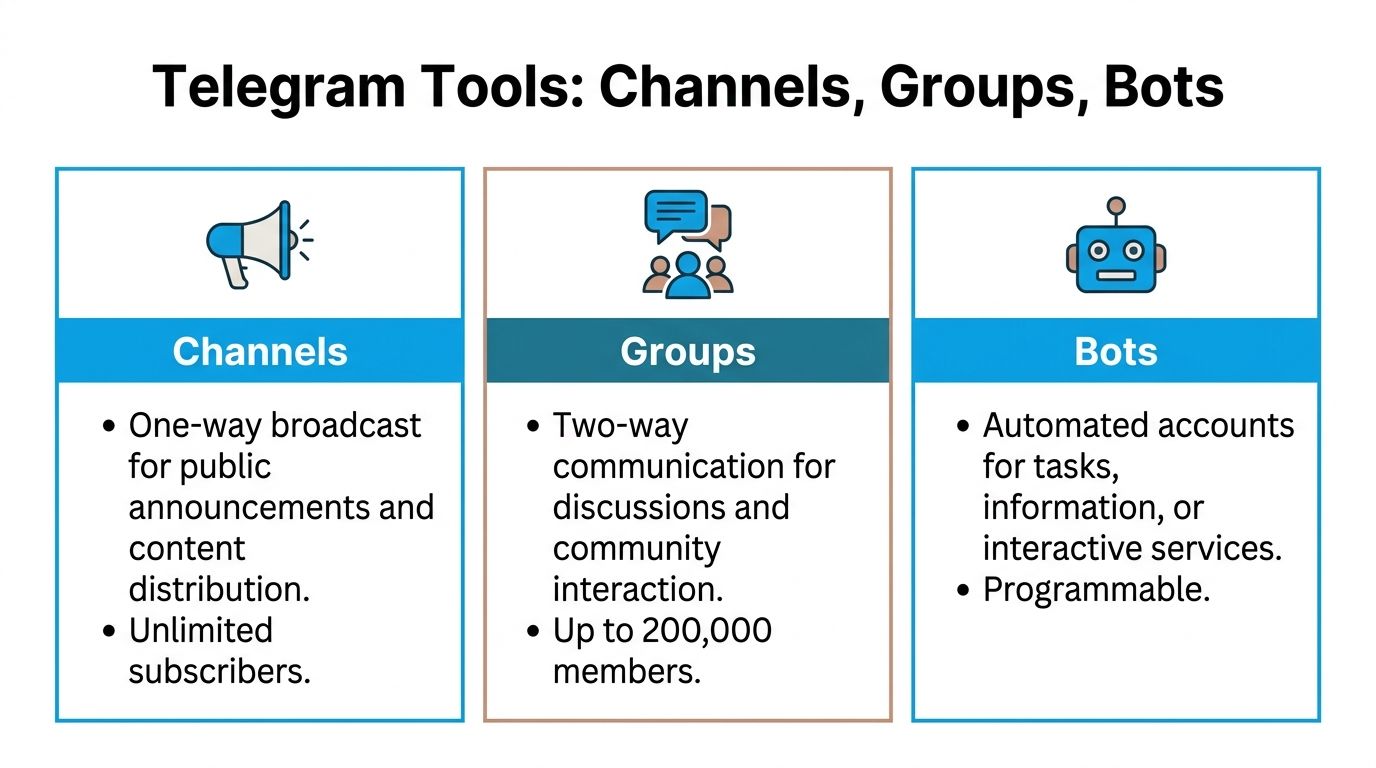
| Feature | Channel | Group | Bot |
|---|---|---|---|
| Primary role | Broadcast content | Host discussion | Automate tasks |
| Communication flow | One-to-many | Many-to-many | User-to-system |
| Who posts | Admins only | Members and admins | Bot responds/acts |
| Audience scale | Unlimited subscribers | Up to 200,000 members | Depends on use |
| Best use case | News, publishing, marketing | Community, support, chat | Alerts, forms, workflows |
Channels are right when you need message control, clean distribution, and a readable archive without off-topic noise.
Groups are for discussion — support communities, local coordination, peer exchange. A common pattern that works well: channel + linked group. Editorial posts stay in the channel; debate and questions live in the group.
Bots aren't audience containers. They automate: send alerts, answer routine questions, collect submissions, trigger workflows. This guide on Telegram bots covers the automation use cases in detail.
Each tool creates a trade-off. Channels give control but can feel distant without feedback loops. Groups create participation but moderation load grows fast. Bots save time but badly designed flows make Telegram feel mechanical.
Public vs Private Channels
Public channels are discoverable via Telegram search and shareable via a permanent link. Right for brands, newsrooms, creators, and researchers who want an accessible archive.
Private channels restrict access to invite links only. Right when controlled access is the product — paid communities, internal team broadcasts, cohort programs.
Use public when distribution is the priority. Use private when access control is the product.
Use cases that show the range
News and information — Telegram channels are naturally suited to time-sensitive publishing. The sequential feed format keeps updates easy to scan. Strongest channels use a recognizable structure, clear timestamps, and tight topic discipline.
Community without group chaos — A channel works as the front door for announcements, launch notes, and curated commentary. If discussion matters, comments or a linked group can sit behind it.
Marketing and sales — Channels support product launches, waitlists, educational sequences, and offer drops. Channels perform better when every post gives subscribers a reason to stay. Low-value posts feel more intrusive here than on an open social feed — you're next to people's private chats.
Research and discourse tracking — Researchers and journalists use public channels as observable records of what organizations and communities choose to publish. A channel becomes a timeline of claims, narratives, and messaging shifts. The limitation: if posts are changed after publication, the visible feed no longer reflects what spread.
Setup and Growth
A good channel starts with a narrow promise. People subscribe when they know what they'll get, how often, and why your feed belongs next to their private chats.

Basic setup: Name it clearly — clever names age badly if they hide the topic. Write a sharp description stating the content focus and posting style. Choose public or private intentionally. Keep posting rights limited to trusted admins. Decide upfront whether comments belong.
Before inviting anyone: Don't launch an empty channel. Publish at minimum: a pinned intro explaining what the channel covers, a sample post showing the expected format, and something immediately useful. First impressions are editorial, not technical.
Growth tactics that work: Cross-promote where your audience already is. Create posts worth forwarding — dense promotional copy rarely moves on Telegram. Build repeatable formats: weekly digests, curated links, recurring Q&As. Keep one consistent voice.
| Content type | When it works | When it fails |
|---|---|---|
| Announcements | Clear, relevant, occasional | Constant self-promotion |
| Curated links | Context added by admin | Bare URLs with no takeaway |
| Media posts | Visual evidence, quick explanation | Decorative filler |
| Opinion/analysis | Consistent point of view | Random hot takes with no pattern |
The fastest way to make a new channel look weak: publish irregularly with no visible editorial logic. Consistency beats volume. For the full operating model — publishing pipelines, content templates, automation, analytics, and legal basics — see how to use Telegram channels.
Analytics and Transparency
Telegram gives large channels native stats: follower counts, growth periods, message views. Enough for basic operation. Not enough for accountability.
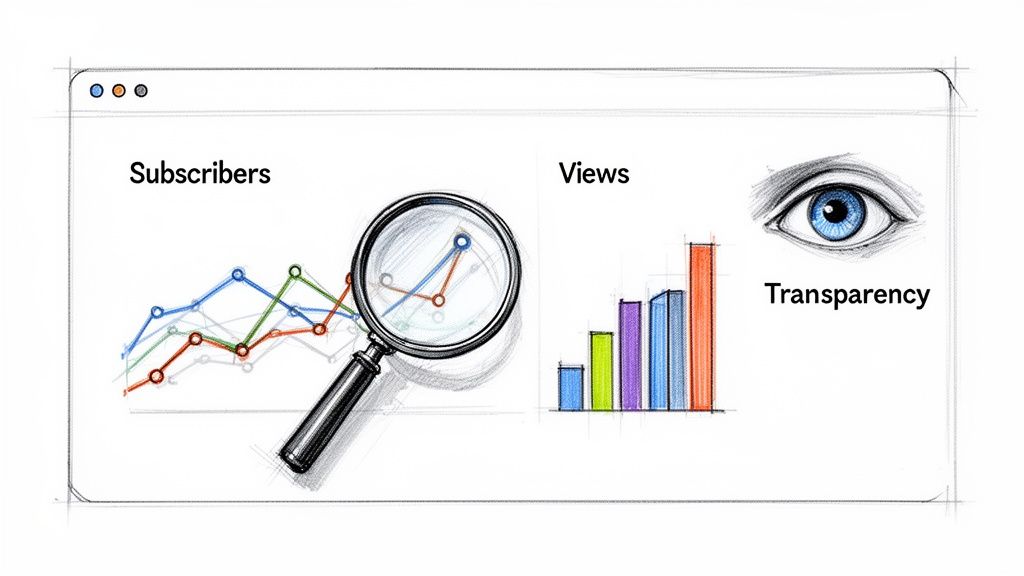
The gap is message history. Admins can edit or delete posts after publication. Native analytics — as documented in Telegram's channel stats API — don't track edits or deletions. For researchers tracking narrative development, or marketers verifying that placements appeared as expected, that's a real problem.
Reach tells you how far a message traveled. Transparency tells you what message traveled.
What to actually measure: - Growth trend: up, flat, or volatile? - View distribution: which posts consistently pull attention? - Content patterns: what formats or themes recur among stronger posts? - Publishing behavior: disciplined or erratic? - Content integrity: were important posts edited or deleted later?
Analytics answer how a post performed. Transparency answers what was posted, what changed, and what was removed. If you manage channels professionally, you need both.
Competitive Channel Management
Most admins stop at publishing and checking views. Competitive management starts when you treat Telegram like a monitored media environment.
Review public competitor channels for: posting rhythm (bursts vs stable schedule), topic clustering, format discipline, and narrative shifts over time. Patterns reveal strategy. Single post wins often reveal luck.
Build a simple review loop: examine top-performing posts, identify failure patterns in weaker ones, compare your mix with adjacent channels, refine timing and topic selection, repeat. Strong channel management isn't flashy. It's iterative.
If your best posts cluster around certain times or days, test it deliberately rather than treating it as coincidence.
FAQ
Can I see who subscribed to my channel? No. Admins see total subscriber count, not individual identities. That privacy model is part of why channels work well for one-to-many distribution.
Can Telegram channels make money? Yes. Common models: ad placements, sponsorships, affiliate offers, paid products, memberships. Revenue follows audience trust, not just size.
Can I schedule posts? Yes. Scheduling makes performance review cleaner because timing becomes a deliberate variable instead of an accident.
Should I enable comments? Enable them when discussion adds value and you have time to moderate. Keep them off for a fast, clean editorial feed.
What's the biggest beginner mistake? Starting too broad. A narrow channel is easier to position, easier for subscribers to understand, and easier to grow than one with no clear identity.
If you want a clearer view of how public Telegram channels behave, Statiko is built for that job. It helps creators, marketers, and researchers analyze public channel metrics, monitor growth, and inspect message history for edits and deletions so they can work from evidence instead of guesswork.
Related posts

Discover how to create telegram channel for 2026. Our guide covers setup on mobile/desktop, public vs. private, first posts, and analytics for growth.

Deciding on Telegram channels vs groups? Our 2026 guide compares features, use cases, analytics, and privacy to help you make the right strategic choice.

Unlock growth with our guide to Telegram channel analytics. Learn to track key metrics, analyze competitors, and make data-driven decisions for your channel.
Start in seconds.
Create a free account to organise channels, track activity, and get recaps delivered to you.
Real-time. Telegram. Analytics.