Telegram Channels vs Groups: The 2026 Strategic Guide
Deciding on Telegram channels vs groups? Our 2026 guide compares features, use cases, analytics, and privacy to help you make the right strategic choice.

A Telegram channel and a group look similar from the outside. They're not. One is a publishing system. The other is a social space. Picking the wrong one is a structural mistake you'll feel every week you run it.
The practical question: which format gives you the right balance of control, audience visibility, and measurement for what you're actually trying to do?
| Criteria | Telegram Channel | Telegram Group |
|---|---|---|
| Communication model | One-way broadcast | Two-way discussion |
| Audience size | Unlimited | Up to 200,000 members |
| Posting rights | Admins only | All members (configurable) |
| Member visibility | Hidden | Visible |
| Analytics | Post-level views and engagement | Basic (larger groups only) |
| Best fit | Publishing, announcements, marketing | Support, community, discussion |
Three questions that cut through the noise:
- Do you need reach or conversation?
- Do you need message control or member participation?
- Do you need post-level analytics or a discussion environment?
One-Way Broadcast vs Two-Way Community
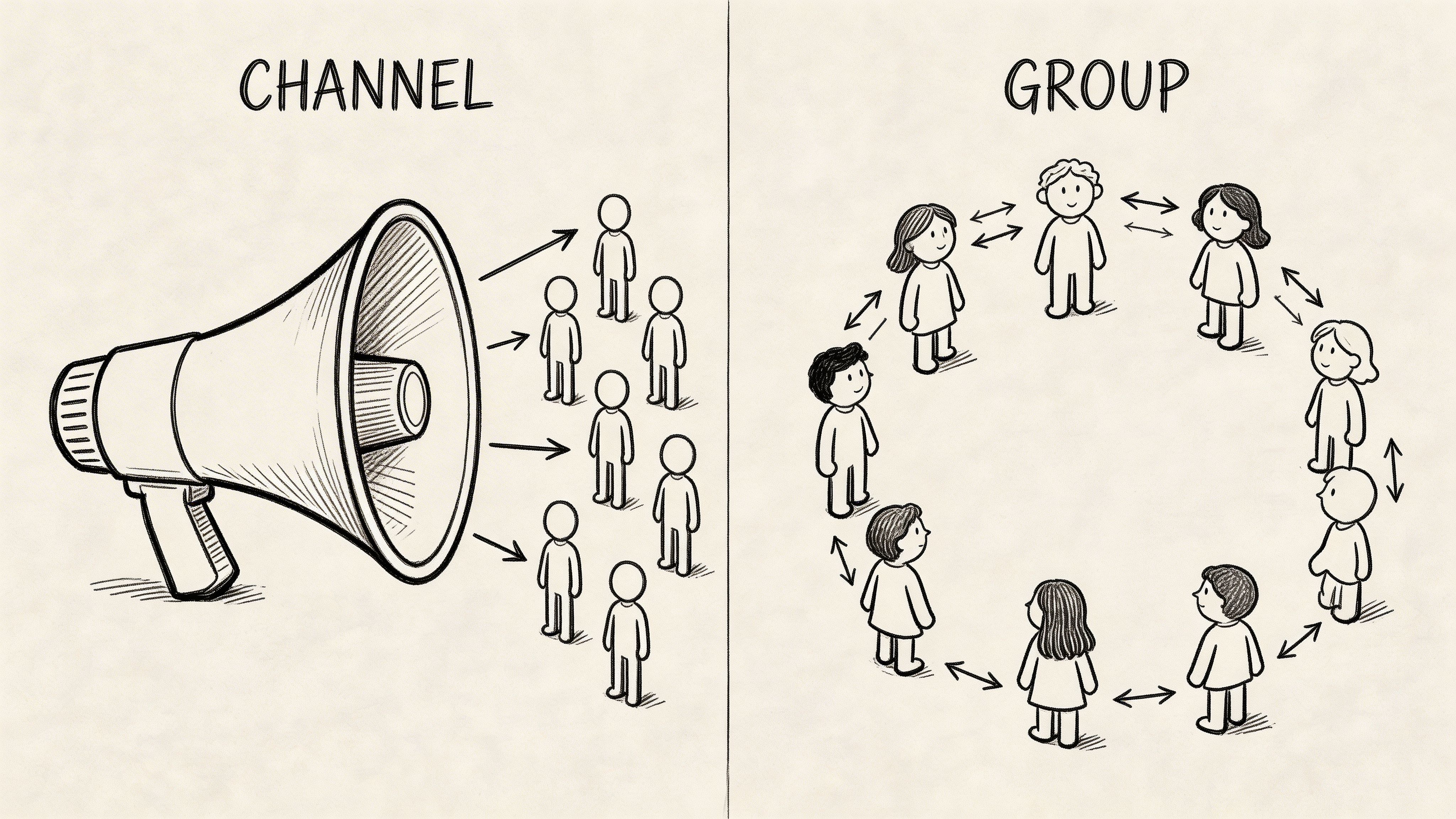
Channels keep the post as the main event. Admins publish, subscribers receive. That clean structure makes measurement easier — views, reactions, and forwards map to individual posts without conversation noise obscuring the signal. Subscribers don't inspect each other; they follow a source. Low social friction, clean distribution.
If you automate publishing or route updates through bots, channels pair better with that workflow. Telegram bot setups are easier to evaluate in a broadcast feed than inside active discussion.
Groups shift the value to participation. Members reply, ask questions, and help each other. That creates qualitative feedback channels can't match — objections, enthusiasm, and confusion all surface in the open. For support communities, local networks, and interest-based spaces, that visibility is the product.
The tradeoff is operational cost. Groups generate moderation work, repetitive questions, and off-topic drift. High message volume can mean demand or just noise — often both.
The strategic mistake is choosing based on early activity. Groups look more alive in week one because conversation is public. That misleads teams whose goal is distribution, not discussion. The opposite error: launching a channel when the audience expected peer support and shared problem-solving.
Define success before launch: - Channel — reach, message control, interpretable content analytics - Group — discussion, visible member relationships, community-generated value - Both — publishing and conversation as separate spaces with different rules
Comparison Across Key Criteria
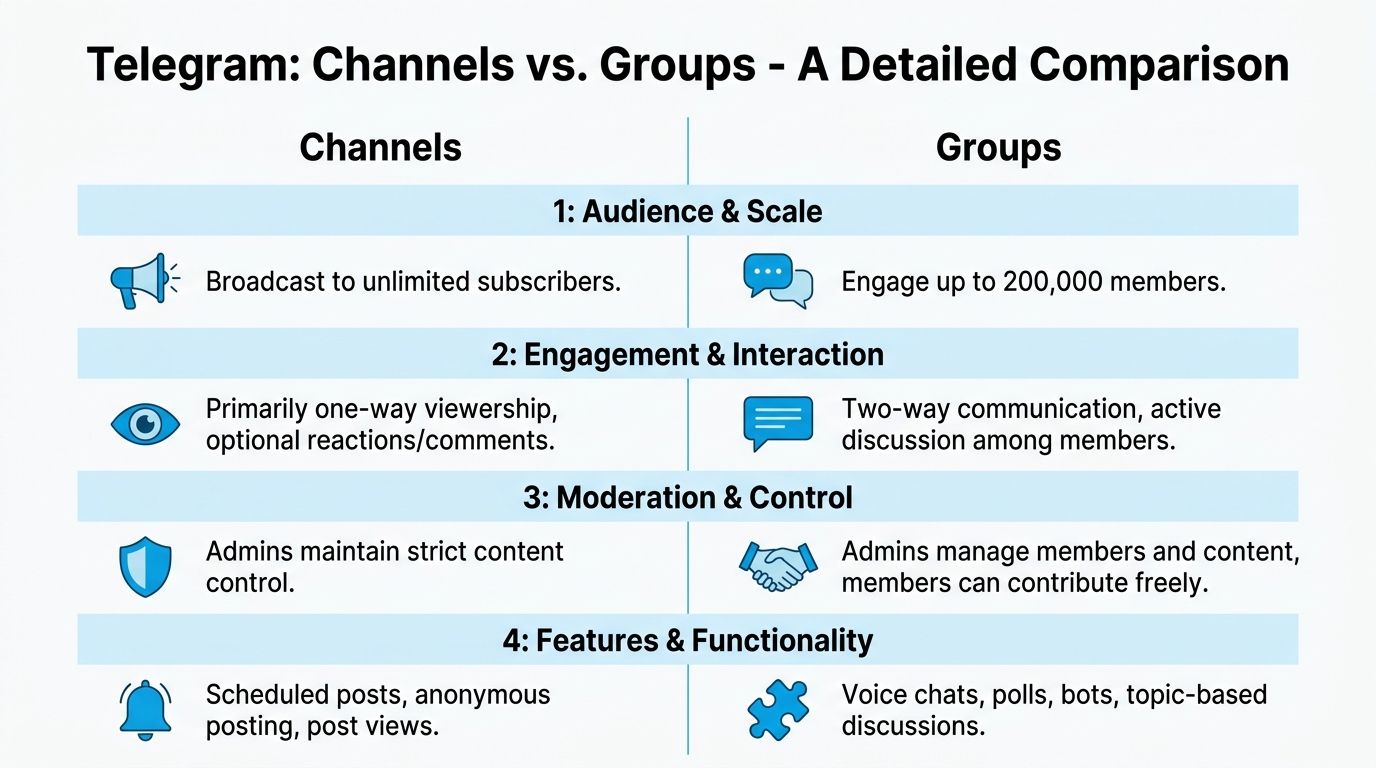
Audience and scale — Groups cap at 200,000 members and assume participation; as that number grows, conversation becomes harder to control and moderation demand increases sharply. Channels have no subscriber ceiling and scale without adding moderation burden. If each new subscriber should mainly increase reach, channels are the right architecture.
Interaction and engagement — Channel analytics are post-level: you can tie reach and response directly to individual pieces of content. In groups, activity accumulates through replies and member-to-member exchange — useful operationally, but harder to read as content demand. Don't evaluate both formats with the same success metric.
Administration — Channels are lighter to operate. Fewer people post into the main feed, quality control is simpler, and the communication goal stays intact. Groups require active rule-setting, permissions, slow mode, and moderation workflows from day one. Planning to automate onboarding or moderation? This guide on Telegram bots for groups is a practical starting point.
Privacy — Channels let people follow without being socially visible to other subscribers. That reduces friction for users who want updates without joining a public member environment. Groups make presence part of the experience — which builds trust and accountability in communities where identity matters, but can suppress participation from observers who prefer staying anonymous.
Using Both
Most serious Telegram operations end up running both. A public channel handles broadcast, brand control, and content performance measurement. A linked group handles support, feedback, and community discussion — the Telegram group chat guide covers the setup options in detail.
Telegram lets you link a group to a channel so channel posts automatically open for discussion in the group. That separates distribution from conversation without forcing subscribers into both unless they want it.
Analytics Gap
This is where the formats diverge most for anyone trying to measure performance. Channel posts show view counts, reaction breakdowns, and forward data. That's enough to compare content, track growth, and spot what's resonating.
Groups have far weaker native analytics. High message volume doesn't tell you whether members are getting value — it tells you they're talking.
For channel performance tracking, Statiko tracks subscriber growth, post engagement, edit and deletion history, and competitor channels without any follower floor. If you're evaluating which channels in your niche are growing and how, the channel search gives you that data for any public channel. The Telegram channel analytics overview covers more options.
FAQ
Can a Telegram group become a channel later? No direct conversion. You'd create a new channel and migrate content manually. Plan the format before you build the audience. If you're past that point already, our migration guide walks through the pre-migration checklist and how to move members without losing them.
Which grows faster? Channels typically outpace groups at scale because they're easier to forward and don't require active participation to deliver value. Groups grow faster in niches where word-of-mouth and peer referrals drive joins.
Do channels show who's subscribed? No. Subscriber lists are private by design. You see aggregate counts, not individual identities.
Can you monetize both? Yes. Channels are more commonly monetized through ads, sponsored posts, and affiliate content. Groups support paid membership, exclusive access, and community-driven offers. See Telegram channel monetization for a full breakdown.
Is one better for SEO or discoverability? Channels are indexed more reliably in Telegram search and external search engines. Groups with public links are findable but less commonly indexed.
If you want to monitor public Telegram channels, compare competitors, and track edits, deletions, and growth patterns in one place, try Statiko. It's built for public-channel transparency and analytics — useful whether you're launching your first channel or trying to understand why an established one is stalling.
Related posts

The 10 best Telegram groups for marketers and creators, the directories to find more, and how to vet a group before you commit time to it.

Discover how to create telegram channel for 2026. Our guide covers setup on mobile/desktop, public vs. private, first posts, and analytics for growth.

Unlock growth with our guide to Telegram channel analytics. Learn to track key metrics, analyze competitors, and make data-driven decisions for your channel.
Start in seconds.
Create a free account to organise channels, track activity, and get recaps delivered to you.
Real-time. Telegram. Analytics.