Your Telegram Wayback Machine: Full Channel History 2026
There is no Telegram Wayback Machine, but Statiko tracks every post, edit, and deletion on public channels — the full history web archives miss.
A traditional Telegram Wayback Machine doesn't exist. Telegram isn't an open web archive target the way normal websites are. The working equivalent is a live tracker for public channels that preserves history as it happens: posts, edits, and deletions.
That matters because the standard advice on this topic is wrong. Check the Wayback Machine, search cached pages, hope a t.me preview was captured at the right moment. That occasionally helps with a public landing page. It tells you nothing reliable about what happened inside a channel.
To find a deleted post, compare an edited message against its earlier version, or review a channel's past without guessing, you need an archive built for Telegram's mechanics rather than a generic web crawler.
The Telegram Wayback Machine You Are Looking For
The term Telegram Wayback Machine usually means one of three things:
- Deleted content: a post was visible before and now it's gone.
- Edited content: a message changed after publication and you want the original.
- Channel history: you need a searchable timeline instead of scrolling Telegram manually.
Telegram doesn't provide a built-in history browser for deleted versions of posts across channels, and web archives don't close the gap. The practical substitute is a channel tracker that watches public channels continuously and stores what it sees over time. Instead of occasional snapshots, it builds a running record.
Working rule: if a tool wasn't actively monitoring the public channel when the change happened, it usually can't reconstruct that moment later.
A web archive tries to revisit a page. A Telegram archive has to observe the channel as it changes.
For broader context, the State of Telegram 2025 analysis is worth reading alongside this if you're evaluating channel monitoring for research or competitive work.
Why Traditional Web Archives Fail with Telegram
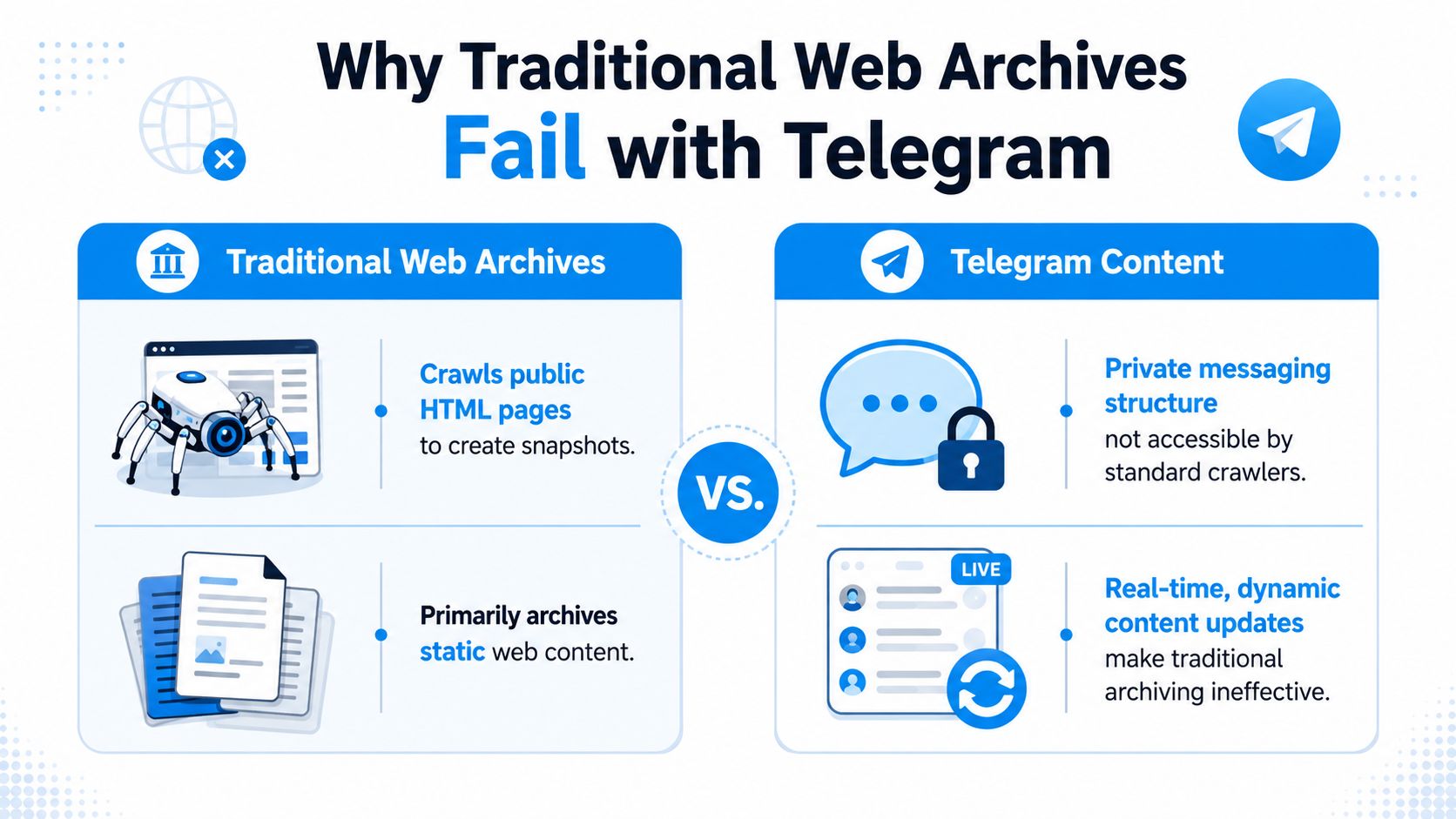
Web archives are designed for websites. They crawl public HTML, fetch a page, save what they can render, and store that snapshot. The model works well enough for static pages, article URLs, and public resources that stay addressable.
Telegram isn't built like that.
What a crawler can actually see
A crawler usually hits a public t.me page, which is a thin preview layer rather than a full historical record. That creates several failure points:
- Partial visibility: the preview page exposes limited content, not the full context of a channel.
- No event history: a crawler can save a page state, but it can't detect that a post was edited between captures.
- Deletion blind spots: if a post disappears before the crawler revisits the page, the content may never be captured.
- Weak continuity: snapshots are intermittent, so they miss the sequence of changes that matters in forensic work.
Continuity is the one that hurts. Telegram history isn't just about what existed. It's about what changed, in what order, and what vanished.
A technical mismatch, not an accident — a web archive grabs isolated frames of public pages, while Telegram channels behave like a stream of events. A saved t.me page isn't a channel history; it's evidence that a crawler saw one public-facing representation at one moment. Archive.org can prove a page existed, or that a channel description looked a certain way on a given date. It won't give you post-level history.
What web archives don't preserve well
A forensic review usually needs details like these:
| Need | Web archive result | Why it falls short |
|---|---|---|
| Original wording of an edited post | Often unavailable | Snapshots don't monitor edits continuously |
| Proof that a post was deleted | Usually indirect | The archive may only show absence, not prior presence |
| Complete post timeline | Fragmented | Captures happen sporadically |
| Search across channel history | Poor fit | Web snapshots aren't structured as message archives |
The problem isn't that people search the wrong archive — Telegram requires a different collection method.
How Modern Channel Trackers Create an Archive
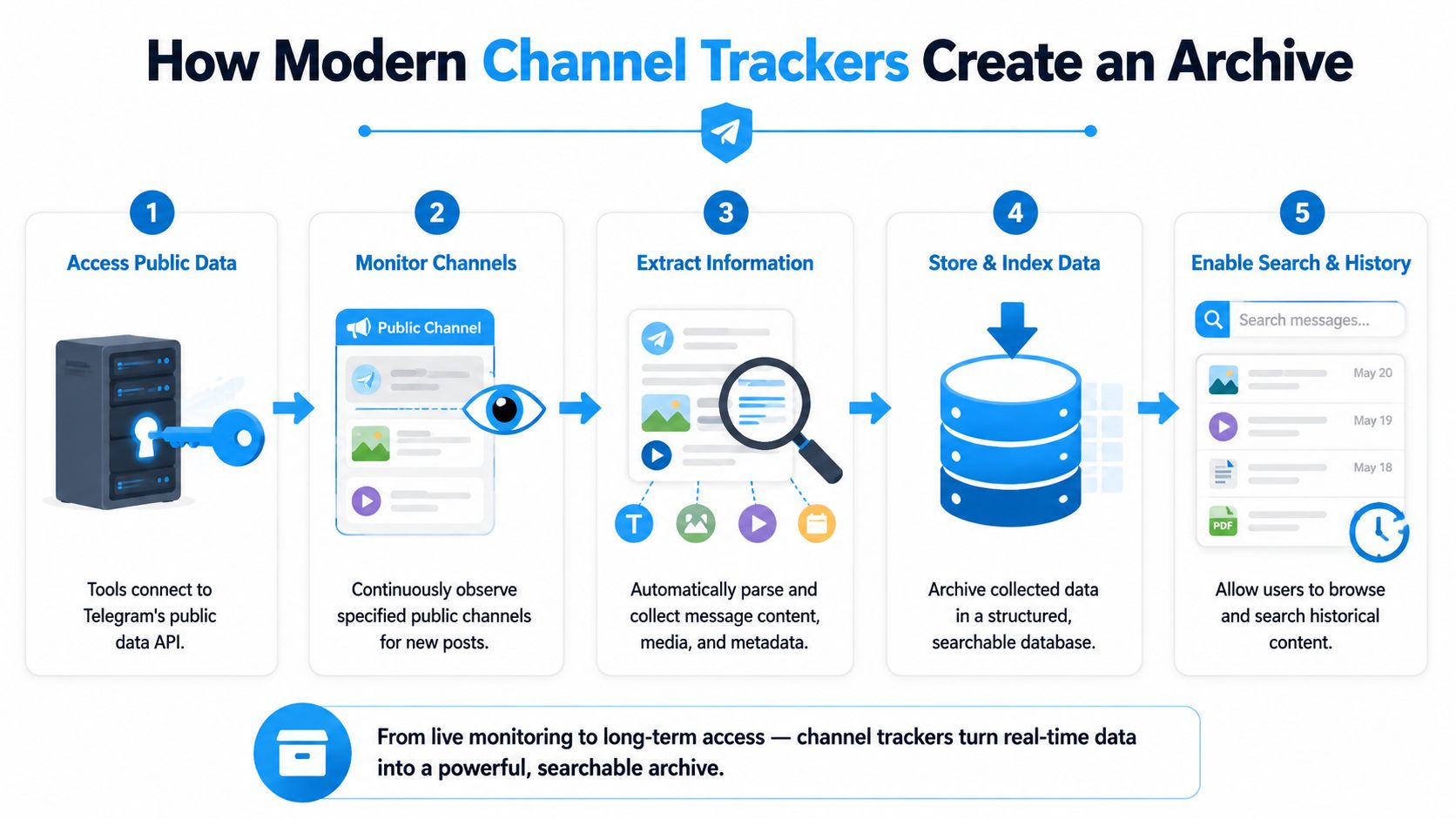
A Telegram archive starts with monitoring rather than crawling. The tool connects to Telegram's public-facing data access points, watches for updates, and writes them into a structured history.
The question shifts. Not "did a bot happen to snapshot this page?" but "was this channel under observation when the event occurred?"
What the archive process looks like
Once a public channel is added, a tracker such as Statiko channel search starts building a record from that point forward:
- The channel enters monitoring — the system observes it continuously instead of waiting for a crawl to revisit a page.
- New posts are logged — each visible post is stored with its content and metadata.
- Existing posts are rechecked — the part a normal archive misses. The tracker revisits known posts to detect content that changed after publication.
- Edits are preserved as versions — when an owner changes a post, the tracker keeps the update and retains the earlier version.
- Deletions are recorded — if a post disappears, the archive marks it deleted and preserves the last captured version.
Preservation only becomes trustworthy when a tool stores versions instead of just the latest state.
Where it stops working — reverse-engineering complete history after the fact, from generic snapshots. Continuous observation of public channels does work, within limits:
- No retroactive recovery before tracking starts: if nobody monitored the channel yet, there may be no earlier version history to retrieve.
- No access to private spaces: private channels, groups, and direct messages remain outside scope.
- No magic reconstruction: once a post changed or vanished without prior capture, any archive is constrained by what it already stored.
For teams moving archived data into downstream analysis, the Telegram chat export guide is the relevant next step.
Exploring a Channel's Complete History with Statiko
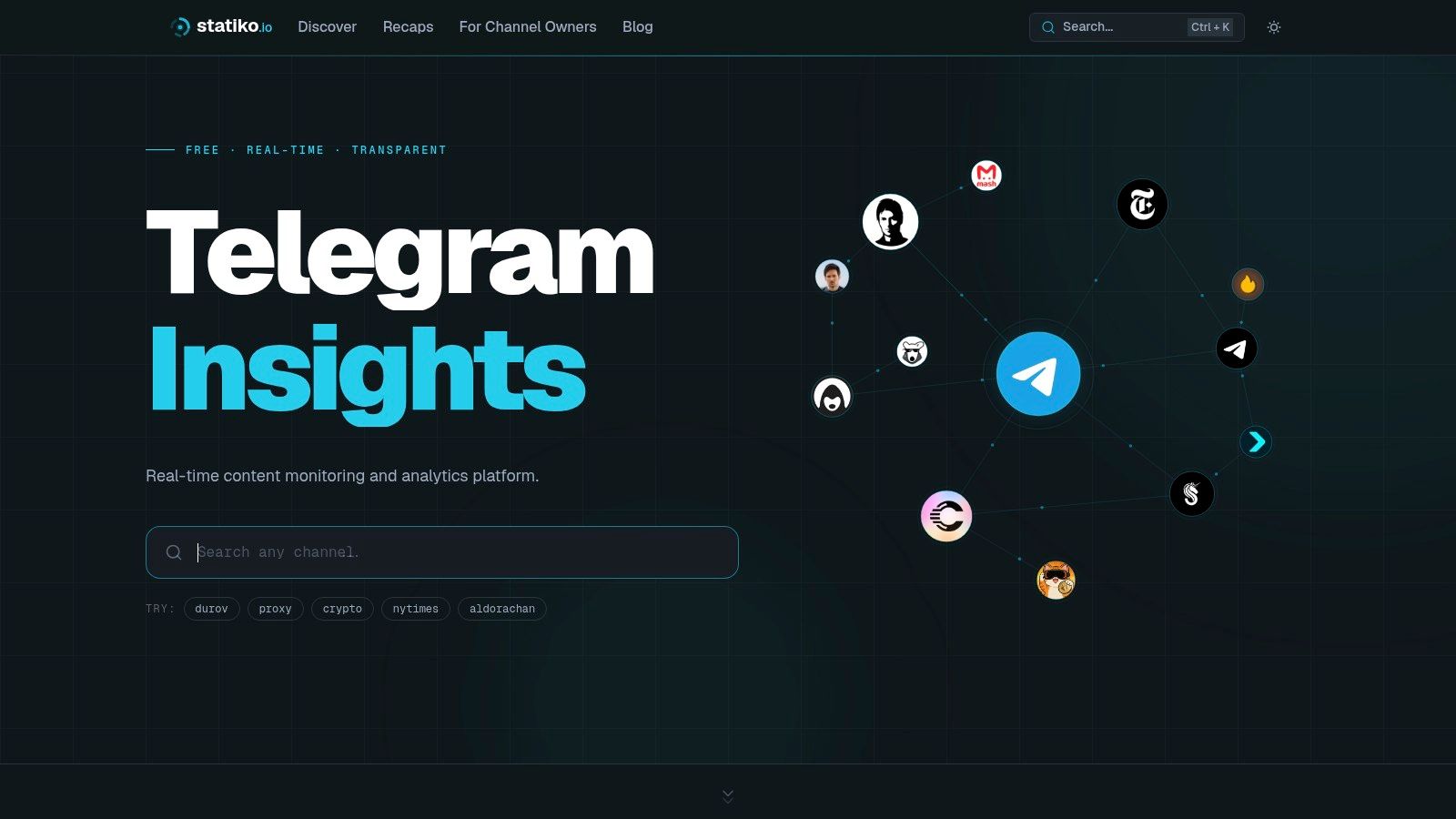
The fastest way to understand a Telegram archive is to open a real channel page. Read it like a timeline, not a social feed. Two examples: Pavel Durov's channel archive and the Telegram News channel archive. Both show the kind of tracking people expect when they ask for a Telegram Wayback Machine.
What to look for on a channel page
Start with the post list. You're not checking what's currently visible — you're looking for signs the archive preserved state changes.
- Edited posts: an edit marker or version history entry attached to the message.
- Deleted posts: whether the interface flags a removed post while retaining the content it captured.
- Chronology: adjacent posts tell you whether a change happened in isolation or as part of a broader publishing pattern.
- Search behavior: find a claim or announcement by keyword, then check whether the current text differs from what was first published.
The interface view that matters in practice:
A practical review workflow
When I'm checking a disputed Telegram post, I don't scroll blindly. I narrow the date range, find the post, then inspect its status trail.
- Locate the channel first: confirm you're on the correct public channel page and not a repost or mirror.
- Search the phrase in question: use the exact wording if you have it. Broad keywords work if you don't.
- Open the post record: check whether the archive shows version changes or deletion status.
- Compare message states: if an edit history exists, read the earlier and later text side by side.
- Document the archive state: save the archived view you relied on, for your notes or reporting.
When a post matters, don't rely on the current wording in Telegram alone. Check whether the channel changed it after publication.
What this reveals in real work — you can see when a channel softened language, removed a link, deleted an announcement, or rewrote a claim after the reaction came in. Those are common behaviors on fast-moving channels, and exactly what a normal web archive misses. The result is a channel history you can interrogate — one that outlives the channel itself, which matters when a whole channel gets deleted.
Practical Use Cases for a Telegram Archive
An archive earns its keep when the question stops being "can I view this post?" and becomes "can I prove what this channel published and how it changed?"
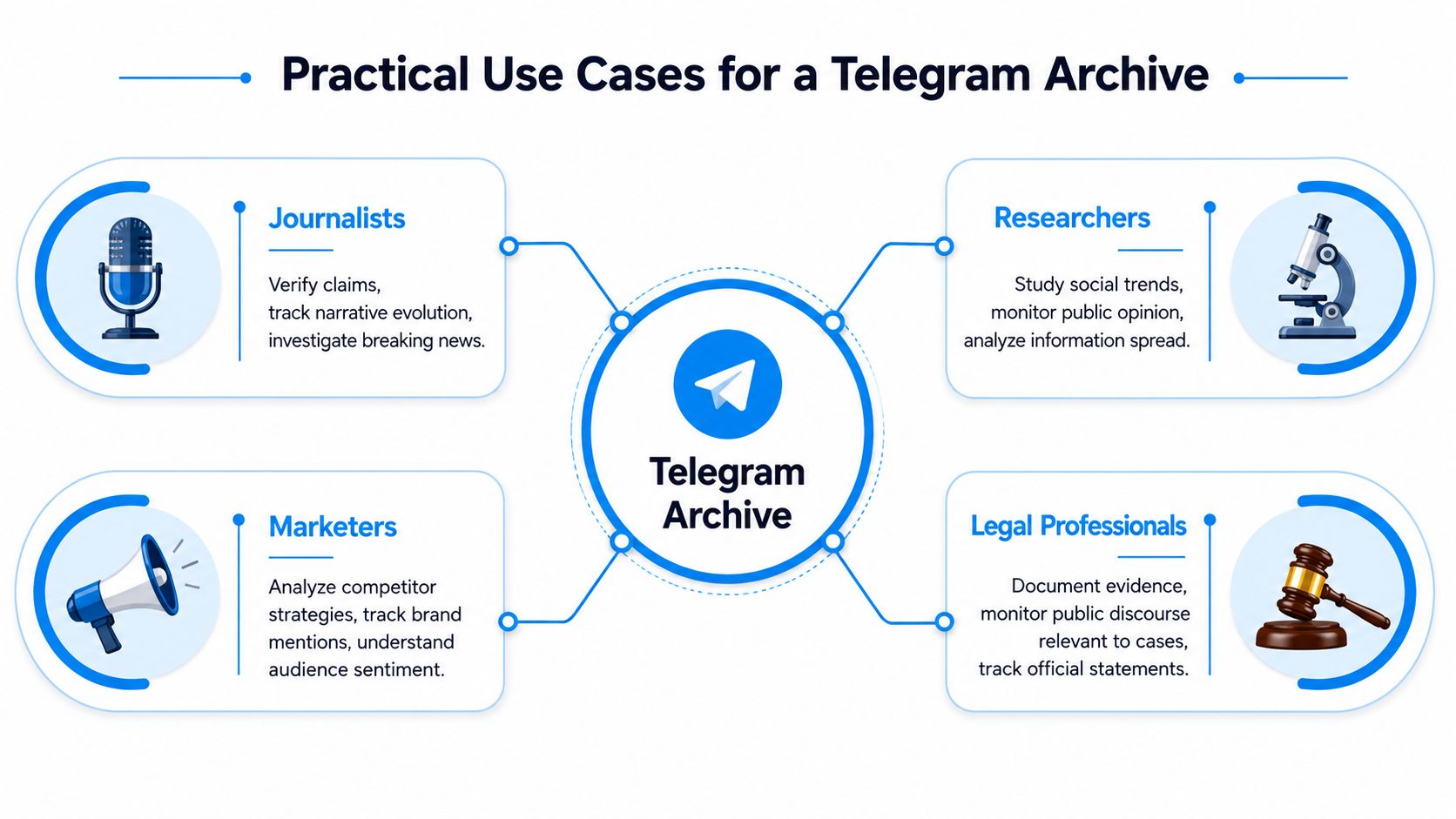
Journalists and researchers
For journalists, the archive supports verification. When a source points to a Telegram statement that was later revised or removed, archived post history establishes what the channel actually published.
Researchers use the same material differently. They care less about a single post and more about how a narrative develops over time, especially in channels that iterate messaging quickly. Public channel history is often less about one deleted message than about the pattern of revision around it.
Marketers and analysts
Public Telegram channels test positioning in real time. They revise calls to action, pull underperforming posts, and change creative framing after feedback. Without history, that activity disappears. Analysts can also trace how brands sequence announcements, repeat key phrases, and shift emphasis across campaigns.
- Competitor review: see what was published, then changed or withdrawn.
- Content strategy analysis: identify recurring themes and the posts that didn't stay live.
- Brand monitoring: track mentions or channel behavior around a product, event, or controversy.
If your work focuses on deleted content specifically, the deleted Telegram messages guide and the walkthrough on how to see deleted posts from a Telegram channel are the closest companion pieces.
Legal and compliance use
Legal teams and investigators care about preservation and public record. When a statement on a public channel becomes relevant to a dispute, moderation issue, or internal review, a preserved version history is materially different from screenshots passed around after the fact. Screenshots can help. A structured archive is better because it keeps the message in channel context.
Frequently Asked Questions
Can I see old versions of a post? Yes, if the post was tracked while the channel was under monitoring. A purpose-built Telegram archive preserves edit history, so you can review earlier versions instead of only the latest text — the channel history viewer guide compares the tools that do this.
Can a tracker see messages from before a channel was added? No. The archive starts when tracking begins. No system can promise complete historical reconstruction for a public channel it wasn't monitoring yet.
Is there an official archive of Telegram? No. Telegram provides the platform, not a universal public history browser for deleted and edited channel posts. That's why searching for a Telegram Wayback Machine usually leads people to the wrong tools.
Is it legal to archive public Telegram channels? In general, archiving public channels is treated as collecting publicly accessible information. Public availability is the boundary: public channels are one thing; private channels, groups, and direct messages are another.
Can I use Archive.org for Telegram at all?
Sometimes, to confirm a public t.me page existed or looked a certain way at one moment. Don't treat it as a dependable source for full message history, edit trails, or deletion evidence.
Can I see private channels or groups? No. Public-channel archives respect Telegram's privacy boundaries and monitor public channels only.
What's the reliable way to search old Telegram channel content? Use a live archive for public channels, then search within the preserved post history rather than relying on web snapshots. That's the closest real answer to a Telegram Wayback Machine.
If you need a working archive for public Telegram channels, use Statiko. It tracks every post, edit, and deletion in public channels, which is what people usually want when they're looking for a Telegram Wayback Machine.
Related posts

Learn how to see deleted posts from a Telegram channel using caches, archives, admin logs, and continuous tracking tools like Statiko.

You get 5 seconds to undo a deletion. After that your odds depend on where the message was — here is what works per chat type, and what doesn't.

Export telegram chat - Learn to export Telegram chat from desktop & mobile seamlessly. This guide covers JSON/HTML formats, public channel tools, and transformi
Start in seconds.
Create a free account to organise channels, track activity, and get recaps delivered to you.
Real-time. Telegram. Analytics.