Your Telegram Channel History Viewer Guide for 2026
Need a Telegram channel history viewer? Explore top tools to see deleted messages, track edits, and analyze public channel archives for research and audits.

Watch a Telegram channel long enough and you'll see it rewrite itself: come back for a post and it's edited, or gone. If you need the historical record, a telegram channel history viewer is the only practical answer. Telegram's own web preview at t.me/s/channelname shows the current public feed, not a timeline of edits and deletions. Start with Statiko, then add analytics tools and web archives when you need a narrower view or a secondary source. The right choice depends on whether you need an audit trail, a campaign check, or a frozen snapshot of a public page.
1. Statiko
Statiko is the first pick for a true telegram channel history viewer. It's built for public channels, needs no login or ownership, and preserves every post, edit, and deletion, so you can inspect exactly what changed and when. Telegram's own API is time-series oriented — period snapshots, follower counts, views per post — which is why a channel timeline fits naturally with how the platform models broadcast analytics Telegram stats API.
Search a public channel at Statiko's catalog, then open its timeline page — the Durov channel overview shows the format. That timeline view is the point: it lets you compare versions instead of seeing only the final state. The platform adds AI-powered recaps, posting-pattern insights, and growth dashboards on top, which makes it useful for competitor monitoring, content audits, and research. The guide on how to see deleted posts from a Telegram channel walks through that workflow.
Practical rule: if you care about provenance, use the tool that stores the version history, not the one that indexes the latest visible post.
A few things make Statiko stand out in practice: - Complete message history: inspect the preserved sequence of edits and deletions. - No-login monitoring: any public channel can be added directly. - Free core features: edit and deletion history, growth analytics, and AI insights. - Public-channel focus: it respects Telegram's privacy boundary and stays out of private channels, groups, and DMs.
The trade-off is simple. Statiko is strong on public-channel truth and useless for private comms or direct-message recovery. For researchers, marketers, and moderators who need a clean record, that's the right compromise.
2. TGStat
TGStat is for broad public-channel indexing with some history attached — not a guaranteed version-by-version record. It's good for looking up posts that were once public, checking channel summaries, and comparing activity across a large catalog.
TGStat stays relevant because it preserves copies of many posts, including some that later disappear from Telegram, which helps when you need to confirm a post existed. The downside is precision. It doesn't promise that every edit or deletion is captured, and that matters for compliance review, journalist verification, or brand-risk checks.
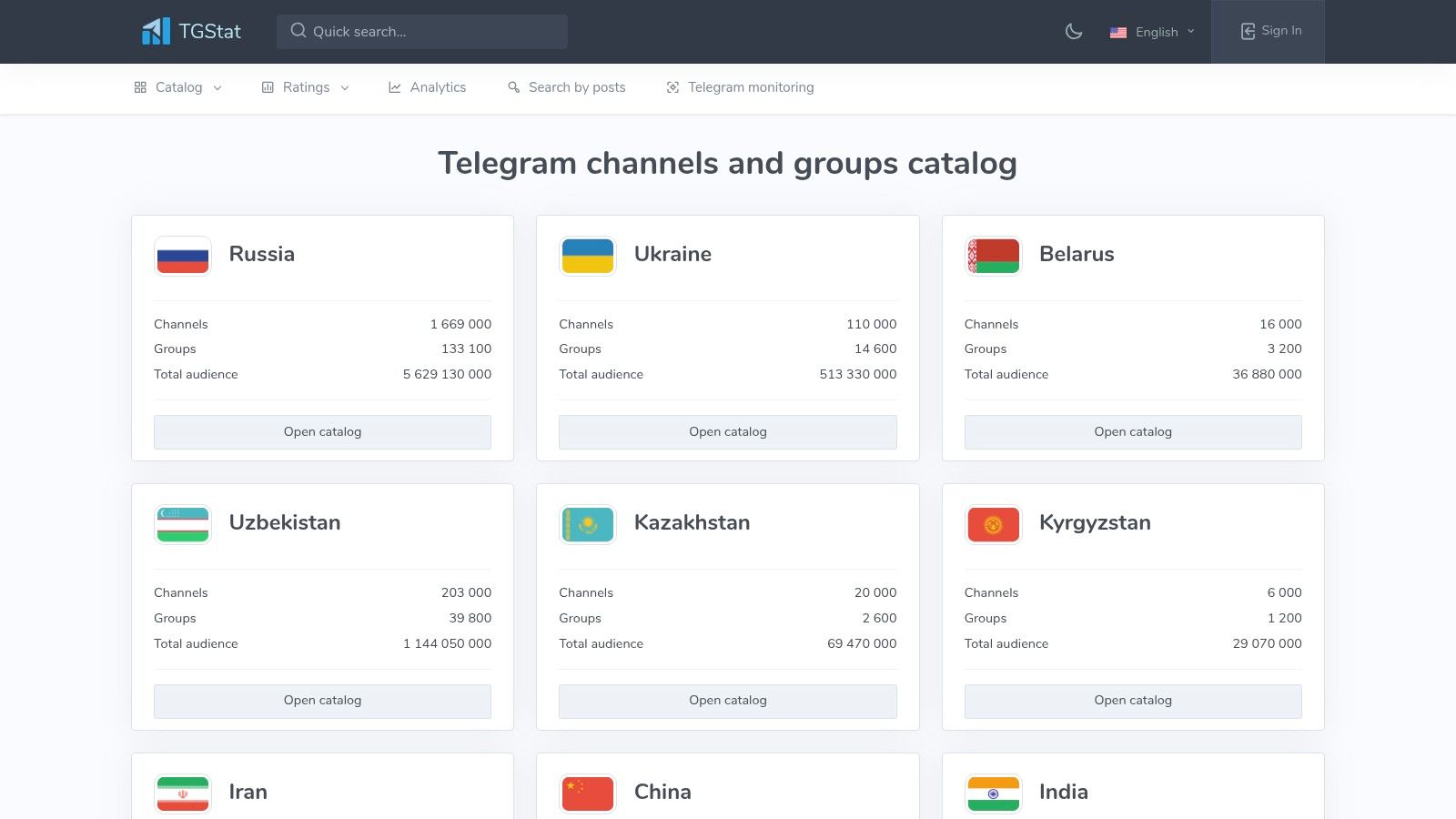
Where TGStat fits best
TGStat makes sense when you need a large public catalog, post search, and enough historical context to audit a campaign or investigate a channel's past behavior. It's also practical for analysts tracking activity without the owner's cooperation.
A few realistic trade-offs: - Useful for vanished posts: it can preserve evidence that a post was once live. - Strong analytics layer: channel summaries and growth history beat raw scrolling. - Incomplete edit coverage: don't treat it as a full provenance log. - Interface caveat: the UI and documentation lean Russian, so onboarding feels uneven — see the guide to TGStat in English.
For quick lookup and broad discovery, TGStat is solid. For proving exactly what changed between versions, Statiko is the better fit.
3. Telemetr
Telemetr is the analytics-first option that feels closest to a live channel browser, which makes it handy for reviewing public feeds in a more structured way than Telegram's preview. Bellingcat's toolkit notes that Telemetr advertises coverage of 11M+ channels and 72B posts, plus channel-name timelines, post search, ad-creative intelligence, and a free-plan API capped at 1,000 requests per month with 5 verified channels and 7-day history. Paid tiers extend history to 90 days and up to 12 months Telemetr toolkit note.
Telemetr isn't trying to be a forensic log. It's built for analysts who want channel context, advertiser activity, and a clean feed view. Vetting a channel for media buying or checking whether a promotion pattern holds over time? Useful. Proving every deletion or edit? It stops short. The site and docs are in English, which makes day-to-day use easier than some older Telegram tooling.
Telemetr is strongest when the question is "what was this channel doing over time?" rather than "what exact line disappeared at 3 p.m. yesterday?"
- Good for channel browsing: the feed appears in a format that mirrors Telegram.
- Good for ad context: creative intelligence helps with sponsored-post review.
- Good for trend reading: historic charts are useful for pacing and consistency.
- Not a full history viewer: it won't reliably capture every edit or deletion.
Telemetr is a strong analyst's tool, not the final word on channel provenance. Use it alongside Statiko rather than instead of it. The wider roundup of Telemetr alternatives covers where each one lands.
4. Popsters
Popsters is for engagement analysis, not historical reconstruction. It loads public Telegram posts, scores them, and shows which content formats are performing. That's valuable for marketers who want reporting out of a live feed without asking the channel owner for access.
The limitation shows up fast. Popsters analyzes posts that are currently retrievable, so it isn't a true telegram channel history viewer in the edit-and-deletion sense. If a post is gone, the tool can't guarantee it will still be there. If a post was edited, you're looking at the current version, not a preserved version chain.

Best use cases for Popsters
It works best for a fast reading of content performance across public channels, and for cross-platform reporting if your team already uses it elsewhere.
What it does well: - Engagement breakdowns: handy for content audits and creative review. - Report exports: XLSX, CSV, PDF, and PPT are all supported. - Public-channel access: no ownership requirement for public feeds. - Simple workflow: easier to hand to a marketing team than a technical archive stack.
What it doesn't: - Edit history: no reliable audit of message changes. - Deletion recovery: removed posts aren't the point of the product. - Full archival depth: the value is analytics, not preservation.
Popsters belongs in a toolkit when the question is performance, not provenance.
5. Intelligence X
Intelligence X is the OSINT-style option for finding historical copies of Telegram content that escaped the original channel. When a public post vanished and you want another place it might have been crawled, indexed, or mirrored, it's worth a search. That suits investigations, evidence gathering, and source checking.
The weakness is coverage. Intelligence X depends on prior crawling, so it isn't a live history tracker. If a post was never indexed, or the crawl missed the right moment, you won't recover it.
Use it as a search layer, not a preservation layer. Given a keyword, channel, or identifier, it can surface older copies. It won't replace a purpose-built tracker for a reliable timeline.
The note on how investigators use Intelligence X with Telegram cases shows why it fits evidence work rather than routine channel monitoring.
Practical rule: use OSINT search engines to recover fragments, then use a timeline tool to verify what happened in sequence.
- Historical discovery: good for finding vanished copies when they exist.
- Programmatic workflows: API and SDK support make it usable in investigations.
- Uneven coverage: you're limited by what was crawled earlier.
- Paid functionality: full use sits behind a paid plan.
Intelligence X is the backup search layer, not the first stop for channel history.
6. tg-archive
tg-archive is the DIY option for teams that want control over their own Telegram archive. It's open source, self-hosted, and syncs messages you can already access into a local database and static website. You capture a channel from the moment you start running it, then keep your own browsable record before posts change or disappear.
The trade-off is timing. tg-archive isn't retroactive, so it can't reconstruct the past before you set it up. It also expects technical comfort — setup, hosting, and keeping the capture schedule running are on you. For a lightweight internal archive, that control is a real advantage.
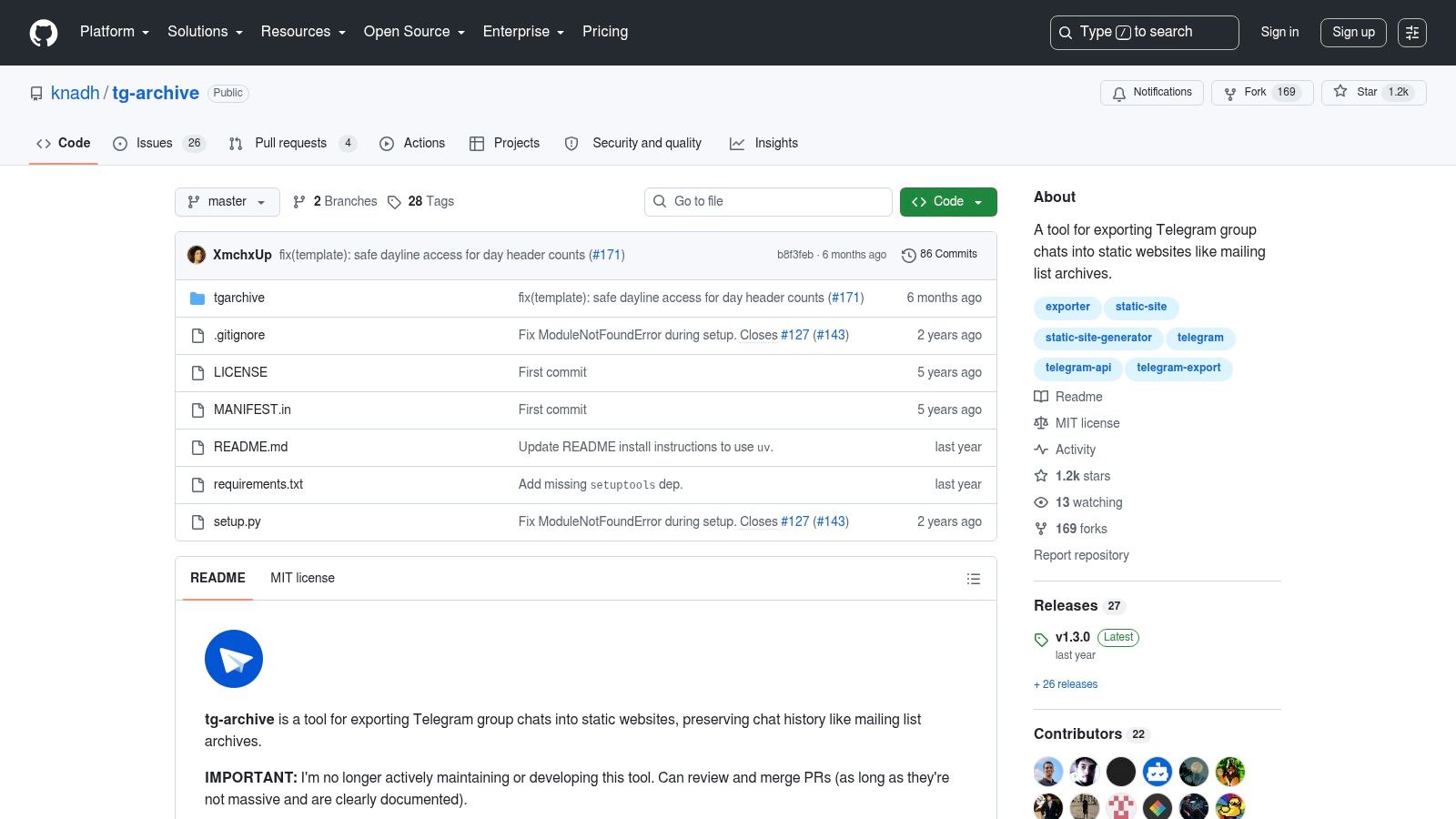
Why practitioners still like it
It's the right choice when you need a portable archive you own and can explain — newsroom, compliance, or research workflows especially.
What stands out: - Local capture: the data sits in your own SQLite-backed archive. - Static browsing: the generated HTML is easy to review and share internally. - Any readable channel or group: if you can access it, you can archive it. - Free and open source: the MIT license keeps the barrier low.
What to watch: - Not retroactive: you only preserve what you start collecting now. - Setup effort: technical work, unlike Statiko's no-login public-channel workflow. - No intelligence layer: it archives well, it doesn't interpret.
If your goal is a private, durable archive under your control, tg-archive earns its place. For instant historical depth on a public channel, Statiko is faster.
7. Archive.today and The Internet Archive
General web archives are the simplest way to freeze a Telegram public page at a point in time. They snapshot the t.me/s/channelname web preview, giving you a timestamped link you can cite later. That's valuable when you need proof that a public page looked a certain way on a certain date.
The limits matter just as much. These services are manual and sporadic rather than continuous crawlers, so they miss most edits and deletions unless someone saved the page at exactly the right moment. They're also not Telegram-specific: good at preserving a snapshot, weak at reconstructing the lifecycle of a channel post.
Use them as evidence anchors, not as your main history system. A saved page can support your notes, but it won't tell you what was deleted yesterday unless someone captured that exact version.
- Best for snapshots: you get a stable URL for citation.
- Best for public pages: the web preview is what's preserved.
- Weak for edits: a later edit usually overwrites the record you care about.
- Weak for deletions: if the page wasn't saved in time, the gap stays a gap.
7-Tool Comparison: Telegram Channel History Viewers
| Tool | Implementation (🔄 Complexity) | Resource requirements (⚡) | Expected outcomes (📊) | Ideal use cases (💡) | Key advantages (⭐) |
|---|---|---|---|---|---|
| Statiko: The Complete History Viewer | Low, web SaaS, no setup 🔄 | Low, browser access; free core features ⚡ | Full edit/deletion audit + AI summaries 📊 | Competitor monitoring, audits, content strategy 💡 | Preserves every edit/deletion; AI insights; free core features ⭐ |
| TGStat | Low, established SaaS 🔄 | Medium, API usage and possible paid tiers ⚡ | Broad archival snapshots; partial edit captures 📊 | Brand safety, ad verification, historical lookups 💡 | Mature API and large catalog; good historical coverage ⭐ |
| Telemetr | Medium, SaaS with analytics UI 🔄 | Medium, some paid datasets/features ⚡ | Historical feed view + ad-intelligence (not full history) 📊 | Media buyers, advertiser research, market analysis 💡 | Ad intelligence and near-original formatting for review ⭐ |
| Popsters | Low, analytics SaaS 🔄 | Medium, paid plan needed for full Telegram history ⚡ | Engagement metrics and best-time suggestions for available posts 📊 | Performance analytics, cross-platform benchmarking 💡 | Fast reports, exports, and cross-platform comparison ⭐ |
| Intelligence X | Medium, OSINT search platform 🔄 | Medium, free search; paid for enterprise features ⚡ | Discovery of archived/deleted copies; coverage varies 📊 | Investigations, retrieving vanished content for evidence 💡 | Purpose-built historical discovery with enterprise tools ⭐ |
| tg-archive | High, self-hosted setup and maintenance 🔄 | High, hosting, runtime, and technical skills required ⚡ | Verifiable, continuous archive from start time (local) 📊 | Controlled long-term archiving, evidence preservation 💡 | Full control, portable static site, open-source (MIT) ⭐ |
| Archive.today & Internet Archive | Low, manual or on-demand snapshots 🔄 | Low, per-snapshot effort; free to use ⚡ | Timestamped snapshots when saved; not continuous 📊 | Ad-hoc evidence capture, citations, one-off proofs 💡 | Immutable public links and easy sharing; free ⭐ |
Choosing Your Viewer for Audits and Analytics
The right telegram channel history viewer depends on the question you're answering. For a complete, verifiable audit trail of what was posted, edited, or deleted, Statiko is the strongest choice, because it tracks every version of every message in public channels and hands you the timeline directly at Statiko's channel search. For broad market context, TGStat and Telemetr are better at discovery, indexing, and analytics than at exact provenance.
Analysts who care about growth patterns, advertiser activity, and general feed behavior get a lot from Telemetr or TGStat. Researchers, journalists, moderators, and brand teams who need to know what changed and when should start with Statiko, then add web archives or OSINT search as supporting layers. tg-archive fits when you want to build your own archive going forward, and the web archives are best for freezing a public page you need to cite.
Telegram's channel model is built for broadcasting, and the native surfaces still don't give ordinary viewers a deleted-or-edited timeline Telegram Channels FAQ. That gap is why this category exists.
Whether you're monitoring a competitor, verifying a claim, or auditing a channel's content changes, start with the tool that preserves the history. Add the analytics layer after you've secured the record.
Frequently Asked Questions
Can I see a Telegram channel's full history without joining it?
Yes, for public channels. The t.me/s/channelname preview shows the current feed, and a monitoring tool shows the version history it recorded. Private channels require an invite, and no external viewer covers them.
Does any tool show posts deleted before I started tracking? Not reliably. Monitoring tools record from the moment tracking starts, so earlier deletions only surface if another service — an OSINT index or a web archive — happened to crawl the post first.
How far back does Telegram itself keep channel history? Indefinitely for posts that still exist, which is the catch. Telegram keeps the current state forever and keeps no record of what was edited or deleted, so "history" in the app means the surviving posts only.
Is a Telegram channel history viewer legal to use? For public channels, yes in general — you're reading content published for anyone to see. The line is public versus private: monitoring a public broadcast channel is not the same as accessing a private group or someone's messages.
What's the difference between an archive and a history viewer? An archive stores copies of posts. A history viewer shows the sequence — original version, each edit, the deletion — which is what you need to prove what changed rather than only what remains.
Which tool is best for verifying a single deleted post? Start with a monitoring service that was already tracking the channel. If none was, check OSINT indexes and web archives for a captured copy, then treat any hit as corroboration rather than a complete record.
If you need the full record of a public Telegram channel, Statiko is the most direct place to get it. It shows edits, deletions, and the timeline behind the current post feed, so you can see what changed instead of guessing. Visit Statiko and inspect a public channel timeline before the next post disappears.
Related posts

Learn how to see deleted posts from a Telegram channel using caches, archives, admin logs, and continuous tracking tools like Statiko.
There is no Telegram Wayback Machine, but Statiko tracks every post, edit, and deletion on public channels — the full history web archives miss.

Master Telegram OSINT with our 2026 guide. Learn profile discovery, channel analysis, network mapping, and the best tools for open-source intelligence research.
Start in seconds.
Create a free account to organise channels, track activity, and get recaps delivered to you.
Real-time. Telegram. Analytics.