TGStat in English: The Practical Guide for 2026
Looking for tgstat in english? Learn what TGStat offers, how to navigate it as an English speaker, and how Statiko compares for deleted-post tracking.
TGStat's interface and most channel metadata are in Russian, and the English experience is uneven. If you want English UX plus full edit and deletion history, Statiko at catalog search is the stronger fit.
| Criterion | TGStat | Statiko |
|---|---|---|
| Language UX | Russian-first, browser translation helps but doesn't fully solve navigation | English-friendly experience for public channel research |
| Channel coverage | Strongest where Telegram is dense in Russian-speaking and post-Soviet markets | Built for public channel discovery and monitoring across public channels |
| Post, edit, and deletion history | Strong on current analytics, not a record of every prior version | Tracks every post, edit, and deletion in public channels |
| Analytics depth | Good for discovery, benchmarking, and cross-market comparison | Good for monitoring, summaries, growth, engagement, and content history |
| Pricing model | Public summaries don't give a clean, consistent pricing story | Core features are free, including edit and deletion history |
| Ideal user | Analysts who need TGStat's discovery layer in dense Telegram markets | English-speaking researchers, marketers, and admins who need a complete record |
What You Actually Get When You Open TGStat Today
TGStat is usable, but it is not English-first. The interface, category labels, and most navigation cues are in Russian, so browser translation is part of the workflow rather than a nice-to-have. If you want a cleaner English alternative, start with Statiko's public channel catalog search instead.
tgstat in english is a language-fit problem, not a feature checklist. TGStat can still help you research public Telegram channels, but you'll spend time compensating for the UI before you reach the data. That matters if your team doesn't read Russian comfortably.
What that means in practice
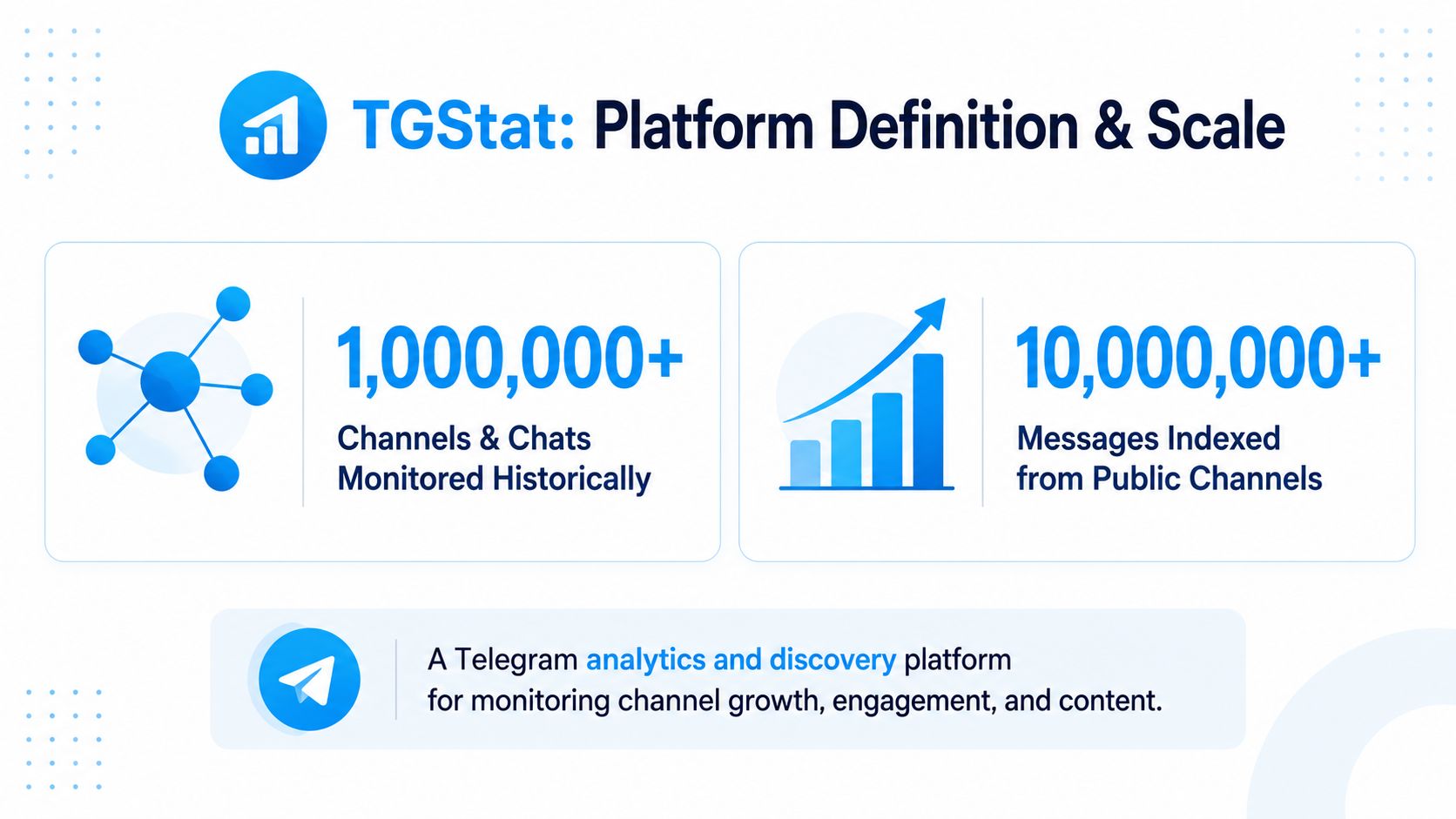
Open TGStat if you want broad discovery in markets where Russian and post-Soviet content is common. Databar's listing puts it at over 22 million data points collected from more than 1,000 channels and groups in real time source. The scale is real. The language barrier is too.
Browser translation is fine if you only need to read reports, compare channels, or inspect a public profile. Skip TGStat if you need a polished English admin experience. The question isn't "can it be translated" — it's "does it stay usable once translated", and that's where TGStat gets rough.
Practical rule: if your work depends on reading quickly, filtering cleanly, and sharing findings with an English-speaking team, TGStat is serviceable, not elegant.
What TGStat Is and Where It Performs
TGStat is a Telegram analytics and discovery platform. It is not a messaging tool and not a private-data tool. Independent summaries put its index somewhere between 2.5 and 5 million public channels and groups across dozens of countries source. Either way, the value comes from scale, discovery, and benchmarking.
Where it is dense and where it thins out
TGStat performs best in markets where Telegram activity is already highly visible in public channels. Bellingcat's toolkit note says it has been used especially for monitoring events in Russian-speaking countries, post-Soviet regions, and far-right groups source. That is the real question behind "tgstat in english": whether the directory is dense enough for your market, not whether the buttons can be translated.
Coverage density changes the quality of your benchmark. In a dense market, TGStat gives you useful side-by-side comparisons, category filtering, and a clear sense of who is active. In a sparse market, the same interface feels like a partial map, because gaps in coverage shape what you can compare with confidence.
The practical takeaway
Treat TGStat as a discovery layer. It is strong when you need to find public channels, compare them across categories, and see how a channel sits inside a bigger ecosystem. It is weaker when you expect uniform global depth, especially in English-language Western markets where Telegram is less central to public discourse.
The split for English speakers is simple. Use TGStat for cross-market research where Telegram is already a major public channel. Use Statiko's guide to AI channel summaries if you want an English-native workflow for summaries and comparisons.
Using TGStat in English Without Losing Your Mind
TGStat has no official English toggle, so the browser does the heavy lifting. Chrome, Edge, and Safari translate the page well enough for reading, but expect friction in channel category labels, post preview snippets with embedded Cyrillic, and ad placements. Translation is a workaround, not a native layer.
The workflow that actually works
Turn on page translation before you search. Then verify the page title, channel name, and core chart labels against the original language whenever a metric looks odd. Translation flattens nuance, and a badly translated category label can send you into the wrong segment entirely.
Use TGStat as a read-only research surface. Don't force it into a publishing or admin workflow — the site wasn't built around English-speaking operators. If you need an English-native path for public channel summaries and comparisons, compare this practical guide on Telegram channel summaries with the TGStat flow you're using now.
Don't trust a translated label if the surrounding chart context looks off. On TGStat, the chart usually tells the truth before the translated menu does.
TGStat vs Statiko at a Glance
People compare TGStat and Statiko as if they were two copies of the same product. They aren't. TGStat is built around discovery and benchmarking. Statiko is built around public-channel monitoring with a record of what happened over time, which is why this broader channel monitoring guide matters if your work is longitudinal.
TGStat vs Statiko Decision Criteria
| Criterion | TGStat | Statiko |
|---|---|---|
| Language UX | Russian-first, translation required for most English users | English-friendly for public channel work |
| Public channel discovery | Strong, especially for cross-market browsing | Strong, with catalog search and channel pages |
| Growth and benchmarking | Strong for channel stats and comparison | Strong, with continuous monitoring and snapshots |
| Post history | Shows current and recent channel state | Preserves every version of every message |
| Edit and deletion history | Not the main strength | Core capability, including deleted-post tracking |
| Best fit | Discovery-heavy research in dense Telegram markets | Researchers, marketers, and admins who need a record, not just a snapshot |
TGStat wins when you need broad discovery across Russian-speaking and post-Soviet Telegram regions. Statiko wins when your analysis depends on knowing what a channel posted yesterday, then edited or deleted today. That single difference changes how you read the history of a channel, because a snapshot can miss the thing you needed to see.
Why Edit and Deletion History Changes the Analysis
Edit and deletion tracking isn't a nice extra. It changes the kind of evidence you can use. TGStat gives you the current state of a channel, recent posts, and growth curves. It doesn't preserve prior versions of edited posts or the content of deleted posts, so you can't reconstruct the trail with confidence.
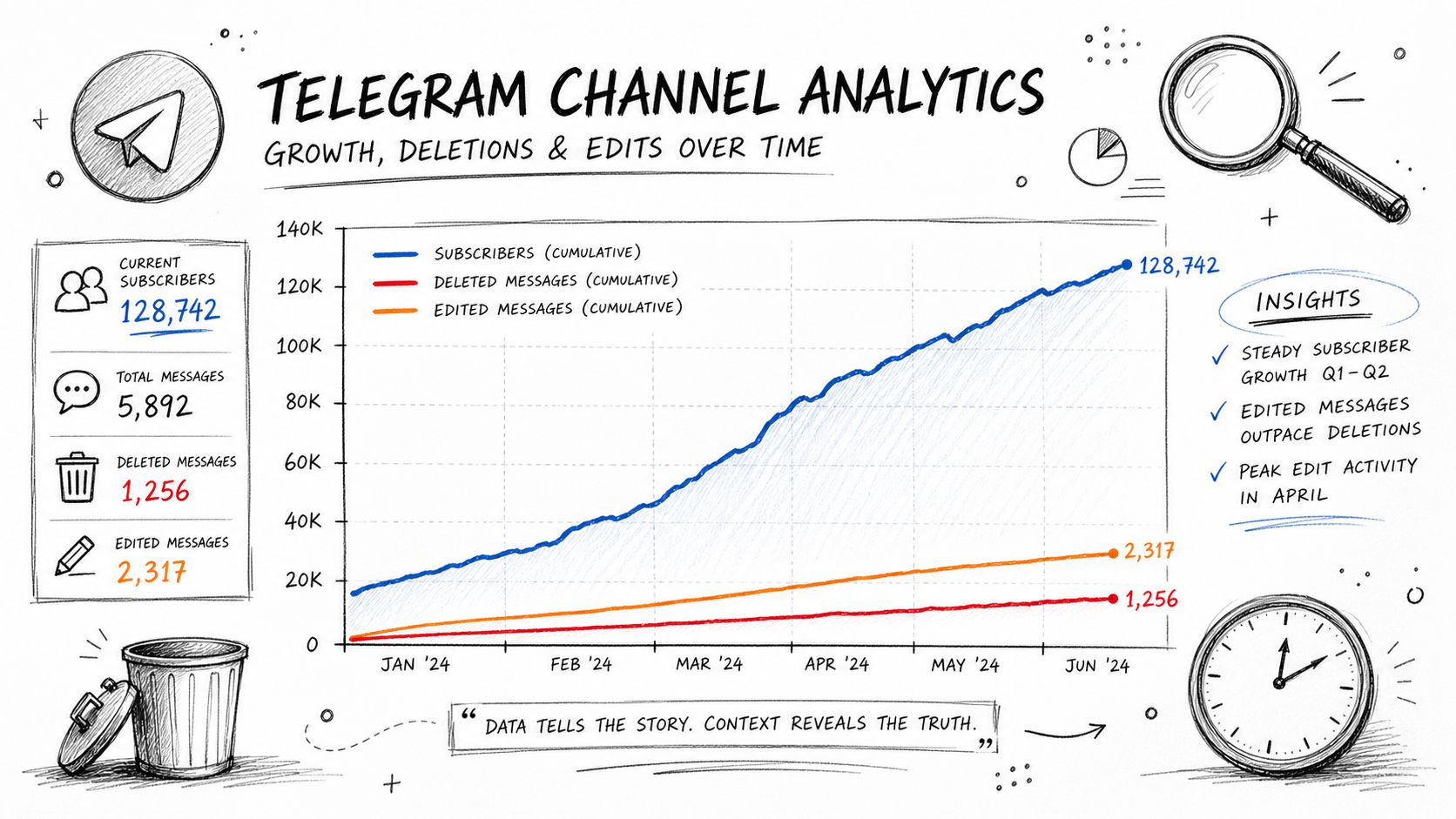
Snapshot tool versus record tool — a snapshot tells you what the channel looks like now. A record tells you what changed, what disappeared, and when. Statiko is the record tool here: it preserves every version of every message in public channels, so you can review edits and deleted content instead of guessing at them. That matters for journalists, investigators, and marketers who need a defensible reading of channel behavior.
This is the part most "tgstat in english" discussions skip. The language question is real. The history question is bigger. If a public channel rewrites a post after it spreads, the current version tells only part of the story.
Which Tool Fits Which Workflow
Use TGStat when the job is discovery-heavy and the market is one where Telegram is already visible at scale. Use Statiko when the job depends on a complete public record, especially edits and deletions.
Match the tool to the job
- Channel admins: TGStat helps with benchmarking and competitor comparison, especially if you already know the market you're watching.
- Marketers: TGStat works well for tracking competitor posting patterns and public-channel positioning.
- Researchers and journalists: Statiko is the better fit when the story depends on what a channel said, then edited out or deleted.
The key difference is not interface polish. It's whether the platform preserves the original text after a change.
Bottom line: if you need a list of channels, TGStat is useful. If you need proof of how a channel's message changed over time, you need a record tool.
Practical First Steps for English-Speaking Users
Start with fit, not features. TGStat is fine for channel discovery where its coverage is strong. If your job is research on public channels, begin at Statiko's public catalog search and search by topic or language — it's the quickest way to decide whether a channel deserves a closer look. The guide to AI channel recaps covers the step after that, moving from discovery to ongoing monitoring.
A direct way to start
- Researchers: search a public channel in the catalog, then inspect summaries, growth, and content patterns. If your analysis depends on deleted-post history, move to a record-preserving workflow instead of stopping at discovery.
- Marketers: open a channel page and compare posting cadence, content types, and recent performance.
- Channel admins: add your own public channel and watch how edits, deletions, and audience trends show up over time.
Both tools stay inside Telegram's public boundaries, so neither one reaches private groups or DMs.
Frequently Asked Questions
Does TGStat have an English version? Not officially. There's no English toggle, so English speakers rely on browser translation. Reports and charts are readable that way, but category labels and navigation stay awkward.
Is TGStat free? Basic channel stats and search are accessible without paying, and deeper reports sit behind paid tiers. The public pricing story isn't consistent, so check the current plan page before you commit.
What is the best TGStat alternative in English? It depends on the job. For discovery in Russian-speaking markets, nothing matches TGStat's density. For English-native monitoring with edit and deletion history, Statiko covers the case TGStat doesn't.
Can TGStat show deleted Telegram posts? No. TGStat reports on the current and recent state of a channel. It doesn't preserve the text of deleted posts or earlier versions of edited ones.
Does TGStat work for non-Russian channels? Yes, but coverage thins out. The index is densest in post-Soviet and Russian-speaking markets, so benchmarks in English-language niches can rest on a smaller sample than you'd assume.
Can either tool see private channels or groups? No. Both work only with public Telegram channels. Private groups and direct messages are out of scope for any public analytics platform.
If you want to see the difference in practice, spend a few minutes inside Statiko and test it against one channel you already monitor. You will know quickly whether you need a discovery layer or a record layer, and that answer matters more than any language toggle.
Related posts

The complete guide to monitoring Telegram channels — the three layers of monitoring, building a watchlist, alerting without fatigue, and 10 tools compared.

The complete guide to AI summaries, recaps and digests of Telegram channels — how they work, the four ways to get one, and seven recap formats.
Start in seconds.
Create a free account to organise channels, track activity, and get recaps delivered to you.
Real-time. Telegram. Analytics.