Telegram Subscriber Count History: How to Track Any Channel
Learn how to access telegram subscriber count history for any public channel. Discover tools, interpret anomalies, and build reliable monitoring workflows.
You need the subscriber history for a public Telegram channel, and the app shows you one number: today's. That tells you nothing about whether the channel grew steadily, bought followers, recovered from a purge, or changed shape after a promotion.
The answer is a historical tracking service rather than Telegram's live counter. Statiko's channel catalog finds public channels and shows the growth history it has recorded, alongside every post, edit, and deletion in those channels. One qualification matters throughout: historical subscriber data is reconstructed from observations, so read the chart as a measurement record rather than an infallible timeline.
Why Native Telegram Analytics Fall Short for Historical Data
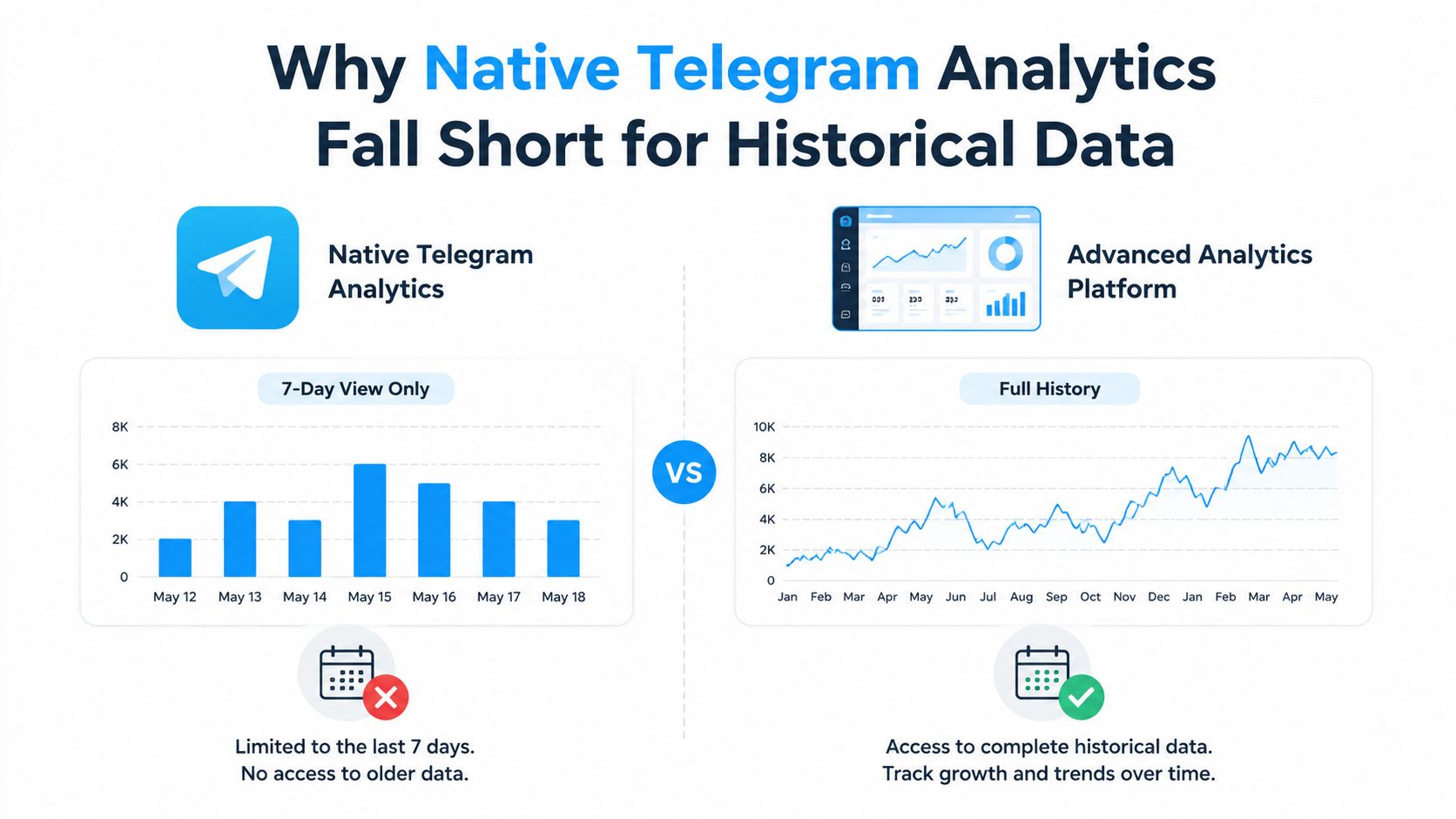
Telegram's native analytics show a channel's current follower count and period-based comparisons, but they aren't an archive of subscriber changes. The statistics structure includes a growth_graph for the absolute subscriber count and keeps current values separate from previous-period values, which tells you growth is treated as a channel metric — not that Telegram publishes a permanent timeline for every channel. Telegram's broadcast statistics documentation sets out that distinction.
The gap matters: a current number can't tell you whether growth came from a cross-promotion, a viral post, a bot campaign, or a slow accumulation of relevant readers. Built-in statistics also only unlock at 50 subscribers, a threshold lowered from 1,000 in Telegram 6.0, as documented in this analysis of Telegram subscription analytics.
What analysts actually need
Native reporting handles a quick operational check. It doesn't handle competitive benchmarking or a long-term audit, which need:
- Consistent timestamps: every observation keeps the exact time it was recorded.
- Historical continuity: the chart shows when tracking began and where observations are missing.
- Size-aware comparisons: a small channel's percentage swing shouldn't outrank meaningful growth at a mature one.
- Anomaly context: a spike gets compared against posts, promotions, and engagement rather than counted as organic success.
For older channels, the pre-tracking period stays unknown. A tool preserves what it observed; it can't recreate data nobody recorded. That's why a Telegram channel history viewer beats a page that only shows today's feed and today's total.
How to Pull Subscriber History Charts Using Statiko
Start at the Statiko channel search catalog, look the channel up by username or name, and open its page. No ownership and no login, so the workflow suits competitor research as well as channels you run.
A practical walkthrough
- Find the channel. Search the public username and confirm the result is the right channel. Similar names are common, so check the profile, description, and recent posts first.
- Open the analytics view. Go to the channel's growth area and select the subscriber history chart.
- Choose the time window. Start with the longest range available to read the overall shape, then narrow around unusual jumps or declines.
- Read the curve as observations. The line shows the recorded total at each observation, so a change between two points is net movement between them — not a list of individual joins and leaves.
- Record the tracking boundary. Note the earliest available observation. A chart that starts recently proves nothing about what came before.
- Investigate events. Line subscriber movement up against publication dates, reposts, campaigns, and deletions. Statiko preserves every post, edit, and deletion in public channels, which is the context that makes a growth event readable.
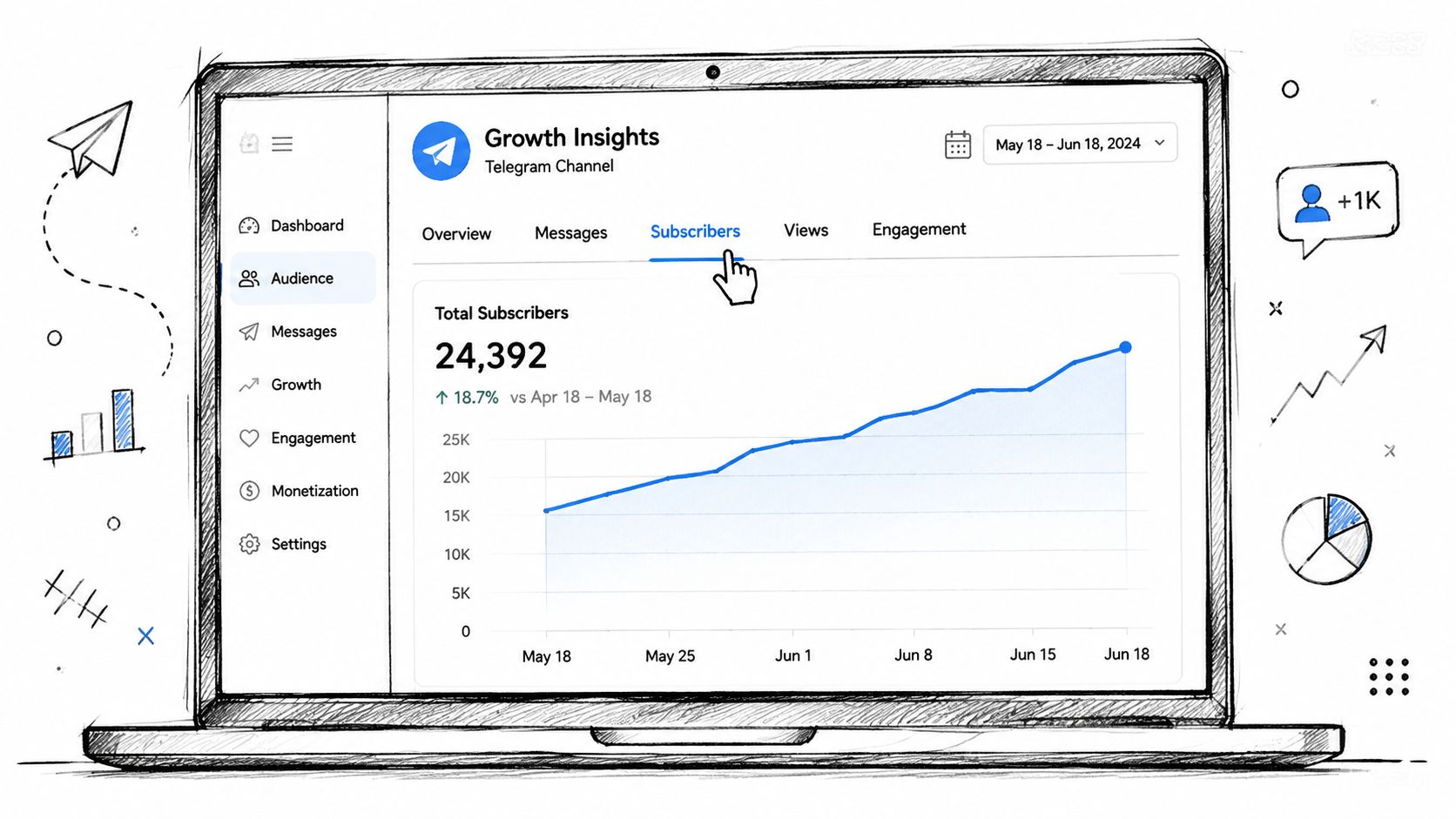
A public-channel chart can contain gaps, and a gap is not zero growth. Daily-snapshot systems treat subscriber counts as observations taken at specific times, which means "no change observed between readings" says only that the readings didn't show one. Rounded counts, common on larger channels, hide smaller movements, so preserve the displayed value and its timestamp instead of implying precision the source never offered.
Private spaces need a different approach: Statiko covers public channels and can't reach private channels, groups, or direct messages.
Reading Growth Charts and Spotting Common Anomalies
A growth chart is evidence, not an explanation. The first question is whether the movement reflects a real audience change or a limit of the measurement.
A smooth upward curve can mean sustained acquisition, or it can be an artifact of coarse observations. Rounded public counts flatten small changes, and a long gap between snapshots makes the next reading look like a jump. TelegramStats' tracking methodology recommends preserving timestamps and never comparing across different snapshot lineages, since subtracting values collected through unrelated measurement histories manufactures growth nobody observed.
Patterns that deserve investigation
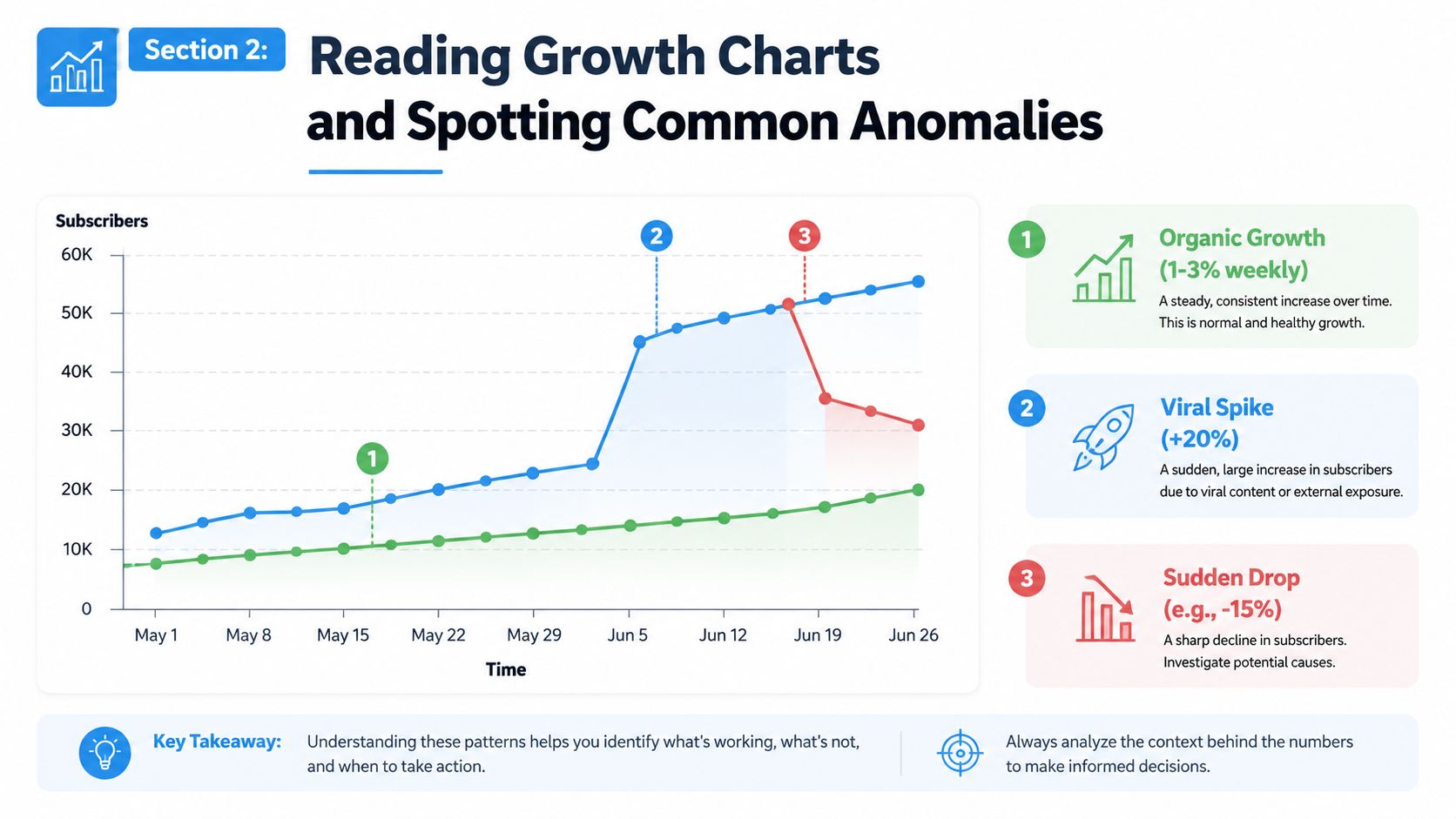
- Steady accumulation: the line rises gradually and content reach moves with it. More credible than a clean, unexplained vertical step.
- A sharp spike: look for a mention, cross-promotion, ad campaign, or unusually successful post on the same date. With no event to explain it, the spike stays unverified.
- A sudden decline: mass unsubscribes, a moderation action, deleted or inactive accounts, or a measurement discontinuity. The chart alone can't say which.
- A plateau: genuine stagnation, rounded counts, or a stretch where the tracker saw no meaningful change.
Channel size changes how you read all of this. Mature channels above 10,000 subscribers commonly plateau around 2–5% monthly growth, while channels between 1,000 and 10,000 often run at 5–15%, according to Creaflow's Telegram analytics guide, which also notes that small channels produce extreme percentage swings. Keep absolute gains and engagement in the review. And never call a spike organic until you can tie it to a dated distribution event, content event, or corroborating engagement movement.
Alternative Tools and Manual Tracking Methods
Statiko is one option for public-channel history. The right method depends on how many channels you monitor, how much historical continuity you need, and whether your team can maintain infrastructure.
| Tool/Method | Historical Depth | Cost | Best For | Key Limitation |
|---|---|---|---|---|
| Statiko | Depends on when public-channel tracking began | Access varies by product feature | Public-channel history and content context | Covers public channels, not private spaces |
| TGStat | Public indexing and available historical metrics | Varies | Broad channel discovery and benchmarking | Updates and coverage vary, especially on smaller channels |
| Telemetr.io | Historical and advertising-oriented views | Some features require paid access | Ad tracking and cross-promotion research | Subscriber-history depth may depend on the plan |
| Popsters | Snapshot-based history from tracking start | Varies | Social analytics across platforms | Can't show periods before tracking began |
| Custom Telegram Bot API pipeline | As deep as your database | Engineering and maintenance effort | Teams needing ownership and export control | Scheduling, rate limits, storage, and validation are yours |
| Spreadsheet | Begins with your first entry | Low direct cost | A small watchlist | Manual collection doesn't scale and invites errors |
A custom pipeline hands you control over schema, timestamps, retention, and exports, along with the operational work a hosted service absorbs. Manual tracking works for a small watchlist checked on a schedule, then turns fragile as soon as several people enter counts differently or skip a week. For a focused tool comparison, see this guide to Telegram channel monitoring tools.
Neither route removes the need to inspect gaps, rounding, and source lineage.
Pairing Subscriber Counts with Engagement Metrics
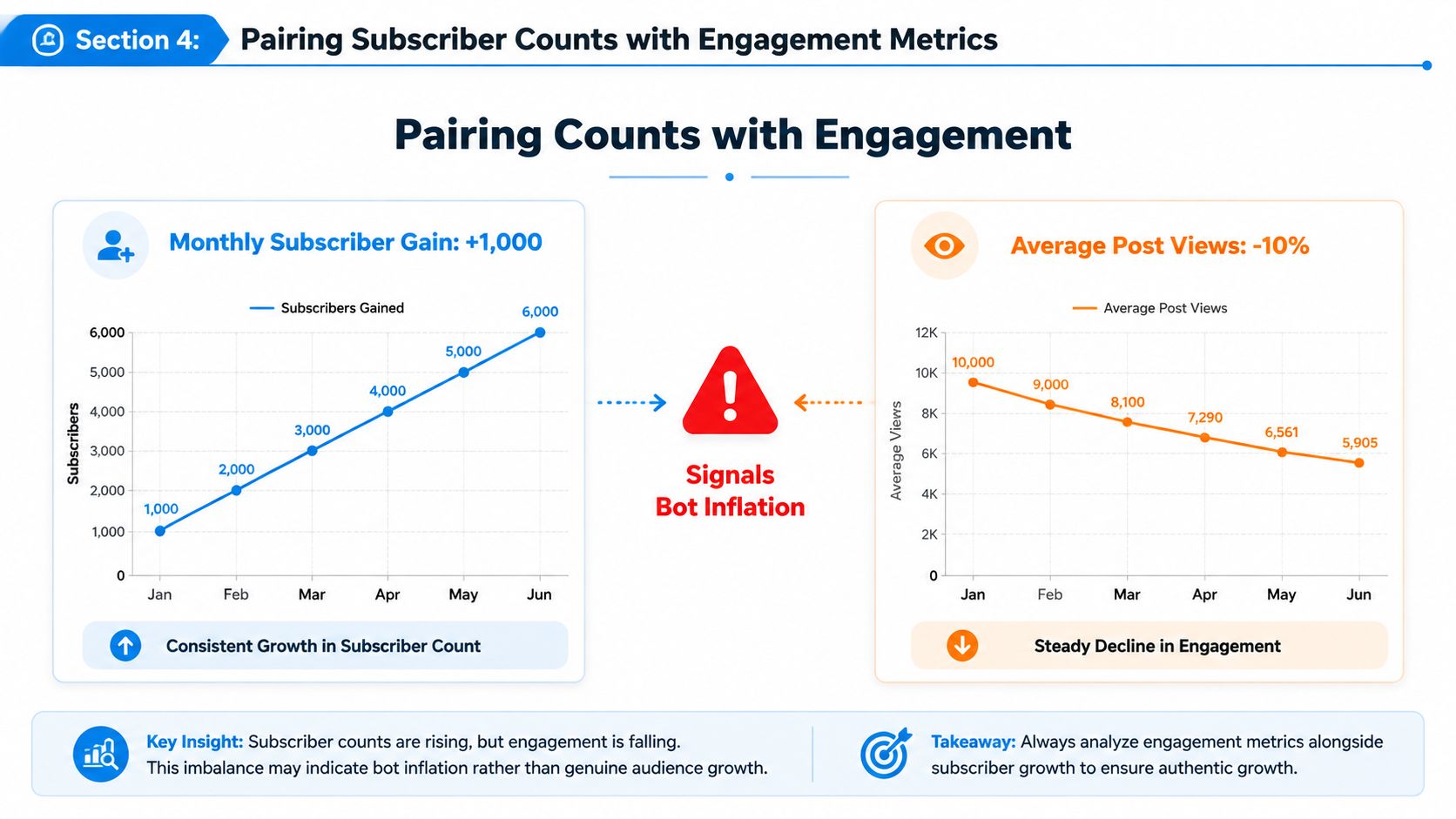
Subscriber totals only become useful next to what subscribers do. A channel can gain followers while average post views weaken, which looks like growth and delivers less reachable attention than before.
Track the subscriber curve alongside average views per post, reactions, and forwards. When subscribers rise and views stay flat or fall, investigate the acquisition source, audience fit, posting changes, and the possibility of inactive or purchased subscribers — the full method for testing an audience covers what to check next.
A useful dashboard view
Put these series on the same reporting page:
- Cumulative subscribers: the audience stock.
- Net subscriber movement: whether that stock expands or contracts between observations.
- Average post views: practical reach.
- Views per subscriber, or ERR: whether reach keeps pace with audience size.
- Reactions and forwards: active response and distribution.
A divergence isn't proof of fraud. A campaign can attract a poorly matched audience, and new subscribers often need time to become regular readers. It is a signal that needs an explanation before the headline count goes into a media kit or a campaign forecast. For Telegram-specific measurement, Telegram channel analytics helps organize the relationship between growth and content performance.
Building a Reliable Monitoring and Reporting Workflow
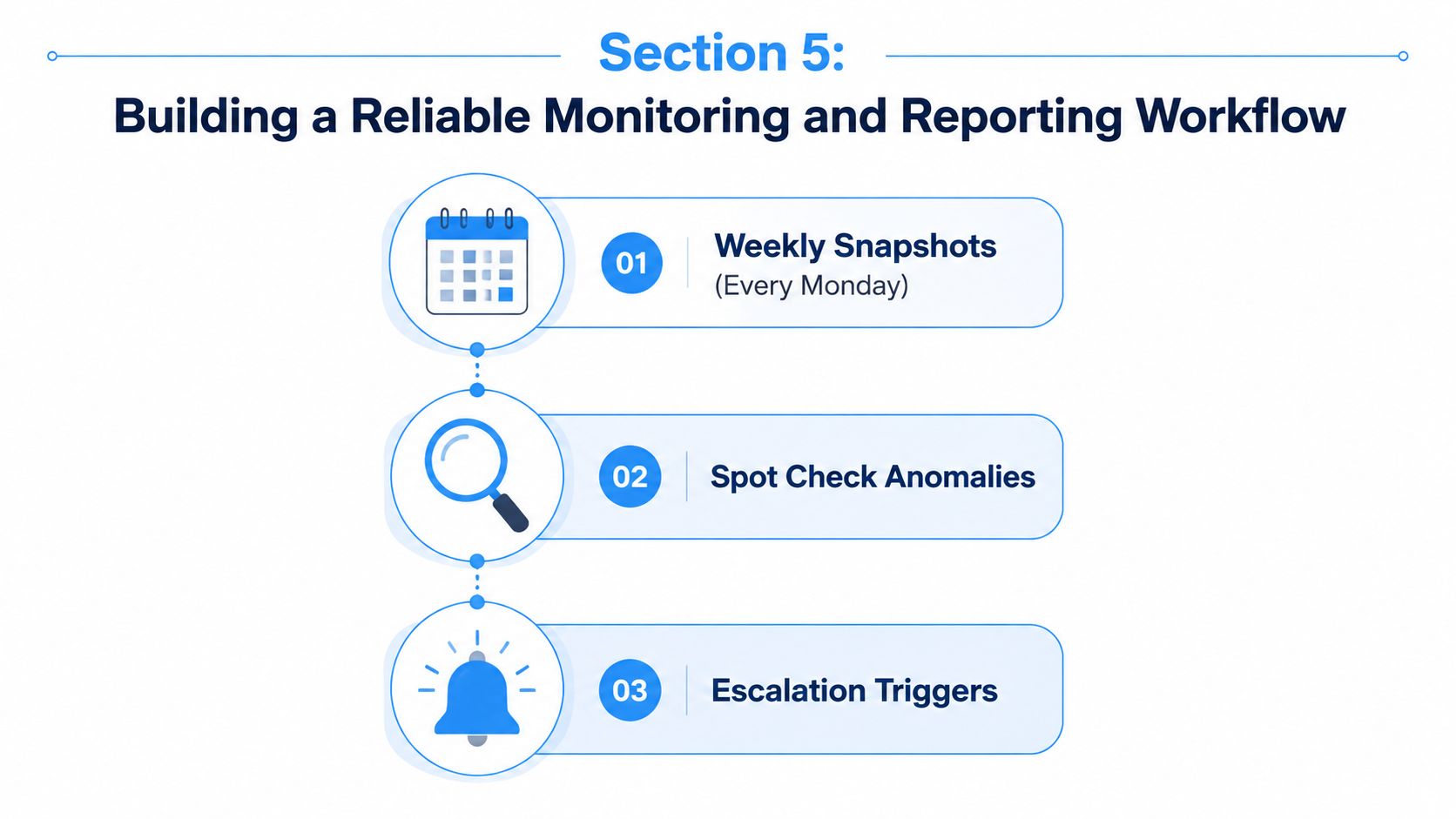
Reliable history comes from consistent collection, disciplined notes, and cautious interpretation. Pick a fixed review cadence that matches the channel's activity and the decisions riding on it — often for an active campaign, slower for research, as long as the timestamps stay consistent.
Use a simple reporting sequence
- Capture the observation. Save the channel, displayed subscriber count, timestamp, source, and any visible rounding.
- Review the movement. Compare the latest point with the previous comparable observation, and never fill a gap with an assumed value.
- Log the explanation. Record promotions, viral posts, major edits, deletion activity, and policy events.
A useful report carries net subscriber change, the shape of the curve, average views, engagement movement, and a short event log. Keep raw observations separate from your interpretation so a later reviewer can tell which conclusions came from measured data and which came from judgment. Treat missing observations as missing evidence, not as evidence of stability.
For benchmarking, segment channels by size band. Refresh frequency differs between large tracked channels and the long tail, and comparisons across incompatible snapshot lineages fabricate growth. Preserve the observation time and compare like with like.
FAQ
Can I see a Telegram channel's subscriber history without being the owner? Yes, for public channels. Third-party trackers record daily snapshots of the public subscriber count, so the history is available to anyone. What you can't see is the period before that tracking started.
How far back does Telegram subscriber history go? Only as far back as someone was recording it. Telegram itself exposes current counts and period comparisons rather than a permanent public timeline, so depth depends on when the tracking service began observing that channel.
Why does a subscriber chart show a flat line for several days? Usually rounding or snapshot cadence rather than a frozen audience. Large channels display rounded counts that hide small movements, and "no change observed" only means the two readings matched.
What causes a sudden drop in a channel's subscriber count? Mass unsubscribes after a topic change, a Telegram cleanup of bot or inactive accounts, a moderation action, or a break in the measurement series. Compare the drop against the post timeline before deciding which.
Can I track subscriber history for a private channel or group? No. Public trackers only see public channels. Private channels, groups, and direct messages aren't observable from outside, so an owner's native statistics are the only source.
How often should I record subscriber counts? Daily for channels in an active campaign, weekly for a routine watchlist. Consistency matters more than frequency: the same time of day, the same source, and the timestamp saved with every reading.
Statiko tracks public-channel content changes and preserves the historical record it observes, so subscriber movement can be read next to a channel's post timeline. Search public channels on Statiko, review the growth history, and check whether the visible changes line up with real publishing and engagement events.
Related posts

Unlock growth with our guide to Telegram channel analytics. Learn to track key metrics, analyze competitors, and make data-driven decisions for your channel.

Need a Telegram channel history viewer? Explore top tools to see deleted messages, track edits, and analyze public channel archives for research and audits.

Run a complete Telegram channel audit before paying for ads or sponsorships. Subscriber history, ER, deletion patterns, and audience geography explained.
Start in seconds.
Create a free account to organise channels, track activity, and get recaps delivered to you.
Real-time. Telegram. Analytics.