Telegram Channel Audit Checklist Before Buying Ads
Run a complete Telegram channel audit before paying for ads or sponsorships. Subscriber history, ER, deletion patterns, and audience geography explained.

You're reviewing a crypto channel with 120,000 subscribers. The rate card looks reasonable, the admin is pushing for payment today, and your team is one wire transfer away from buying inventory that may never reach a real buyer.
A Telegram channel audit is pre-payment due diligence, not a glance at subscribers and average views. Subscriber counts aren't independently verified, Telegram's app doesn't show outsiders a complete edit and deletion record, and a channel can look polished today because it removed the damaging posts yesterday. The audit tests three things before you pay: whether growth looks authentic, whether engagement reflects people rather than impressions, and whether the channel's historical record is trustworthy.
Find the candidate through Statiko's public-channel catalog search and open its page at statiko.io/tg/{handle}/overview. Statiko tracks every post, edit, and deletion in public channels, which gives non-owners a historical evidence layer Telegram doesn't hand to ordinary viewers.
Why a Telegram Channel Audit Matters Before You Pay
The rate card is not the product. Verified audience quality, retained placement, and credible delivery are. A channel can show a large subscriber count while generating little genuine attention, and an administrator can accept payment, then delete or rewrite the sponsored post — a review of the current feed will never see it.
Treat the channel as an advertising asset with a record of changes. Without administrator access, the post-version archive is your evidence layer — the practical source of truth when the visible feed can't show what disappeared.
The three checks that protect your budget
- Growth curves: steady audience development, unexplained spikes, cleanup events, and movement synchronized with unrelated channels.
- Engagement quality: views per subscriber, reactions per view, and forwards per view, kept separate. Views alone establish nothing about buying intent.
- Post-version history: what the channel edited, removed, or rewrote after publication. Post-payment deletion puts your purchased inventory at risk.
Native Telegram statistics cover follower counts, views per post, and public forwards, but access depends on channel permissions, and unavailable owner-level data is not proof of performance. If the seller won't provide enough evidence to verify delivery, reject the deal or write protections into the contract.
Classify incomplete evidence as unverified: missing data is not positive evidence.
Prepare the Audit Workspace and Define Your Goals
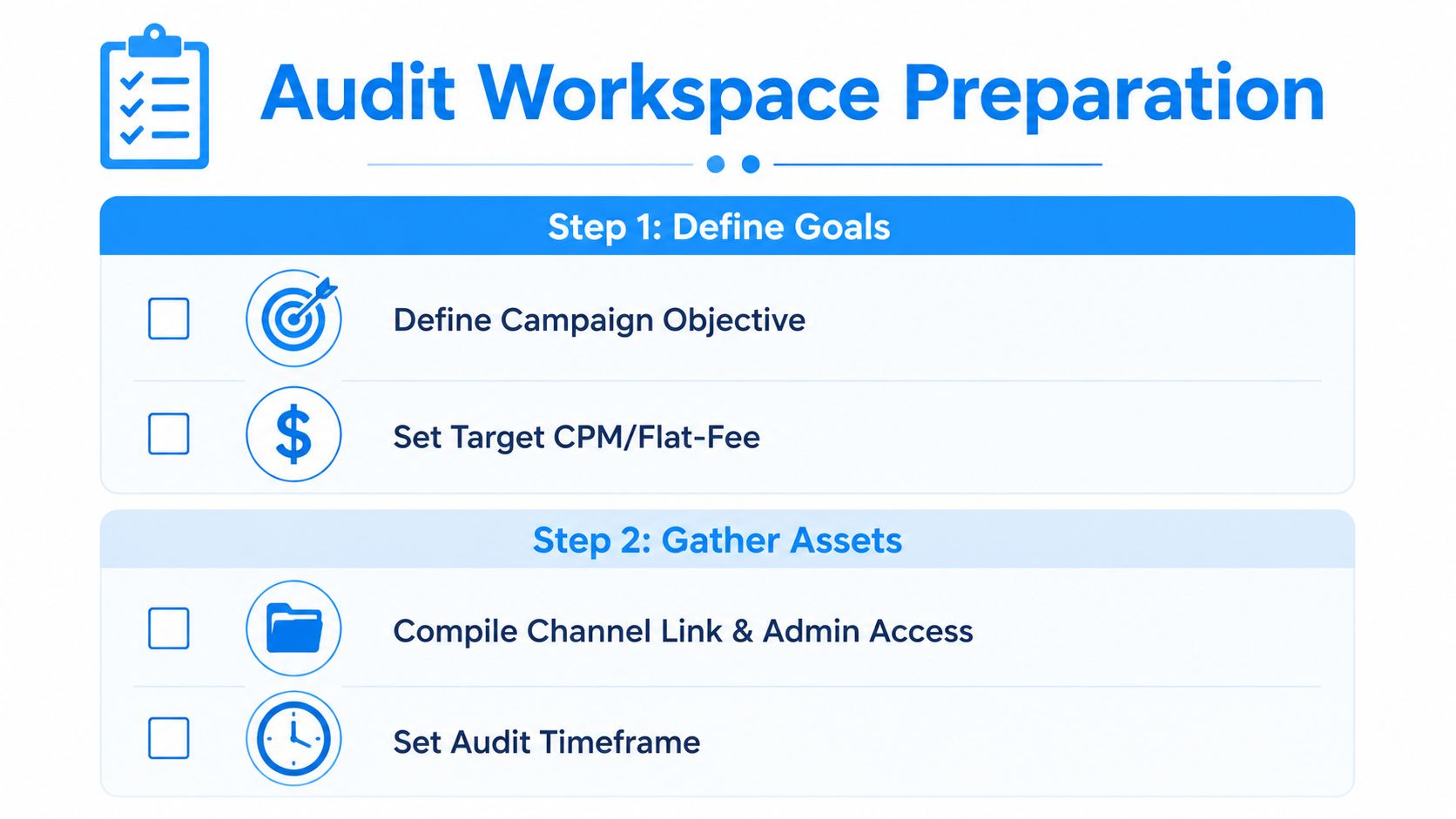
Write a one-line campaign brief before you open an analytics dashboard, stating the objective, the price benchmark, the minimum engagement level you'll accept, and the audience geography you need. "Reach crypto users" is too vague: decide whether you need traders, developers, founders, or investors.
Then shortlist channels matching the niche, language, and audience profile. Record the description, pinned post, admin information, handle, and subscriber count, and save screenshots with the audit date in the filename — that stops a seller from quietly changing the presentation while your team evaluates the deal.
Stage the tools next. Open the candidate in Statiko for post-version and deletion evidence, use TGStat or Telemetr for public growth and reach indicators, and create a spreadsheet named for the channel handle and audit date. For the wider monitoring workflow, see the guide to the best Telegram channel monitoring tool.
Keep three buckets as you go: raw exports, dated screenshots, and the scoring sheet that holds peer comparisons, weighted scores, and contract conditions. A structured workspace keeps evidence out of chat threads, so you can show exactly why you approved, renegotiated, or rejected the placement.
Read the Subscriber History for Real Growth
Read the curve before you discuss price. It shows whether growth came from sustained publishing, a documented promotion, or a cleanup staged just before the sales pitch.
Split the subscriber count history into three windows: the last 90 days for direction, the last 30 days for current momentum, and the last 7 days for recent manipulation. Owners can pull historical follower and period metrics from Telegram's native statistics; everyone else reconstructs longer-term behavior from public records.
Flag these patterns and require an explanation backed by records:
- A sudden 10–20% jump within 48 hours with no matching publication or promotion.
- A long flat plateau followed by a sharp staircase.
- A steady stream of unsubscribes that never settles.
- Near-identical growth movements across several channels in the same niche within minutes.
Compare subscriber changes against publishing activity. A channel that adds 5,000 subscribers in a week on two posts gave the new accounts no obvious content-driven reason to join. That isn't proof of fraud, but it demands campaign records, source attribution, or a lower-risk deal structure. Check whether posts were edited or deleted after the spike as well, since post-payment deletions erase the evidence that justified the purchase. The full method for testing an audience is in the guide to checking a Telegram channel for fake subscribers.
| Signal | Healthy Channel | Suspicious Channel |
|---|---|---|
| Growth shape | Gradual movement with explainable spikes | Sudden jumps without matching content events |
| Posting relationship | Subscriber gains follow useful or widely shared posts | Large gains appear during quiet publishing periods |
| Peer comparison | Movement differs naturally from nearby channels | Multiple channels rise in near lockstep |
| Recent activity | Last-week behavior resembles the broader trend | A sharp pre-sale spike follows a long plateau |
A channel adding 1–2% net subscribers per week carries a different risk profile from one reporting 18% growth in a single weekend. The first still needs engagement verification. The second needs source-level proof, version history, and deletion checks before you approve payment.
Decompose Engagement Rate Beyond the Vanity Number
Break the headline number into three ratios before approving a placement:
- Views per post divided by subscribers — how much of the visible audience sees a typical post, the standard Telegram engagement rate.
- Reactions per post divided by views — whether viewers take an observable action.
- Forwards per post divided by views — whether content travels beyond the original audience.
For public-channel comparisons, Telegram channel analytics organizes post-level performance and historical signals. Examine the pattern across many posts, never a single high-performing placement.
Compare two channels of different sizes. A 200,000-subscriber channel averaging 12,000 views reaches 6% of its base per post. A 50,000-subscriber channel averaging 8,000 views reaches 16%. The smaller channel looks more efficient, though the larger one can still win if its forward behavior, audience fit, and downstream actions are materially stronger. No buying decision should rest on the first ratio.
| Metric | Healthy Channel | Borderline | Inflated |
|---|---|---|---|
| Views per subscriber | Consistent with recent history and peer context | Strong reach with unexplained variation | High views with weak supporting signals |
| Reactions per view | Reactions fit the audience size and topic | Interaction varies sharply by post type | Views stay high while reactions collapse |
| Forwards per view | Forwarding supports genuine distribution | Diffusion changes by format | Forwarding is negligible despite large reach |
| Timing | Posts land during relevant active periods | Results depend heavily on one time block | Timing creates impressions without interaction |
A view farm leaves a clear fingerprint: views stay high while reactions and forwards decline. Bad publishing times produce the same commercial problem without any bot activity — the post collects impressions while the audience you wanted is asleep.
On a 50,000-plus channel, treat a forward-to-view ratio below 2% as a red flag rather than proof of manipulation. Ask for post-level evidence, compare against relevant peers, and check whether the strongest results came from ordinary posts or isolated promotions. A seller who supplies only a headline rate has handed you a due-diligence problem.
Inspect Edit and Deletion History as a Trust Signal
The feed you see is the channel's polished state. The version archive is the evidence. Before paying, check what the owner changed or removed after publication.
A post that promoted a project before its collapse, vanished afterward, or had its referral link swapped tells you more than a clean profile page ever will. Use Telegram edit history monitoring to review that record and preserve earlier versions before payment.
Classify each event instead of treating every edit as suspicious.
Acceptable edits
- Correcting a spelling mistake.
- Updating a broken destination link without changing the commercial claim.
- Clarifying wording while preserving the original meaning.
- Removing duplicate or accidentally published material, with an explanation.
Commercially dangerous patterns
- A large deletion cluster within 48 hours of a token launch.
- Repeated edits that replace referral links after a post has accumulated views.
- Post bodies rewritten after a regulatory complaint.
- Sponsored posts removed after payment, especially with no replacement inventory offered.
- A promotion for a project that later failed, followed by bulk cleanup of related posts.
Apply a firm walk-away rule: deleting more than 15% of the last 90 days of posts without an explanation disqualifies the channel. Unexplained deletion clusters wreck your ability to verify past claims, assess brand-safety exposure, and trust the promised retention period. Absence from the current feed doesn't prove an event never happened — it may show that someone removed it.
Ask the seller to confirm the post-retention period in writing, and put replacement inventory and refund triggers in the agreement. Preserve the archive before payment, then compare it against the live feed after the sponsorship runs. Payment followed by deletion is a trust failure, not a publishing discrepancy.
Extract Audience Geography, Posting Frequency, and Content Mix
Subscriber age, subscription duration, and location aren't publicly exposed in Telegram's channel statistics, so external verification and subscriber-history proxies carry the weight (TGStat analytics guidance).
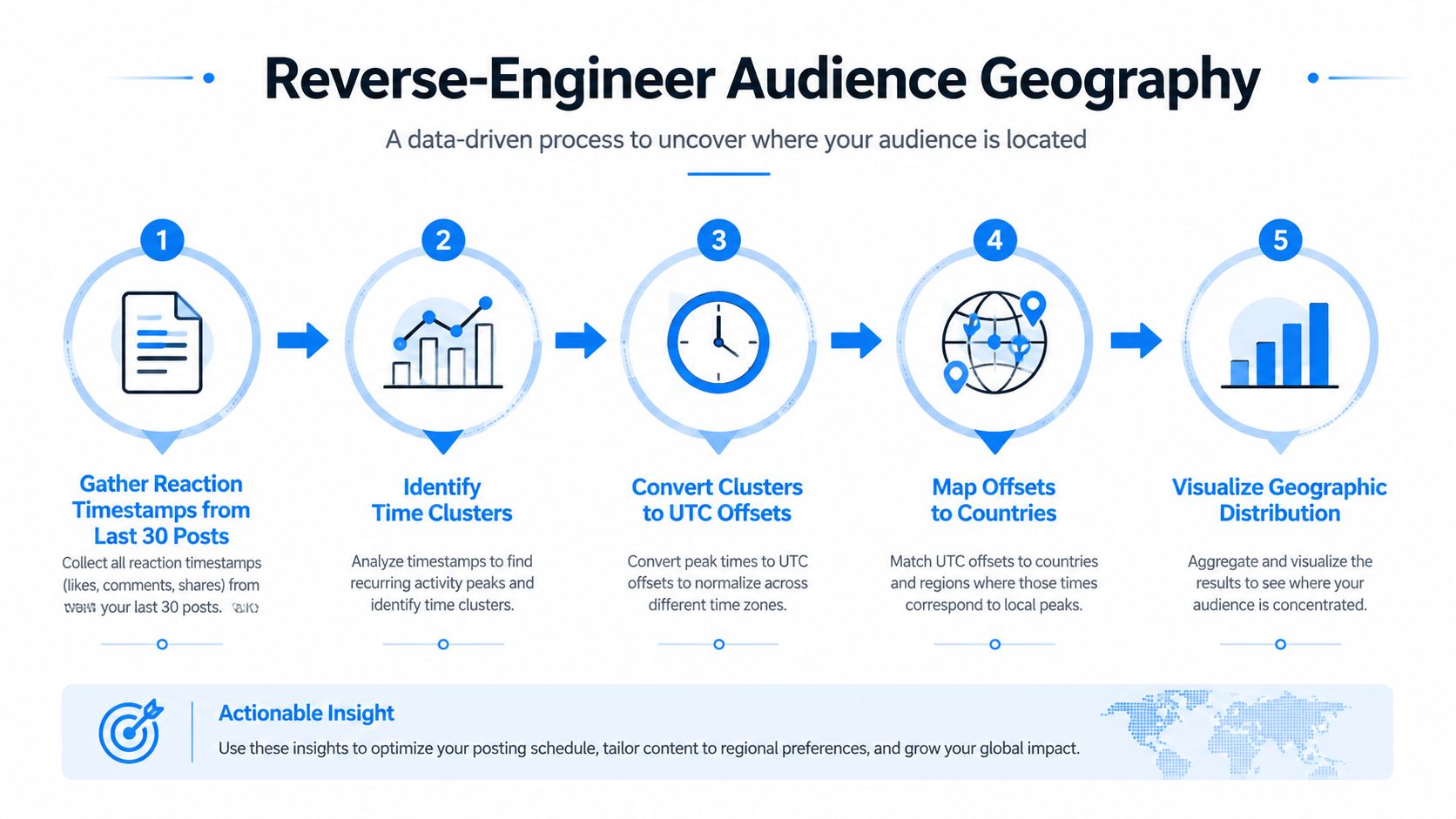
Start with reaction timestamps from the last 30 posts. Group visible activity into time clusters, convert the clusters into approximate UTC offsets, and map those offsets to country bands. Allow roughly two hours either way, because reaction timing is a directional signal rather than a location. Then check the result against language, posting times, topic references, and whatever audience evidence the seller provides.
Track cadence over the trailing 90 days. Count posts per day, identify when sponsored content would appear, and flag channels that bury an advertisement inside a 20-post daily avalanche. Channels posting fewer than three times per week may struggle to retain the audience you're buying.
Tag every post as original analysis, curated news, or promotional content, and require a promotional share below 30% over the last 60 days. A channel that mainly sells promotions delivers an audience trained to scroll past commercial posts.
Benchmark the Channel Against Three to Five Peers
A candidate can look strong in isolation and still be overpriced. Pick 3–5 peer channels in the same niche, language, and audience tier, then collect the same fields from each on the same day. Consistent timestamps matter, because public metrics move continuously.
Compare 90-day subscriber delta, engagement rate per post, views-to-followers ratio, posting frequency, average post lifespan, and deletion rate.
Use TGStat, Telemetr, and Statiko as appropriate, but don't mix definitions without documenting them. One platform reports mean views while another emphasizes median views, and those aren't interchangeable.
| Channel | Subscribers | 90-Day Growth % | ER % | Views per Post | Posts per Week | Deletion Rate % |
|---|---|---|---|---|---|---|
| Candidate | Record current value | Calculate from archive | Define formula | Record consistently | Count consistently | Calculate from history |
| Peer A | Record current value | Calculate from archive | Same formula | Same source | Same window | Same definition |
| Peer B | Record current value | Calculate from archive | Same formula | Same source | Same window | Same definition |
| Peer C | Record current value | Calculate from archive | Same formula | Same source | Same window | Same definition |
The table is a worksheet: enter verified observations and keep the calculation method identical across rows.
A channel with 4.2% engagement looks attractive until comparable peers average 7%. A channel with half the followers but higher views per post may offer a better effective CPM. The tie-breaker: if the candidate doesn't beat at least two peers on the metrics tied to your campaign objective, renegotiate or walk.
Run the Moderation and Compliance Mini-Checklist
Brand safety starts with the feed, not the contract. Scan the last 200 posts for crypto airdrops promising guaranteed returns, MLM recruitment chains, unlicensed financial advice, adult redirects, and links to known phishing domains.
Check whether the admin has pinned a scam-warning disclaimer, then verify the channel isn't impersonating a brand. Review the username history through an external archive to catch squatted handles rebranded after launch, since a channel's identity can change while its older promotional record stays relevant.
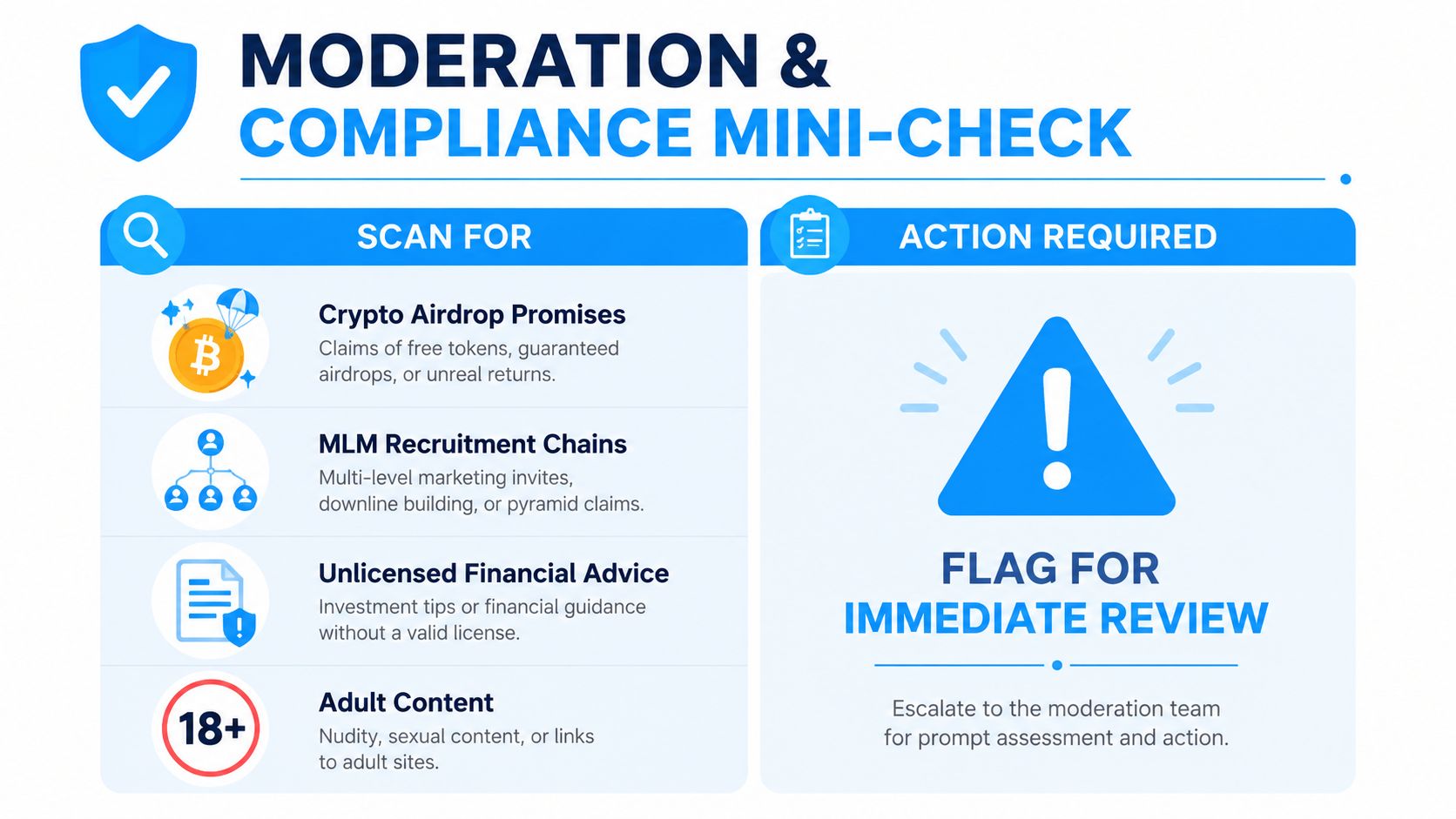
Read the comments under recent posts where they exist. Replies dominated by bot-like praise, repeated single words, or generic emoji strings deserve scrutiny; genuine questions and topic-specific discussion are a stronger signal, though no comment pattern proves authenticity on its own.
In regulated categories — finance, health, gambling — require the admin to confirm how sponsorship disclosure will work under your jurisdiction and Telegram's advertising requirements. Put the disclosure format, placement, retention window, and approval process in the insertion order.
A clean moderation record doesn't guarantee performance. It tells you whether your brand will sit beside content that could trigger complaints, platform action, or avoidable reputational damage.
Score the Channel With a Pre-Buy Checklist
Turn the evidence into a repeatable score instead of arguing from impressions. Rate each dimension from 1 to 5, multiply by its weight, and add the results.
| Dimension | Weight |
|---|---|
| Growth authenticity | 25% |
| Engagement quality | 25% |
| Content integrity | 15% |
| Audience fit, including geography and language | 15% |
| Compliance cleanliness | 10% |
| Price-to-performance versus peers | 10% |
Content integrity should reflect edit and deletion behavior, not the current tone of the feed. Audience fit means the people your campaign needs, not the channel's stated location. Price-to-performance has to use the same definitions you applied to the peers.
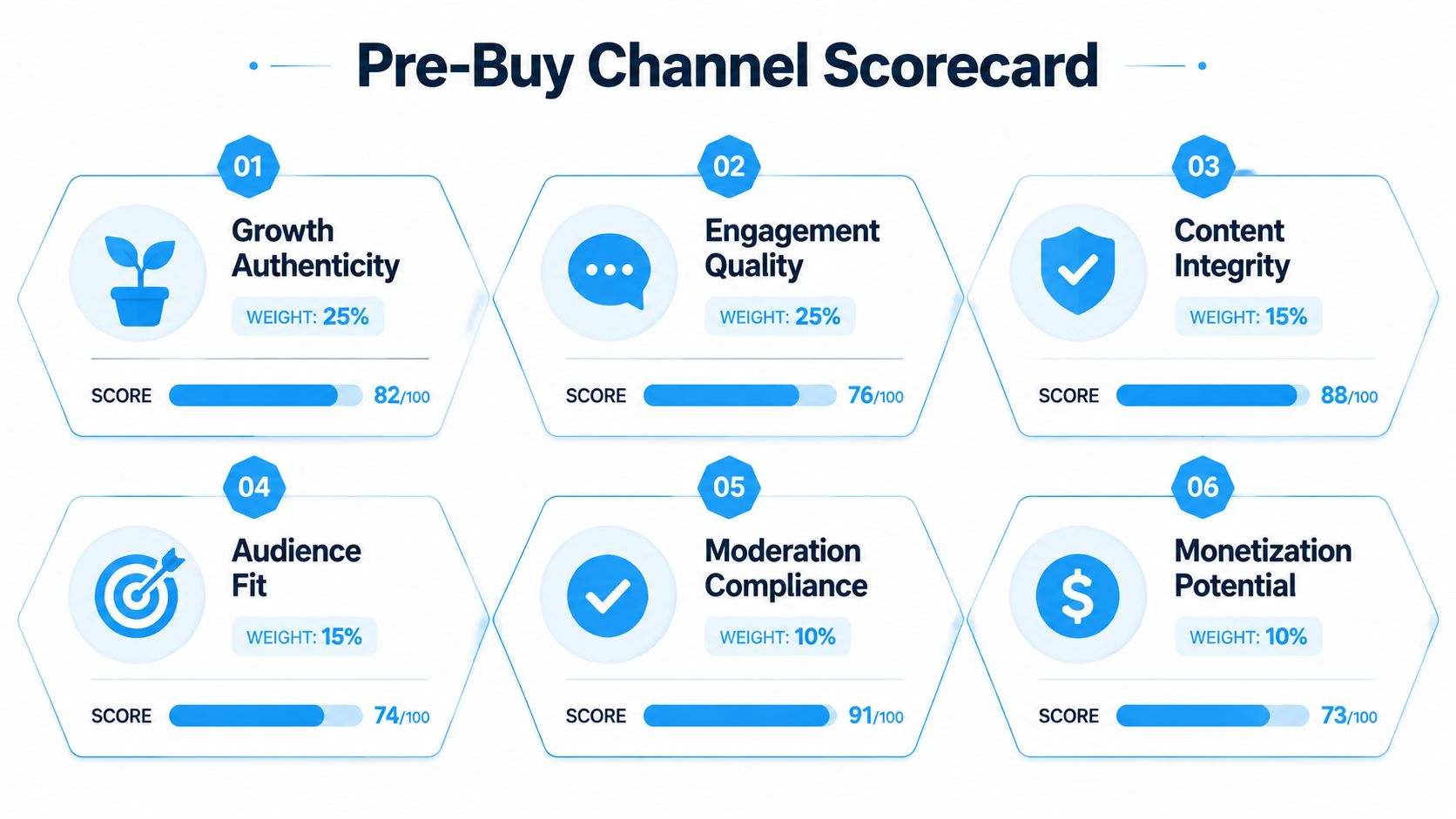
Decision bands: above 4.0, green-light the placement subject to contractual protections; 3.0–4.0, negotiate price, format, retention, or payment structure; below 3.0, walk away.
Keep the sheet identical across candidates and add evidence notes beside each score: post IDs, screenshots, dates, peer observations. The model doesn't replace judgment; it stops judgment from being driven by a large subscriber count and an urgent seller.
Turn the Audit Into a Prioritized Action Plan
Every finding needs an owner and a commercial consequence. Classify the result as Green Light, Negotiate, or Walk Away, then rank the findings by financial impact.
Post-payment deletion history and inflated engagement outrank minor geography uncertainty or inconsistent cadence: a channel that deletes paid promotions creates a direct delivery problem, while awkward timing still works when audience fit and retention terms are strong.
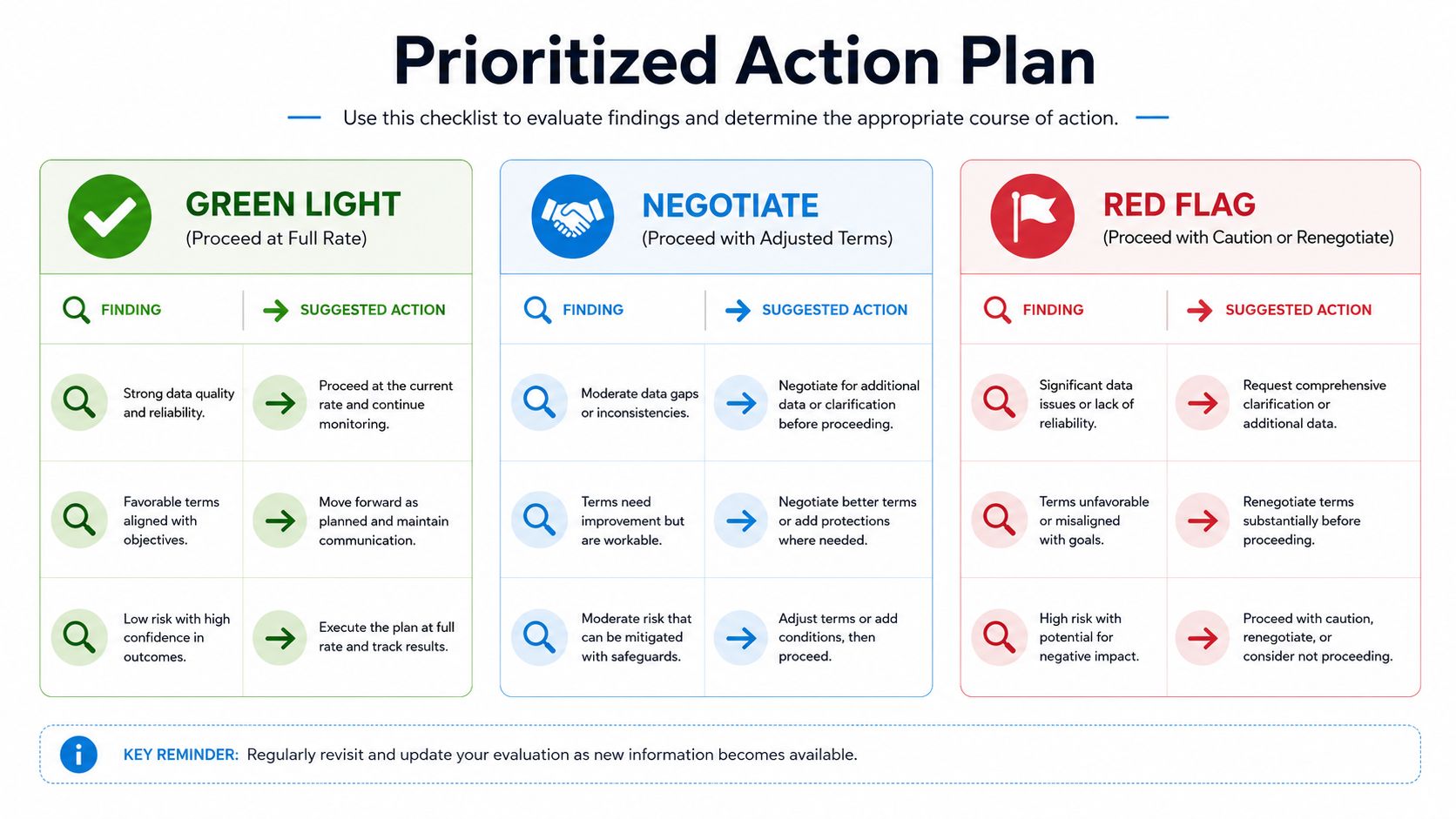
Green Light — proceed at the agreed rate when growth, engagement, integrity, audience fit, and compliance evidence support the score. Protect the purchase with a content-retention window, replacement inventory if the post disappears, and a refund trigger for non-delivery.
Negotiate — adjust the terms when the channel is plausible but the evidence is mixed. Ask for milestone payments, capped exposure, a post-payment content lock, a multi-post package, or a price tied to verified reach. Put the concession in writing rather than accepting a verbal assurance.
Walk Away — decline on recent deletion of paid posts, bot-cluster engagement, or materially mismatched audience geography. Save the evidence and record the reason so a colleague doesn't reopen the same deal after the channel changes its presentation.
Make the Audit a Quarterly Habit and Keep Records
A pre-buy review protects one transaction; a recurring audit protects renewals and rate negotiations.
Review active channels quarterly. During paid promotion or rapid growth, switch to monthly checks and resolve critical issues within 24–48 hours — the cadence recommended in this Telegram channel audit checklist guidance.
Store every review in a dated folder with the score sheet, peer snapshot, edit-history evidence, and action plan. Add a lighter mid-quarter check on post performance and deletion activity, since those signals move faster than audience geography or retention.
Keep an archive rather than relying on the current feed, and compare quarter over quarter on engagement, subscriber retention, deletion behavior, and red-flag counts. Use the same definitions across channels so the scores stay comparable, then update your rejection rules after each cycle and send them to whoever approves sponsorship spend.
Don't buy because a channel looks large today. Buy when growth, interaction, audience fit, and historical evidence support the price.
FAQ
How long does a proper Telegram channel audit take? A first pass on growth, engagement ratios, and deletion history takes 30–60 minutes per channel. Peer benchmarking and the compliance scan add another hour. Budget more only when the placement is large enough to justify it.
Can I audit a Telegram channel without admin access? Yes. Subscriber history, post views, reactions, forwards, posting cadence, and edit and deletion records are all observable from outside. Owner-only statistics add detail, but the checks that protect your budget don't depend on them.
What engagement rate is good for a Telegram channel? It depends on size and niche, which is why the peer comparison matters more than an absolute number. Read views per subscriber, reactions per view, and forwards per view separately, and treat a forward-to-view ratio below 2% on a large channel as a flag worth explaining.
What should I do if the channel deletes my sponsored post? Enforce the retention clause you agreed before payment: replacement inventory, a refund trigger, or both. Preserve the archived version of the post beforehand so you can show what ran and when it disappeared.
How do I estimate audience geography without owner analytics? Cluster reaction timestamps across the last 30 posts, convert them into UTC offsets, and cross-check against language, topic references, and posting times. It's directional evidence, not a location report, so treat it as one input to the audience-fit score.
How often should I re-audit a channel I already work with? Quarterly for active channels, monthly during a running campaign or a period of rapid growth. Audience quality and deletion behavior can change between the audit and the next placement.
Statiko keeps public Telegram growth history, post-level performance, and full edit and deletion tracking in one place, so your audit rests on a record instead of a seller's screenshot. Look up your next candidate on Statiko before the invoice arrives.
Related posts
Learn how to check Telegram channel for fake subscribers with view ratios, growth analysis, and Statiko tools for due diligence.
Learn how to view, track, and archive Telegram edit history across desktop, mobile, and web — plus tools that surface every version of a message.

Unlock growth with our guide to Telegram channel analytics. Learn to track key metrics, analyze competitors, and make data-driven decisions for your channel.
Start in seconds.
Create a free account to organise channels, track activity, and get recaps delivered to you.
Real-time. Telegram. Analytics.