Check Telegram Channel for Fake Subscribers: A 2026 Guide
Learn how to check Telegram channel for fake subscribers with view ratios, growth analysis, and Statiko tools for due diligence.
Subscriber counts on Telegram are unreliable. The useful test is the views-to-subscribers ratio across the last 10 posts: below about 2% is a red flag in a large channel, and above about 5% is more consistent with real reach when the engagement and growth curves agree.
You're negotiating an expensive placement. The owner sends a screenshot of the member count, points at a few popular posts, and wants payment before the campaign starts. Don't approve a deal from a screenshot. Check a Telegram channel for fake subscribers by comparing recent views, subscriber history, engagement consistency, and profile quality over time.
Statiko's channel search is the fastest starting point, because it lets you inspect public-channel analytics without relying on the seller's evidence. Statiko records every post, edit, and deletion in public channels — a record no promotional screenshot can provide.
Why Subscriber Counts Lie on Telegram
A channel owner tells you it has 80,000 subscribers, and the placement price reflects that. Before you move the budget, ask a better question: how many of those subscribers see and respond to recent posts?
Take the last 10 posts, add their view counts, divide by 10, then divide that average by the current subscriber count. Below about 2% is a red flag on a large channel. Above about 5% usually points to healthier reach, provided the engagement pattern and historical range back it up. That baseline comes from practical fake-subscriber audit guidance.
The ratio carries this much weight because Telegram gives ordinary visitors no native bot-follower metric. You can see public views and reactions, but not a platform report telling you which subscribers are automated, dormant, or unreachable. Audience verification is an external evidence problem.
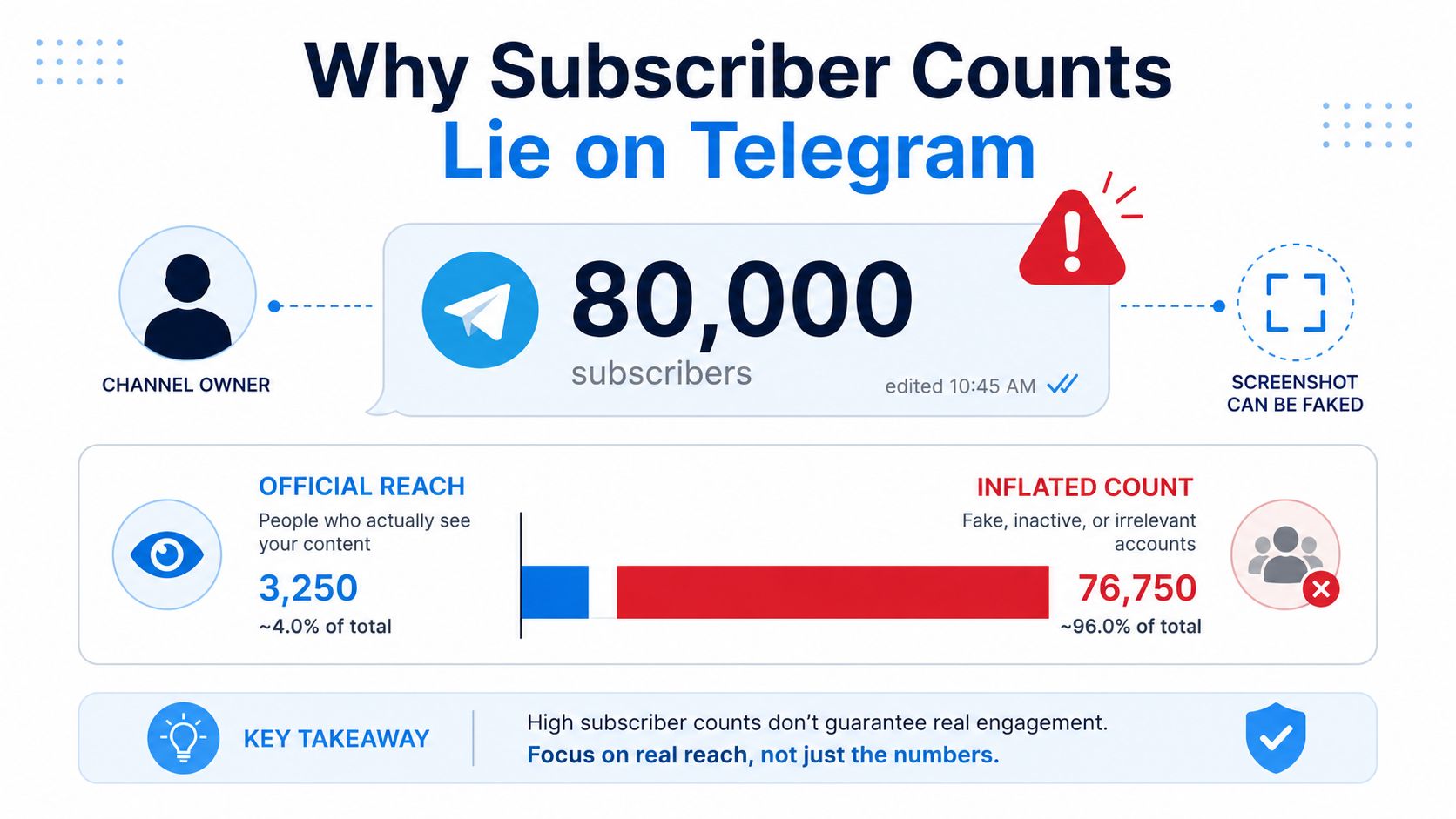
Size is not proof of reach
A 2020 academic study of fake Telegram channels found they averaged 19,636 subscribers, and that more than 45% of them held over 10,000. Those same fake channels carried only about 10% of the subscriber base of the verified channels they imitated. The study of fake Telegram channels has the underlying data.
A channel doesn't need to look empty to be inflated. Fake channels mimic legitimate scale, clear the size thresholds buyers filter on, and still underperform on audience activity.
Treat the subscriber count as a denominator, not as proof of distribution. You're buying exposure, so views, forwards, reactions, posting history, and growth behavior all outrank the headline membership figure. Never price a placement from the subscriber count alone — make the seller show that recent audience activity supports it.
If you're weighing acquisition tactics from the other side of the table, the risks in buying Telegram channel subscribers explain why purchased membership isn't reach.
Red Flags That Signal Fake Subscribers
One metric rarely exposes a suspicious channel. The warning appears when subscriber growth, content distribution, and audience behavior stop describing the same audience.
Understand how inflated audiences behave
Fake subscribers exist because membership is easy to display and hard to verify from a seller's screenshot. Purchased accounts make a channel look established, clear a buyer's minimum-size filter, and support a higher placement price without adding anyone who opens, forwards, or reacts.
Watch for the purge cycle first. Low-quality accounts sit in the subscriber total until Telegram removes them or the supplier's accounts vanish, and the channel drains suddenly. If the owner buys another batch, the curve climbs again. One decline has several innocent explanations; repeated rise-and-drain sequences don't.
Timing tells you more than the drop itself. A removal event can reveal that an earlier growth jump was made of accounts that never read anything. Compare the loss against the channel's growth history, posting record, and any public promotion before deciding what it means. This audit guide has a workable framework for separating purge evidence from normal fluctuation.
View-bot inflation distorts in the opposite direction. Rather than adding people, the seller inflates post views so the channel looks like it delivers reach. Those views arrive without matching reactions, forwards, comments, or sustained performance on later posts, so a strong view count can't validate the subscriber base on its own.
A real promotion, mention, or viral post leaves some trace in the timeline even when the response is uneven, so an unexplained vertical jump followed by unchanged delivery means the new members arrived for appearance. The most revealing sequence combines both distortions: growth, flat or inflated views, a purge, then another acquisition wave. The visible numbers reset while real reach stays weak.
Separate normal volatility from fraud patterns
Telegram audiences move unevenly. Topics, regions, posting schedules, and external sharing all vary, so don't call a channel fraudulent because one post underperformed or one decline lacks an obvious cause.
Escalate when several behaviors line up: growth with no visible acquisition event, no durable change in later distribution, engagement weakening after new members arrive, and a repeated drain-and-refill curve. The question stops being whether one number looks unusual and becomes whether the channel's history supports the audience you're being asked to pay for.
Statiko's historical snapshots let you follow that sequence across months. Mark every unexplained growth and purge date, then line them up against the channel's posts and promotions.
Running the Audit on a Statiko Channel Page
Open Statiko's catalog search, enter the public channel, and open its page at statiko.io/tg/{handle}/overview. No ownership, no login. Then work through the page in the order a buying decision actually runs: growth first, recent delivery second, content history third.
Start with the longest growth range
Set the chart to the longest period available. A short window can make a purchased audience look stable simply because it begins after the suspicious event. A long history exposes the jumps, drains, and repeated cycles a current screenshot hides.
Three things to look for:
- Unexplained vertical movement. Note dates where subscribers arrived unusually fast, then search the post history for a matching campaign, mention, or viral item.
- Post-spike behavior. Check whether views, reactions, and forwards changed after the rise.
- Drain and refill patterns. A drop followed by a near-identical rise needs a reason, not a vague claim about algorithmic growth.
Calculate the last-10-post baseline
Pull the latest 10 view counts from the per-post panel. Add them, divide by 10, divide again by the current subscriber count, then compare the result against the channel's own older performance and against comparable channels in the niche.
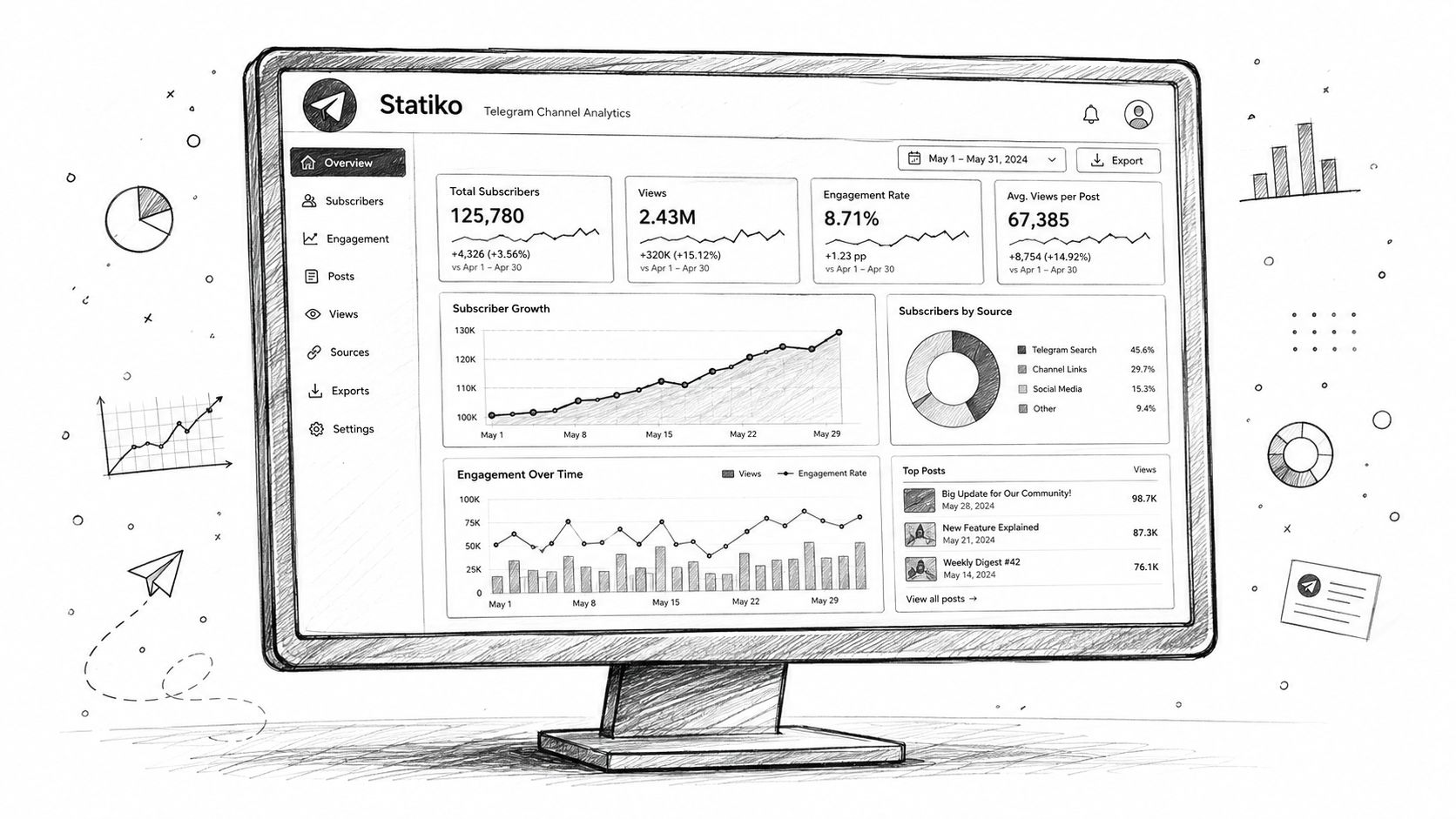
Don't stop at the percentage. Read the distribution behind it: a healthy-looking average can hide one unusually strong post carrying several weak ones. A single viral post, a time-zone effect, or one low-engagement snapshot will all mislead you in isolation.
Inspect edits and deletions
Statiko keeps every version of a message in a public channel and tracks edits and deletions. That history surfaces content rewritten after publication, removed after poor performance, or changed so the current channel reads cleaner than its record — and a channel's commercial story usually rests on exactly that history.
The channel recap summarizes top posts, anomalies, posting patterns, and engagement changes across the period you're reviewing. When you need the historical content itself rather than the current feed, the Telegram channel history viewer covers that workflow.
Ten minutes won't prove every account is genuine. It will tell you whether the seller's claimed reach deserves a longer conversation or an immediate no.
Sampling Subscriber Profiles for Quality
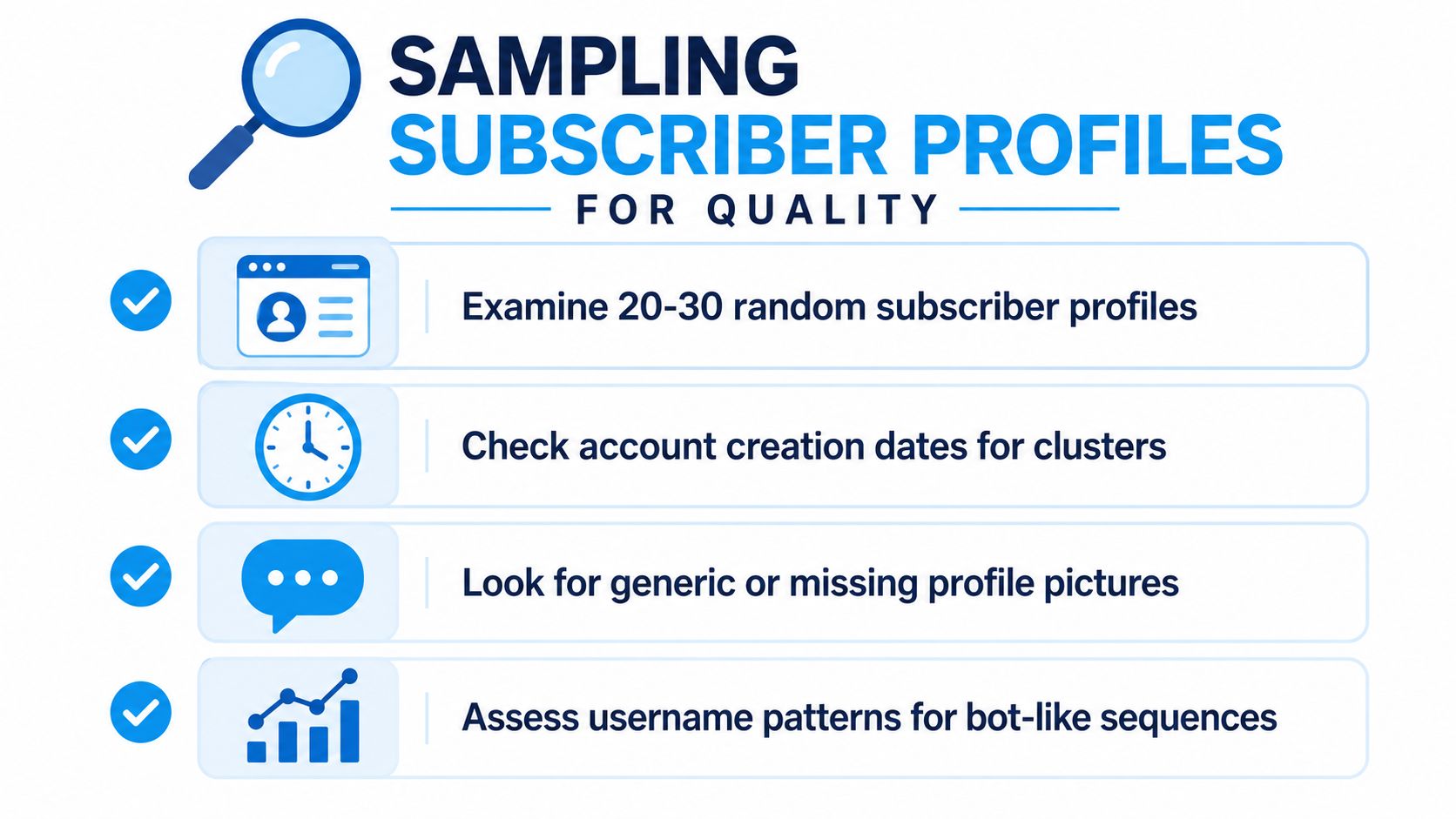
Charts show macro behavior; profiles are the micro-level check. Where the member list is public, sample roughly 50–100 profiles at random across the full member range rather than only the newest arrivals, so a colleague can reproduce the review. Profile inspection works alongside growth and engagement evidence, not instead of it.
Don't reduce the sample to a percentage test. A niche channel can hold many quiet members, and regional audiences use Telegram differently from the ones you know. You're documenting repeated patterns that support or contradict the chart.
What to log during the sample
One row per profile, recording the same characteristics every time:
- Profile completeness: blank avatars, missing bios, accounts offering no identity signals at all.
- Username structure: autogenerated-looking names, repeated formats, mechanically produced sequences.
- Account timing: clusters of creation or joining dates that coincide with a subscriber spike.
- Activity evidence: the difference between a quiet real person and a profile that is entirely empty.
Blank avatars and missing bios prove nothing alone, since plenty of legitimate users protect their identity or never finish a profile. The concern is a large cluster of those signals among accounts that arrived right after a suspicious jump.
When manual inspection isn't enough
Sampling has limits. Aged bot accounts carry avatars and old activity, and temporary accounts leave before you get to them. Profile evidence should confirm a pattern already visible in the growth chart or the view data.
On a large channel, document the sample size, selection method, observed traits, and dates, then compare the target against similar channels in the same topic and geography. The Intel Slava Z analysis shows what public-channel intelligence looks like when it's built on historical comparison.
Walk away when the owner refuses reasonable verification, the profile sample shows concentrated low-quality patterns, and the engagement data points the same way. Don't walk away because a few members have no photo.
Tracking Fraud Evolution After the Purchase
A channel can pass a one-time audit and deteriorate before your placement runs. Fake-subscriber supply is cheap — bot-heavy packages go for $0.03–$0.05 per 1,000 subscribers, according to this Telegram channel analysis — so an owner can top up an audience days before a campaign without leaving an obvious long-term mark. Audience quality is not a fixed attribute: inflation evolves through purges, refills, and fresh attempts to make a weak audience look active.
Purges reveal the earlier purchase
Cleanup events run at enormous scale. A 2025 dataset counted 1,331 bots flagged by Telegram as scam or fake accounts, and reporting gathered by operators who track them describes cleanups that stripped 21.2 million subscribers from channels in Russia, 14.5 million in Iran, and 13 million in Uzbekistan.
For an advertiser, a purge isn't only a platform event: it exposes the channel's earlier acquisition behavior. A sudden fall doesn't prove the owner bought subscribers, but it should trigger a fresh ratio calculation and an explanation.
Refill cycles change the curve
After a purge, an owner often replaces what was lost, and the historical chart turns into a sawtooth: a rise, a decline, another rise, another decline. Repeated cycles say far more than a single drop, because they describe a continuing practice rather than ordinary churn.
Statiko's daily snapshots let you compare the channel before and after your deal. Save the pre-purchase baseline, then check whether subscriber growth, views, reactions, and forwards keep moving together. If the member count climbs while content response stays flat, reopen the negotiation or cancel the placement.
View inflation can defeat a simple ratio
Artificial views add a second layer of deception. Pad the posts and the views-to-subscribers ratio looks acceptable while real audience quality stays poor. Run the ratio across multiple posts, compare it against older history, and read reactions, forwards, cadence, and growth events together.
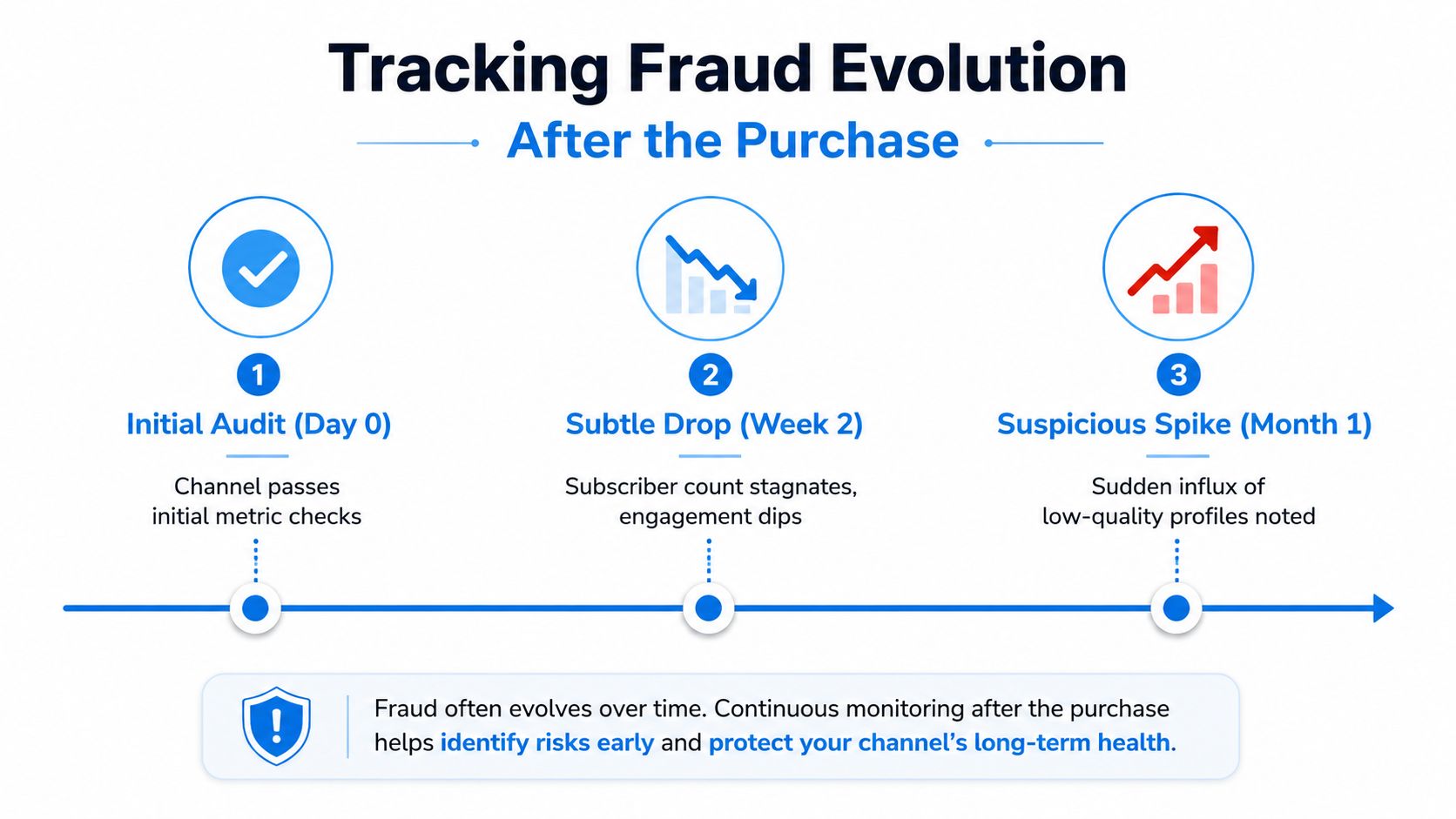
A clean pre-purchase snapshot is evidence for one moment, not a guarantee about the audience you reach on launch day. Re-audit before the post goes live, especially after an unexplained spike or a recent purge.
Your Pre-Deal Audit Checklist
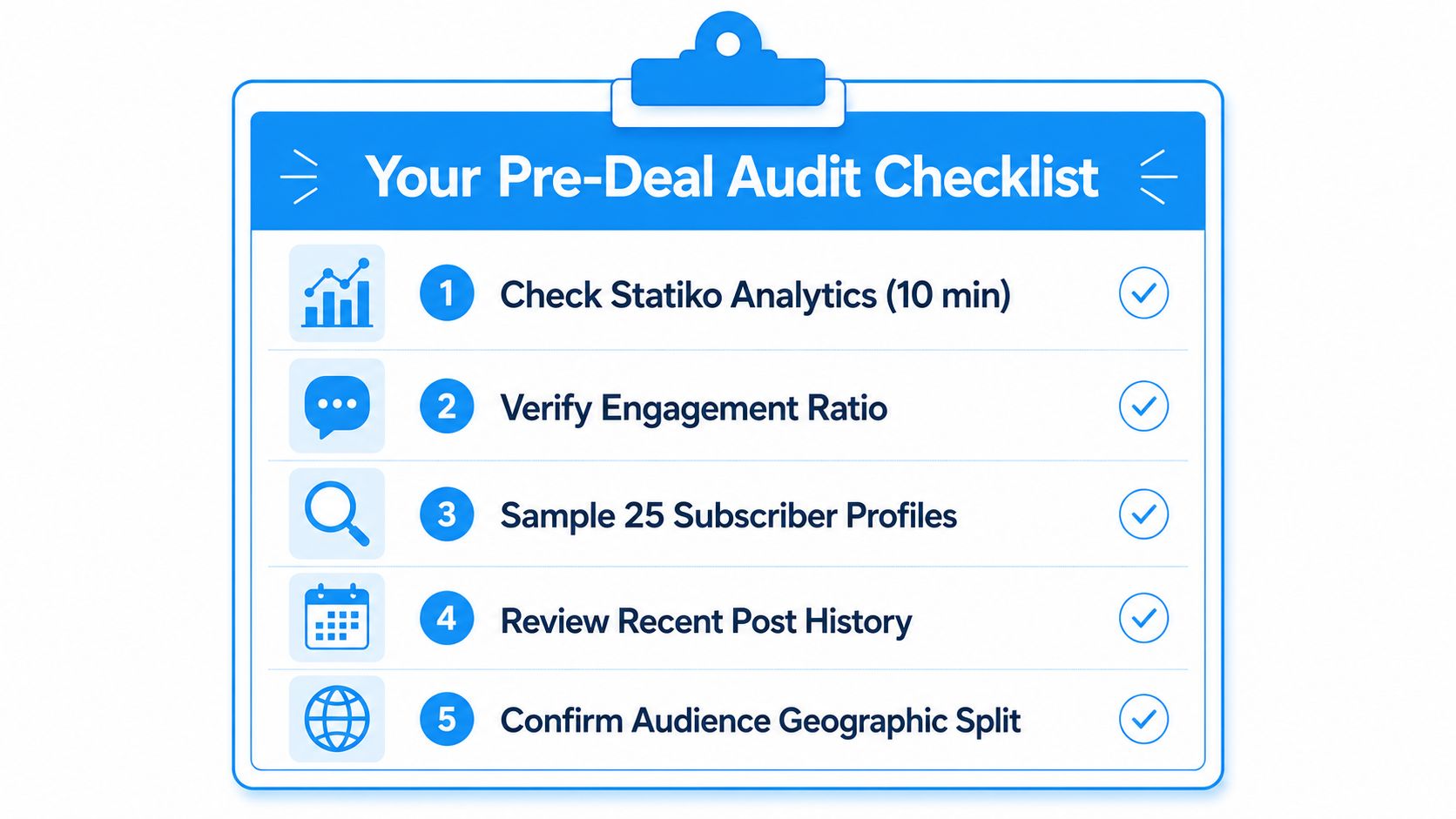
Run this before approving a placement, sponsorship, or channel acquisition, alongside the wider Telegram channel audit checklist. Keep the results in writing, with the date and the channel URL, so you have a baseline if the owner changes the audience later.
- Open the public analytics page. Review the longest growth history available and mark unexplained spikes, drains, and refill cycles.
- Calculate the recent ratio. Average views across the last 10 posts, divided by the subscriber count. Below about 2% is a serious warning on a large channel; read anything above 5% alongside engagement and history.
- Read the post history. Compare views, reactions, forwards, posting cadence, edits, and deletions, and look for engagement collapse after a joining wave.
- Sample profiles. Inspect roughly 50–100 random subscribers where access allows, spread across the member range. Record blank profiles, missing bios, suspicious username patterns, and timing clusters.
- Benchmark peers. Compare the target against channels with a similar topic, geography, and audience. A niche specialist won't match a mass-market news channel, and that gap isn't fraud.
- Review the channel recap. Use the AI summary to locate top posts, anomalies, and notable changes across the period.
- Set a monitoring date. Re-audit within 30 days on deals large enough to justify ongoing oversight.
- Walk away under clear conditions. Reject the deal when the ratio stays below about 2% on a large channel, a growth spike has no matching engagement lift, or the owner can't explain a major subscriber loss.
Purges have removed millions of subscribers in single events, so a channel that looks acceptable today can change sharply tomorrow. Make monitoring part of the buying process, not an emergency response after your campaign underperforms.
FAQ
How do I check a Telegram channel for fake subscribers without admin access? Everything you need is public: recent post views, subscriber history, reactions, and forwards. Open the channel on Statiko, run the last-10-post ratio, and read the growth chart across the longest range available.
What is a normal views-to-subscribers ratio on Telegram? On a large channel, below about 2% is a warning and above about 5% is more consistent with real reach. Small and niche channels often run higher, so compare a channel against its own history and against peers in the same topic and language before judging it.
Can a channel have real subscribers but fake views? Yes. View bots inflate post views without touching the member count, which makes the ratio look healthy. Cross-check reactions, forwards, and comment activity, since inflated views rarely bring matching engagement.
Does a sudden subscriber drop mean the channel bought subscribers? Not on its own. Telegram purges accounts, and real audiences churn after a topic change or a posting break. It becomes evidence when the drop follows an unexplained spike, or when the rise-and-drain pattern repeats.
How many subscriber profiles should I sample? Roughly 50–100, spread across the member range rather than taken from the newest arrivals. Log profile completeness, username structure, account timing, and activity signals, then treat the result as confirmation of the chart evidence rather than a verdict on its own.
How often should I re-audit a channel I already bought from? Right before each placement goes live, and within 30 days on deals large enough to justify the oversight. Audience quality changes between the audit and the campaign.
Statiko gives you public Telegram growth history, post-level performance, and edit and deletion tracking in one place, so you can test an ad seller's audience instead of trusting a screenshot. Visit Statiko before you approve your next placement, record the channel baseline, and recheck it when the campaign date arrives.
Related posts

Considering to buy Telegram channel subscribers? This guide unpacks the risks, data, and sustainable alternatives for real channel growth in 2026.

Unlock growth with our guide to Telegram channel analytics. Learn to track key metrics, analyze competitors, and make data-driven decisions for your channel.

Need a Telegram channel history viewer? Explore top tools to see deleted messages, track edits, and analyze public channel archives for research and audits.
Start in seconds.
Create a free account to organise channels, track activity, and get recaps delivered to you.
Real-time. Telegram. Analytics.