How to Verify a Deleted Telegram Post Existed
Learn how to verify a deleted Telegram post existed with proven methods. Discover effective techniques for message recovery and history tracking.

The popular advice is wrong: you usually can't recover a deleted Telegram post by looking again, refreshing the app, or asking Telegram to bring it back. If you need to verify a deleted Telegram post existed, the question isn't "where did it go?" but "what evidence survived outside the channel?" Once a public post is removed, the native channel record is typically gone, and Telegram's own security and recovery limits leave you with external traces, if any exist at all.
People also blur the line between recovery and verification. Recovering your own chat history through exports or device artifacts is one problem. Proving that a public channel post once existed is another, and it's harder, because you need an external trace that predates deletion. If no pre-existing record exists, there may be nothing defensible to prove.
Practical rule: if the only evidence is the empty channel itself, you don't have proof. You have an absence.
Why Most Deleted Telegram Posts Cannot Be Recovered
Telegram doesn't offer an official restore feature, so the default assumption has to be conservative. Once a post in a public channel is deleted for everyone, Telegram won't give you a clean native recovery path. Checking the channel again is a dead end — the post isn't there, and the platform isn't going to reconstruct it for you.
The evidence threshold is higher than people expect. To verify a deleted post existed you need something that captured it before it vanished — an export, a notification, a cache, a forward, an archived snapshot. That makes this a forensics problem, not a chat recovery problem.
Public channels are a different problem
Private chats and public channels behave differently. If you're recovering your own local chat data, exports and device-level artifacts can help. With a public channel, the native source of truth has usually been erased, and you need a separate record that already existed before deletion.
Telegram Desktop export is one of the few durable ways to preserve a history before it disappears. Once a chat archive exists, it can substantiate that a message or post was present at a specific time. For public-channel work, the better question is whether a trace exists anywhere else, not whether Telegram still shows it.
What not to waste time on
Asking the admin might get you an answer, but it doesn't produce independent verification. Refreshing the app won't either. If your evidence has to stand up in research, journalism, or internal review, it needs to outlive the deletion event. Otherwise all you have is a claim.
Stop asking how to pull the post back out of Telegram. Start asking what was captured before deletion.
Reactive Traces You Can Check After Deletion
When a post is already gone, you're left with whatever traces survived outside the original channel. Some are fragile, some accidental, none guaranteed. Check them fast — every hour raises the chance that caches get overwritten, notifications get cleared, or the only forward copy gets buried in another chat.
Start with cached previews and forwarded copies
Cached previews are the fastest place to look because they're local. Telegram clients and device caches can hold media or text fragments temporarily, so a post may leave a trace after the channel entry disappears. These traces are opportunistic, not durable, and they vanish as soon as the cache is overwritten.
Forwarded copies are better when they exist, because they sit in another chat or in saved messages. They only help if someone forwarded or saved the post before deletion. If nobody did, there's nothing to inspect.
If you find a forwarded copy, treat it as corroboration, not the whole case. It proves someone preserved the content, not that the live channel still contains it.
Check Android notification history carefully
Android notification history can be useful if the notification arrived before deletion. It may preserve content fragments that were visible when the alert fired, giving you a time-stamped trace outside the channel. That only works if the device had notification history enabled and the message text was exposed in the notification.
Don't overread it. A notification fragment corroborates existence, but it rarely preserves the full post, media, or context. If notifications were disabled, dismissed, or never delivered, this avenue goes nowhere.
Use archive sites as corroboration, not certainty
Archive sites and third-party indexes can confirm that a post once existed if they captured it before deletion. They're incomplete by design, because they only preserve what they crawled or were sent. If the channel was deleted before the crawler's snapshot, there may be no archive record at all. Treat any hit as partial evidence: the archive tells you what was seen, not everything that was posted.
What a good reactive check looks like
A decent after-the-fact review should cover all of these:
- Cached previews: look on the device that received the post first.
- Forwarded copies: search chats, saved messages, and group mirrors.
- Notification history: inspect Android logs if notifications were on.
- Archive sites: look for a snapshot that predates deletion.
Reactive traces can confirm that a post existed, but they're fragile and incomplete. Finding nothing doesn't prove the post never existed — it means the surviving evidence is gone.
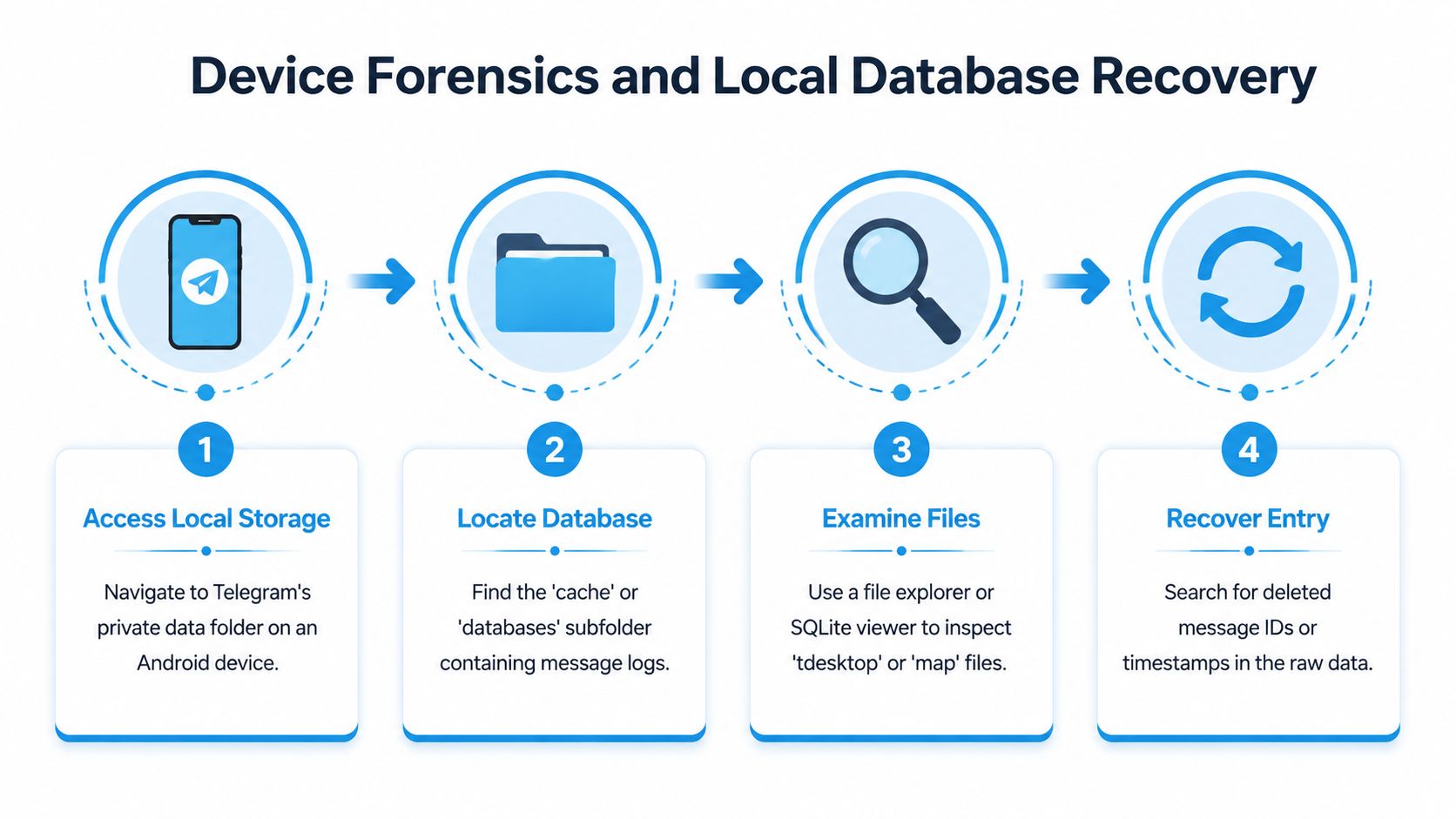
Device Forensics and Local Database Recovery
If the post matters enough, the device itself is the next layer. Deletion doesn't always wipe every local trace at once. On Android, remnants may survive in local storage, caches, and database files until they're overwritten or reused.
Work from the local database, not the live app
A defensible approach starts with the device's SQLite artifacts. Telegram for Android stores message data in databases such as cache4.db, and recovery may be possible if the relevant pages are still intact or if remnants remain in the Write-Ahead Log. You're looking for proof that a message record existed, even if the full text is no longer visible.
The workflow is straightforward. Isolate the device so it doesn't sync or overwrite more data, copy the database and WAL files, then inspect them with a SQLite parser or forensic suite. The most useful result is often metadata: a message record, a deletion timestamp, or residual row structure showing the item existed before removal. If the local database is fragmented or partially damaged, careful acquisition matters more than aggressive analysis.
The timing window is narrower than expected
This is the part investigators underestimate. Once Telegram or the operating system reuses those database pages, recovery odds drop sharply. Cloud-deleted content is even less forgiving: if the content was removed from Telegram's servers, device forensics can't restore what no longer exists anywhere authoritative.
Use exports when you still can
Telegram Desktop export is the cleanest preventive move when you know you'll need a record later. It creates a durable archive before deletion, which can then substantiate that a post existed at a specific time. Export won't save you retroactively, though — the archive has to exist before the deletion event.
Export Telegram chats before they disappear is the safer habit when you're documenting channels for research or reporting.
Continuous Monitoring as the Only Reliable Verification Method
Reactive checks all hit the same wall: they depend on traces that may already be gone, or that never existed in a useful form. Continuous monitoring avoids the trap because it starts before deletion and keeps a record as the channel changes. For public channels, that's the only approach that consistently produces a defensible timeline.

Why timelines beat after-the-fact guessing
A deleted post's timeline can only be reconstructed reliably if monitoring began before the deletion. Statiko's channel timeline is built for that. It tracks every post, edit, and deletion in public channels, so you can see what changed and when it disappeared. A preserved timeline turns a claim into a record.
Anyone can add a public channel through Statiko's public channel search, without ownership or login. A channel page like the Durov channel overview shows the historical view you get once a channel is tracked over time. The value goes beyond the current post: you can inspect the sequence of versions that led up to deletion.
What Statiko preserves in practice
Continuity is the part that matters. If a post gets edited and later deleted, the monitoring record shows both the modified version and the disappearance. Reactive methods rarely give you that chain of events. They surface fragments, and fragments aren't a timeline you can defend.
Statiko also surfaces channel recaps that highlight anomalies like deletion spikes, which helps when you're watching several public channels and need to spot unusual behavior quickly. The point isn't to replace judgment. It's to keep a structured record you can trust when the original post is gone.
Bottom line: if you weren't tracking before deletion, you're mostly guessing afterward.
Public channels only — Statiko respects Telegram's privacy boundaries, so this is monitoring where independent observation is legitimate, not a way into private chats, groups, or DMs. If a post matters enough to prove later, it matters enough to track before it disappears. How Telegram channel timelines help with deleted-post verification explains the monitoring logic in more detail.
Comparing Verification Methods by Reliability and Effort
Compare what each method gives you against the effort it demands. Some traces are quick to check but weak. Others are technically stronger but time-sensitive. Only continuous monitoring works consistently, because it doesn't depend on luck after the fact.
| Verification Methods Compared | Reliability | Effort | Works After Deletion |
|---|---|---|---|
| Cached previews | Low to moderate, because they're temporary and easily overwritten | Low, a quick device check | Sometimes |
| Forwarded copies | Moderate if someone saved or forwarded the post | Low to moderate, depends on search scope | Yes, if a copy exists |
| Android notification history | Moderate when enabled and delivered before deletion | Low, but device-specific | Sometimes |
| Archive sites | Moderate as corroboration, incomplete by design | Low to moderate, search varies | Sometimes |
| Device forensics | High when artifacts survive, but time-sensitive | High, requires acquisition and parsing | Sometimes |
| Desktop exports | High if created before deletion | Moderate, depends on preparation | Yes, if exported first |
| Continuous monitoring | Highest for proving existence and timing | Moderate to high, but ongoing | Yes, because it starts before deletion |
How to read the table
Cached previews and notification history are fast checks, not guaranteed proof. Forwarded copies are stronger when they exist, because they place the content outside the original channel. Archive sites corroborate existence, but they're only as complete as their crawl coverage.
Device forensics sits in a different tier. It can produce stronger evidence than a screenshot if the local database is intact, but it demands careful handling and the timing window is narrow. Desktop exports are excellent when you had the foresight to save them.
Continuous monitoring is the only method that avoids the "maybe it survived" problem. With a timeline already running, you don't need to hope a cache still exists.
Which method fits which job
A journalist usually needs the fastest corroboration available, so cached traces, forwards, and archives are the first pass. A marketer watching competitor channels benefits from continuous monitoring, because deletions and edits are part of the signal. A researcher building a dataset should think in exports plus monitoring, since longitudinal records matter more than one-off recovery attempts.
Reactive methods answer whether evidence survived. Monitoring answers whether evidence was ever lost to begin with.
Building a Practical Verification Workflow
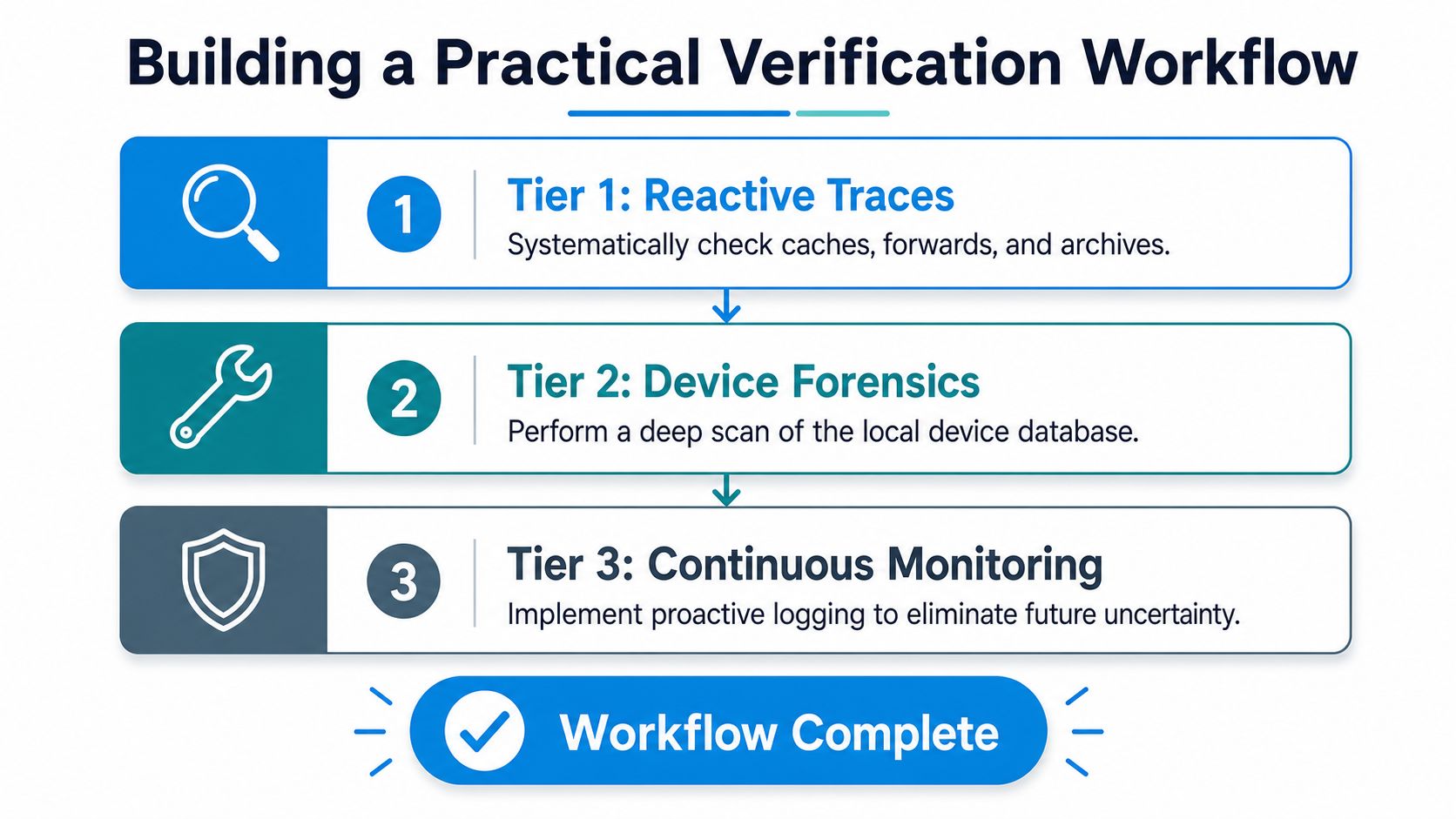
A workable process has three tiers, in a specific order. Start with reactive traces while they're still available: cached previews, forwarded copies, notification history, archive hits. If the post matters enough and the device is still available, move into forensic acquisition before the local database pages are reused. Then set up continuous monitoring for any public channel where future deletions would affect your work.
A clean decision path
If you discover a deletion within hours, start with the easiest evidence: cached previews, forwarded copies, Android notification entries, archive hits. If one produces a reliable timestamp or a surviving copy, you may already have enough to show the post existed.
If that fails and the device is still in play, escalate to local database recovery. Pull the database and WAL files, preserve the device state, and inspect the SQLite artifacts before anything gets overwritten. When you missed the monitoring window and the post is mission-critical, that's your last workable option.
Rule of thumb: if the post's existence might matter later, don't treat monitoring as optional.
Build the habit before you need the proof
The most useful workflow is pre-emptive. Track public channels that matter to your work, save exports when you need offline records, and use a platform that keeps a channel timeline so deletions don't erase the evidence entirely. Treat recovery tools as the backup, not the plan.
Frequently Asked Questions
Can Telegram restore a deleted post for me? No. Telegram has no restore feature for deleted channel posts, and support won't reconstruct removed content on request. Anything you recover comes from outside the live channel.
Does a screenshot count as proof a post existed? Weakly. A screenshot is trivial to fabricate and carries no verifiable timestamp, so on its own it rarely satisfies a serious review. It's useful as corroboration next to an archive snapshot, an export, or a monitored timeline.
How long do deleted messages stay recoverable on an Android device?
There's no fixed window. Remnants in cache4.db and the WAL survive until those pages are reused, which can take hours or weeks depending on how heavily the device is used. Acquire the data as early as you can.
Can I verify a post from a channel I never followed? Only if something external captured it — an archive snapshot, a forward, or a monitoring service that was already tracking the channel. Monitoring records start when tracking starts, so nothing captures a channel retroactively.
Is it legal to archive public Telegram channels? Archiving publicly accessible content is generally treated as collecting public information. The boundary is public versus private: public channels are one thing, private groups and DMs are another.
What's the difference between recovering a post and verifying it existed? Recovery returns the content itself. Verification establishes that the post was published at a specific time, which can rest on metadata alone — a deletion timestamp or a monitoring record can prove existence without recovering the full text.
For public Telegram work, use continuous monitoring as the default. Statiko gives you the public-channel timeline and deletion history you need, while keeping the scope limited to public content. That's the right boundary for this kind of verification.
Related posts

There is no Telegram Wayback Machine, but Statiko tracks every post, edit, and deletion on public channels — the full history web archives miss.

Export telegram chat - Learn to export Telegram chat from desktop & mobile seamlessly. This guide covers JSON/HTML formats, public channel tools, and transformi

Learn how to see deleted posts from a Telegram channel using caches, archives, admin logs, and continuous tracking tools like Statiko.
Start in seconds.
Create a free account to organise channels, track activity, and get recaps delivered to you.
Real-time. Telegram. Analytics.