How Much Is a Telegram Channel Worth? A 2026 Guide
Learn how much is a telegram channel worth in 2026. We break down CPM models, revenue multiples, red flags, and how Statiko verifies every claim before you buy.

A Telegram channel with 100K subscribers can be worth $1,000 or $40,000, depending on its real engagement, average post views, and niche CPM. Channels in the 10K to 50K range often generate $100 to $500 per month, while 200K to 1M channels average $2,000 to $10,000 monthly.
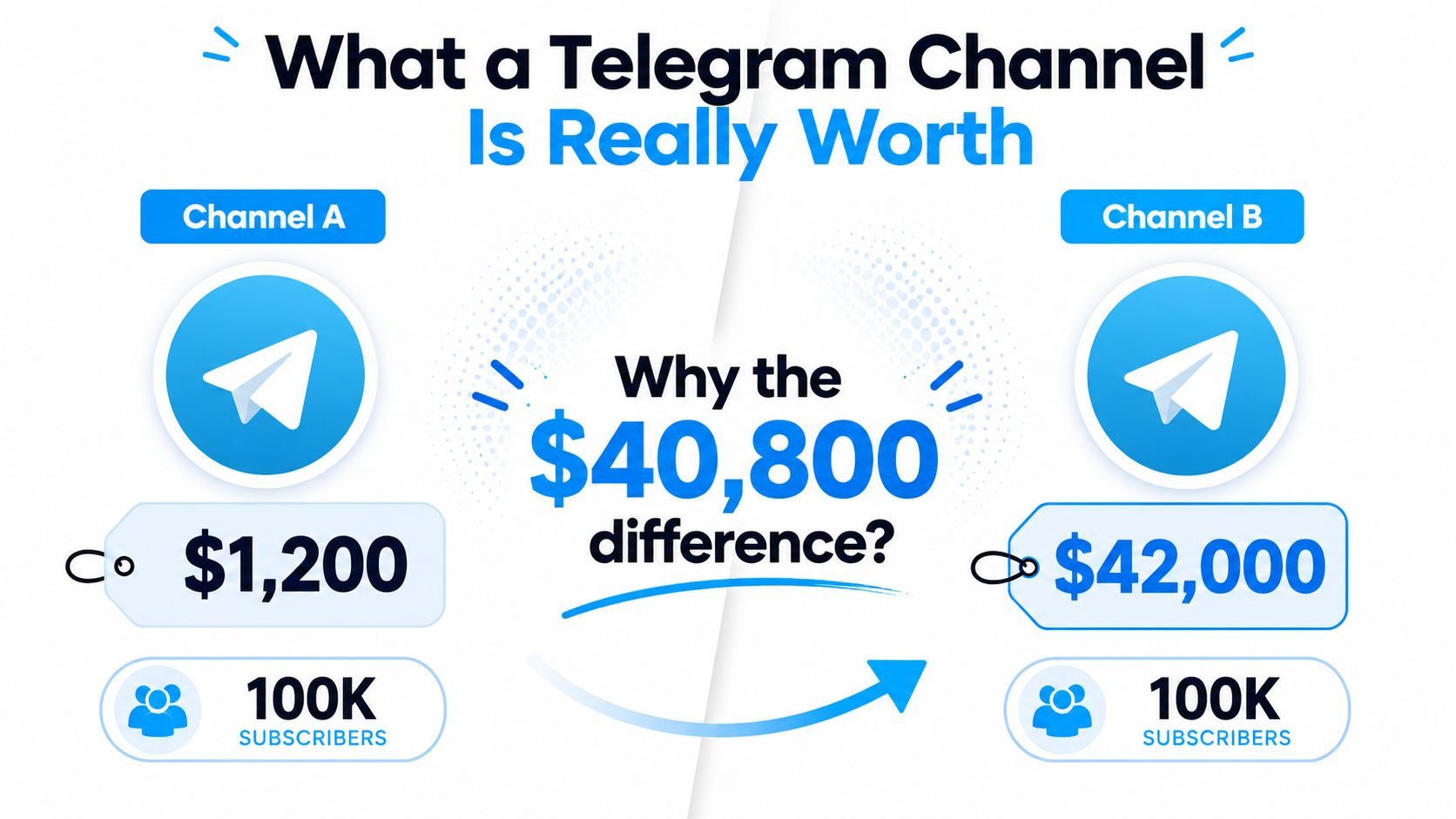
You're looking at two listings that read almost identically on paper. Both show a large subscriber badge, both claim an active audience, both promise monetization potential. One seller wants $1,200 and the other $42,000. The difference is rarely the subscriber count. It's how many people see each post, what advertisers pay to reach them, and whether the seller can prove the revenue.
That's the whole answer to how much a Telegram channel is worth: price it from documented attention and earnings, then use subscribers as context.
What a Telegram Channel Is Really Worth
Two 100K-subscriber channels, one listed at $1,200 and one at $42,000. "Which has more followers?" is the wrong question — they're identical on that count. The question is why one channel produces valuable attention and the other doesn't.
Start with two numbers: average post views and niche CPM. Views show the audience an advertiser can realistically reach. CPM shows what that reach is worth. A finance channel doing 35K views per post at an $8 CPM has a completely different commercial profile from a memes channel doing 60K views at $1.50. The memes channel reaches more people; the finance channel attracts advertisers who pay more for them.
The starting formula:
Estimated post value = average post views × niche CPM ÷ 1,000
That isn't a full sale price, but it's the right anchor. Subscriber count describes the potential pool. Views and CPM tell you whether the pool is alive and commercially useful.
Telegram's native monetization makes this more concrete. Since March 2024, owners can see revenue statistics under Channel Settings > Statistics > Monetization, with ad-revenue withdrawal documented in Telegram's channel monetization announcement. Buyers can increasingly evaluate cash flow directly rather than working from subscribers and seller promises. When a seller leads with subscribers and dodges average views and revenue records, the asking price is built on vanity metrics.
The Metrics That Actually Move the Price
A valuation separates four inputs: audience size, actual reach, engagement quality, and documented revenue. Each moves the price differently.
Subscribers establish scale, not price. Treat the count as a ceiling, then discount it when views, reactions, forwards, or growth patterns point to inactive or artificial members. A big audience with weak reach is worth less than a smaller responsive one.
Average post views are usually the strongest revenue indicator. Take the average from a consistent sample of recent posts rather than the one viral hit the seller wants to show you. View rate — average views divided by members — is the most useful Telegram-specific metric, because advertisers pay for attention and not for dormant memberships. The Telegram channel analytics guide covers how to organize that review.
Engagement adds a layer. Read reactions and forwards per post, not only views. An ER below 1% suggests dead subscribers; ER above 8% can support premium pricing when the interaction is genuine and consistent. Both are signals rather than verdicts, since news, private-interest, and entertainment channels interact in very different ways. The Telegram engagement rate formula sets out how to calculate and compare it.
Niche and geography set CPM. Official Telegram Ads bids on CPM with a floor around 0.1 TON per 1,000 impressions. Direct sponsorship benchmarks run roughly $10 to $12 in Tier-1 geographies and $15 to $20 or more in business and finance, while emerging markets go much lower. TGMetrics' advertising benchmarks give useful market context for that spread.
| Metric | What It Measures | Price Impact | Source of Truth |
|---|---|---|---|
| Subscribers | Headline audience size | Sets scale, discounted when inactive or artificial | Channel history and independent analytics |
| Average post views | Reach per publication | Usually the strongest ad-revenue signal | Recent post sample |
| Engagement rate | Reactions and forwards relative to audience | Supports or weakens the quality premium | Post-level interactions |
| Niche CPM | Advertiser value per thousand impressions | Moves pricing sharply across categories and geographies | Comparable sponsorships and market benchmarks |
| Revenue history | Actual monetization | Supports an earnings multiple when documented | Invoices, payout records, affiliate dashboards |
Revenue is the input a seller can least easily dispute once the records are complete. Ask for sponsored-post logs, paid-subscription records, affiliate dashboards, and payout evidence, plus Telegram's native monetization statistics where the channel qualifies.
Three Valuation Models Side by Side
Run more than one model before making an offer. Each answers a different question, and the valuation gets credible when the outputs land in the same range.
The CPM model suits an ad-driven channel with stable reach. Estimate monthly impressions, multiply by a defensible niche CPM, divide by 1,000, then apply a risk-adjusted earnings multiple. It works best when the channel sells recurring placements and recent views hold steady.
The revenue-multiple model is better when the seller can prove earnings. Take documented monthly revenue from subscriptions, ad sales, and affiliate income, then apply a multiple between 12x and 36x. The low end fits unstable, owner-dependent, or thinly documented income; the high end demands transferability, recurring revenue, clean audience quality, and reliable records.
The price-per-active-subscriber model is a sanity check and nothing more. $0.05 to $0.40 per active subscriber, calibrated by niche, engagement, and churn — never a substitute for revenue evidence or view analysis.
| Model | Formula | Best For | Weakness |
|---|---|---|---|
| CPM | Monthly views × niche CPM ÷ 1,000 × multiplier | Ad-led channels with steady reach | Sensitive to view volatility and advertiser demand |
| Revenue multiple | Verified monthly earnings × 12x to 36x | Channels with invoices and payout records | Fails when earnings are incomplete or inflated |
| Price per active subscriber | Active subscribers × $0.05 to $0.40 | Fast sanity checks with limited revenue data | Ignores monetization quality and transfer risk |
When two models disagree by more than 20%, don't average them and call the result precise. Find the disagreement — it usually traces to inflated views, an unrealistic CPM, incomplete revenue, or a subscriber count padded with inactive members.
For the revenue side, the Telegram channel monetization guide connects audience activity to the streams a buyer can actually underwrite.
Worked Examples From Sub Count to Sale Price
The math clears up once you separate audience size, inventory, and earnings. These are illustrations, not market guarantees.
Channel A, crypto signals
50,000 subscribers, 12,000 views per post, sponsored placements at a $25 CPM, and $120 per affiliate conversion.
Assume the operator publishes enough sponsored inventory for a monthly base of 120,000 impressions:
120,000 ÷ 1,000 × $25 = $3,000 monthly sponsor revenue
The affiliate record shows 10 conversions that month:
10 × $120 = $1,200 monthly affiliate revenue
Documented monthly earnings: $4,200. At an 18x multiple, that's $75,600.
The buyer still has to check whether the sponsored inventory is repeatable, whether affiliate income transfers with the channel, and whether the 12,000 average views hold.
Channel B, lifestyle
120,000 subscribers, only 8,000 views per post, a $6 CPM, and weak affiliate monetization. On the same 120,000 monthly impressions:
120,000 ÷ 1,000 × $6 = $720 monthly sponsor revenue
With negligible affiliate income and nothing to support an earnings multiple, the value anchors to the lower ad yield and the colder audience. The larger subscriber count doesn't rescue it.
| Metric | Channel A, Crypto Signals, 50K subs | Channel B, Lifestyle, 120K subs |
|---|---|---|
| Subscribers | 50,000 | 120,000 |
| Average views per post | 12,000 | 8,000 |
| CPM | $25 | $6 |
| Monthly sponsor impressions used | 120,000 | 120,000 |
| Monthly sponsor revenue | $3,000 | $720 |
| Affiliate revenue | $1,200 | Weak and undocumented |
| Documented monthly earnings | $4,200 | Lower and less certain |
| Reference multiple | 18x | Earnings data too weak for the same confidence |
Channel A commands more value per subscriber because it generates more monetizable attention and documented income. Channel B wins the badge and loses the sale, because buyers pay for active commercial reach rather than unused capacity.
Red Flags Buyers Miss Without Edit History
A seller can make a weak channel look healthy without touching the subscriber count: buy bot subscribers, show only the strongest post, delete low-engagement content before screenshotting, or present an old viral post as current reach.
Revenue dashboards deserve the same suspicion. A screenshot can omit dates, hide refunds, exclude failed campaigns, or show gross income instead of transferable profit. Ask for raw records and check them against the publishing history.
Edit and deletion records matter here because Telegram content changes after publication. An edited post may no longer be the version that earned its visible metrics, and deleted weak posts make a curated sample look stronger than the real record.
A continuous history covering 90 days or more gives you a basis for checking consistency. It shows whether the seller removes weak posts, rewrites copy after publication, or preserves only the viral material. It can't prove every subscriber is genuine, but it makes selective storytelling much harder. A clean screenshot is marketing material; a preserved post history is evidence.
Read the Telegram edit history guide before you accept screenshots as proof. Treat one edited post as a reason to look closer, not as fraud. The question is whether edits and deletions cluster around weak performance, or change the story the listing tells.
Running Due Diligence in Statiko
Use a repeatable sequence instead of browsing. The Statiko catalog search finds a public channel by handle or name, and Statiko tracks every post, edit, and deletion in public channels, so you can hold the seller's claims against an independent record.
- Find the channel. Paste the public handle into the catalog search and confirm the profile, identity, and subscriber history over time. Not a forwarded listing, not a cropped screenshot.
- Open the post history. Look for continuous content across 90 days or more. Gaps mean inactivity, deletion, or selective preservation.
- Calculate view rate. Compare average post views against subscribers. A high count with weak reach gets discounted until the seller explains the audience.
- Scan revisions and deletions. Look for clusters around sponsored posts, viral claims, or the periods the revenue narrative depends on. A pattern matters; one edit doesn't.
- Challenge the CPM. Hold the requested sponsorship rate against niche and geography benchmarks. Finance, business, and tech audiences command more, but the channel still needs the reach to justify it.
- Export the evidence. Build a report for co-buyers, advisers, or escrow: channel identity, view history, engagement observations, monetization records, anomalies.

Statiko covers public channels only. Private channels, groups, and direct messages stay out of reach, so private revenue claims still need seller records verified through payment platforms or contracts.
Closing the Deal Without Overpaying
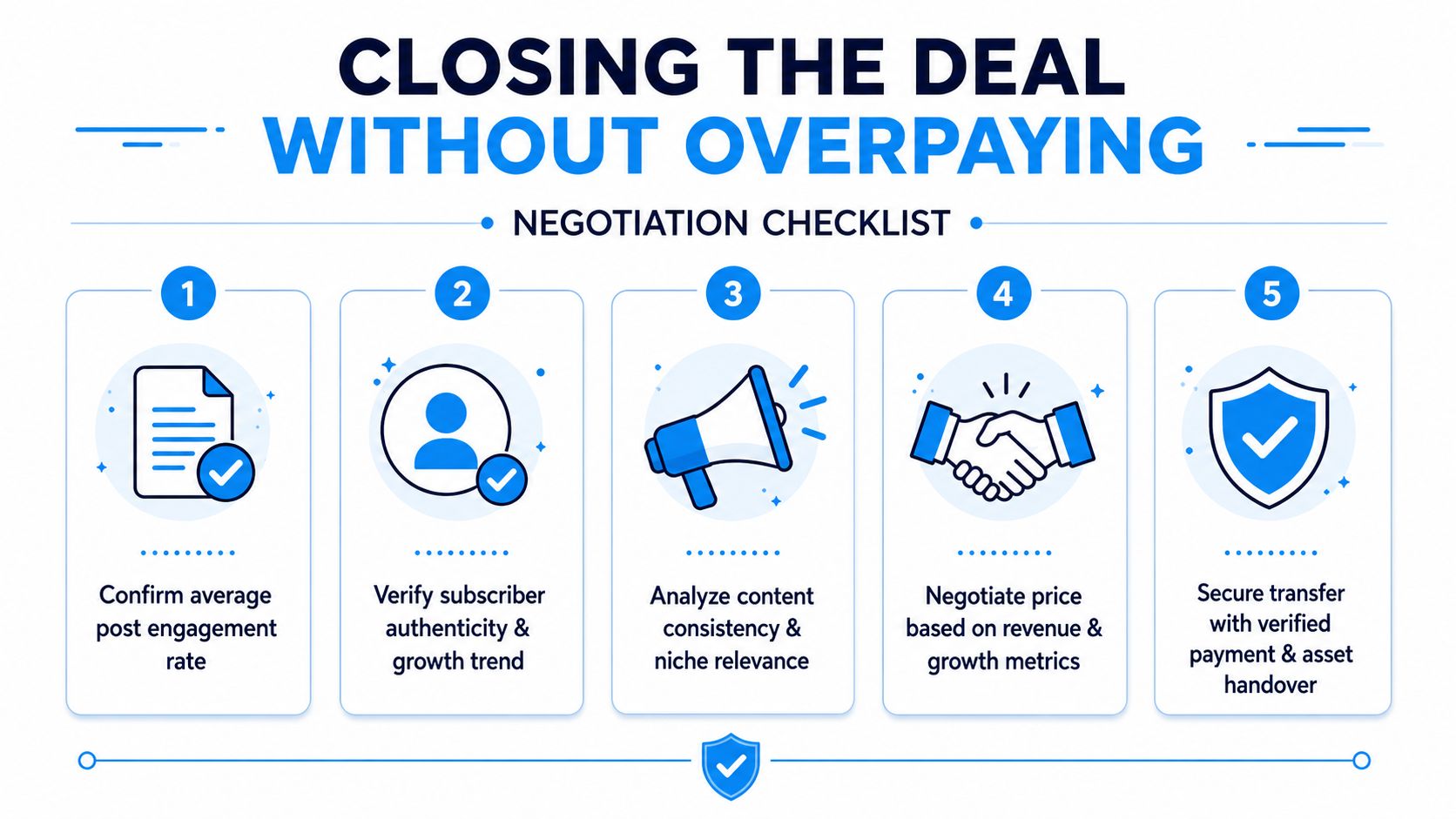
Build the final offer from evidence rather than urgency. Before transferring funds, confirm average post views, a realistic niche CPM, documented 90-day revenue, subscriber quality, and the edit and deletion history.
- Verify the audience. Current subscribers, view rate, engagement, and growth patterns, in independent analytics.
- Request raw payout proof. Invoices, payment records, affiliate dashboards, and Telegram monetization statistics where applicable.
- Set a walk-away price. Use the CPM or revenue-multiple model, then check it against the active-subscriber figure.
- Discount uncertainty. Cut the offer when revenue is owner-dependent, views swing sharply, or the audience geography doesn't match the seller's CPM.
- Protect the transfer. Use escrow with a 7 to 14 day post-transfer verification window to confirm access, ownership, content continuity, and monetization records.
A seller who refuses independent verification has told you something useful. Don't pay for claimed potential when nobody will document current attention and earnings. Sellers with clean records, stable reach, and transferable revenue can defend higher multiples precisely because they removed your uncertainty.
The asset is provable attention that produces repeatable income. Subscriber badges help buyers find scale; average views, niche CPM, revenue history, and the edit record decide whether the channel earns a premium.
FAQ
How much is a Telegram channel with 10,000 subscribers worth? Somewhere between a few hundred and several thousand dollars, depending on average views, niche CPM, and documented revenue. A 10K channel earning $300 a month with proof behind it prices on that earnings multiple, not on the subscriber count.
What multiple do Telegram channels sell for? Typically 12x to 36x monthly revenue. The low end covers owner-dependent or poorly documented income; the high end needs recurring revenue, clean audience quality, transferable monetization, and complete records.
How do I check whether a seller's numbers are real? Compare their screenshots against an independent record of the channel's posts, views, edits, and deletions over at least 90 days. Deleted weak posts and edited captions are the two easiest ways to make a curated sample look better than the channel.
What's a normal CPM for a Telegram channel? Around $10 to $12 in Tier-1 geographies, $15 to $20 or more in business and finance, and considerably less in emerging markets. Official Telegram Ads bids from a floor near 0.1 TON per 1,000 impressions.
Can I buy a Telegram channel safely? Use escrow and negotiate a 7 to 14 day post-transfer verification window, so you can confirm ownership, access, content continuity, and monetization before the funds release. Verify audience quality before you agree on a price, not after.
Does a high subscriber count justify a high price? Only when views back it up. A 120K-subscriber channel doing 8,000 views per post is worth less than a 50K channel doing 12,000 at a higher CPM. Advertisers buy attention, so that's what you're really purchasing.
Use Statiko to search public Telegram channels, review post-level performance, and inspect edit and deletion history before you make an offer. Build the evidence report from verified views, engagement, growth, and channel activity, then price the asset on documented earning power rather than the subscriber badge.
Related posts

A practical guide to Telegram channel monetization in 2026 — covering sponsored posts, affiliate marketing, paid subscriptions, pricing, and analytics.

Run a complete Telegram channel audit before paying for ads or sponsorships. Subscriber history, ER, deletion patterns, and audience geography explained.

Learn how to check Telegram channel for fake subscribers with view ratios, growth analysis, and Statiko tools for due diligence.
Start in seconds.
Create a free account to organise channels, track activity, and get recaps delivered to you.
Real-time. Telegram. Analytics.