How to Find a Telegram Channel: 5 Methods That Work
In-app search only gets you so far. Use usernames, t.me links, directories, and subscriber data to find channels — then vet them before you join.

Finding a Telegram channel can be as simple as typing a keyword into the app's global search bar, looking up a specific username, or clicking a direct t.me link. These are the go-to methods for quickly locating communities, news outlets, or interest groups on the platform.
Search every public channel in one place.
Statiko indexes public Telegram channels — not groups, bots, and contacts mixed into one stream — so every result carries real metrics: subscriber history, posting frequency, edits and deletions. No login needed. Search the catalog.
Every Way to Find a Telegram Channel

Most people stick to the basics when looking for Telegram channels — a quick keyword search, maybe a link someone shared. But Telegram has grown into something much bigger than a chat app. With over 1 billion monthly active users as of 2025 (up from 300 million in 2019) and roughly 2.5 million new users joining daily, the platform hosts massive communities on practically every topic imaginable. The top 50 global channels alone have a combined 102 million subscribers.
The problem? Finding the good stuff isn't always straightforward. Telegram's native search mixes channels with groups, bots, and random users, so you need a few tricks up your sleeve.
This guide walks through every method available — from basic in-app search to analytics-driven discovery — so you can actually find channels worth following.
Quick Guide to Finding Telegram Channels
| Method | Best For | Difficulty |
|---|---|---|
| In-App Search & Usernames | Quick searches for known channels or general topics. | Easy |
t.me Links & Invites |
Directly accessing specific channels you've found elsewhere. | Easy |
| Channel Directories | Browsing curated lists and discovering popular channels by category. | Easy |
| Telegram Bots & Hashtags | Automating searches and finding content on specific topics. | Medium |
| Advanced Discovery (Statiko) | Deep competitive analysis, finding similar channels, and AI-powered insights. | Advanced |
Pick whatever method fits your situation — or combine a few for better results. We'll also cover how to use Statiko for analytics-driven discovery and how to vet channels so you don't waste time on dead or fake communities.
How to Search for Channels Inside Telegram

Telegram's global search bar sits at the top of your chat list and searches across your chats, contacts, and public channels. It works, but the results can be messy — you'll get a mix of groups, users, and channels all thrown together. A few small adjustments make it much more useful.
Refining Your In-App Search
Think about what you’re trying to find before you start typing. Are you looking for a channel with a specific name, or are you just exploring a topic? How you frame your search makes a huge difference.
- Searching by Channel Name: If you have a name in mind, like "Crypto News," typing that in directly will push channels with that exact title to the top. Easy enough.
- Searching by Topic: For broader discovery, use keywords related to the content you want. A search for "sustainable gardening" might bring up channels that don't have those words in their title but discuss the topic constantly.
Don't forget about the "Posts" tab in your search results. This lets you hunt for keywords inside the messages of public channels you've already joined. It's a lifesaver when you remember a specific discussion but can't recall which channel it was in.
Pro Tip: Specificity is your best friend here. Instead of a generic search for "tech," try "AI startups" or "cybersecurity news." The more dialed-in your search term, the better the channels you'll find.
Using Usernames and t.me Links
Sometimes, the best way to find a channel is to skip the search bar altogether. Every public Telegram channel has a unique username, always formatted as @[channelname]. If you know the handle, you can type it straight into the search bar for a perfect match.
For instance, if a tech blog says their Telegram is @FutureTechDaily, popping that into search will take you directly to their channel, no guesswork required.
Even better, many channels promote themselves with direct t.me links on their websites or social media profiles. These links look like https://t.me/channelname. Clicking one opens the channel right inside your Telegram app. It's the simplest and most precise way to join a community you've found out in the wild—the digital equivalent of being handed a direct invitation. For a full workflow covering how to vet a channel once you've found its link, see our Telegram link finder guide.
Best Telegram Channel Directories and Search Sites
When Telegram’s built-in search hits a wall, it's time to look outward. The internet is teeming with third-party channel directories and specialized search engines built to fill the exact gaps left by the native app.
Think of these websites as the Yellow Pages for Telegram. They organize thousands of public channels into clean, searchable categories. Unlike the app's often-unpredictable global search, these platforms usually give you advanced filters for language, country, or specific topics, making your discovery process much more targeted. You could, for instance, hunt for marketing channels in Spanish or find tech news channels based in Germany—a task that's nearly impossible within the app itself.
Of course, not all directories are created equal. The quality can vary wildly, so you need to know what you're looking for. A well-maintained directory will have up-to-date listings and accurate subscriber counts. An abandoned one is just a graveyard of dead links and inactive channels.
How to Spot a Quality Directory
Before you start clicking, take a moment to size up the directory itself. A few quick checks can tell you if a site is a valuable resource or just a waste of time.
- Check for recent additions: A living, breathing directory will proudly show off its newest channels. If the "latest additions" are from six months ago, you're better off moving on.
- Look at the categories: Are they specific and well-organized? Vague, catch-all categories like "Other" or "General" often signal a poorly curated list.
- Read user reviews: Many directories let users rate and comment on channels. This feedback is gold for spotting high-quality communities and steering clear of spammy ones.
One of the biggest wins with these platforms is seeing community feedback at a glance. A channel with hundreds of positive ratings is a much safer bet than one with none. It’s the social proof you need to make a smarter choice before you even click "Join."
Tapping into Niche Communities
Beyond dedicated directories, don't sleep on the power of online communities. Forums like Reddit, Quora, or even specialized Facebook groups can be absolute goldmines for channel recommendations.
Just searching for "best Telegram channels for [your interest]" on a relevant subreddit will often turn up curated lists and passionate suggestions from real people. This is how you find the hidden gems that haven't made it onto the big directory sites yet. For a practical example of this, see our curated list of grupos telegram gay — seven active LGBTQ+ communities with a breakdown of what each one is actually good for. If music is the topic, our breakdown of Telegram channels for music discovery covers editorial feeds, artist channels, and curator accounts worth tracking. For researchers, exploring these community discussions can also provide crucial context, a technique we cover in our guide on using Telegram for OSINT investigations.
Finally, some clever developers have created Telegram bots that scrape these external sites and feed the results directly back into the app. You can message a search bot with your keywords and get a list of relevant channels without ever leaving Telegram, combining the convenience of the app with the power of external indexing.
How to Find Channels by Subscribers and Engagement
Keyword searches and directories work fine for basic discovery, but if you're doing competitive research or trying to map out a niche, you need more than that. Analytics platforms like Statiko let you filter channels by actual data — subscriber growth, engagement rates, language, category — instead of just hoping the right keywords turn up good results.
Once you've built out a watchlist, discovery stops being the hard part. Keeping up with all of them is. Our guide on how to monitor Telegram channels at scale covers the workflow for scaling from a handful of channels to a real monitoring system.
Pinpoint Channels with Advanced Filters
The real value is in stacking filters. Instead of browsing through hundreds of results, you narrow down to exactly what you need:
- By Category: Drill down into hyper-specific niches like "Fintech," "Indie Gaming," or "Sustainable Living."
- By Language: Easily find channels catering to a specific linguistic audience—perfect for international market research.
- By Subscriber Growth: Target channels that are exploding in popularity to spot emerging trends, or focus on stable, established communities.
- By Engagement Rate: Identify channels with genuinely active audiences, filtering out the ones with huge subscriber counts but zero interaction.
This saves a lot of time compared to scrolling through directory listings or guessing keywords in Telegram's search bar.
Uncover Hidden Gems with Similarity Search
One of the most useful features in analytics tools is similarity search. You take a channel you already like, and the platform finds others with overlapping audiences and content. Say you found a good DeFi channel — similarity search will show you its competitors, related communities, and other channels that audience follows.
This is particularly useful for:
- Competitive Analysis: Instantly see who your target channel is competing against for audience attention.
- Market Mapping: Quickly get a complete picture of the key players and influencers within a specific niche.
- Audience Expansion: Find new communities where your ideal audience is already spending their time.
Understanding demographics is a big piece of this puzzle. Over 30% of Telegram users are aged 25-34, with another 22.5% between 18-24. Geographically, 38% are in Asia, 27% in Europe, and 21% in Latin America. Platforms like Statiko empower your search by analyzing public channel metrics within these key demographics, letting you compare strategies in high-value niches across the globe. You can dive deeper into Telegram's audience demographics to really refine your targeting.
Using these advanced tools shifts your entire perspective. You’re no longer just looking for a single channel; you’re analyzing an entire network of interconnected communities. This strategic viewpoint is what separates casual users from professional marketers and researchers. For the directories worth working and the signals that separate a live channel from a padded one, see our guide to hot Telegram groups and channels. For the metrics layer that comes after discovery, see Telegram channel analytics. And if you want the search engines compared side by side — plus the discovery-to-vetting workflow for groups rather than channels — our Telegram group search engine guide covers both.
How to Vet and Verify Channels Before You Join
Finding a channel that looks perfect for your niche is only half the battle. Before you smash that "Join" button, it's smart to do a quick quality check. This ensures you're joining a valuable community, not just a ghost town full of fake subscribers.
The most obvious metric—subscriber count—can be wildly misleading. A channel with 100,000 subscribers sounds impressive, right? But if each post only gets 500 views, something is definitely off. That massive gap between subscribers and actual eyeballs is a huge red flag for an inactive or artificially inflated audience.
Look Beyond the Follower Count
A healthy, active channel has a balanced engagement ratio. You want to see a consistent number of views per post relative to the total subscriber count.
There's no single magic number, but a solid ratio often sits around 10-30% or more, depending on the topic. A channel that consistently falls below that isn't a place where you'll find a genuinely active community.
Another crucial step is to simply scroll through the channel's history. Ask yourself a few key questions:
- Is the content consistent? A quality channel sticks to its theme and posts regularly, not just in random bursts. A channel description that matches the actual content is a good signal the admin is serious about their focus.
- Does it provide real value? Look for insightful posts, original content, or useful links—not just endless reposts from other channels.
- How old is the channel? A channel that's been around for months or years is generally far more reliable than one that popped up last week.
Think of this as a quick audit. A few minutes of it shows you a channel's true purpose and how consistently it delivers.
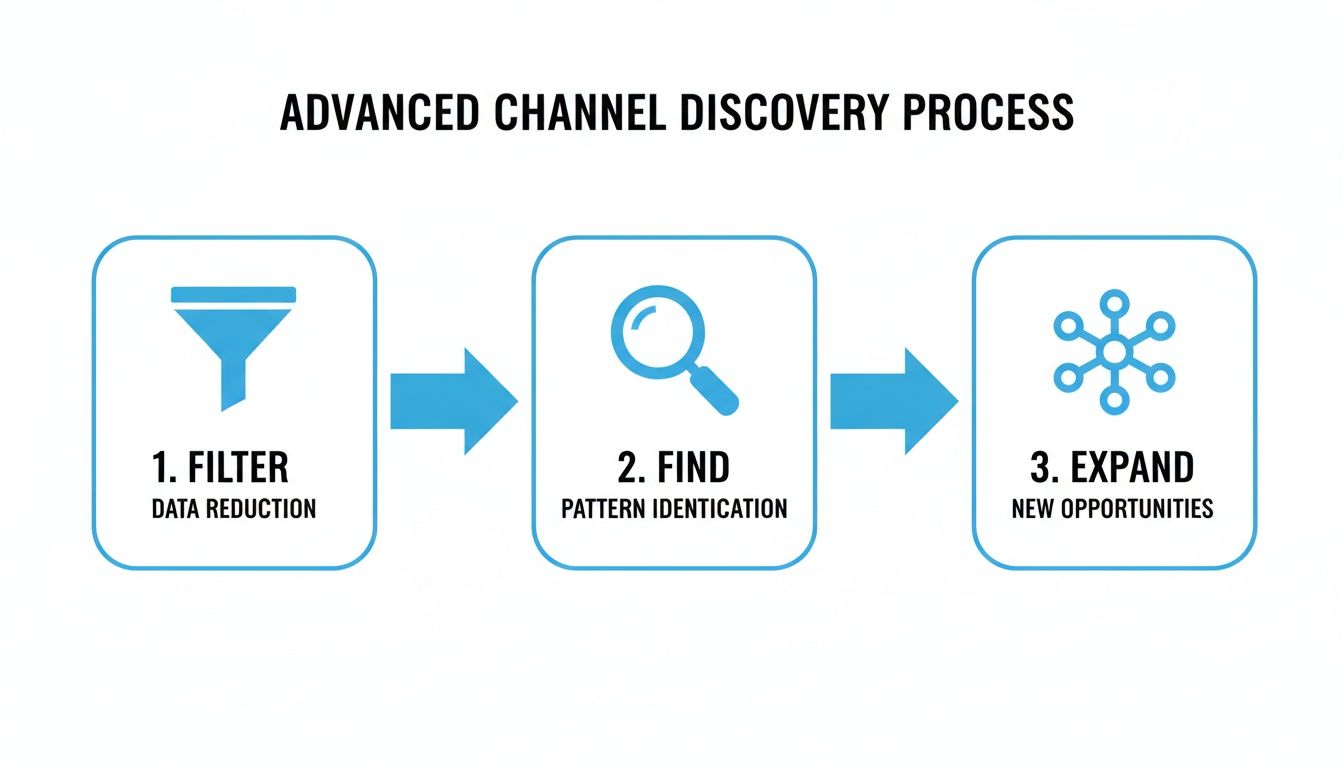
This simple process of filtering, finding, and then expanding your search is key to systematically uncovering high-value communities.
Check for Content Transparency
One of the most powerful ways to verify a channel's credibility is by checking for transparency. Does the administrator constantly edit or delete posts after they've been published?
Occasional edits for typos are perfectly normal, of course. But frequent, significant changes are a bad sign. It often means the channel is trying to alter its message, hide bad predictions, or cover up false information.
Key Insight: A channel that frequently deletes or heavily edits its past content might be trying to manipulate its history. Genuinely trustworthy channels stand by what they post.
With over 1 billion monthly active users, Telegram is a hub for high-engagement channels, but that also means you need to be careful. Tools like Statiko bring critical transparency by monitoring and timestamping every message edit and deletion. This helps you verify a channel's credibility before you commit.
To give you a quick reference, here’s a simple checklist to run through before joining any new channel.
Channel Quality Checklist
| Metric to Check | What to Look For (Good Sign) | Red Flag to Avoid |
|---|---|---|
| Engagement Rate | Views are 10-30% or more of subscriber count. | Massive gap between subscribers and views. |
| Content History | Consistent posting on a clear topic over months/years. | Sporadic posts, reposts only, or a brand new channel. |
| Admin Activity | Original content, interaction, and a clear voice. | Anonymous admins, no original posts, spammy behavior. |
| Post Edits | Occasional small edits for typos. | Frequent, significant edits or deleting old posts. |
| Subscriber Growth | Steady, organic growth over time. | Sudden, massive spikes in followers overnight. |
Making these quick checks a habit will save you from joining low-quality, spammy, or even fraudulent channels. It’s all about making an informed decision so your feed is filled with valuable content from communities you can actually trust.
Telegram Channel Search FAQ
A few things come up often when people try to find Telegram channels. Here are straight answers to the most common questions.
Can I Find Private Telegram Channels?
Let's get this one out of the way: No. You simply cannot search for private Telegram channels using any public method.
This isn't a limitation of the tools; it's a core privacy feature of Telegram itself. Private channels are designed to be exclusive communities, and access is strictly controlled. Whether you're using Telegram's own search bar, a third-party directory, or even a powerful analytics tool like Statiko, these channels are invisible.
The only way in is through a direct invite link, which has to come from a channel admin or an existing member. There are no backdoors or workarounds.
Important Takeaway: Any service or tool that claims it can find or get you into private Telegram channels is almost certainly a scam. Steer clear. Legitimate platforms respect these privacy boundaries and only work with publicly available data.
How Can I Tell If a Channel Has Fake Subscribers?
Spotting fake subscribers is probably the most critical skill you can develop when vetting channels. The biggest red flag is a massive gap between the subscriber count and the actual views per post. If you see a channel with 50,000 subscribers but each post only gets a few hundred views, you're looking at a ghost audience.
Another dead giveaway is weird, unnatural growth. A real channel tends to grow steadily over time. If a channel magically jumps from 1,000 to 20,000 subscribers overnight without some piece of viral content to back it up, you can bet those followers were bought.
Here are a few quick checks you can run yourself:
- Check the Engagement Ratio: A healthy channel will have post views that are a reasonable percentage of its total subscribers. Anything absurdly low is suspicious.
- Scan the Comments: If comments are on, are they real conversations or just a flood of generic phrases like "good post" and "nice"? Bot comments are usually painfully obvious.
- Look at the Growth History: Use an analytics tool to see the channel's subscriber timeline. Sudden, sharp spikes are almost always a sign of purchased followers.
What Is the Best Way to Find Channels in a Specific Language?
Since Telegram's built-in search isn't great at filtering by language, you'll need to get a bit more creative. A multi-step approach usually works best.
First, start with a third-party channel directory that has explicit language filters. These websites are often the fastest way to pull together an initial list of channels for a specific linguistic audience. They do the basic sorting for you.
Next, take the best channels from that list and plug them into an analytics platform with a similarity search feature. Once you find one good German-language tech channel, for example, this feature can instantly point you to dozens of others with similar content and audiences. It's like building a map of that entire niche.
Finally, don't forget the human element. Jump into communities on places like Reddit or Facebook that are dedicated to that language or culture. Simply asking, "What are the best German-language tech news channels on Telegram?" can often lead you to hidden gems that automated tools would have missed completely.
Found the channels. Now keep up with them.
Statiko Recaps tracks the public channels you pick and sends one digest with only what matters, so discovery doesn't turn into forty muted chats. See how Recaps works.
Start in seconds.
Create a free account to organise channels, track activity, and get recaps delivered to you.
Real-time. Telegram. Analytics.