Top 6 Telegram Channels Music for Discovery in 2026
Discover the top Telegram channels music for 2026. Our curated list covers genres, artist channels, and expert tips to find your next favorite tune.
Telegram isn't just a chat app for music. 29% of Telegram users use it to download music, movies, and books — enough that music channels deserve study as a category, not just a follow list.
Skip the "best channels to follow" framing. The better question: which channels teach you something about distribution, format, cadence, and trust. Editorial feeds, artist-owned broadcast streams, curators, mirrors, niche aggregators — each model leaves different signals.
TGStat's public music rankings sort by reach, not subscriber count, the right lens for broadcast channels where distribution quality beats raw size. Producing your own music? Pairing that research with free music creation software connects production to distribution.
The six channels below are case studies, not a recommendation list: what they publish, how repeatable their formats are, where they send traffic, and what a tool like Statiko shows about edits, deletions, and cadence shifts over time.
1. Pitchfork
Pitchfork on Telegram is the cleanest example of an editorial feed used as a monitoring channel, not a community hub. If you run artist marketing, label comms, or audience research, you're following it because it compresses site coverage into a stream of headlines you can classify fast.
It's useful for mapping artist press cycles — reviews, news hits, festival updates, and feature coverage arrive in recognizable formats, easier to monitor than channels where every post uses a different frame.
What to analyze — Headline structure is the strongest signal. Stable syntax lets you sort posts into release coverage, artist controversy, festival news, and review sentiment proxies with little manual cleanup. Track headline repeatability, genre bias, and click-out dependence — most value lives off-platform, so Telegram is the notification layer.
Editorial channels are best for timing analysis, not engagement modeling — they show the press cycle, not how fan communities talk. Pitchfork's drawback is the same thing that makes it useful: strong signal, thin in-app experience, with little discussion to inspect.
Auditing competitors in adjacent genres? Pair Pitchfork with a broader discovery pass. Statiko's guide on how to find Telegram channels helps expand from one publication feed into artist, label, and curator ecosystems.
2. Lofi Girl
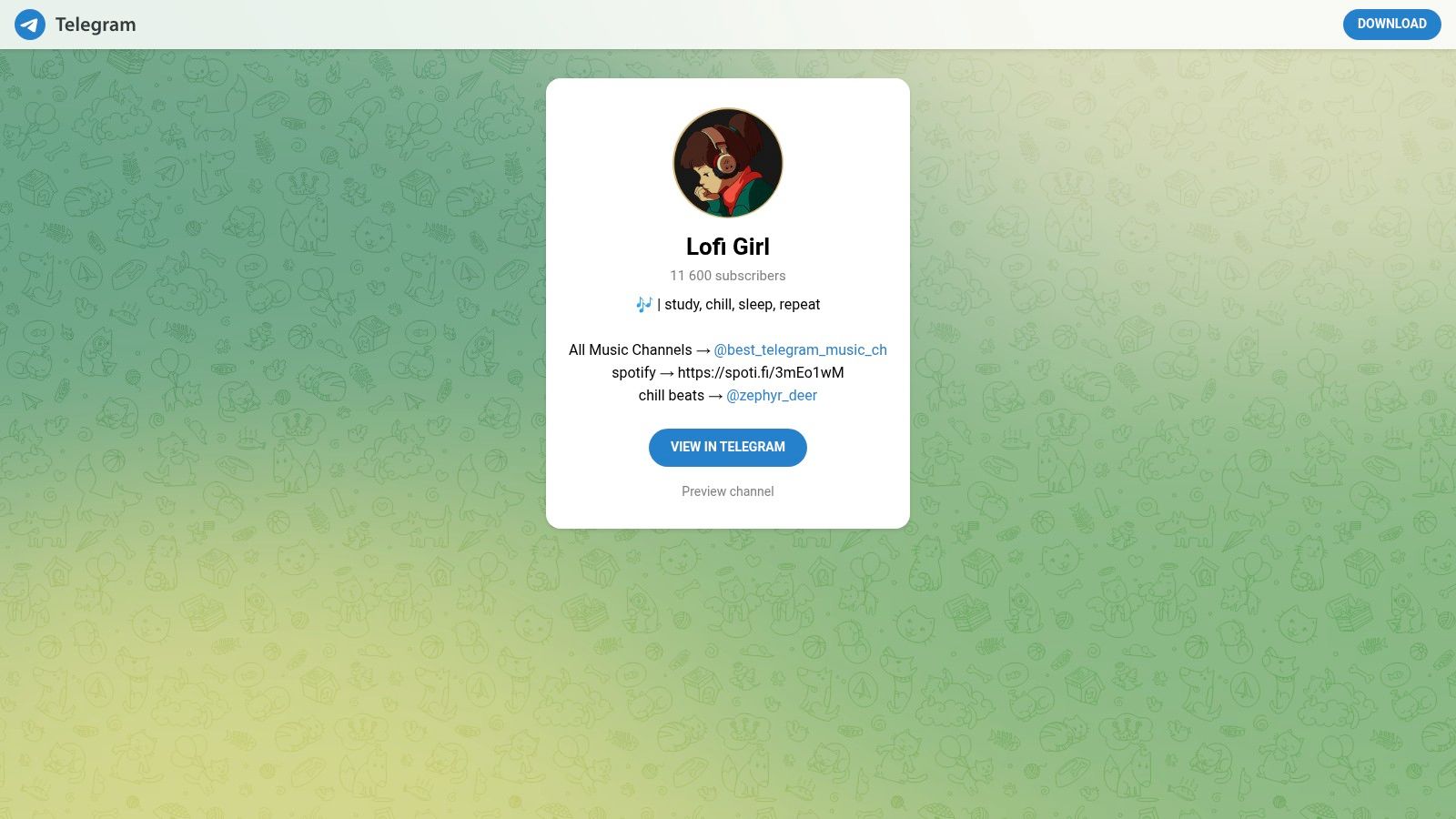
Lofi Girl on Telegram is a strong benchmark for evergreen listening behavior — more useful than a trend-only feed if you're studying functional music. It shows how a narrow mood category stays relevant without constant novelty.
Posts classify easily: chill, study, sleep, focus, and playlist-style discovery cues in a repeatable format. Clean formatting reduces ambiguity when tagging by mood, destination platform, or release type.
Why it works as a benchmark — Lofi channels win through consistency, not surprise. You're not asking whether a single post exploded, but whether it maintains a durable consumption loop: mood labeling, playlist routing, evergreen demand built for repeat consumption rather than campaign spikes.
Worth reading alongside this: an explainer on soundtrack for study and relaxation, on why lo-fi channels behave differently from artist announcement channels — they serve a function first, fandom second. Don't judge a lo-fi channel by whether every post feels new. Judge it by whether the format keeps matching recurring listening contexts.
One caution: treat Lofi Girl as a curated discovery surface, not a perfect proxy for an official label pipeline, once you start comparing it against artist or label channels.
Turning this kind of feed into an actual workflow is covered in Statiko's how to use Telegram channels — a step from passive following to structured monitoring.
3. Chillhop Music
Chillhop Music on Telegram is structured enough to audit — useful for creators, labels, and marketers who want a repeatable benchmark instead of one viral post to chase.
The main signal is cadence discipline. Chillhop publishes within a recognizable frame — recurring artwork styles, seasonal packaging, mixes, release-linked posts — that's easy to classify. In Statiko, track posting intervals, spot edits, and separate real format changes from cosmetic caption tweaks.
What to examine in the posting pattern — Split a sample into three buckets: mixes, compilations, and standard track or release posts. Compare timing, views, forwards, and whether edits cluster around specific formats or campaign moments — a cleaner benchmark than subscriber count alone.
Film Threat's piece on Telegram marketing for music PR makes a point that holds up here: sustainable rhythm beats forced volume, and how a channel responds after timing changes matters more than surface growth. Chillhop has enough consistency for side-by-side comparison, without the noise of artist chats or broad news feeds — comparable formats, tight genre boundaries, and a low-noise distribution model that makes cadence easy to audit.
The trade-off: a well-ordered channel can look stronger than it is if you only check a few posts. Go longitudinal — several weeks, repeated publishing windows, repeated visual templates, edits made after posting. That separates a stable content operation from posting into a familiar aesthetic.
Use Chillhop less as a recommendation and more as a benchmark for how a niche music brand holds attention without constant novelty.
4. Monstercat (fan-run feed: @tgMonstercat)
tgMonstercat on Telegram solves a real monitoring problem: official label activity is usually split across social accounts, release pages, and artist profiles. A fan-run feed compresses that into one stream that's faster to audit.
Monstercat helps here because the label already publishes within recognizable series — Silk, Uncaged, Instinct — which gives you visible content buckets and makes classification easier than in a general EDM channel. Compare cadence by series, check whether formats cluster around release types, and spot whether visual packaging stays consistent across sub-brands.
The trade-off is accuracy control. A fan-run feed can be better organized than the official source and still weaker on verification — use it to monitor patterns, then confirm release dates, artwork, or campaign language against first-party posts before quoting them.
The practical read: series tracking, cadence analysis (bursts, fixed rhythms, or campaign clusters), edit monitoring, and trust assessment — a tidy feed isn't the same as a transparent one.
That last point is where public channel analytics earn their keep. Telegram's discovery pages show a description and a follower count, not whether the operator edits posts often, posts on a stable schedule, or deletes low-performing updates. Statiko fills that gap by exposing edits, deletions, and cadence.
Building automation around release tracking? Telegram music bots for monitoring and workflow design connects channel observation to an actual operating setup.
5. Experimental Music Channel
Experimental Music Channel on Telegram is the opposite of a mass-market feed — exactly why it's useful for niche curation, avant-garde releases, soundtrack research, or leftfield artist discovery. Broad editorial channels flatten too much; this one doesn't.
The advantage is taxonomy. Ambient, drone, noise, minimal synth, field recordings, and free jazz don't sit comfortably in mainstream buckets, and a channel that keeps those distinctions legible becomes analytically useful fast.
Best use case — Treat it as a map, not a scoreboard. Reach in narrow subscenes is irregular, and a niche post can still matter if it surfaces a cluster of aesthetics before larger channels notice: sub-style segmentation, overlap hunting, aesthetic trend spotting — motifs and language that move before the market names them.
Evaluating experimental channels with mainstream expectations doesn't work. Uneven metadata, non-standard formatting, and spiky engagement aren't automatically signs of poor quality — smaller channels can be richer than larger ones if they preserve scene-specific language.
This kind of feed is also a discovery seed. Identify recurring labels, artists, or descriptors, then search outward into connected public channels to build a more accurate scene graph than any generic "best music channels" roundup gives you.
6. Indie Dance
Indie Dance on Telegram sits between editorial curation and distribution-feed behavior, which gives analysts more to work with: how the operator labels tracks, how often premium prompts appear, whether cadence stays consistent or slips into opportunistic bursts.
That matters more than genre alone. It shows how dance-focused audiences are packaged, and where discovery ends and monetization begins.
What it reveals about packaging and trust — Start with formatting discipline. Indie Dance frames posts around adjacent tags like indie dance, nu-disco, and electro, which makes categorization easier and saves time when benchmarking multiple music channels against generic repost volume.
Then check transparency. "Plus" prompts and other upsell signals show up in the content flow itself, so you can see the operator's segmentation model in public — whether free posts are top-of-funnel discovery or a partial product pushing a paid layer.
Surface-level browsing misses the two things that change the read of a channel fast: post edits and cadence shifts. Repeatedly edited captions, or promotional prompts clustering around release windows, say more about strategy than a static screenshot ever will — where Statiko earns its keep.
A practical review starts with three checks: post consistency, monetization visibility, and edit behavior — do edits add metadata, fix errors, or rewrite the pitch after publication.
There's also a rights question. Some posts reference downloadable file formats, which should make brands cautious about reposting or treating the feed as a clean promotional partner. Useful channels aren't always low-risk ones.
Use Indie Dance as a packaging benchmark, not a recommendation source — how niche operators mix curation, access gating, and formatting without the polish of a full media brand. Creator-workflow communities increasingly group Telegram distribution with AI music tools, as this AI creator tools repository shows.
6 Telegram Music Channels Comparison
| Channel | Implementation complexity 🔄 | Resource requirements ⚡ | Expected outcomes 📊⭐ | Ideal use cases 💡 | Key advantages ⭐ |
|---|---|---|---|---|---|
| Pitchfork | Low, straightforward feed ingestion and headline parsing | Low, minimal engineering; occasional paywall checks | High editorial signal; timely review/news alerts for U.S. market | Campaign/newsjacking, sentiment monitoring, alert automations | Recognized authority; high post velocity; consistent headline style |
| Lofi Girl | Very low, simple playlist-link posts and repeatable format | Very low, lightweight ingestion; Spotify link handling | Good trend signal for lo-fi demand; quick sampling via playlists | Ambient discovery, benchmarking evergreen background music | Playlist links for instant sampling; consistent curation format |
| Chillhop Music | Low, steady stream and mix postings; 24/7 content handling | Low–Moderate, continuous cadence; media streaming considerations | Strong scene-cycle visibility; useful for seasonal/compilation tracking | Monitoring chillhop releases, A/B testing post formats | Niche focus; high cadence; label-aligned releases and mixes |
| Monstercat (fan-run: @tgMonstercat) | Low, feed mirror easy to ingest but requires validation | Low, community-run; some moderation/verification needed | Good for spotting emerging artists and release tempo; not always official | Tracking label ecosystem, release patterns, artist entry points | Clear series tagging; strong EDM audience recognition |
| Experimental Music Channel | Low, curated niche posts but varied metadata quality | Moderate, expert tagging/curation improves usefulness | Unique discovery; high-value niche signals but low volume | Research, avant-garde trend-mapping, niche curation | Granular genre taxonomy; surfaces under-served discoveries |
| Indie Dance | Low–Moderate, structured posts and "Plus" upsell mechanics | Low–Moderate, parsing structured content; rights checks advised | Targeted trend/artwork monitoring; regular release notices | Monitoring indie-dance/nu-disco trends and festival artwork tropes | Consistent formatting for parsing; clear upsell mechanics and focused niche |
Final Thoughts
Public music channels produce a steady stream of signals — post timing, format choices, repost patterns, edits, deletions. All of it is evidence creators and marketers can study.
A useful Telegram music channel isn't just a feed with good tracks — it's a visible distribution system with clear habits. Pitchfork packages authority. Lofi Girl and Chillhop Music show how repeatable formats sustain long-term attention. tgMonstercat shows the upside and risk of fan-run mirrors. Experimental Music Channel and Indie Dance show how niche curators frame discovery and monetize attention.
Reach still matters, and TGStat's music rankings compare channels by distribution strength rather than subscriber totals alone. But a smaller channel can be more useful for benchmarking if its cadence is stable, its niche is defined, and its archive stays consistent over time.
Track what each channel posts, how often it edits, which formats repeat, and where transparency breaks down — material for competitive analysis and trend-spotting, not just passive consumption. Building releases yourself? Pairing channel research with production workflow also helps — teams experimenting with faster pipelines may want to learn AI song production so creation and distribution analysis improve together.
Statiko is useful here because it records public Telegram channel edits, deletions, growth snapshots, and posting cadence. That makes each of these channels more than a recommendation. They become case studies you can measure, compare, and use as benchmarks for your own music distribution strategy.
Related posts

In-app search only gets you so far. Use usernames, t.me links, directories, and subscriber data to find channels — then vet them before you join.

Master how to use Telegram channels with our 2026 guide. Learn setup, growth strategies, and advanced automation to build an influential audience.

Discover the ultimate list of Telegram music bot resources, from API docs to open-source code. Find the perfect solution for your channel's audio needs.
Start in seconds.
Create a free account to organise channels, track activity, and get recaps delivered to you.
Real-time. Telegram. Analytics.