Ultimate Telegram Link Finder
The ultimate Telegram link finder. Discover, verify, & analyze public channels using advanced search, directories, and powerful analytics tools.

Most advice about finding Telegram links treats discovery as the hard part. It isn't.
A t.me URL is easy to surface. The harder job is deciding whether the channel behind it is legitimate and worth tracking. Skip that step and you risk following clones, engagement farms, or channels that quietly edit their history when scrutinized.
Finding a Link Is Only Half the Battle
Public channels are easy to find. What's harder is separating primary sources from copycats, abandoned feeds, and channels that changed ownership without disclosing it. In crowded niches, a clone only needs to look credible for a few seconds.
Before trusting any discovered link, check:
- Does the channel post on a consistent cadence?
- Does the content match the title and description?
- Do older posts show a stable topic, or did the channel pivot abruptly?
- Do views, forwards, and posting intervals look plausible?
- Does the admin hide edits and deletions, or is the history clean?
For a baseline on what established channels look like, browse top Telegram channels by audience and category, then compare your candidates against that standard.
Discovery Methods
The simplest starting point is still Telegram's built-in search — but don't stop there.

Telegram native search is fast when you know the topic, brand, or handle. Search the obvious keyword first, add brand names or geography, try the local language for regional niches, and open several results — not just the first one.
Google site:t.me operators often outperform in-app search for precision:
- site:t.me your keyword
- site:t.me "exact phrase"
- site:t.me niche brand region
This also surfaces links embedded in articles and forums that Telegram itself won't show. For teams automating discovery at scale, understanding scraping pipelines helps judge the freshness of third-party finder tools. Pratt Solutions on Python scraping is a solid primer.
Link types matter:
| Link pattern | What it means | What to do |
|---|---|---|
t.me/channelname |
Public username link | Good for discovery and analysis |
t.me/+... |
Invite link | Verify the source context first |
| Shortened or reposted links | Intermediated sharing | Check origin before joining |
A clean public username link is the best starting point — it gives you a stable identity to evaluate.
Directories and Bots
Directories and bots widen the top of your funnel. Use them for structured questions: which channels are active in this category, which languages show consistent posting, which names and branding keep recurring. They're good at surfacing patterns — not at verifying quality.
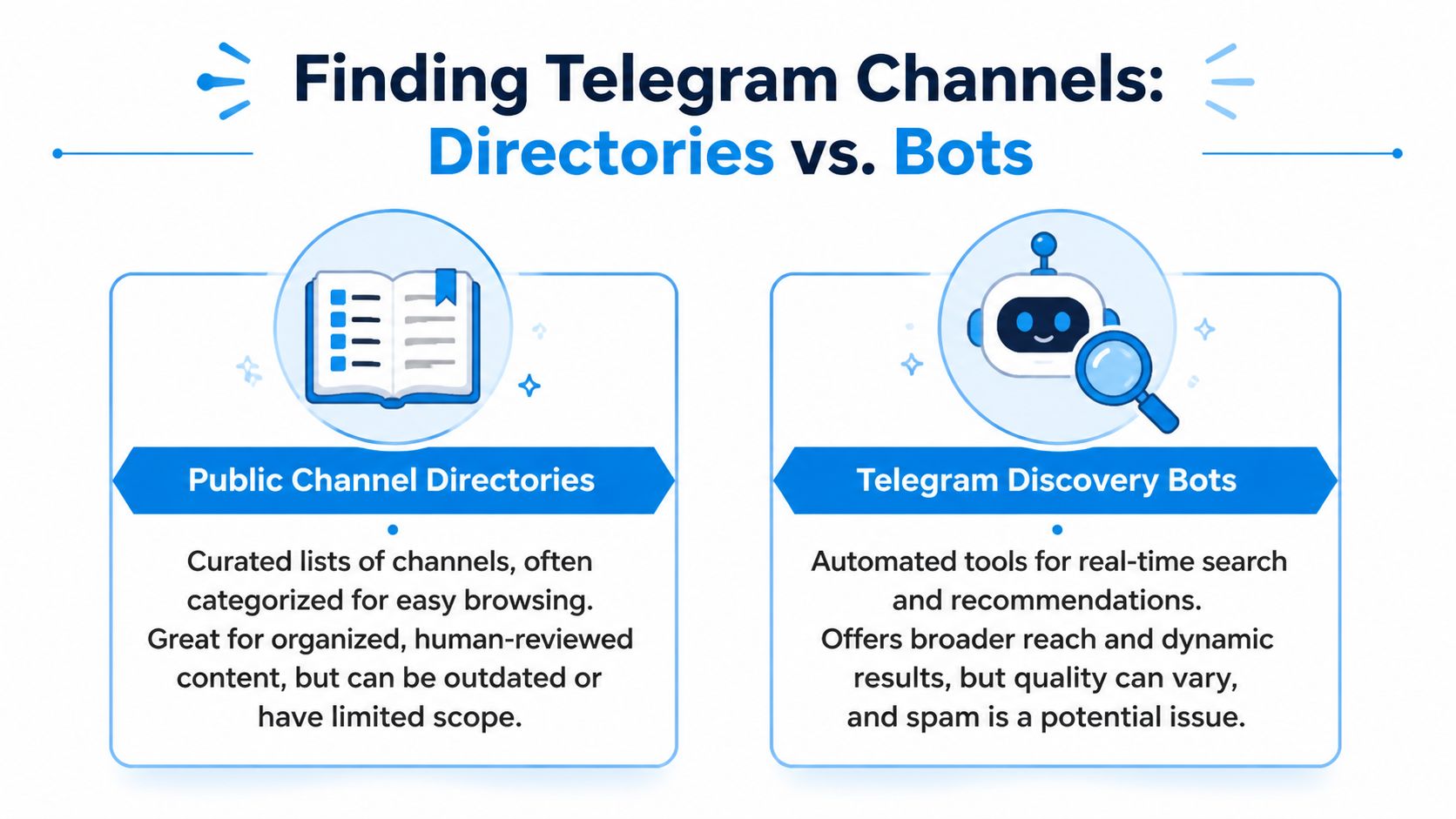
| Tool type | Best use | Main weakness |
|---|---|---|
| Public directory | Browsing by category, language, or market | Listings may be outdated or loosely categorized |
| Discovery bot | Fast keyword exploration and related-channel lookup | Results often lack context and quality control |
| Manual search | Checking exact names or known entities | Weak coverage for broad discovery |
Both fail at the same point: they tell you a channel exists. They don't tell you if it's active or authentic.
For what Telegram bots can and can't reliably surface, see Statiko's list of Telegram bots. For how scraping pipelines handle dynamic pages, ScreenshotEngine on Playwright covers the mechanics.
Verifying Channel Authenticity
Most link-finder guides stop before this part. That's a mistake.
Red flags like deleted scam posts show up in 25% of top channels in recent audits. A public link tells you where the channel is — not whether the operator is trustworthy.
Start with behavior, not branding. Logos and descriptions are easy to copy. Operating history isn't.
- Thematic consistency — a channel claiming one niche but constantly pivoting into promotions deserves scrutiny
- Recent posts — read enough to understand tone, cadence, and whether posts inform or just funnel
- Abrupt shifts — sudden audience or content changes often signal a sale, takeover, or monetization pivot
- Repetitive outbound pushes — constant pushes to secondary groups or off-platform offers are warning signs
Deleted posts matter. Some operators clean up aggressively after backlash or failed promotions. If you only assess what's still visible, you're seeing the sanitized version. A channel's visible feed is not its full history.
Large channels can still be low trust. Small ones can be excellent. What matters is whether the activity pattern, content style, and history align. For deeper investigations, Statiko's Telegram OSINT guide frames channel review as an evidence problem, not a discovery problem.
Advanced Analysis with Statiko
Finding a link is easy. Deciding whether the channel is worth tracking takes analysis.
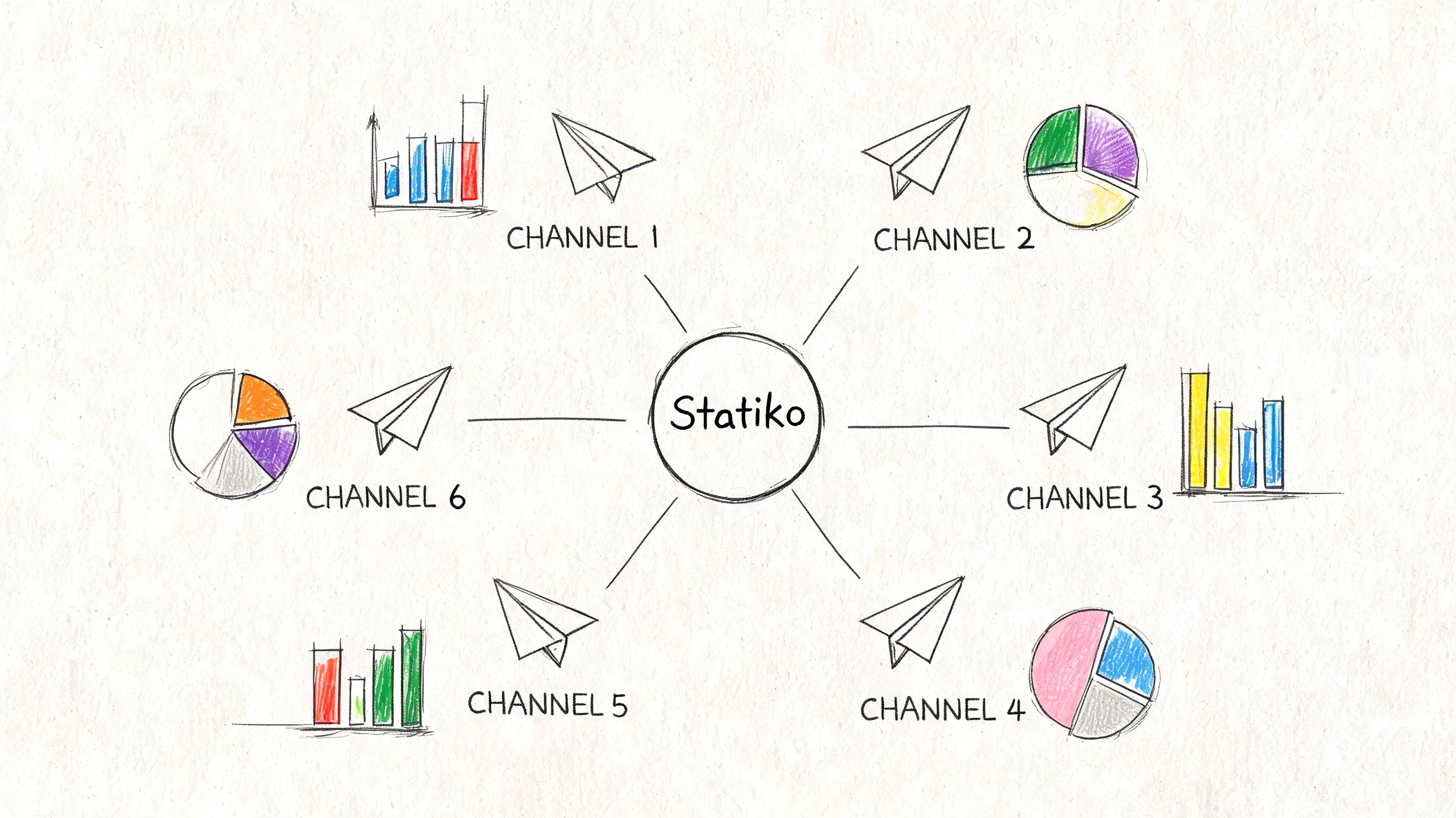
Start with engagement rate, not subscriber count. Subscriber count is the easiest metric to inflate. For channels above 500 subscribers, healthy ERR typically sits around 25–30%. Rates above 50% deserve scrutiny. According to PR-CY's Telegram analytics guide, ERR is average post reach divided by subscriber count, multiplied by 100. A big channel with weak reach usually has an inflated or inactive audience.
Check how the audience arrives. Common source categories include followers, channels, URLs, groups, private chats, and search. Each tells a different story:
- Search-led growth — channel name and topic match real demand
- Channel-led growth — repost networks or coordinated cross-promotion
- URL-led growth — outside distribution from websites or newsletters
- Sharp source shifts — worth investigating whether this is a promotion push or a change in tactics
Use historical patterns to test authenticity. Statiko lets you inspect growth alongside posting behavior, edits, and deletions. Three things to look for:
- Growth matching visible activity — legitimate spikes follow successful posts, partnerships, or external distribution
- Growth disconnected from activity — subscriber jumps without visible output changes suggest inflated audience quality
- Edit and deletion behavior — light editing is normal; repeated cleanup after promotions or controversial posts is a red flag
| Decision | What it means |
|---|---|
| Trust | Reach, growth, and history support the channel's public identity |
| Watch | Pattern needs more time or comparison |
| Reject | Metrics or history don't hold up |
Your Workflow
A reliable Telegram link finder isn't one tool — it's a sequence:
- Find candidates — native search, Google operators, directories, bots
- Vet each one — public history, engagement logic, consistency checks
- Monitor over time — channels drift; a useful source last month can become a promotion feed
If you adopt that verification-first habit, you'll stop collecting random links and start building a channel list you can defend.
If you want a faster way to vet public Telegram channels after discovery, Statiko is built for that job. It helps you analyze public channel metrics, compare performance, and inspect edit and deletion history so you can decide whether a channel is authentic before you follow, reference, or benchmark it.
Related posts

In-app search only gets you so far. Use usernames, t.me links, directories, and subscriber data to find channels — then vet them before you join.

Master Telegram OSINT with our 2026 guide. Learn profile discovery, channel analysis, network mapping, and the best tools for open-source intelligence research.

Discover the 7 definitive platforms to find and analyze the top telegram channels. Unlock metrics, growth data, and content strategies to dominate Telegram.
Start in seconds.
Create a free account to organise channels, track activity, and get recaps delivered to you.
Real-time. Telegram. Analytics.