Build a Thriving Telegram Dating Channel
Launch your Telegram dating channel. Guide covers setup, safety, content, growth, monetization, & analytics to build a thriving community.

You're probably in one of two situations: you want to launch a telegram dating channel and aren't sure how to keep it from becoming a spam funnel, or you already run one and realized member count alone doesn't tell you whether the community is healthy.
Dating on Telegram can work, but only when you treat the channel like a public product. Admins who last in this niche do three things well: define the format early, control trust aggressively, and measure what's happening instead of guessing.
The Opportunity
Business of Apps reports Telegram at 800 million monthly active users. That scale means niche communities can find real audiences — a dating channel doesn't need to appeal to everyone.
Admins get this wrong when they launch with a vague promise like "meet new people." Better positions: city-specific matchmaking, faith-based dating, age-banded communities, serious-only introductions, women-led moderation, curated profile drops. Each gives members a reason to stay.
A channel is closer to a content property than a group chat. Every post teaches members what behavior the space rewards. If a stranger can't understand the audience, rules, and posting format within a few seconds, the positioning is still too loose. The same logic described in Yellow.ai's engagement channel framework applies: reduce friction, make user intent obvious, guide people toward one clear next action.
The difference between active and dead channels usually isn't effort — it's structure. Healthy ones behave like curated directories with a clear editorial standard. Members know what a good profile looks like and what gets removed.
Laying the Groundwork
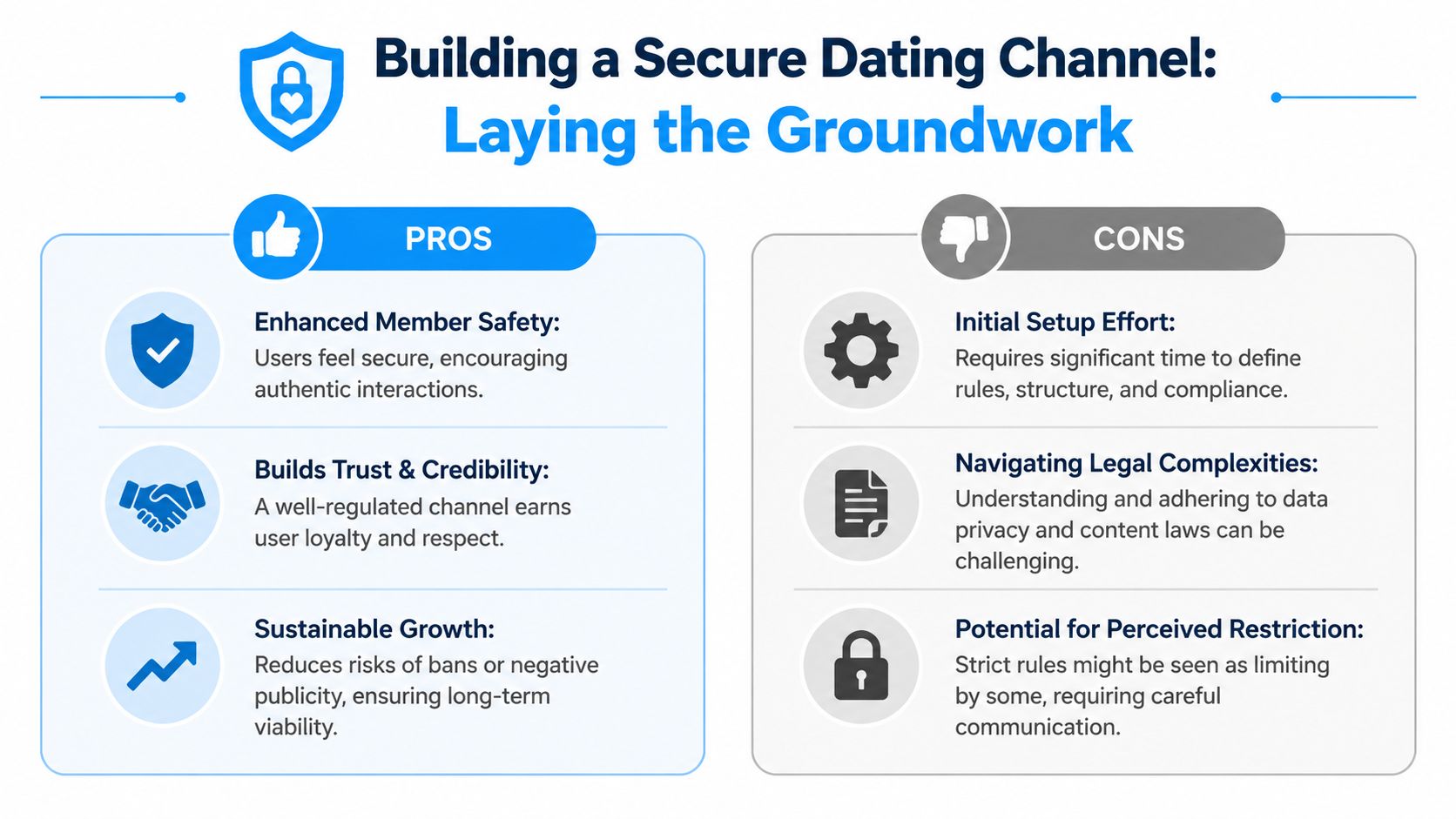
The first real decision isn't branding — it's format. Channels, groups, and People Nearby serve different intents with different moderation and spam profiles. Pick the wrong one and no rule list will fix the problems later.
| Format | Best for | Main risk | Admin workload |
|---|---|---|---|
| Public channel | Curated profiles and controlled publishing | Hidden low-quality submissions | Moderate |
| Public group | Live discussion and fast social interaction | Spam, harassment, impersonation | High |
| People Nearby | Local discovery and immediate contact | Low control over member quality | Variable |
A channel gives editorial control — admins publish, members consume. Submissions happen through forms, bots, or direct review. A group creates energy through live conversation but also more spam and conflict. People Nearby skews toward fast interaction rather than structured matchmaking — if your brand promise is curation, it fights your process.
Rules that can be enforced — "Be respectful" isn't a rule. Use operational ones:
- Age boundary: State the minimum age explicitly, don't leave it implied.
- Profile standard: Require fixed fields — age range, location, intent, contact method.
- Content limits: Ban explicit solicitation, crypto pitches, duplicate submissions, external payment requests.
- Enforcement ladder: Explain what triggers removal, restriction, or permanent ban.
Also note what you won't police. If members expect identity verification and you only review formatting and spam indicators, say so clearly.
Disclosures before you need them — Add visible notices covering age disclaimer, privacy expectations, regional restrictions, how submissions are reviewed, and how to report abuse. If your audience is sharing handles and moving into DMs, the risk surface changes immediately. Design the compliance layer alongside the format — not after you need it.
Core Content Strategy
Most dating channels fail because they publish whatever arrives. The stronger approach runs content like a funnel: capture attention, qualify intent, move people toward contact. The strongest channels post structured profile cards and short CTA-heavy prompts, comparing daily subscriber growth against message frequency to distinguish organic growth from low-quality bursts.

Think of every post as doing one of three things:
Acquisition — Brings new people in or reminds members to participate. Teaser profiles, theme drops ("Professionals in London," "Serious dating only"), icebreaker prompts. Keep them short and scannable — if it reads like a diary entry, people skip it.
Qualification — Filters for intent before mismatches spill into DMs. Preferred age range, city, relationship intent, language, deal-breakers, whether the person is open to voice notes or video verification. A fixed profile card beats freeform text because members can compare options quickly.
Conversion — Creates the handoff from browsing to contact. Be specific: "DM with keyword COFFEE if you match the age range." Vague CTAs like "reach out if interested" create friction because people don't know how or when.
A simple weekly structure keeps the feed alive without constant novelty:
| Day type | Post style | Why it works |
|---|---|---|
| Profile day | Curated profile cards | Gives members a reason to browse |
| Prompt day | Icebreakers or polls | Creates light participation |
| Feature day | Member spotlight or themed segment | Adds social proof |
| Reminder day | Submission rules and safety notices | Protects quality without slowing the feed |
What works: profile templates, short captions, direct CTAs, recurring series, clear submission gates. What doesn't: long anonymous confessions, random reposts, mixed audiences with conflicting intent, inconsistent posting gaps followed by floods.
If your channel description still feels fuzzy, review clear Telegram channel descriptions before locking the format. A solid content strategy falls apart if the channel promise is confusing.
Moderation
In a dating environment, trust is the product. If members suspect fake profiles or silent rule changes, the channel loses value immediately — even if the subscriber count still looks fine.
Moderation has to be visible, consistent, and documented. Preserving original post content, edit history, and tracking deletions matters in dating specifically because profiles are often edited after publication and accountability disappears without version history.
A practical workflow:
- Review every profile before publication — check required fields and contact method consistency.
- Preserve the original version — if a poster later changes age, photos, or handle, moderators need a record.
- Track deletions — profiles that vanish after complaints often matter more than ones that stay up.
- Log report outcomes — members should know whether a report led to removal, warning, or no action.
- Escalate repeat patterns — one odd submission might be noise; a pattern usually isn't.
Bots vs. human review — Separate moderation into two layers: an automation layer (intake forms, keyword filters, duplicate detection, basic anti-spam) and a human review layer (profile checks, report handling, edge cases). Bots can't notice when someone subtly edits a profile after publication or changes contact details to dodge earlier complaints. A Telegram dating bot handles intake well — trust still needs human judgment.
Publish your enforcement logic. If you remove posts or ban users without explanation, members fill the gap with theories. A simple note — what got removed, which rule applied, how someone can appeal — is enough. You don't need to shame users publicly. You do need to show that moderation isn't arbitrary.
Scammers prefer spaces where history disappears. Serious users prefer accountability. That's one way a public dating channel outperforms a chaotic group — when the moderation model is clear, trust compounds through behavior, not promises.
Audience Growth
Growth gets easier once the channel feels safe and the content model is stable. Before that, promotion mostly amplifies weaknesses. The right target isn't "more members" — it's more members who fit the channel's promise.
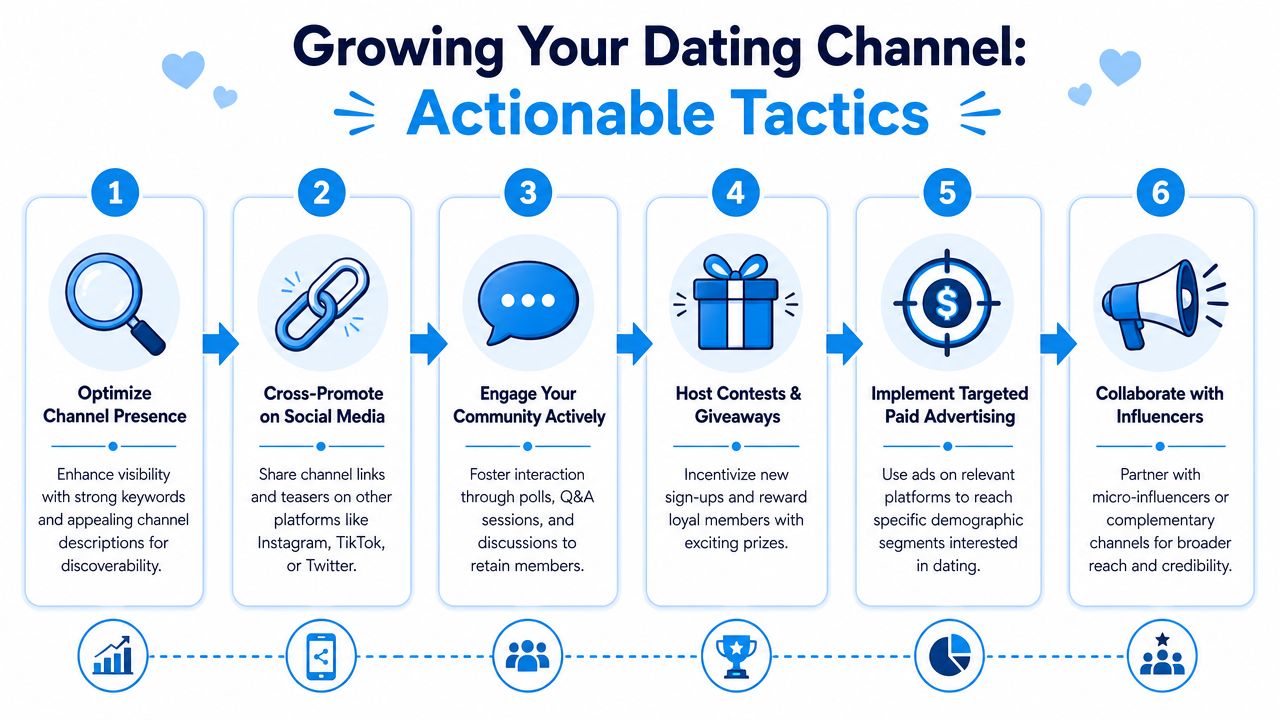
On-platform discoverability — Telegram search is blunt. Use the channel name, @username, and description to signal audience, location, and intent clearly. "Berlin Serious Dating Channel" or "Muslim Matchmaking London" beats "Singles Hub." This Telegram channel growth guide covers the search-facing basics.
Acquisition portfolio — Don't rely on one source: - Cross-promotions with adjacent communities: lifestyle, local events, city guides, relationship advice - Directory listings: useful for discovery, but treat them as visibility not trust-building - Shoutout swaps with channels serving a compatible audience and clear standards - Owned social traffic: profile previews and prompt screenshots on other platforms
For creators bridging from Instagram, this guide on connecting Telegram with Instagram audiences covers moving followers without making the transition feel abrupt.
Reward sharing carefully — Good incentives: featured placement, faster review queue, premium formatting, access to themed posting days. Weak incentives: cash-like rewards, unrestricted posting access, anything that encourages fake invites.
| Tactic | Member quality | Control | Risk |
|---|---|---|---|
| Cross-promo with aligned channels | Usually higher | Medium | Moderate |
| Directory listings | Mixed | Low | Higher spam exposure |
| Social platform teasers | Higher if niche is clear | High | Low to moderate |
| Broad paid promotion | Highly variable | Medium | Can attract low intent |
Watch for wrong-kind growth. If subscriber count jumps but profile quality drops and moderation load rises, the acquisition source may be polluting the channel. A lot of admins celebrate the graph and ignore the consequences.
Monetization
A dating channel takes real labor — reviewing submissions, handling reports, shaping content, protecting trust. Monetization makes sense. The mistake is monetizing in ways that damage credibility faster than revenue can replace it.
Premium profile placement — Works best when featured spots are clearly labeled and still reviewed under the same rules.
Submission fee — Can reduce low-effort spam. Be clear that payment covers review and placement, not acceptance. If members assume payment guarantees approval, you've created a fairness problem.
VIP tier — Works when it delivers something concrete: earlier access to curated drops, additional filters, members-only matchmaking rounds. Fails when "VIP" just means paying to stand in the same messy room.
Keep ad sales tightly controlled. One scammy sponsor undoes months of trust-building. Label sponsored content clearly, review landing pages, and don't let advertisers bypass submission standards.
Don't sell credibility. A "verified" badge should never be sold as a cosmetic upsell without a real verification process. Revenue works when members feel the payment improves the experience. It collapses when they feel it buys exceptions to the rules. Revenue is sustainable when members feel the payment improves the experience — it collapses when it looks like buying exceptions.
Analytics
Most admins either ignore data or watch vanity metrics and miss what's actually happening. For a dating channel, analytics should answer operational questions: which posts attract the right members, which days create submission backlogs, which promos bring weak traffic. Analytics platforms can expose subscriber counts, average reach per post, and posting frequency for public channels.
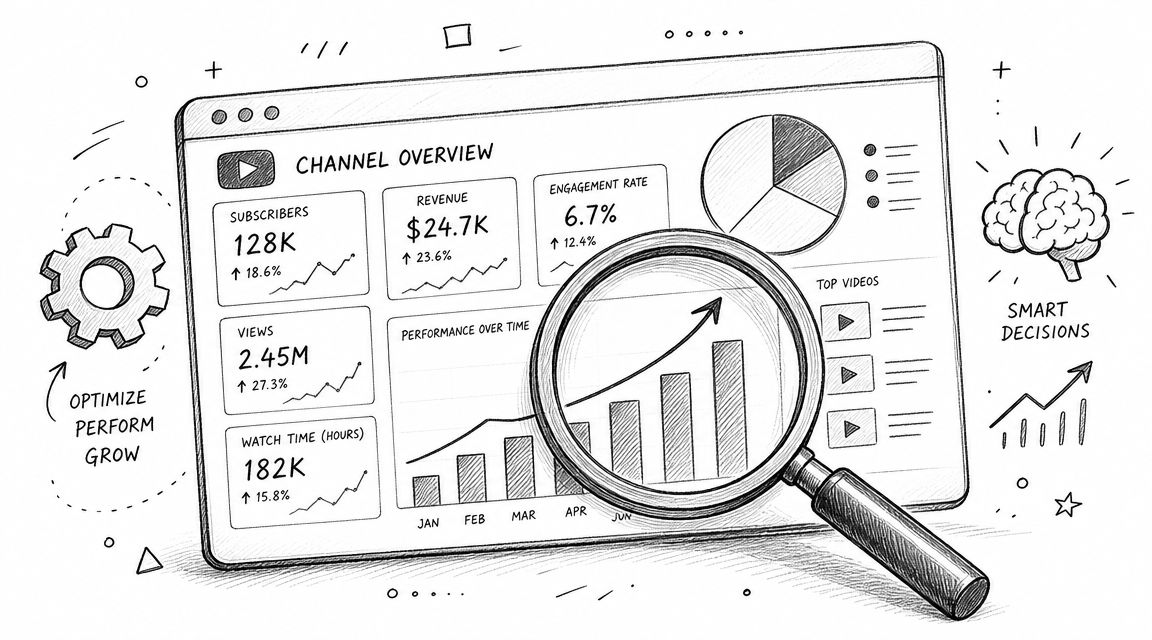
A compact operating dashboard:
| Metric | Why it matters | What to question |
|---|---|---|
| Subscriber growth | Shows momentum and acquisition quality | Did growth follow a relevant promo or a broad burst? |
| Average reach per post | Reveals whether members see content | Are some formats getting ignored? |
| Posting frequency | Spots inconsistency or overposting | Are you flooding the feed and lowering attention? |
| Edit and deletion history | Protects trust and accountability | Are profiles changing after publication? |
Benchmark against nearby channels — similar audience, language, geography, and intent. Look at posting frequency, whether they use profile templates, and whether growth appears steady or burst-driven. Don't compare a local matchmaking channel to a giant entertainment feed.
For public channels, Statiko tracks message edits, deletions, and daily snapshots — useful when you need visibility into how a dating channel's content evolves. You can search and compare channels at statiko.io/catalog/search. As noted in studies of creator monetization, monetization only works when the underlying audience is real and engaged — analytics tells you whether you're building that foundation or faking momentum.
The less obvious use of data is trust management. A profile edited after publication is not just a content event — it can be a safety event. A growth burst that drops quality is not just a marketing event — it's a moderation event. Treat the numbers as operating signals, not decoration.
If you run a public Telegram channel and want a clearer view of edits, deletions, posting history, and growth patterns, Statiko gives you a way to inspect channel behavior with transparent public-channel analytics. It's useful when you need evidence, not guesswork, to manage trust and improve performance.
Related posts

Looking for Telegram groups for dating? Explore 8 types of groups, from niche to local, and learn how to vet them for safety and find real connections.

Launch a successful dating Telegram group. This guide covers setup, safety rules, growth tactics, moderation, and using analytics to build a thriving community.

Learn how a Telegram dating bot works, from core features to monetization. This guide covers building bots, managing risks, and driving growth with analytics.
Start in seconds.
Create a free account to organise channels, track activity, and get recaps delivered to you.
Real-time. Telegram. Analytics.