Dating Telegram Group: The Complete 2026 Launch Guide
Launch a successful dating Telegram group. This guide covers setup, safety rules, growth tactics, moderation, and using analytics to build a thriving community.

The pattern is predictable: create a group, invite a few people, call it a dating community. Within days, fake profiles slip in, conversations die, aggressive members drive normal people away. What looked like a community becomes an unmoderated comment section.
A dating Telegram group doesn't grow because it exists. It grows because the operator builds trust, structure, and measurement into the experience from day one. Generic advice like "post more" or "promote on social media" doesn't help if the group becomes unsafe or chaotic once members arrive.
Measure the public channel, not just the group.
Statiko indexes public Telegram channels — growth snapshots, posting patterns, edits and deletions with timestamps. If your dating community has a public front door, that's the part you can measure and benchmark. Browse the Lifestyle category.
Why Your Next Community Should Be a Dating Telegram Group
People are tired of low-context dating environments. Endless swiping creates volume, not connection. A dating Telegram group changes that — members enter a shared room, see how others communicate, and join conversations before moving to private chats. That creates more social proof than any static profile.
Telegram has the audience. It reached 1 billion monthly active users in March 2025, with 450 million daily active users and a core demographic of 25 to 34 year olds — 59% male, 41% female.
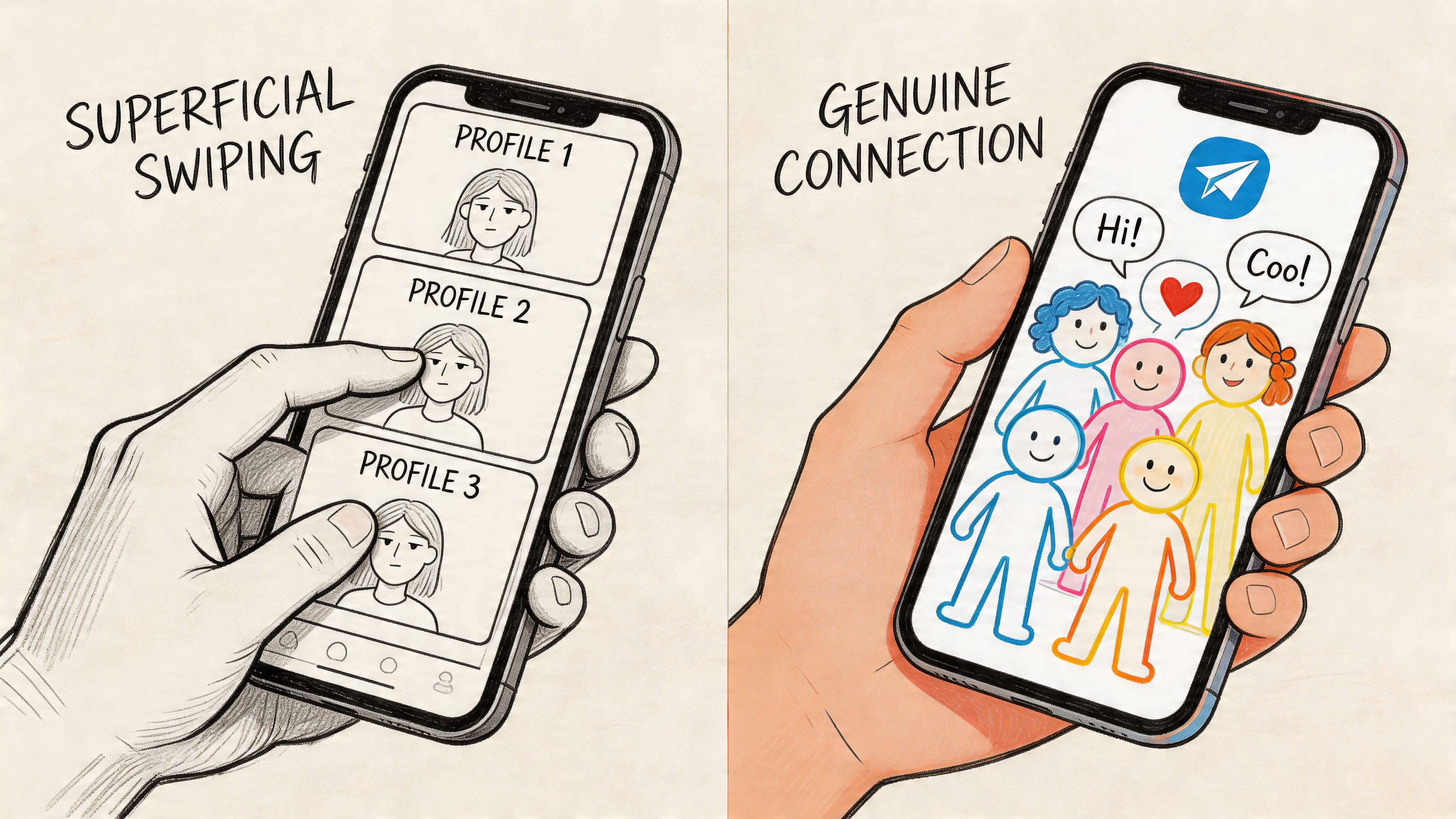
Demand is real. Search interest for dating Telegram group links grew in 2026, with groups proliferating across international, location-based, and interest-oriented segments, as Wrathcode's overview of dating Telegram group links documents. Users are actively looking for alternatives to traditional apps.
This format works best when context matters: local singles groups, interest-based communities, diaspora spaces, and age-specific groups all benefit from visible conversation. Members judge tone before engaging. Admins shape behavior in public. Good participants stand out faster.
Trade-offs to plan for:
- Spam risk: Dating groups attract bots, fake accounts, and self-promoters.
- Safety pressure: If members don't feel protected, they stop participating.
- Gender imbalance: Telegram's audience skews male, so community design has to work harder for comfort.
- Volatility: Activity can drop quickly without structure.
Most admins think growth is the challenge. It isn't. Growth without control makes the group worse.
Laying the Foundation
A vague concept fails fast. "Singles group" tells people nothing about who belongs or what to expect. The right niche doesn't just narrow the audience — it improves conversation quality.
Useful group concepts:
- Local: Faster meetups, stronger relevance. Privacy concerns vary.
- Interest-led: Better conversations, slower matching.
- Age-banded: Reduces mismatched expectations.
- Intent-based: Casual, serious, or marriage-oriented groups each need different rules.
- Regional diaspora: Often strongest because members share cultural context.
For a full breakdown of how these types behave in practice and how to evaluate each one before joining, see 8 types of Telegram dating groups explained.
If you can't explain who the group is for in one sentence, the positioning isn't tight enough.
Telegram structure options:
| Format | Best use | Strength | Weakness |
|---|---|---|---|
| Public group | Open social interaction | Fast community feel | Harder to control first impressions |
| Channel with linked discussion | Curated entry and announcements | Cleaner top-level communication | More admin work |
| Private group via invite | Higher trust and screening | Better quality control | Slower growth |
For most dating communities, a channel plus linked discussion group is the cleanest model. The channel handles rules, intros, and announcements. The linked discussion handles conversation. That separation makes moderation easier because the group doesn't need to carry every function at once. For a deeper look at building the channel side of this setup, see how to build a Telegram dating channel.
Setup before you open the doors:
- Create a memorable public link if discoverability matters.
- Pin one welcome message with purpose, rules, and intro format.
- Add admin roles early, even if the group is still small.
- Restrict obvious abuse vectors: random promo links and unsolicited media.
- Prepare your first week of prompts before opening.
Your name and description do real work. Use a name that signals where, who, and what kind of environment. Your description should answer: who this is for, what interaction is welcome, what's not tolerated, and how to join properly.
If you plan to automate onboarding, read this guide to Telegram dating bot setup before building the flow — especially if you want structured intros, screening prompts, or rule acknowledgments before members start chatting.
Give members a structure for intros. Don't ask people to "say hi" — it produces nothing. Pin a prompt: name or nickname, city, age bracket, relationship intent, two interests, one unusual fact, what kind of person they'd like to meet. This creates usable context and gives moderators a quick way to spot low-effort or suspicious accounts.
Rules, Verification, and Moderation
In dating communities, safety is what members judge first. They can forgive a slow week of conversation. They don't forgive a room that feels risky, chaotic, or fake.
Write rules moderators can actually enforce. Loose rules create loose enforcement. "Be respectful" gives moderators nothing to act on when someone skirts the line with sexual pressure or manipulative DMs. Useful rules name the behavior, the boundary, and the consequence:
| Rule Category | Guideline | Consequence |
|---|---|---|
| Respectful communication | No insults, hate speech, sexual harassment, or public shaming | Warning or ban based on severity |
| Consent and boundaries | No repeated unwanted DMs, guilt-tripping, or pressure for off-platform contact | Immediate removal for repeated behavior |
| Profile honesty | No impersonation, stolen photos, or misleading identity claims | Immediate removal |
| Adult content | Follow the stated policy for explicit language and images | Warning, mute, or ban |
| Promotion | No ads, lead gen, or unrelated links | Message removal and possible ban |
| Privacy | No reposting private chats or personal details without permission | Immediate removal |
| Spam | No flooding, mass-tagging, or bot-like activity | Mute or ban |
Verification should add friction for bad actors, not for everyone. Age confirmation and a lightweight identity check covers most cases. For higher-trust groups, a selfie with a handwritten phrase or date removes most throwaway accounts. Make it consistent — if one suspicious account slips through, members notice and trust drops fast.
A sustainable verification workflow:
- Confirm age eligibility and niche fit at entry
- Request a current selfie with a short handwritten phrase for verified groups
- Compare submission against Telegram name, photos, and account behavior
- Tag members as verified, limited, or pending review
- Recheck accounts after complaints, sudden profile changes, or suspicious DM patterns
For automating parts of this, Telegram bots for groups can reduce manual load without removing human review where it matters.
Enforcement ladder members can see:
- Correction for formatting mistakes or low-level off-topic posts
- Formal warning for disrespect, rule evasion, or inappropriate outreach
- Temporary mute for repeated disruption or ignoring moderator instructions
- Immediate ban for fake identities, harassment, threats, doxxing, or predatory behavior
Document every serious action. Save screenshots. Log who acted, why, and what evidence supported the decision. Without records, one moderator bans an account while another lets the same behavior slide a day later.
Transparency is a retention tool. Members judge the outcome, not your internal process. If complaints are rising, verified members are going quiet, or retention drops after waves of unverified joins, tighten entry controls and shorten response times. Statiko helps here — it gives operators a historical record of what changed inside the group and when, making it easier to spot abuse patterns and check whether a moderation policy is actually reducing low-quality participation over time.
Igniting Growth From Zero Members to a Thriving Community
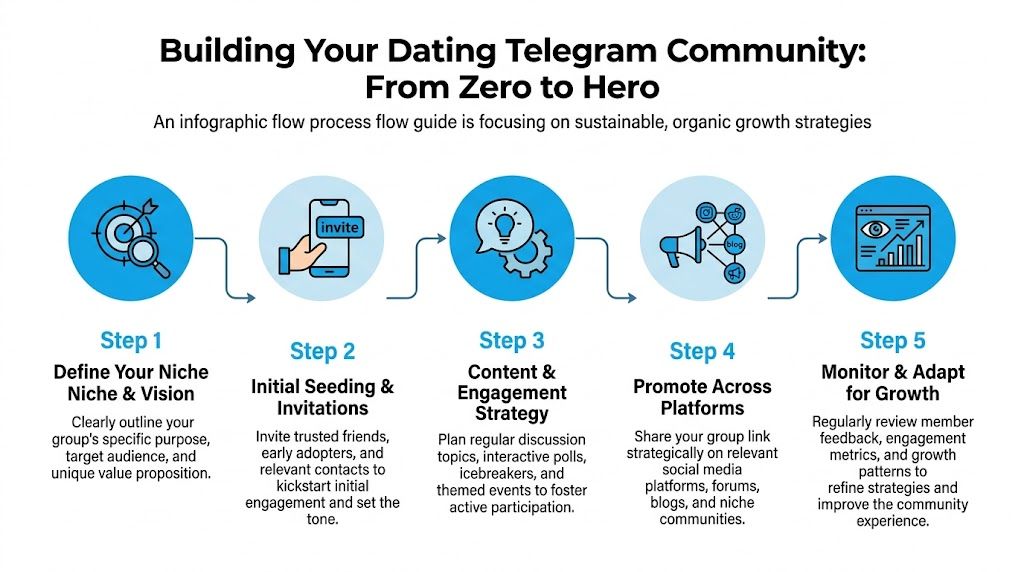
A new member opens the group and sees eight silent introductions and no admin activity for twelve hours. They leave in under a minute. Early growth is less about reach and more about what people see in their first session.
Seed the first layer manually. Start with people who improve the room on day one — socially reliable members from your network, trusted connectors from adjacent communities, early adopters comfortable posting first. Don't try to fill the group fast. Make the first fifty members look like the kind of people the next five hundred will want to meet.
Before spreading invite links, understand how Telegram invite links work for community growth and attribution. Trackable setup matters when you're sourcing from multiple channels.
Promote where your community actually lives. City-based dating groups often perform well on Instagram Stories, local TikTok content, and creator partnerships. Niche groups built around religion, profession, or lifestyle get better results from Reddit, newsletters, and admin-to-admin swaps.
Cheap traffic creates moderation load before it creates value. Judge acquisition by retention and conversation quality, not raw joins. If a source brings people who ignore prompts or trigger reports on day one, cut it.
Create a weekly rhythm. People rarely invent momentum in dating spaces — posting carries social risk. Structure lowers that risk:
- Monday: New-member intro prompt
- Tuesday: Poll or preference matchup
- Wednesday: Voice-note question
- Thursday: Interest-based thread (fitness, books, food, travel)
- Friday: Live mixer or themed discussion
- Weekend: Casual chat with active moderation
Keep prompts narrow and specific. "What are you looking for?" underperforms. "Pick one for a first date in your city: coffee, walk, rooftop drink, or food market" gets movement.
Run events early, even with a small group. Timed intro rounds, city-specific chat hours, and opt-in matching threads give quiet members a reason to participate without inventing their own opening line. Track what happened after each event — posting history, activity spikes, whether conversation stayed active the next day. That's where disciplined operators separate from hobby admins.
Tactics that look efficient but damage dating groups: - Buying members inflates the headline number and weakens every engagement signal underneath it - Dropping open links everywhere raises spam pressure without context - Over-promoting before the chat is active burns attention you won't get back - Relying on announcements alone turns the group into a bulletin board
Optimizing with Data-Driven Community Management
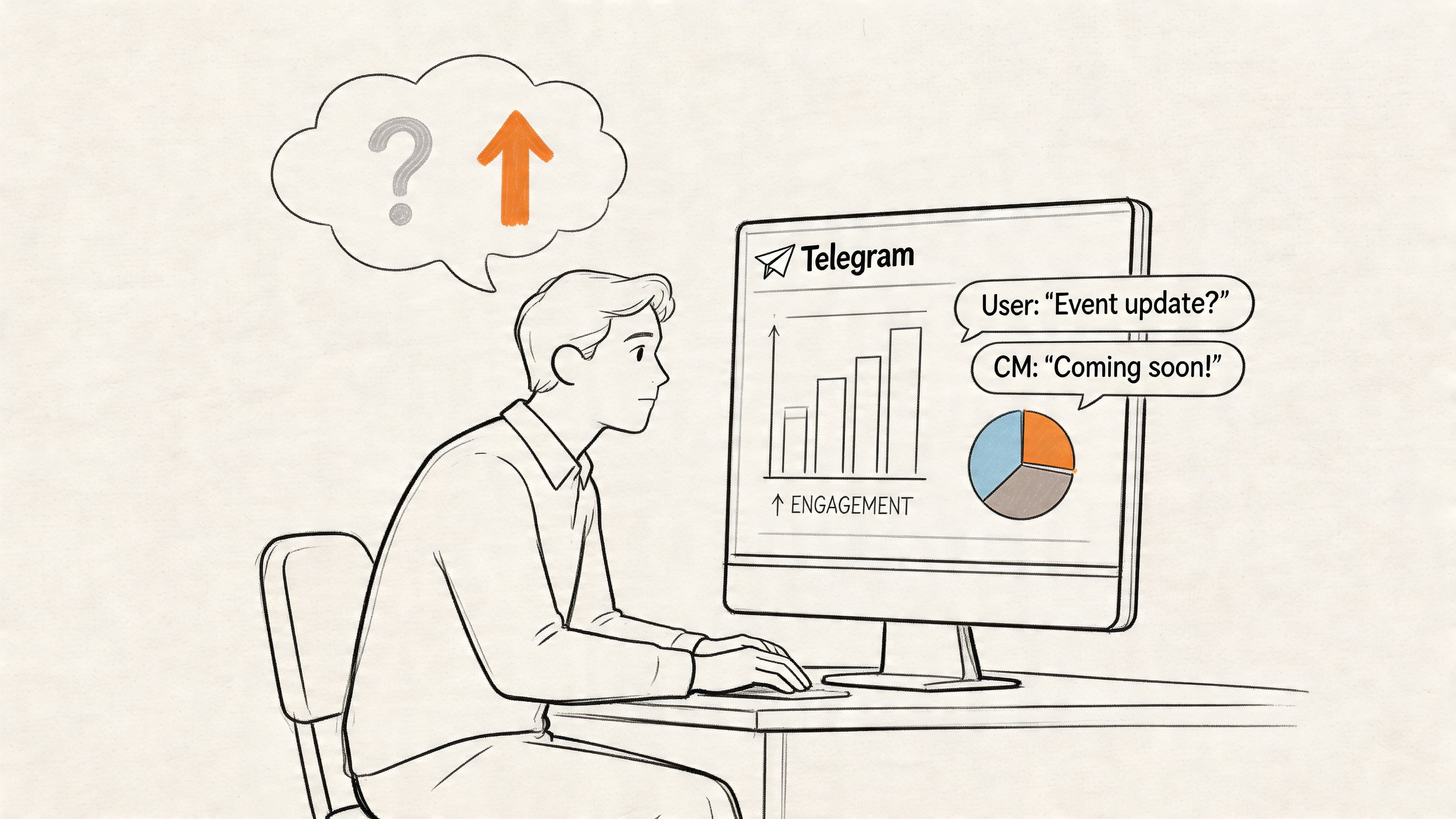
A dating group often looks healthy right before it starts slipping. The chat is active enough, member count is still rising, nobody feels urgent pressure. Then response quality drops, good members stop posting, and the admin team realizes they were judging the room by noise instead of patterns.
Visible metrics can lie. A burst of joins may come from a low-quality promo source. A busy thread may be driven by conflict, not connection. Even a spike in profile posts can be a warning sign if it comes with more deletions, more reports, or shorter retention.
The analytics gap hurts dating groups first. Telegram gives admins a partial view — especially across a mix of public channels, linked discussion groups, and private spaces. Statiko fills that gap with historical visibility into public assets: posting history, growth snapshots, edit patterns, and activity changes over time. It helps answer practical questions. Did the new intro format improve participation? Did a collaboration bring real members or just passive joins? Did trust drop after you changed the tone of promotions?
Posting cadence — which post types bring replies, how long discussion stays active after each prompt, whether certain days produce better member behavior. Consistency usually outperforms volume. One structured prompt at the right time beats five generic announcements.
Timing by member behavior — dating behavior clusters on commutes, breaks, and after-work hours. Run timing reviews against intro replies, event participation, retention after join spikes, and moderation incidents after high-traffic windows. If your audience spans multiple regions, one posting schedule is a lazy compromise.
Edit and deletion patterns — high edit volume can point to harmless cleanup, or to misrepresentation and bait-and-switch posting. Frequent deletions often signal bad actors testing messages and removing evidence. Statiko surfaces this on public-facing assets. Watch for repeated rewrites on promo-style posts, clusters of similar edits from new accounts, and deletions shortly after complaints.
Use snapshots instead of memory. Admin memory is unreliable. A week with two arguments feels worse than a quiet week with lower retention. A promo push feels successful because joins rose, even if most members never engaged.
A practical review routine: - Member growth and drop-off by day - Reply depth on prompts, not just view counts - Activity spikes after events or collaborations - Moderation incidents tied to specific campaigns or time windows - Suspicious bursts followed by edits or deletions
Benchmark other communities for systems, not surface tactics. A fast-growing group may look successful because of tone, while the real driver is scheduling discipline, tighter entry filtering, or a cleaner public funnel. Review how often they post interactive prompts versus announcements, what formats trigger replies, and whether growth spikes line up with events or partnerships. Then compare to your own numbers.
If the community is private, still measure the public layer. Many dating groups use a split model: public assets handle discovery, rules, and trust-building; private spaces handle interaction. That's often the right setup. A workable structure: - Public channel for brand, rules, events, and proof of activity - Private or controlled discussion space for member interaction - Moderation workflow connecting public signals with private reports - Recurring review using Statiko to monitor how the public layer performs over time
You don't need to see private conversations to learn which messaging attracts better members or which campaigns send in spam.
Your Questions Answered
How do I reduce legal and platform risk? Set an age minimum, state what interactions are allowed, and make consequences visible before anyone posts. If the group includes adult discussion, say that plainly and tighten verification. Document moderation decisions — complaints in dating groups rarely arrive with clean context. Written logs help you show removals followed a process.
Can a dating Telegram group be monetized without ruining trust? Yes — charge for convenience, curation, or extra formats: paid events, labeled profile boosts, vetted circles, or concierge-style matching. Don't charge for baseline safety. Verification and rule enforcement belong in the standard experience. Trust collapses fast when members feel protected only if they pay.
How do I avoid admin burnout? Burnout usually starts with chaos, not scale. Build systems early: intake templates, pinned rules, prewritten warning messages, a simple strike ladder, and moderator notes that survive staff turnover. Visibility helps too — Statiko gives operators posting history, edit and deletion tracking, and benchmarking tools that make it easier to spot problems before your team feels them as burnout.
How should I handle member disputes? Handle reports quickly and privately first. Review actual context, not just the cleanest screenshot. Don't over-mediate repeat behavior — if a member keeps creating confusion around consent, honesty, or harassment, remove them. High activity is not a defense. Groups lose good members when admins protect socially active offenders because they drive conversation.
What's the biggest mistake new operators make? Chasing visible growth before building operational discipline. Fast joins, loose screening, and high chat volume often produce the wrong kind of momentum. Smaller groups with tighter standards retain better members and generate stronger word of mouth.
Do I need analytics if my group is still small? Yes. Small groups are easier to correct. Early measurement shows whether a promo source brings real members or low-quality traffic, and whether moderation incidents cluster around specific campaigns or themes. If you wait until the group feels messy, you're fixing culture instead of shaping it.
If you run public Telegram channels around dating, community building, or audience acquisition, Statiko gives you a professional layer of visibility. You can monitor growth snapshots, review edits and deletions with timestamps, analyze posting patterns, and benchmark public channels without guessing. That's useful when you want cleaner moderation, better timing decisions, and a public-facing strategy grounded in evidence instead of instinct.
Watching competitors by hand doesn't scale.
Statiko Recaps monitors the public channels you choose and delivers one digest of what actually changed — new posts worth reading, edits, deletions. See how Recaps works.
Related posts

Learn how a Telegram dating bot works, from core features to monetization. This guide covers building bots, managing risks, and driving growth with analytics.

Master the Telegram invite link for community growth. Learn creation, security, and analytics to maximize channel reach & engagement.

Discover the best bot for Telegram group management in 2026. Reviewing top 10 for moderation, anti-spam, engagement, & analytics. Get setup tips!
Start in seconds.
Create a free account to organise channels, track activity, and get recaps delivered to you.
Real-time. Telegram. Analytics.