Your Telegram Channel Newsletter: A Complete Guide
Learn to create, grow, and optimize a Telegram channel newsletter. Our guide covers content, growth, and using Statiko for professional analytics.
Posting on Telegram is easy. The hard part starts when your channel has enough subscribers to look healthy but you still can't answer basic questions. Which posts pull people back? Which topics get forwarded instead of merely viewed? Which edits quietly damaged trust?
At that point you're running a publication, whether you planned to or not. A Telegram channel newsletter works when you stop thinking like a broadcaster and start thinking like an editor: set a format, protect quality, watch response patterns, and treat analytics as part of publishing rather than a report you open once a month.
Beyond Broadcasting Why Your Channel Needs a Newsletter Mindset
Many channel owners hit the same wall. They post often enough, some messages perform well, but the operation feels reactive: a product update, then a meme, then a sale, then silence. The channel exists; the newsletter discipline doesn't.
A Telegram channel newsletter is a recurring editorial product with a promise behind it. Readers subscribe expecting a certain kind of value on a consistent rhythm. Break that expectation and resonance drops long before the subscriber count does.
A broadcaster asks, "What should I post today?" An editor asks:
- What is this channel for — what specific outcome does a subscriber get?
- What recurring formats work — briefs, breakdowns, curated links, alerts?
- What counts as success — views alone, or views plus forwards and follow-on actions?
- What damaged trust — sloppy edits, deletions, vague claims, abrupt topic changes?
If a subscriber can't describe your channel's value in one sentence, your editorial promise is still too fuzzy.
Most Telegram advice covers distribution, not analysis. Almost nothing explains how to track edit history, deletion history, or engagement validity — in an environment where 23.5% of users rely on non-institutional channels for news, per the Telegram channels research summary.
Vanity growth hides operational problems. You can gain subscribers while losing attention, or publish more while teaching readers to ignore you. The newsletter mindset forces better questions:
| Weak channel habit | Newsletter habit |
|---|---|
| Posting whenever there's something to say | Publishing on a deliberate cadence |
| Judging success by raw subscriber count | Judging success by response and retention signals |
| Editing posts without record-keeping | Treating content integrity as editorial quality |
| Mixing topics freely | Building recognizable content pillars |
Professional channel management starts with the decision that your channel is a publication with standards.
From Concept to Channel Your Strategic Blueprint
A channel usually feels coherent to the person running it long before it feels coherent to the reader — the subscriber sees a few unrelated posts and no reason to build a reading habit. A Telegram channel newsletter needs a plan that survives week three, not just launch day.
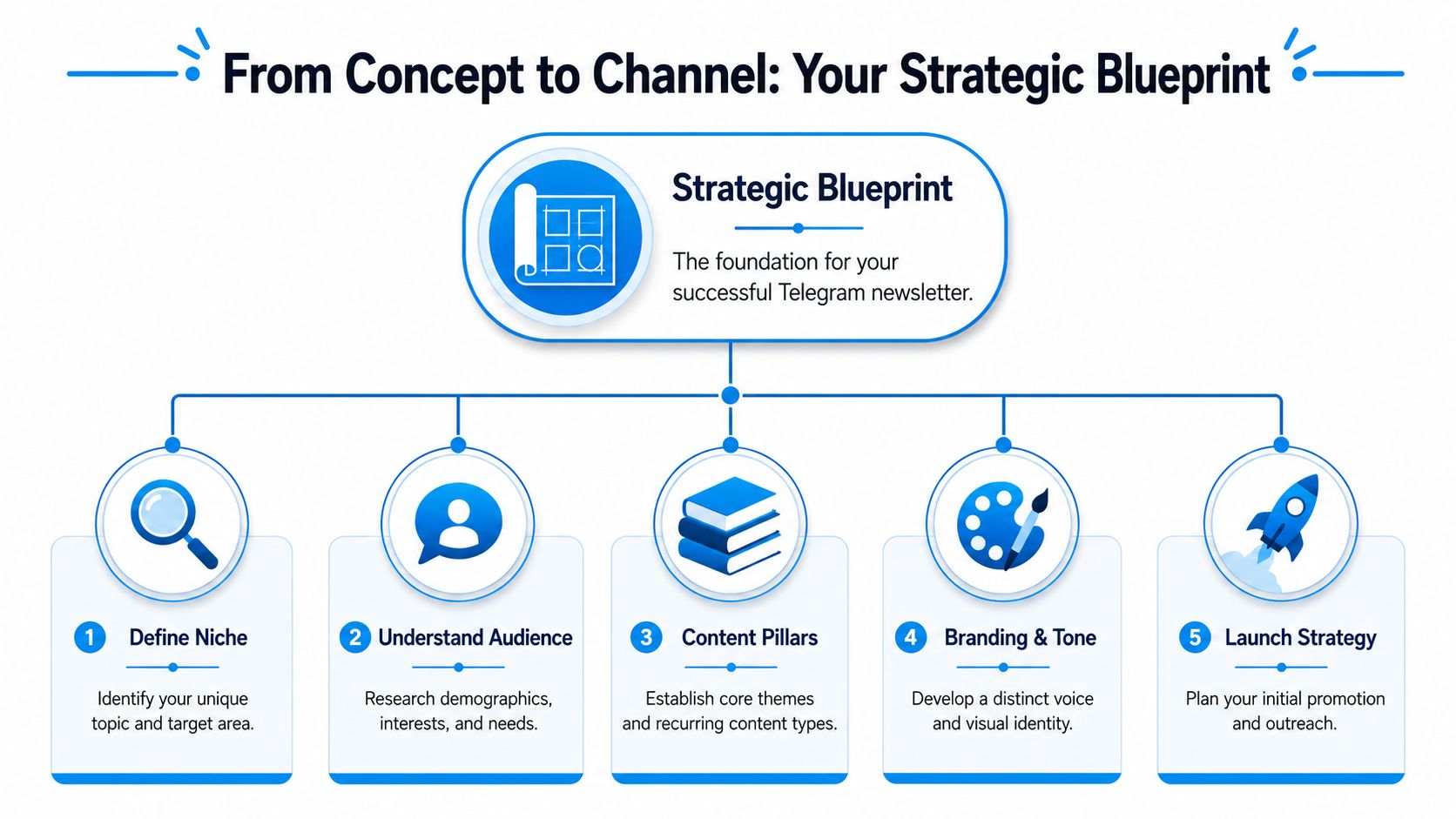
Start with market position. The three-phase Telegram marketing methodology suggests studying 10 to 20 competing channels before building anything. Look for gaps you can own:
- Coverage gap — others report events, nobody explains what changes next
- Format gap — others post long commentary, your audience wants short decision-ready briefs
- Audience gap — others write for peers, you write for buyers, operators, or local readers
- Trust gap — others edit, delete, and repost without a trace, while you keep content history clean
That last one gets ignored too often. On Telegram, editorial quality isn't only what you publish — it's how reliably you maintain it. If a post changes after publication or disappears, that pattern matters. This is why Statiko belongs in the stack: it shows edits, deletions, and performance patterns that are easy to miss when managing by instinct. Use channel search to pull up the competitors you're studying and compare them side by side.
Set your operating rules before launch. Without limits, every new idea gets published and the channel drifts. Decide up front:
- Primary promise — one sentence on why this channel deserves a place in someone's feed
- Core reader — a specific person, not a broad category
- Three content pillars — enough range to stay fresh, few enough to stay recognizable
- Posting cadence — a frequency you can hold without quality slipping
- Promotion rules — how often you pitch, sell, or run sponsor content
- Integrity rules — when posts can be edited, what gets a correction note, what gets deleted versus archived
I've seen channels grow fast, then lose credibility because old posts were rewritten or removed with no internal record. A newsletter operation needs memory. Otherwise optimization turns into guesswork.
Use phases, but keep them practical. In the foundation phase, aim for consistency — the methodology above recommends 3 to 5 posts per week with a mix of 50% educational, 30% entertaining, 20% promotional. A reasonable start: educational posts earn attention, lighter posts keep the feed readable, promotions work better inside an established rhythm.
In the optimization phase, partnerships, paid placements, bots, and mini-apps start to matter, because content alone rarely scales for long. This is also where weak operations show up: if one format drives views but gets heavily edited after publishing, or a post type attracts subscribers who never return, raw growth hides the problem. Statiko separates useful growth from noisy growth by showing what happened to the content itself, not just the view count. In the expansion phase, retention becomes the bigger job — the question is whether the channel still feels sharp and trustworthy at scale.
Define "good" before you publish: a good post fits a pillar, a good week matches your cadence, a good edit improves clarity instead of rewriting history. That's the difference between posting content and managing a publication.
Crafting Posts That People Actually Read
A subscriber opens your channel on a crowded commute, sees a wall of text, and moves on in under two seconds. Your posts compete with chats, alerts, and other channels in the same scroll. Clarity wins first, then structure, then proof.
Write for mobile attention. A post doesn't need to be short — it needs a clean point of entry. One benchmark from the Telegram management pitfalls guide: weak, generic messages consistently underperform concise posts built for mobile reading. The pattern:
- Line 1: the claim, tension, or new information
- Line 2: why the reader should care now
- Body: one idea per paragraph
- End: one action, question, or takeaway
Basic, but on Telegram clean formatting usually beats clever phrasing.
Lead with specifics or lose the click. Weak copy sounds like it was written for everyone: "We have some updates to share." Stronger copy gives a concrete payoff: "Three changes this week affected reach, reply quality, and sponsor demand." Subscribers judge relevance almost instantly; vague openings waste the only moment attention is available.
A quick editing rule: delete the first sentence and reread the post. If it improves, the opening was filler.
Formatting carries part of the load. Bold the phrase that needs to stick, break paragraphs before the eye tires, and add links only when they move the reader to the next useful step — like this guide on how to grow a Telegram channel with a repeatable content system.
Write to a defined reader. Generic, unpersonalized messaging hurts engagement. The fix isn't fake personalization — it's naming the reader's actual situation: a founder tracking competitor moves, an operator watching conversion quality, an analyst separating signal from noise.
That specificity also protects editorial integrity: if a post gets edited three times after publishing because the angle was unclear, the problem started in planning. I treat edit history as an editorial metric — Statiko shows which posts needed cleanup and which formats hold up without revision, so you improve the next issue instead of guessing from view counts.
Make media do a job. A screenshot proves a claim, a chart compresses a long explanation, a poll segments the audience — if the answer changes what you publish next. If you're implementing a paid Telegram funnel, this matters even more, because decorative content attracts clicks without helping conversion.
| Format | Best use | Common mistake |
|---|---|---|
| Image | visual proof, summary card, chart | decorative filler with no information |
| Video | walkthrough, reaction, demo | long clips without framing |
| Poll | audience segmentation, preference check | asking a question you won't act on |
| Link post | curated recommendation | dropping links without commentary |
The strongest posts do one thing well. Once a post tries to teach, entertain, sell, and provoke at the same time, it loses force.
Proven Strategies for Subscriber Growth
Most growth advice is either "post consistently" or aggressive promotion that ignores retention. Sustainable growth means matching acquisition to editorial fit — if the wrong people join, your metrics get noisy and future posts get harder to judge.
Partnerships beat random outreach. The key isn't finding the biggest channel; it's finding one whose audience already values what you publish. Adjacent positioning beats identical: a niche operator channel may send fewer people but better readers than a founder meme channel. Keep the pitch simple — state the overlap, offer a format (swap, feature, roundup inclusion), and don't force hard-sell language into a partner mention.
Build growth loops outside Telegram. If your model includes premium access, study how others are implementing a paid Telegram funnel — the lesson isn't "add a paywall," it's that public content should prepare people for the next level of value. The loop: publish a strong public post, turn the idea into a short asset for another platform, bring interested readers back, watch which topics retain best, repeat.
Make subscribers your distribution layer. Forwarding is the easiest growth to sustain, and it only happens when a post makes the subscriber look helpful, informed, or early. Shareable posts are easy to summarize in one sentence and low-friction to pass along. This guide on how to grow a Telegram channel works as a checklist for discoverability — adapt the parts that fit your niche instead of copying every tactic.
Growth tactics don't rescue weak positioning. They amplify whatever the channel already is.
Fix the channel surface first. Before spending energy on promotion: a channel name clear enough to parse in search results, a description that says what the reader gets, a pinned post that acts like a welcome issue, and a visual identity that's recognizable without being overdesigned.
Beyond Views Measuring What Truly Matters with Analytics
A familiar mistake: a post spikes in views, the team calls it a win, and a week later nothing changes. No lift in shares, no pattern worth repeating. That happens when a channel is managed like a feed. Newsletter operators review performance issue by issue — attention, distribution, retention, editorial consistency. Views are only the surface.
What Telegram gives you, and what it doesn't. As the overview of Telegram built-in statistics explains, built-in analytics only unlock above a follower threshold, and the reporting covers a short recent window. For a casual channel that may be enough; for a newsletter operation it usually isn't: historical comparison is weak, cross-channel benchmarking is limited, and edit and deletion history is missing entirely.
| Need | Native stats | Professional workflow |
|---|---|---|
| Quick performance snapshot | Good enough | Better with historical context |
| Cross-channel comparison | Limited | Needed for benchmarking |
| Edit and deletion history | Not built for this | Needed for integrity checks |
| Competitor monitoring | Minimal | Ongoing input for positioning |
| Long-horizon content review | Narrow view | Needed for strategy |
The two metrics that explain channel health. The Telegram analytics breakdown points to view rate percentage (are subscribers still opening what you publish?) and forward rate (is the post strong enough that readers distribute it for you?) as the core indicators. Review them beside subscriber movement over time. High views with no forwards usually means good timing or a strong headline; solid forwards plus steady net gains point to a repeatable theme — the difference between a post that was seen and one that moved the channel forward.
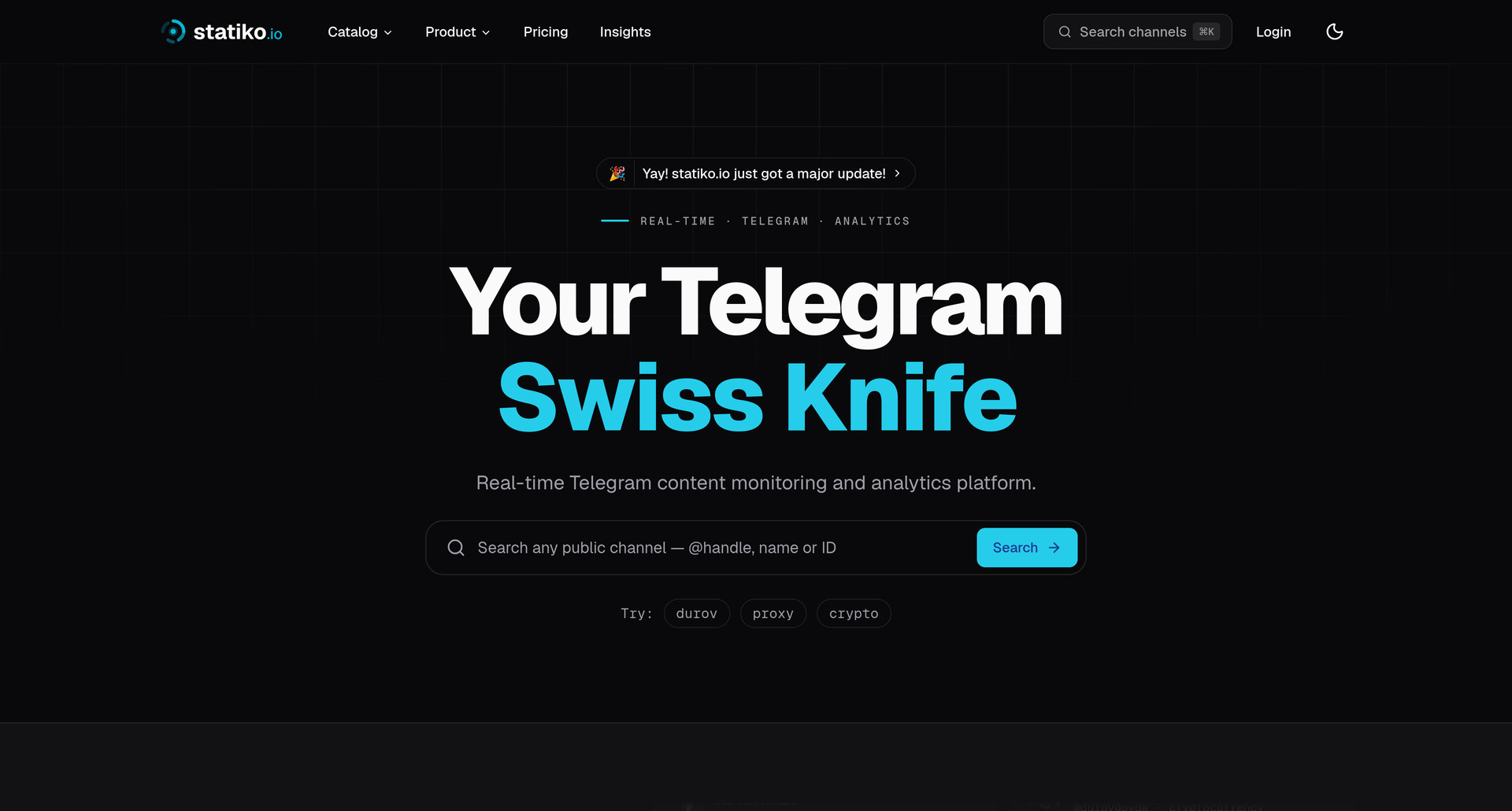
Why content integrity belongs in analytics. If a post was edited three times after publication, that matters. If weak promotions were deleted before the monthly review, or a competitor keeps quietly removing underperformers, that matters too. This is where Statiko becomes part of the working stack: it tracks public channel edits, deletions, posting patterns, and competitor behavior in one place, so you measure not only what performed but what had to be corrected or removed after going live.
Build a review habit, not just a dashboard. Dashboards create the illusion of control; review habits create better decisions. A practical cadence:
- After each post: log the topic, format, CTA, and any post-publication edits
- Weekly: review view rate, forwards, and outlier posts
- Monthly: compare content pillars, posting rhythm, subscriber movement, deletion patterns
- Quarterly: audit competitor shifts and whether the channel still matches its positioning
If you run Telegram alongside email, review subscriber quality across both — this article on strategies for growing your email list is useful for thinking through signup intent before those subscribers reach your Telegram newsletter. If you can't explain why a post worked or how often your content needed repair after publication, you're still managing by instinct.
Automating Your Workflow and Scaling Your Impact
A Telegram newsletter gets harder to manage when every task depends on memory. The most impactful improvement is usually workflow design — not more hustle, better systems.
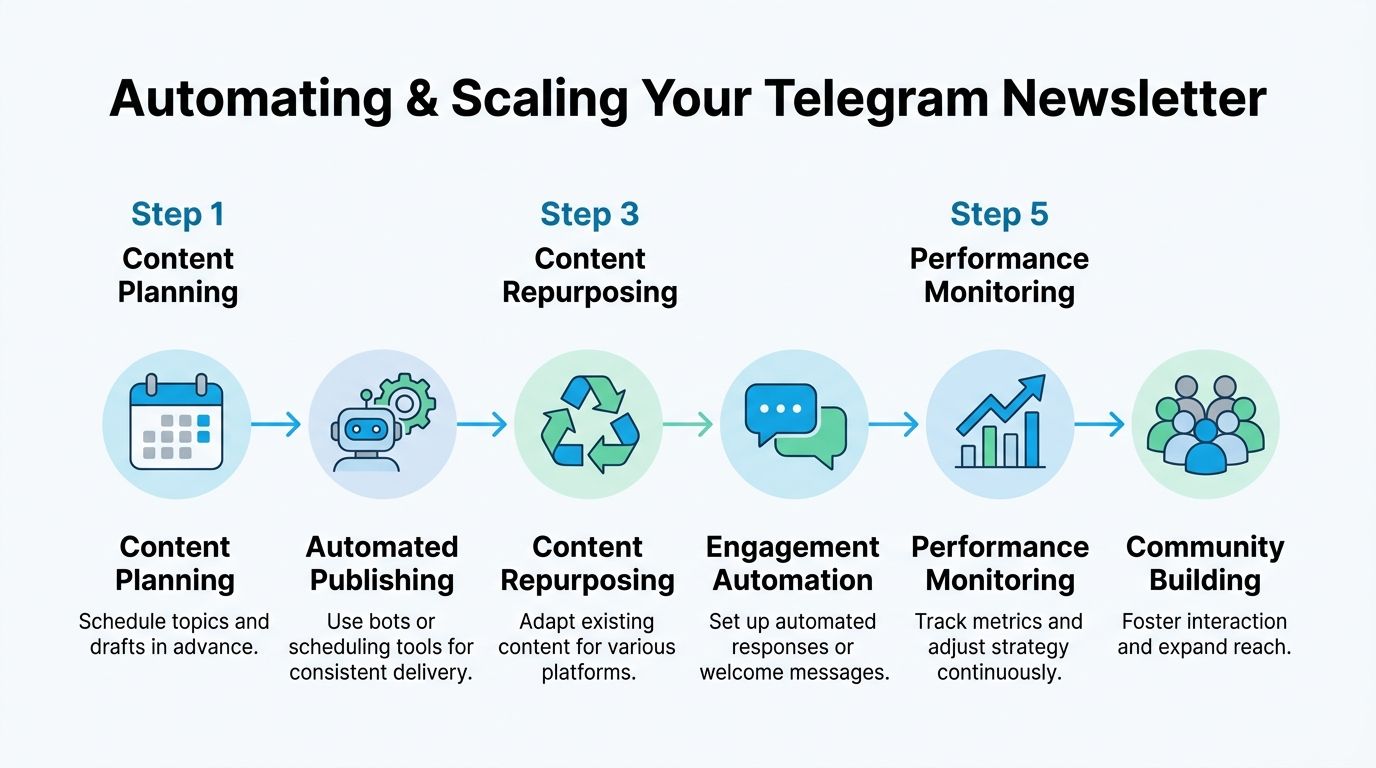
Automate the predictable parts while keeping editorial judgment human: batch and schedule posts, use bots to orient new readers, generate recurring recaps, and track competitor shifts without manually checking channels. Statiko's upcoming creator tools are built around this workflow — scheduling, content suggestions, and best-time-to-post analysis in one place. For a broader model, this effective social media posting guide covers repeatable publishing systems across channels.
Use automation to tighten the feedback loop. The point isn't convenience — it's speed of learning. A mature setup lets you publish, monitor, review, and adapt without rebuilding your process every week. Bots handle distribution timing, scheduled reports surface performance patterns, and AI-assisted channel digests can summarize your own channel or competing public channels so you don't read everything line by line. For teams building around bots, this overview of a Telegram channel bot workflow shows how notifications, publishing support, and analytics fit together.
The channels that scale cleanly reduce friction between insight and action. When your publishing process lives in a system instead of your head, the newsletter stays resilient — solo or with a team.
Statiko is one of those tools that becomes hard to work without once your channel moves beyond casual posting. It gives you a practical way to monitor any public Telegram channel, preserve edit and deletion history, review growth and engagement patterns, compare competitors, and generate AI-powered recaps without manually reconstructing what happened. If you want your Telegram channel newsletter to run like a professional publication instead of an improvised feed, start with Statiko.
Related posts

Master how to grow telegram channel using our proven 2026 framework. Get actionable steps for content, promotion, and analytics for rapid growth.

The complete guide to AI summaries, recaps and digests of Telegram channels — how they work, the four ways to get one, and seven recap formats.
Start in seconds.
Create a free account to organise channels, track activity, and get recaps delivered to you.
Real-time. Telegram. Analytics.