Telegram Channel Analytics: A Guide to Growth in 2026
Unlock growth with our guide to Telegram channel analytics. Learn to track key metrics, analyze competitors, and make data-driven decisions for your channel.

You open your channel, glance at the subscriber count, and feel stuck. The number is up from last month, but you can't answer the questions that matter. Which posts made people stay? Which ones got edited or deleted after they spread? Why does a competitor on the same topic punch harder with fewer posts?
Telegram gives you visible signals, not a full picture. You can see motion — not cause, sequence, or hidden corrections.
That blind spot matters. With over 950 million monthly active users, Telegram channels have become powerful media outlets, yet fewer than 10% of channel admins use dedicated analytics tools beyond the native interface according to Statiko's overview of Telegram channel analytics adoption. Most admins are running public media assets on a dashboard built for quick checks.
Useful Telegram channel analytics starts where vanity metrics stop. Subscriber totals and raw views are the surface. The layer worth working in is channel intelligence: post-level behavior over time, patterns across topics and formats, competitor tracking, and the hidden history of edits and deletions.
Introduction Beyond Subscriber Counts
A healthy channel doesn't always look healthy. Some channels add subscribers while content quality slips. Others look flat but keep getting forwarded, cited, and revisited.
The mistake is treating the subscriber line like a verdict. It's a lagging indicator.
If your dashboard tells you what happened but not why, you don't have analytics yet. You have instrumentation.
Public channels leave traces basic dashboards miss. Posts get edited after publication. Messages disappear. Some formats attract views but no distribution; others spread even when raw views look ordinary. Three questions separate strong operators from everyone else:
- What survived attention? Which posts held interest after the first wave of views.
- What spread beyond the channel? What got forwarded, cited, or copied into adjacent conversations.
- What changed after publication? Silent edits and deletions often reveal more than the original post.
Read channels that way and analytics stops being a reporting task. You're not counting messages — you're reconstructing behavior.
Defining Telegram Channel Analytics
Telegram channel analytics is turning public channel activity into usable decisions. At the basic level: reading views, forwards, and audience movement. At a serious level: tracking how content performs over time, how revisions alter meaning, and how one channel's behavior compares with another's.
Native analytics is a speedometer — it tells you the vehicle is moving. Professional analytics is closer to a diagnostic report: it says which system is under strain, what changed recently, and what breaks next if nothing changes.
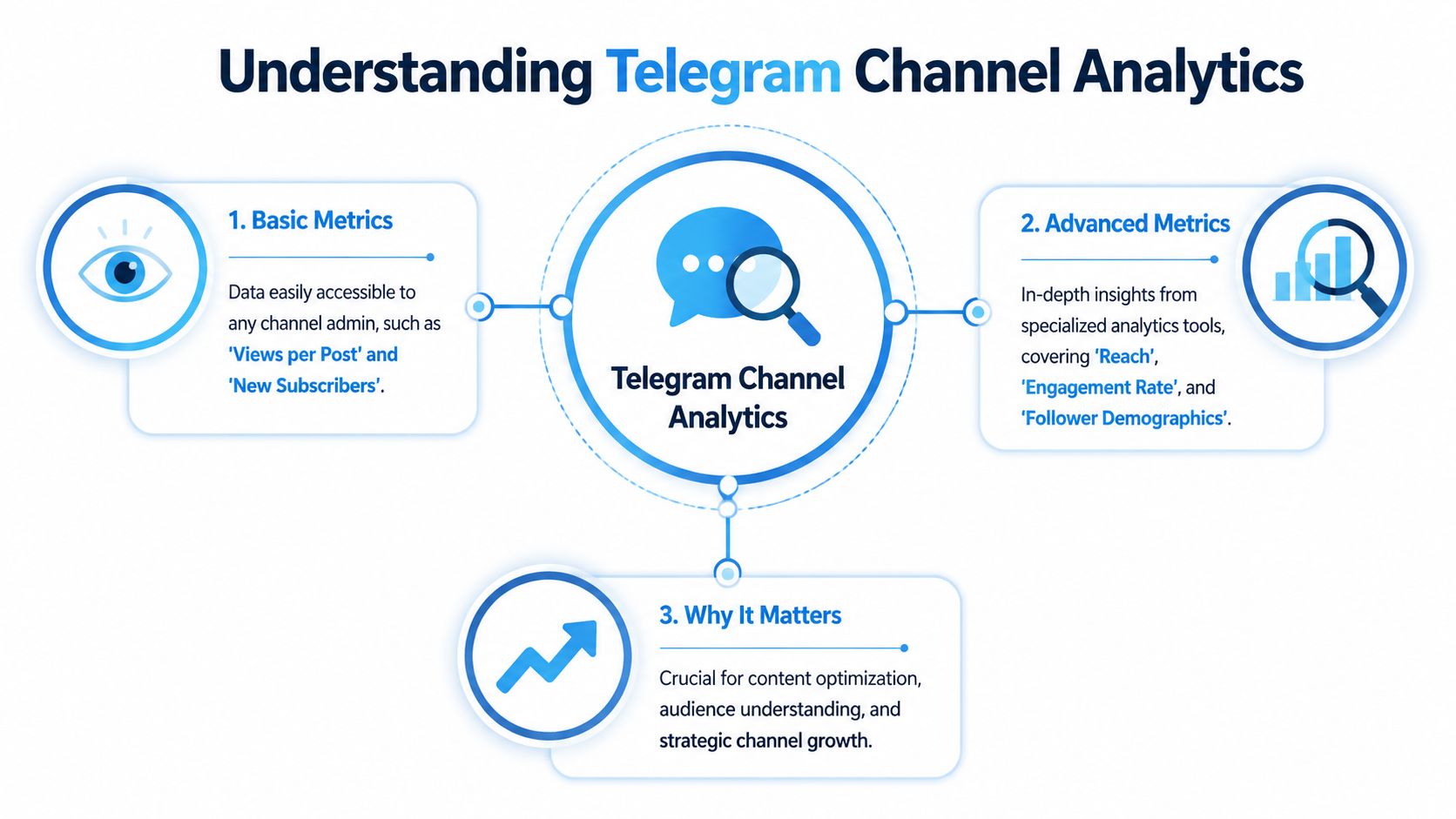
Basic analytics covers the visible layer: views per post, subscriber movement, forwards and reactions. Good for daily operations — did today's post land better than yesterday's — but it says nothing about structural performance.
Deeper analytics focuses on context, sequence, and hidden changes:
- Content decay — how quickly attention falls off after publication.
- Relative performance — was the post strong for that channel, not just in absolute numbers.
- Retention signals — which post types precede unsubscribes or audience cooling.
- Edit and deletion history — was a post rewritten, softened, corrected, or removed.
- Cross-channel comparison — cadence, topics, and structure versus rivals.
- Pattern recognition — recurring behaviors humans miss in manual review.
Native stats answer "did people look?" Better analytics answers "what did this post do in the system?" A post can underperform on views and still matter strategically — if it shapes later content or triggers a chain of deletions.
Once you're tracking that much detail, the next step is packaging it. The monitoring and reporting guide covers the metric groups, anomaly checks, and review cadence that turn raw numbers into something a team can act on.
Key Metrics for Understanding Performance
Every useful number on Telegram has a shadow question behind it. Start with the native metrics, but know what each one can't tell you.

The same problem exists on every platform — this friendly guide to Instagram insights shows it in a different environment: visible metrics help, but they don't explain content quality or audience intent.
Views are the most overvalued metric. They show a post attracted initial attention, not whether anyone found it persuasive or worth sharing. A high-view post may just have good timing or a strong headline.
Forwards mean more — someone decided the post deserved to travel. But you still don't know whether it moved because it was useful, inflammatory, or easy to repurpose.
Subscriber growth is the easiest signal to misread. Growth can follow a strong content cycle, an outside mention, or a burst of curiosity. Without post-level context, a rising line can hide weak retention.
| Metric | What it shows | What it misses |
|---|---|---|
| Views | Initial attention | Whether the post changed behavior |
| Forwards | Distribution | Why people shared it |
| Subscriber growth | Audience movement | Which content earned or harmed retention |
The dark matter metrics
Engagement rate — compares response against visibility. A post with ordinary views can still be a strong performer if the audience that saw it acted on it.
Retention signals — channels don't just grow, they train their audience. If certain themes repeatedly precede cooling interest or churn, the problem isn't one bad post. It's a content mismatch.
Edit history — one of the most underused metrics in public-channel analysis. A post rewritten after publication means the first version wasn't stable. Corrected facts, a toned-down claim, wording optimized after weak pickup — the version trail exposes the gap between what a channel first said and what it wanted archived.
Deletion history — even more revealing. Deletions can mean error correction, reputation management, campaign cleanup, or a failed test. When analyzing competitors, a pattern of removals often tells you more than their greatest-hits list.
To move past simple post ranking, learn to measure content performance with more context — especially when visible reach and strategic impact don't match.
A short visual walkthrough:
When I'm decoding a public channel quickly, I skip the top-viewed post and look for three things: content that kept traction after its first burst, revisions that changed meaning, and messages that vanished. Deletion is often a signal of pressure, not housekeeping.
From Data to Decisions How to Interpret Metrics
Single metrics rarely tell a clean story. Combinations do.
- High views, low forwards — the packaging worked better than the payload. Curiosity without pass-along value.
- High forwards, modest views — niche content with strong shareability. Build for precision, not volume.
- Audience growth after a topic cluster — you found a topic fit, not just a lucky post.
- Subscriber softness after a recurring format — the format may be exhausting your audience.
- Repeated edits on the same type of post — you may be publishing too early and correcting in public.
None of these should trigger a snap judgment. What matters is recurrence. One spike is noise. A pattern is behavior.
Interpreting competitors without guessing
Most competitor analysis on Telegram fails because people fixate on visible winners — copy the topic, mimic the formatting, wonder why it falls flat. Better to infer the operating model:
- What do they publish repeatedly, even when it doesn't go viral? That's their true strategic pillar.
- Which posts get revised or removed? That's the friction in their editorial process.
- When do they publish for reaction versus authority? Usually different post styles.
- Which themes attract new attention, and which maintain loyalty? Healthy channels use both.
The same metric pattern means different things depending on whether the channel exists for brand awareness, lead generation, or community retention.
Strong analysts don't ask whether a post was "good." They ask what role it played — attract, deepen trust, spread, provoke correction. A useful habit: write a one-line interpretation beside every notable post. Not "performed well," but "strong initial interest, weak propagation." Do that consistently and channel behavior becomes legible fast.
Actionable Analytics Workflows for Growth
Good analytics isn't a one-time audit. It's a repeatable loop that shortens feedback cycles and builds a record of what your channel responds to.
Weekly content performance audit
Run this weekly on your own channel. Keep it short enough that you'll actually do it.
- Pull the week's posts into one view. The full set, not your favorites.
- Mark outliers. Unusually strong or weak attention, heavy forwarding, visible reaction.
- Check for hidden instability. Edited posts, removed posts. A post that needed correction belongs in the review even if its metrics looked good.
- Compare by format and topic. Explainers, news reactions, visual posts, and promos don't serve the same purpose — don't judge them as if they do.
- Write one operational takeaway. Example: "Short explainers on one recurring topic spread better than late-day commentary."
Competitor benchmark routine
This is where most operators gain the biggest edge. You don't need to copy competitors — you need to decode them. Pick a small set of public channels that overlap with your audience, then review:
- Posting rhythm — steady, bursty, reactive, or event-driven?
- Message construction — concise, threaded, visual, provocative?
- Revision behavior — do they edit after publication? Do deletions cluster around specific topics?
- Posture — optimizing for authority, urgency, utility, or identity?
A platform like Statiko streamlines this: it tracks any public channel, preserves edit and deletion history, and surfaces AI-driven patterns that are hard to catch manually across multiple channels. A competitor's deleted posts are often more instructive than their successful ones — success shows what they want you to see, revisions show what they had to fix.
Content hypothesis testing
Once you've audited yourself and benchmarked rivals, stop making broad changes. Test one hypothesis at a time.
- State it clearly. "Audience responds better to concise tactical posts than broad opinion posts."
- Define what varies. Topic, structure, timing, format, or tone — one thing.
- Keep the rest stable. Change everything at once and you learn nothing.
- Review visible and hidden outcomes. Did it hold attention, get redistributed, or need later edits?
- Log the result. Even inconclusive ones.
The channels that improve fastest run a simple cycle: audit last week's output, benchmark a small competitor set, run one controlled test, record what changed (including edits and removals), repeat. Subscriber count is the scoreboard. These workflows show you how the game is being played.
Choosing Your Analytics Toolkit
Native analytics is fine for quick self-checks. It falls apart as soon as you need historical context, competitor monitoring, or proof of what changed after publication. If your work depends on understanding public channels professionally, your toolkit has to answer what native stats can't: which posts were edited after circulating, which messages disappeared, how one channel's topic mix compares with another's.
| Feature | Native Telegram Analytics | Statiko Platform |
|---|---|---|
| Data history | Basic native view of current and recent performance | Continuous daily snapshots over time |
| Competitor tracking | Not designed for structured cross-channel analysis | Tracks any public channel without ownership login |
| Edit and delete history | No preserved version trail | Preserves every version and deletion history |
| Cross-channel comparison | Limited | Built for channel intelligence and comparisons |
| AI-driven insights | No pattern summaries | AI recaps and pattern detection for public channels |
| Access scope | Your own eligible channel data | Public channels only, including channels you don't own |
The trade-off is simple: native analytics is immediate and convenient; dedicated analytics gives you memory, comparison, and forensic visibility.
Analysts working in public-channel environments often borrow methods from open-source research. For that mindset, this guide to OSINT tools for digital privacy frames how public data can be gathered and interpreted responsibly.
What to look for in a tool — skip the dashboard polish and check four things: can it monitor channels you don't own, can it preserve edits and deletions, can it summarize patterns instead of just listing posts, and can it support monitoring over time.
The landscape, by job. Most Telegram tools are one of three things wearing an analytics label: an analytics platform, an ad marketplace, or a directory. Knowing which you're looking at saves a lot of evaluation time.
| Tool | Type | Best for | Cost |
|---|---|---|---|
| Statiko | Analytics + discovery | Growth tracking, edit/deletion history, AI insights | Free |
| TGStat | Analytics directory | Competitor benchmarking and audience vetting | Freemium |
| Telemetr.io | Analytics platform | Fraud detection and ad-buy due diligence | Freemium/paid |
| Telega.io | Marketplace | Handpicking channels for targeted ad buys | Per-post pricing |
| TGList.io | Directory | Quick initial channel discovery | Free |
| TgLib | Directory | Finding niche and non-English channels | Free |
| DirectoryTG | Curated directory | Exploring channels, bots, and sticker packs | Free |
Directories answer "does this channel exist and roughly how big is it." Marketplaces answer "what would it cost to advertise here." Only analytics platforms answer "what has this channel been doing over time," and only some of those preserve what changed. For the full head-to-head, see the best Telegram channel monitoring tools; for where Telegram sits in a wider stack, this comparison of monitoring tools and social listening suites.
Getting started — pick one public channel to audit (yours or a competitor's), following the pre-buy channel audit checklist if money is involved. Track one month of visible performance and hidden changes, then turn observations into decisions: cut one weak format, repeat one durable format, watch whether the channel stabilizes.
The right toolkit changes what you're able to see. On Telegram, the most useful signals are often the ones that weren't meant to remain obvious.
Frequently Asked Questions
Is it legal and ethical to analyze public Telegram channels? Yes — you're observing information channel owners chose to publish openly. Stay within public data, don't claim private access, don't misrepresent the record. It's observation, not intrusion.
Can I analyze private channels or groups? No. Private channels, groups, and DMs are outside the scope of responsible public monitoring. If a tool claims visibility into private Telegram spaces, be skeptical.
What's the difference between free and paid analytics tools? Free tools cover the visible layer well enough for casual checks. Paid tools add history, monitoring continuity, and competitor comparison — the missing context around edits, deletions, and cross-channel patterns.
Do I need advanced analytics if my channel is still small? You need a method more than a stack. Smaller channels often improve faster because patterns are easier to spot when you can review every post closely.
What is the most overlooked Telegram metric? Edit and deletion history. Most admins focus on what's visible now. Serious analysts care about what changed after publication — that's where uncertainty and strategic recalibration show up.
If you want to analyze public Telegram channels with more than native surface metrics, Statiko is built for that use case. It tracks any public channel without requiring ownership, preserves edit and deletion history, and uses AI recaps to surface patterns, anomalies, and content shifts that are easy to miss in manual review.
Related posts

The complete guide to monitoring Telegram channels — the three layers of monitoring, building a watchlist, alerting without fatigue, and 10 tools compared.

The complete guide to AI summaries, recaps and digests of Telegram channels — how they work, the four ways to get one, and seven recap formats.
Start in seconds.
Create a free account to organise channels, track activity, and get recaps delivered to you.
Real-time. Telegram. Analytics.