WhatsApp and Telegram: The Ultimate 2026 Creator Guide
Deciding between WhatsApp and Telegram for your channel? Get an in-depth comparison of features, analytics, and growth strategies for creators and marketers.
You've hit a familiar wall. Organic reach on the big platforms is unstable, ads keep getting pricier, and you want one channel you can actually build on. The shortlist narrows fast: WhatsApp or Telegram.
Both let you message people directly. Both support groups. Both feel more personal than a feed. But the real question isn't which app looks nicer — it's which one matches the audience relationship you're trying to build.
Want high-touch communication with people who already know you? One platform fits. Want scalable distribution, public communities, and visibility into what other publishers are doing? The other has the edge. Most comparisons never get past feature lists or privacy slogans to say that plainly.
You're not picking a messenger. You're picking a distribution model, a moderation workload, a discovery path, and an analytics ceiling.
The Creator's Dilemma: WhatsApp or Telegram
Most creators don't start with a platform thesis. They start with friction.
You post good content, people ask for a private group, and the operational questions land all at once. Can this scale? Can moderators keep up? Can you measure any of it? Can you see what competitors are doing?
WhatsApp works best when the relationship already exists — people know the brand or the organizer and want to stay in a smaller circle. Telegram leans toward an open, broadcast-first model that suits creators, publishers, and brands that treat messaging as a media channel, not just a support line.
The hidden decision behind the app choice — the visible comparison is features; the real one is operating model. WhatsApp favors retention over discovery, built for conversations among people who already know each other. Telegram favors distribution over intimacy, giving admins more room to publish and expand in public. On one platform your job is relationship maintenance; on the other, it's channel management.
Practical rule: Choose WhatsApp when access is the product. Choose Telegram when reach is the product.
That distinction shapes onboarding, moderation staffing, publishing cadence, and reporting. A premium coaching cohort has different needs than a public alerts feed. Get it wrong and the failure isn't immediate — it shows up later as growth you can't manage and a channel you can't measure.
Reach vs. Community: Two Platform Philosophies
WhatsApp built its dominance on private communication. It hit 2 billion monthly active users in February 2020, had already been the leading mobile messaging app since 2014, and handled roughly 100 billion messages a day that year — with India (400 million users) and Brazil (120 million) as anchor markets, per Lime Technologies' WhatsApp statistics overview.
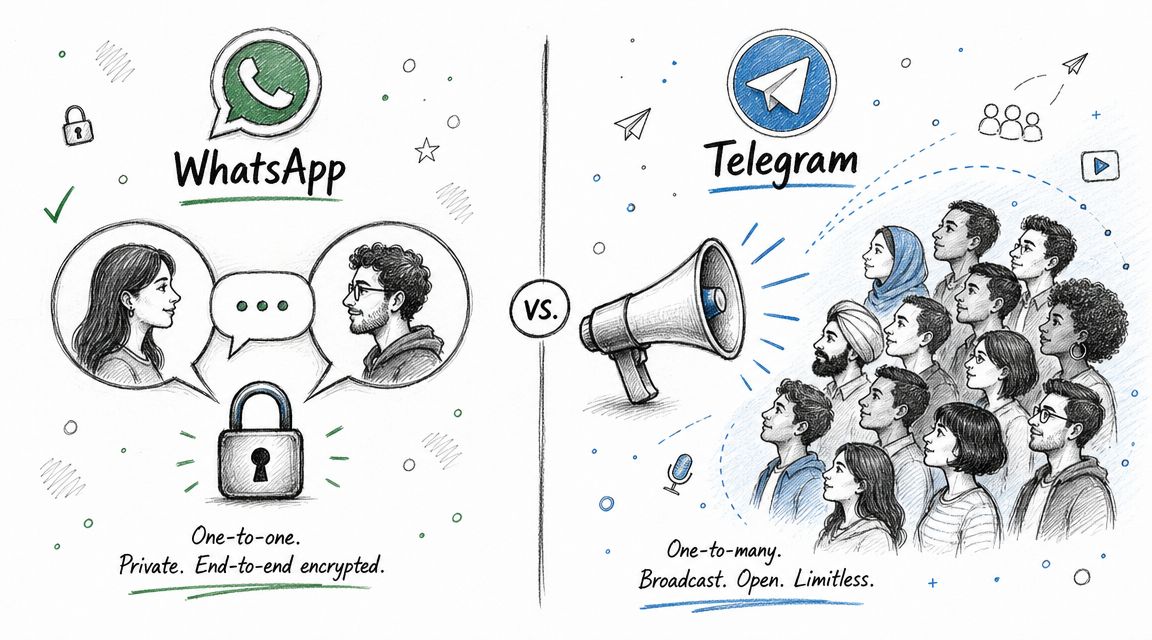
That scale doesn't mean public reach for creators — it means the app is embedded in everyday communication, useful for meeting people where they already talk to friends and colleagues, less useful if your growth model needs open discovery.
Telegram's numbers point elsewhere. It crossed 1 billion monthly active users in March 2025, climbing from roughly 200 million, then 700 million, then 950 million along the way. One estimate puts it at 43% of the global online population outside China — a global platform, not a niche messenger, according to SQ Magazine's Telegram statistics roundup.
Private network vs. public distribution — WhatsApp behaves like a private network layer: people open it because they already have someone to talk to, which is why it works for support and trust-first member groups. Telegram behaves more like a distribution system with messaging features attached, extending naturally into channels and creator-led publishing — so your operation ends up looking more like a media property than a group chat.
A marketing team weighing the two should ask three questions:
| Decision factor | Telegram | |
|---|---|---|
| Primary relationship model | Existing contacts and known communities | Public or semi-public audience growth |
| Best use case | Retention, support, smaller circles | Broadcast, discovery, large communities |
| Team mindset required | Community care | Media operations and channel strategy |
The bigger installed base isn't automatically the better growth platform. The better one is whichever platform's structure matches how people find, join, and consume your content. WhatsApp and Telegram aren't substitutes — they solve different problems.
A Feature Showdown for Channels and Groups
Product philosophy becomes real in admin panels and member limits. Here's the comparison, before opinion gets in the way:
| Capability | Telegram | |
|---|---|---|
| Group size | Up to 1,024 members | Supergroups up to 200,000 members |
| Live video participation | Up to 32 people | Up to 1,000 participants |
| Best fit | Smaller private communities | Large-scale communities and broadcasts |
These limits, via YollaCalls' WhatsApp vs Telegram comparison, shape more of the day-to-day experience than most people expect.
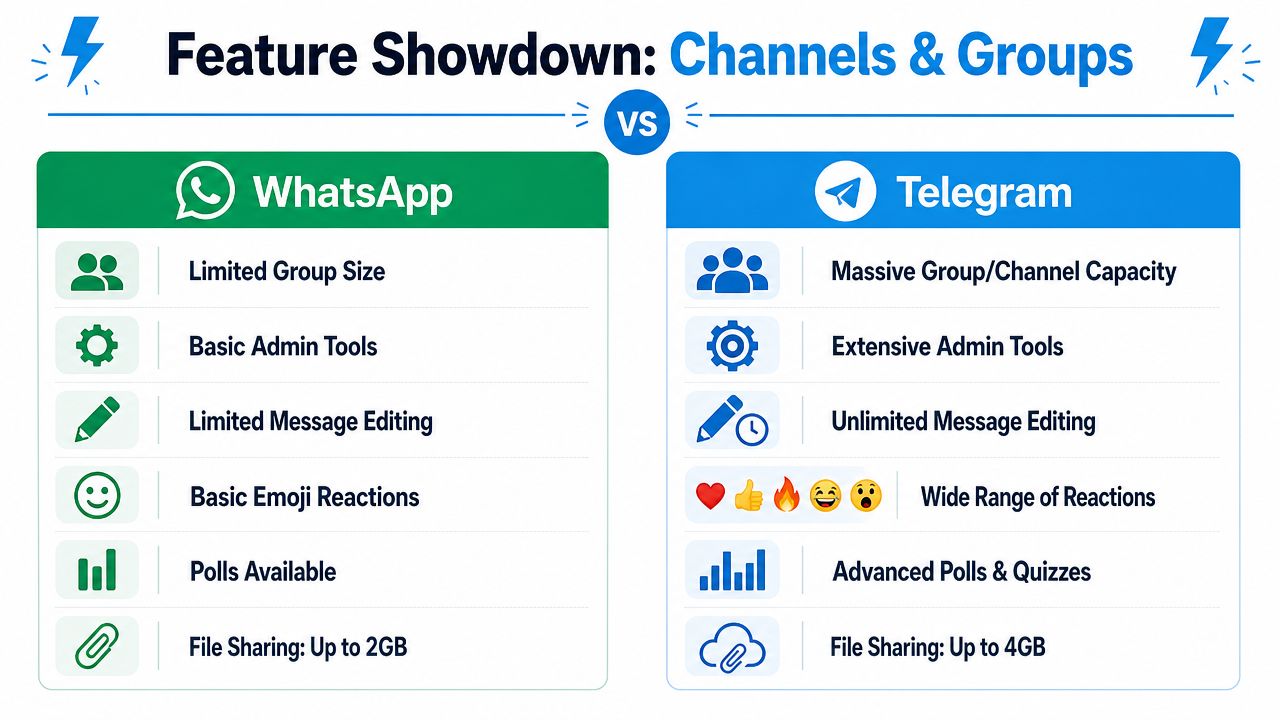
Scale changes what you can run. On WhatsApp you tend to publish for a narrower audience — updates and reminders that feel closer to direct messages, and harder to segment once a group gets active. Telegram's larger caps let you separate broadcasting from discussion and run something closer to a continuous feed: launches, recurring series, event commentary, niche communities that need room to grow. For the tactical breakdown, see this guide to Telegram channels vs groups — it focuses on how format affects publishing and participation.
Admin experience beats headline features. WhatsApp suits compact communication loops — keeping a customer circle warm, sharing updates, staying in direct contact. Telegram supports layered design: broadcast content, moderated discussion, and event-style communication that fit together naturally. Video capacity matters here too — a team wanting live interaction beyond a small room hits WhatsApp's ceiling fast. A recurring town hall or creator Q&A stays native on Telegram at real scale; on WhatsApp it stays small or moves elsewhere.
Here's a quick product walkthrough of the operational gap:
Most comparisons stop at "Telegram supports bigger groups." The real point: WhatsApp is optimized for contained communities, Telegram for scalable audience architecture, and the right call depends on whether you're hosting members or publishing to a market.
If your plan includes public distribution and audience expansion, Telegram's structure supports that directly. If it depends on closeness and controlled membership, WhatsApp stays simpler.
Moderation, Automation, and Admin Control
Community quality depends less on member count than on how fast admins can enforce norms.
WhatsApp keeps moderation manual, which works fine in small groups — human and direct. Once a group gets busy, moderation starts eating staff time: removing spam, repeating rules, handling edge cases one by one.
Telegram gives operators more controls, which matters once you want predictable systems instead of constant intervention. High-volume moderation usually needs four things: automated onboarding (welcome messages and posting rules without an admin repeating themselves), spam filtering (junk has to disappear fast or signal quality drops), permission layering (not every moderator needs the same authority), and routine enforcement (repeat violations need a process, not improvisation).
Telegram's bot ecosystem makes those workflows realistic — bots that greet members, filter keywords, enforce pacing, and route repetitive tasks away from humans. If you're already mapping campaigns across platforms, pairing this with broader tools for social media content planning keeps publishing and moderation from drifting apart.
Manual moderation feels manageable until a launch, event, or news cycle makes the community active — then the issue isn't spam, it's coordination. Start with common Telegram bots for groups: they turn Telegram from a chat app into an operational environment, standardizing repetitive actions and keeping public spaces coherent.
Strong moderation tools protect editorial consistency, not just community health. A noisy channel makes every post less effective.
WhatsApp still works fine where moderation needs are low — a paid cohort or alumni group may not need any automation. But if your growth model assumes open inflow or a broad public community, manual admin effort becomes the bottleneck long before content quality does. WhatsApp asks people to manage people. Telegram lets teams manage systems.
Measuring What Matters: Analytics and Intelligence
A message gets strong anecdotal feedback, another seems quiet, a competitor's channel looks more active — and if you can't answer "what's actually working" with evidence, content planning slips back into guesswork.
WhatsApp is built for direct communication, not rich public measurement, which creates a blind spot for teams trying to evaluate performance or benchmark competitors. Telegram moves further in the right direction because public channels create observable signals — for your own review, and for competitive intelligence beyond self-reporting.
Public channel behavior lets marketers ask sharper questions: content patterns (announcements, commentary, recaps, clips?), cadence (bursts, fixed rhythm, tied to events?), revisions (are they editing after publishing?), deletions (are certain formats pulled more often?). Messaging channels often compress a brand's whole strategy into one feed — what they promote, how they frame offers, when they shift tone.
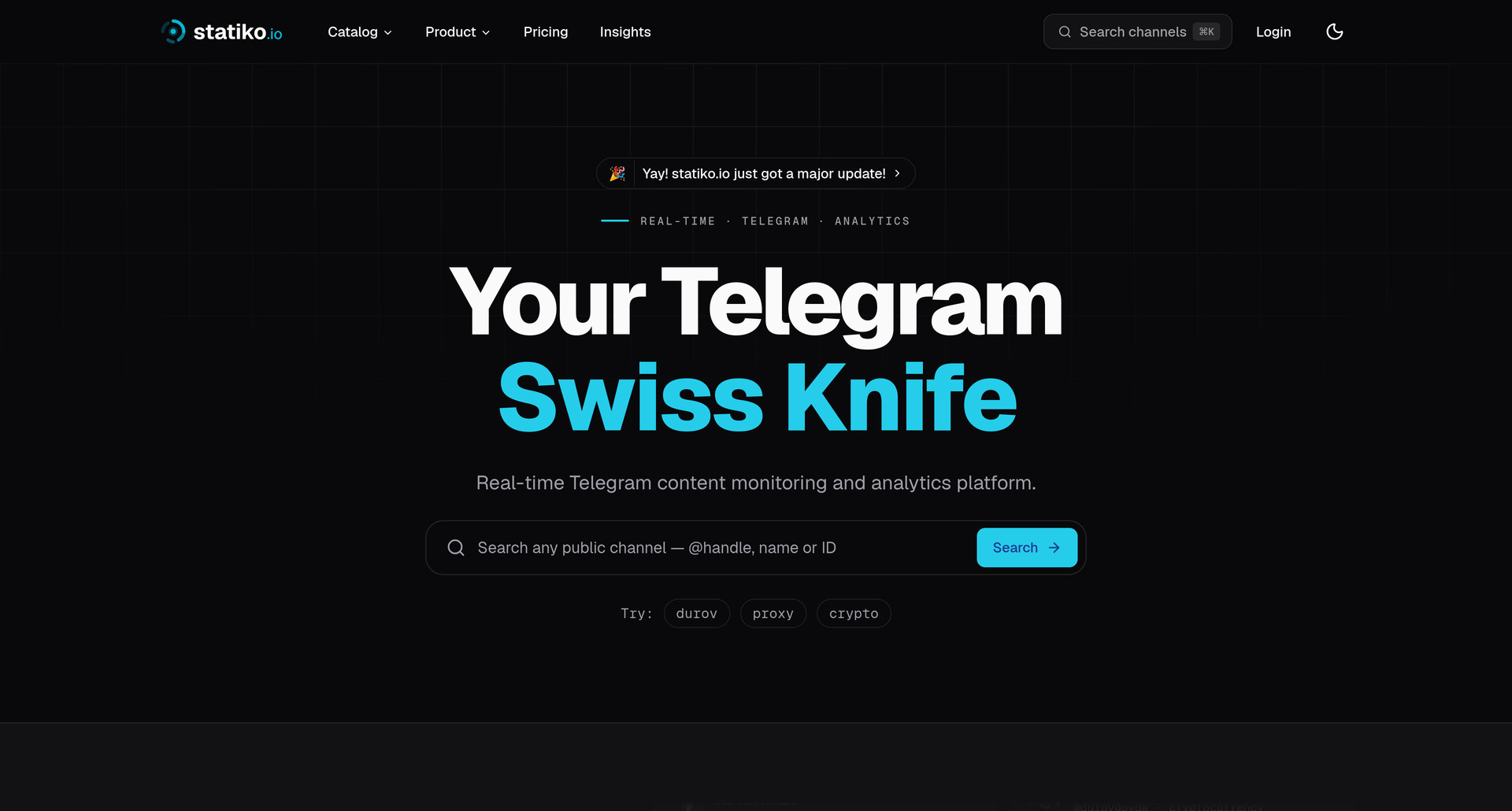
This is the angle most comparisons miss: Telegram's real advantage for marketers isn't community size, it's transparency around public content behavior. Statiko tracks public Telegram channels, preserves edit and deletion history, and lets you analyze posting patterns, growth signals, and comparable channels — all without touching private chats or DMs. That's what turns Telegram into something close to a measurable media environment.
The platform that exposes more public behavior gives your team more room to learn, benchmark, and adapt.
WhatsApp is still the right call when closeness is the goal. But for an analyst or growth team, it offers far less visible surface area for learning from the market.
The Real Privacy Tradeoff: Metadata vs. Content
Privacy talk usually collapses into one question: is the message encrypted? That's incomplete.
The Digital Forensic Research Lab's analysis of point-to-point messaging apps notes that WhatsApp is end-to-end encrypted but still collects significant usage metadata, while Telegram collects minimal usage data. That's a different tradeoff — content privacy versus what the platform can observe about your social graph and usage patterns.
For creators and brands, the issue isn't just message secrecy — it's the surrounding data environment. Metadata (who's connected to whom, when people are active) can reveal audience relationships even when content stays protected. Telegram's public channels are open by design, but only for content publishers chose to show — which turns the question into "what public footprint do you want." The split between Telegram's cloud chats and Secret Chats is the other half of that picture, since only one of the two keeps the platform out of your message content.
Privacy isn't a single slider. It's a tradeoff between content confidentiality, platform visibility, and behavioral data exposure.
Measuring public Telegram channels isn't the same as inspecting private conversations — it only covers content publishers already chose to show, which is why transparency here doesn't have to be invasive. On the WhatsApp side, operational security for customer communications still deserves attention; see this guide to essential tips for securing WhatsApp data if your team runs business contact through it.
Choosing Your Strategy: Dual Presence or Full Migration
Need direct contact with customers or members in a familiar environment? WhatsApp is the safer default. Want a scalable audience hub with stronger public distribution? Telegram fits better.
Dual presence works when your audience has different expectations at different stages of the relationship: WhatsApp for closeness (support, premium groups, local communities), Telegram for top-of-funnel publishing (public updates, thought leadership, scalable growth). Let Telegram attract attention and WhatsApp deepen trust for people who want direct access.
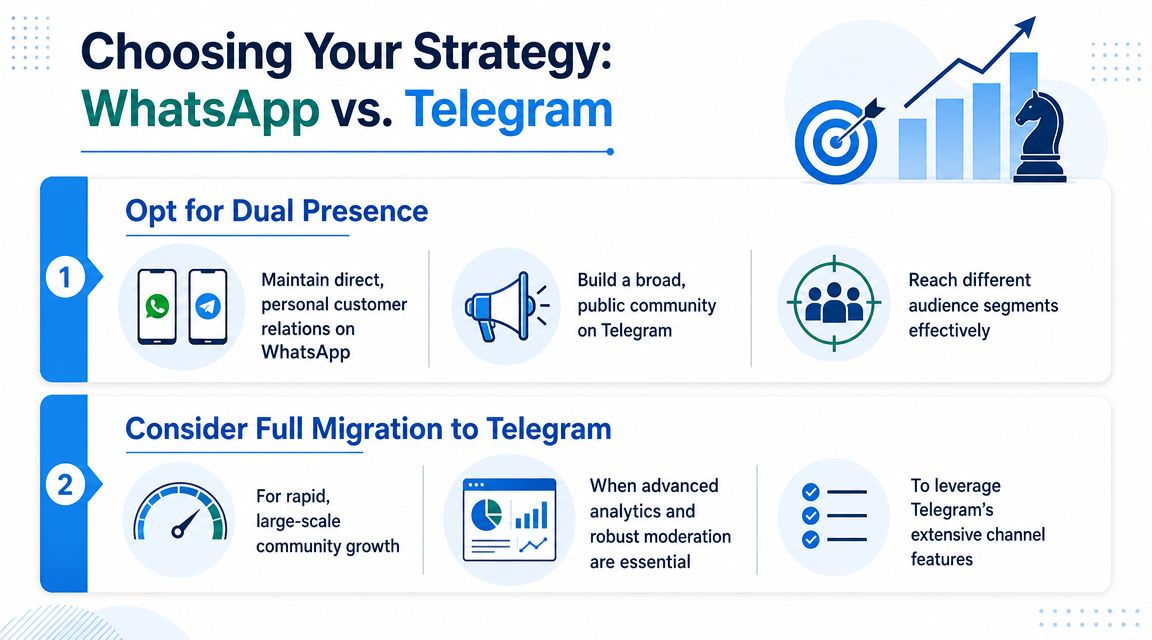
Full migration to Telegram makes sense once messaging becomes a media operation rather than a customer-contact layer — public content archives, larger communities, moderation systems, measurable competitor visibility. During migration, account setup and verification across markets matters; temporary numbers for SMS verification can help during testing or provisioning.
A short migration checklist: move your most repeatable content first, keep the joining path obvious from existing channels, decide whether discussion lives in the same place as distribution, brief moderators before you scale promotion, and track what audiences engage with after the move.
The conclusion isn't that one platform wins. WhatsApp and Telegram serve different layers of the funnel. WhatsApp keeps relationships warm. Telegram turns messaging into a public content system.
If Telegram is part of your growth strategy, Statiko can help you monitor public channels, review edit and deletion history, compare competitors, and understand content patterns without accessing private chats or groups. For marketing teams that want clearer visibility into Telegram publishing, that makes channel decisions easier to evaluate.
Related posts

Deciding on Telegram channels vs groups? Our 2026 guide compares features, use cases, analytics, and privacy to help you make the right strategic choice.

Discover the 12 best Telegram bots for groups to automate moderation, engage users, and get analytics. A complete guide for community managers.
Start in seconds.
Create a free account to organise channels, track activity, and get recaps delivered to you.
Real-time. Telegram. Analytics.