TG Picture Stories: A Guide to Visual Storytelling
Learn to plan, create, and measure engaging TG picture stories. This guide covers visual narrative, best practices, and using analytics for Telegram growth.
You're probably already posting images on Telegram — a launch photo, a screenshot dump, a behind-the-scenes Story, maybe an event gallery. The problem usually isn't effort. It's structure. Most image posts don't land because they aren't built as stories, so viewers get fragments instead of a narrative.
That's where TG picture stories come in — a working system for turning visuals into something people can follow, remember, and act on. On Telegram that means two things: the native Stories feature, and a planned sequence of images inside a regular channel post. They solve different jobs, and mixing them up is the first mistake most channels make.
Treat visuals this way and you get clearer signals back — which frame pulled attention, which sequence held together, which edit changed how a post read. That beats asking whether one image was "good."
Understanding the Power of Visuals on Telegram
A channel owner posts the same event two ways in one day: a Story during the event with quick frames while attention is hot, then a permanent multi-image post that shows what happened and why. Not duplicate assets — different jobs.
Telegram Stories are the platform's native temporary format, introduced in 2023 with privacy controls, editing tools, and view statistics. Stories last 6, 12, 24, or 48 hours, per Telegram's Stories tour. Use them when recency, selective visibility, or fast feedback matters.
Sequential picture storytelling is Telegram's other format — not officially labeled, but an editorial system. Images appear in a deliberate order so a viewer can follow context, action, proof, and conclusion without extra explanation.
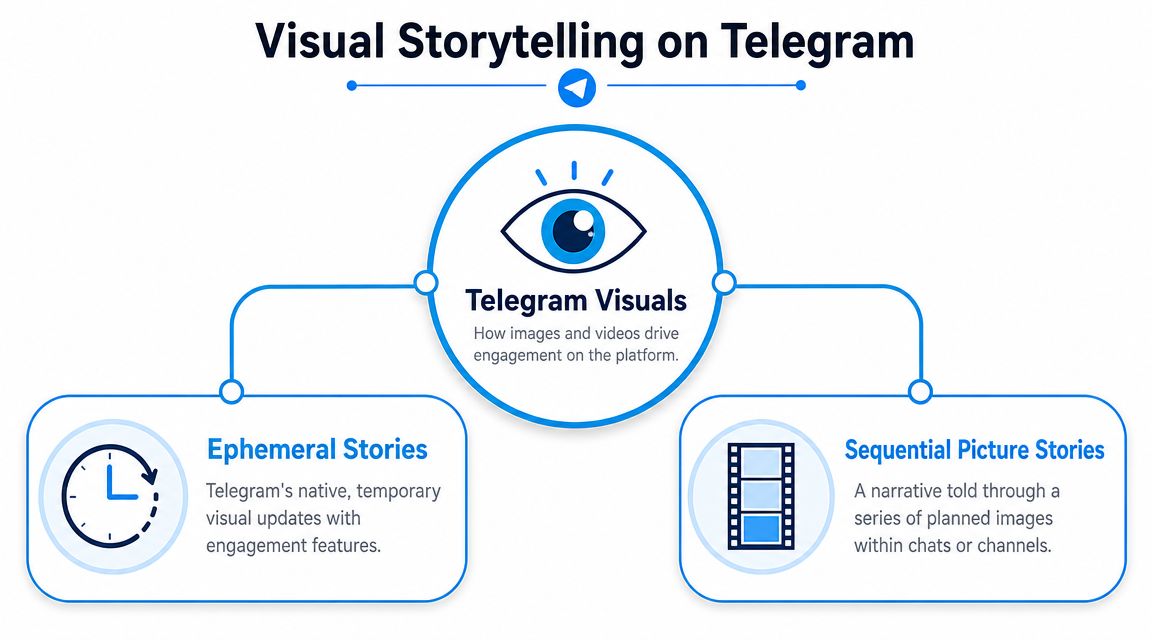
Two formats, two jobs
Stories fit content with a short decision window:
- Behind-the-scenes updates during a launch, event, or shoot
- Live coverage where speed beats archive value
- Audience-specific posts using Telegram's visibility controls
- Creative testing before a stronger concept moves into the permanent feed
Multi-image channel posts work better when the sequence carries the message:
- Explaining a process people can revisit
- Documenting an event after the fact, in order
- Showing proof where sequence affects credibility
- Building reference posts that keep getting views
Stories catch attention in the moment. Channel posts store meaning and accumulate value in the archive. Match the format to the objective, not habit.
What strong visual execution looks like
Strong Telegram visuals are structured, not just attractive — the audience should understand what changed from one frame to the next and why the sequence ends where it does. Weak performance usually traces to one of three mistakes: using Stories for material that needs permanence, pushing disposable backstage content into the main feed, or posting image sets with no narrative order and leaving viewers to do the editorial work themselves.
Framesurfer's video production template is built for video, but the planning logic fits picture stories too — define the purpose of each frame before upload.
The bigger advantage isn't posting more visuals — it's building a repeatable narrative system across Stories and permanent posts, then measuring what holds attention. Statiko's guide to the benefits of Telegram for channel growth covers the broader strategy.
Planning Your Visual Narrative Step by Step
The best picture stories are decided before the first upload — not polished to death, just planned enough that every frame has a job.
A useful method: the wide-to-detail sequence. Start with the widest framing to establish context, then move through medium, portrait, and close-up shots. That structure preserves continuity and maps well to Telegram's multi-picture format, as described in this guide to the five shots of storytelling.
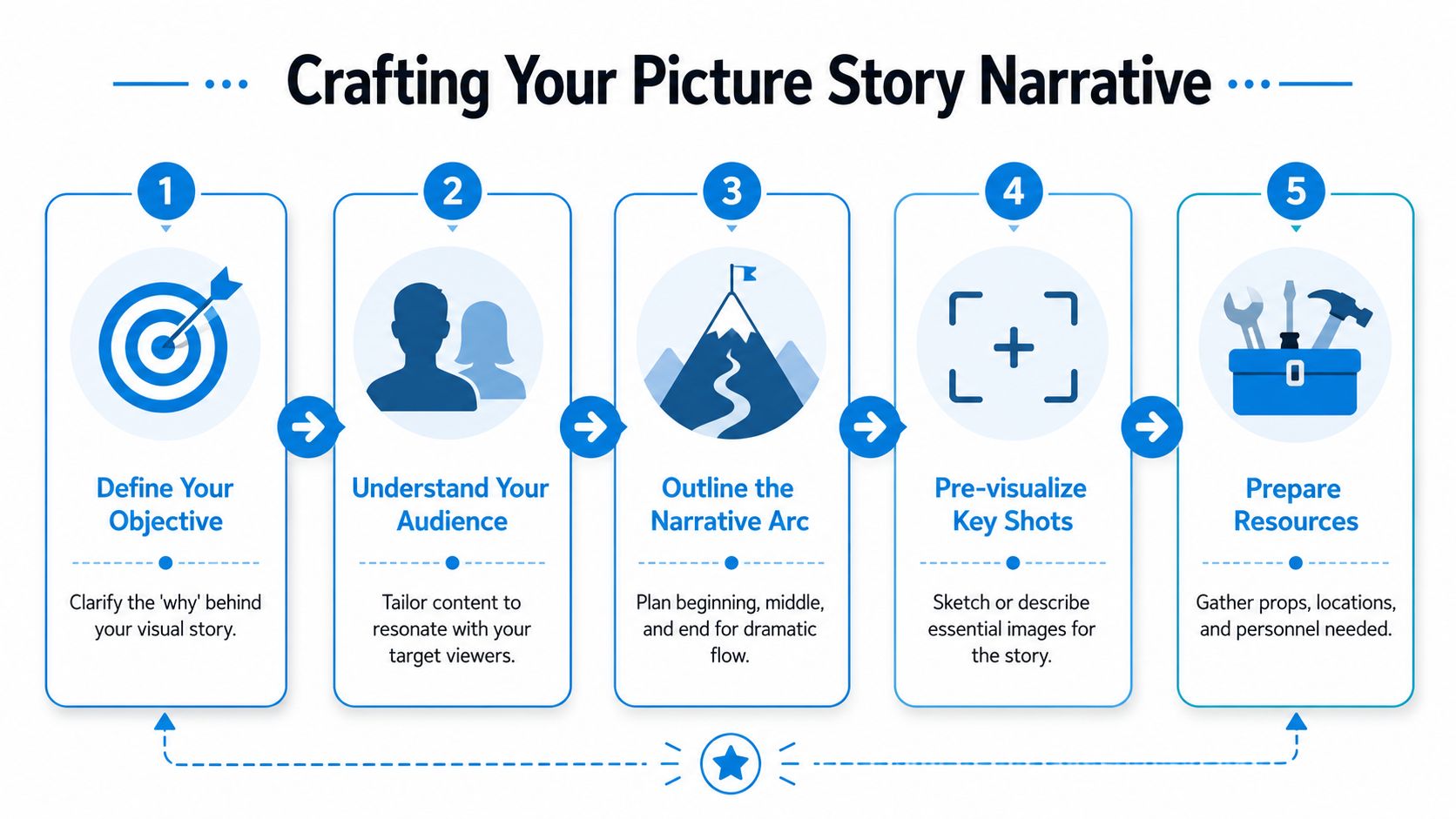
Start with the outcome, not the images. Decide what the audience should understand by the final frame before you plan shots. Most weak sequences fail here — they document what happened without deciding what the post is trying to prove.
A clean pre-production prompt: what's the takeaway, what would a skeptical viewer need to see, and what order makes that conclusion feel obvious. A product release might take "this solves a real user problem." A field event might take "this happened here, with these people, under these conditions." The story changes depending on the claim.
Build a five-part storyboard
You don't need filmmaking software, just a note or a spreadsheet:
- Opening frame — where are we
- Subject frame — who or what matters
- Action frame — movement or progression
- Proof frame — a concrete detail
- Closing frame — the intended conclusion
Not every sequence needs all five in equal weight, but a missing one means the viewer has to do too much interpretive work.
A random gallery makes the audience sort the facts. A planned sequence does that work for them.
Sequence changes meaning
The same four images tell different stories depending on order. Lead with a close-up and the post feels intimate, maybe selective; lead with a wide frame and the same event feels grounded. Put the proof image too late and many viewers won't reach it; too early and the sequence loses momentum. "Post your best image first" is incomplete advice — the strongest opener is the frame that gives the rest of the sequence a stable interpretation, not necessarily the prettiest shot.
| Sequence question | Why it matters |
|---|---|
| What frame establishes place first | Reduces confusion immediately |
| Where does the human element appear | People read faces and gestures faster than abstract context |
| Which image acts as proof | Anchors the claim |
| What can be removed | Redundant frames slow the scan |
Telegram lets you edit posts after publication, which is useful but risky if the narrative wasn't planned first. If your sequence depends on later clarification, it was underplanned. Good planning produces posts that still make sense from only the first few frames or a screenshot shared elsewhere.
Production and Creation Best Practices
Planning gives you the map. Production decides whether it survives contact with reality. The biggest creation mistake: relying on one hero image and hoping the caption carries the rest. People scan fast on mobile — if the story only makes sense after careful reading, most viewers won't reconstruct it.

Expert visual storytelling guidance recommends shooting sequences, not singles, and covering at least one establishing, human-interest, context, and detail frame, per Platypod's photojournalism storytelling guide.
The four frames you should almost always capture
These are coverage rules, not artistic ones.
- Establishing frame — shows the setting, so the sequence doesn't feel detached
- Human-interest frame — a person, reaction, or gesture; without one, stories feel sterile even when the subject matters
- Context frame — the relationship between subject and environment, where scale and conditions become legible
- Detail frame — the evidence: labels, interfaces, hands at work, damage, texture, tools, documents
Avoid redundancy, not repetition. Telegram viewers tolerate thematic consistency but not visual repetition that says nothing new. A common weak sequence: same subject, same angle, a slight pose change, another slight pose change, then a close-up. That's drift, not progression. Before keeping a photo in the set, ask: if this frame disappears, does the story lose meaning? If not, cut it.
Caption each frame as part of the sequence. Captions should support image order, not repeat what's already visible — anchor the frame with a fact the image can't show, clarify why it comes next, or prompt action. Bad captioning falls into two traps: every image gets the same generic tone, or one long caption tries to explain the whole set while the image order does none of the work.
If the viewer needs a long caption to understand frame one, the frame order probably needs revision.
For teams repurposing visuals across formats, an AI video generation tool can turn a still sequence into a motion-friendly Story variant without rebuilding the concept.
Optimize for Telegram's viewing reality. Image storytelling gets consumed in bursts: favor readability over decorative composition, use contrast so frames survive quick scrolling, crop tighter than you would for desktop-first platforms, and keep in-image text minimal unless it's essential evidence. If your sequence leans on motion, mixing in loops can help — this guide to GIFs for Telegram covers where motion adds emphasis and where it just adds noise.
Publishing and Optimizing for Maximum Reach
A strong sequence can still underperform if you publish it at the wrong moment, to the wrong audience, with no next step.
Match the post to audience intent. Stories work well when not every follower needs the same update — Telegram's audience controls let you decide who sees one. Multi-image posts serve a different purpose: a visual record that stays in the archive and can be referenced later. If the sequence documents a claim that may get revisited, permanence wins.
Time for attention, not convenience. Publishing when the asset pack happens to be ready is convenient for the team, not a strategy. Check your own channel history: when do image-heavy posts get early traction, does the audience behave differently on weekdays versus weekends, and do Stories get viewed quickly or fade if posted too late? There's no universal best time — only a channel-specific pattern shaped by geography, language, and whether your channel is news-driven, community-led, or product-focused.
Write the CTA before you publish
Too many visual posts end with no instruction, wasting the attention the sequence earned. Strong CTAs usually fall into a few categories: a reply CTA asking what viewers noticed in the final frame, a navigation CTA pushing to a linked post or pinned message, a verification CTA asking the audience to compare or add context, or a conversion CTA tied to a launch or offer.
Don't bolt the CTA on. If the sequence shows a process, ask for the next question. If it documents a claim, ask what evidence viewers still want.
Measuring Success and Verifying Authenticity
Most guidance on Telegram visuals stops at posting. That skips the part that sharpens your next decision: measurement.
Telegram Stories already give direct feedback — the feature includes detailed stats and view counts, so it's measurable rather than purely ephemeral. That's a baseline for evaluating which narratives people actually watch.

Measure the sequence, not just the post
A picture story can fail in more than one way: get views but lose coherence, get reshared because one frame is provocative while the rest is weak, or perform well and then degrade after edits. Raw visibility isn't enough — look for patterns:
| Signal | What it can tell you |
|---|---|
| Early views on Stories | Whether the topic and opening frame earned fast attention |
| Reshares or forwarding | Whether the sequence had value beyond the original audience |
| Comment quality | Whether people understood the intended takeaway |
| Post edits over time | Whether the narrative needed repair after publication |
If your team only checks the first number it sees, it won't learn much. Better analysis asks where the story held up and whether it still made sense after changes.
Provenance matters more than most content teams admit
There's a blind spot in visual Telegram content: people want to know whether a picture story is original, rearranged, or edited after the fact — especially on public-interest topics. Guidance on ethical visual storytelling points to the need to verify authenticity and editing history, per Vital Strategies' piece on ethical visual storytelling. A sequence can look persuasive while still being incomplete or altered.
Don't just ask whether an image is real. Ask whether the sequence is original, ordered correctly, and still in its initial published form.
Use tooling to close the loop. Native Telegram metrics won't give you the full history of public content over time. Statiko itself tracks message edits and deletions with timestamps, plus daily snapshots and posting-pattern analysis — so you can check whether a story changed after publication instead of guessing what got edited away.
Advanced Tactics and Common Mistakes to Avoid
A familiar pattern: strong raw material, a steady posting cadence, decent reach — and visual posts that still underperform because the sequence has no editorial logic. The problem usually isn't production quality. It's packaging, timing, and review discipline.
Advanced tactics that hold up in practice
Run sequences in arcs, not batches. If one image set has to do too much, split it into phases — orientation, then process or conflict, then outcome. Each post stays readable, and you get cleaner data on where interest holds and drops.
Build for mixed-format consumption. A good sequence works whether part of the audience sees it first as a Story or later as a forwarded album: the first frame needs context, the middle needs progression, the last needs a clear next step.
Use one motion asset with intent. A short clip or screen recording sharpens a sequence when motion explains change or proof. It weakens the story when added just to feel more active — one strong motion frame beats a stack of mediocre clips.
Mistakes that weaken the story fast
The errors that show up most often in channel audits:
- The first frame looks good but explains nothing
- Several frames repeat the same information
- Captions restate the obvious instead of adding context
- The sequence makes a claim with no proof frame
- The ending gives no instruction
- Format choice doesn't fit the material — time-sensitive updates buried in albums, reference content lost in Stories
- Teams post and never compare outcomes, so weak habits repeat
That last one matters most: a sequence often gets blamed for a weak topic when the real issue was frame order or timing.
A stricter quality check before publishing
Run this before any sequence goes out:
- Can the audience follow the narrative from frame order alone?
- Does each image add new information, not just a new angle?
- Is there at least one frame that supports the main claim directly?
- Will the post still make sense if one image is forwarded out of context?
- Did you choose the format based on user behavior, not team preference?
Channels that apply this consistently don't need more content. They need better sequencing and tighter measurement after publication.
If you manage a public Telegram channel and want clearer insight into how visual posts change, perform, and compare over time, Statiko gives you a transparent way to monitor edits, deletions, posting patterns, and channel-level trends without relying on guesswork.
Related posts

Explore the key benefits of Telegram for channel operators and analysts. Learn about privacy, bots, massive reach, and how to verify it all with data.

Learn how to find, create, and optimize GIFs for Telegram. This guide covers everything you need to boost channel engagement with standout animations.
Start in seconds.
Create a free account to organise channels, track activity, and get recaps delivered to you.
Real-time. Telegram. Analytics.