Telegram Sex AI: A Guide to Detection and Risk Mitigation
Understand the risks of Telegram sex AI bots. Learn to detect, monitor, and analyze AI-generated explicit content with best-practice workflows and tools.
A review of Telegram abuse channels found at least 50 AI bots offering to generate explicit images or videos, with a combined 4 million-plus monthly users, according to a WIRED review summarized here. This isn't fringe experimentation — it's an operational abuse category with scale, repeat traffic, and monetization behind it.
For channel owners, researchers, trust and safety teams, and OSINT analysts, the question isn't whether this material exists. It does. The harder problem is monitoring an ecosystem built on bots, reposting networks, and channels that pivot from promotion to deletion within hours.
What Is Telegram Sex AI and Why It Matters
Telegram sex AI covers bots and channel workflows that generate, market, or route users toward AI-assisted sexual content: image bots that claim to "undress" subjects, generators that sexualize identifiable people, roleplay agents that retain context across sessions, and broker channels that push users into payment flows or private archives.
A 404 Media investigation into Clothoff-style nudify apps documented a commercial market built around non-consensual synthetic imagery. Telegram fits that pattern because bots, channels, referrals, and private groups combine into a distribution system that's easy to rebrand after moderation pressure.
Classification matters. A bot offering fantasy chat may also collect user-submitted images, redirect to a second bot, and archive edited promotional posts across mirror channels. A promo channel can look inactive until old messages get edited to insert a new username or payment address, so researchers who only capture current message state miss half the record. Track referral channels, repost clusters, and bot directories such as public Telegram bot listing resources.
What these services actually do:
- Image abuse bots generate explicit content from ordinary photos
- Synthetic persona bots simulate erotic conversation and retain context
- Broker channels route users to generators, mirror bots, and premium tiers
- Evidence laundering channels edit or delete promotions after complaints while reposts survive elsewhere
Telegram abuse rarely sits in one place — it spreads through linked accounts, copied captions, username changes, and edited calls to action. Channel owners, trust and safety analysts, and investigators all need to know not just what was posted, but what changed, what disappeared, and which accounts amplified it before deletion. The real question is whether a network of bots and channels operates as repeatable infrastructure, and whether your monitoring process can catch it before operators rename, edit, or delete the traces.
The Ecosystem of AI Sex Bots on Telegram
Telegram sex AI activity works more like an operating system than a single bot category. Public channels, mirror bots, payment prompts, and repost networks combine to acquire users, route them into private interactions, and recover fast after bans.
The technical stack is more capable than the spam-bot stereotype suggests. A technical overview of NSFW chatbot development describes a common build: LLMs such as LLaMA 3 or GPT-class models paired with retrieval-augmented generation for continuity, vector databases like FAISS or Pinecone for memory, and delivery layers built on FastAPI or WebSockets — the same components that support persistent roleplay and gated premium access.

How the bot layer works — four layers matter to investigators, each leaving different artifacts.
| Layer | Operational role | Examples named in the source |
|---|---|---|
| Model layer | Generates text or interaction logic | LLaMA 3, GPT variants |
| Memory layer | Retrieves prior context for continuity | RAG, vector stores |
| Storage layer | Holds embeddings and interaction traces | FAISS, Pinecone, Weaviate |
| Delivery layer | Manages sessions, filtering, and real-time output | FastAPI, Socket.IO, WebSockets |
If a bot seems unusually persistent, the likely explanation is stored context, not human oversight — collect profile changes, edited payment prompts, and timing patterns across linked channels, since the visible bot account is often just the delivery layer.
Why network mapping beats single-bot tracking. A single username rarely captures the full operation. Operators rotate bot handles, spin up backup channels, repost testimonials, and redirect users through fresh invite links after enforcement. What stays stable is the promotional language, admin accounts, and duplicated media.
A practical mapping workflow should record:
- Discovery nodes — channels advertising "deepnude" or "nudify" requests
- Routing behavior — channels pushing users into bots or off-platform payment chats
- Retention signals — memory claims, roleplay continuity, premium upsells
- Recovery infrastructure — replacement bots and renamed channels after takedowns
A broader Telegram bots list resource helps identify naming conventions before narrowing by behavior and repost patterns — the higher-value question is whether multiple accounts function as one cluster.
Monetization leaves traces even without a visible payment rail. Operators monetize through tiered access, subscriptions, and private support channels while limiting transparency around fulfillment — exposure that goes beyond content policy, given the documented impact of generative AI on privacy laws. Direct proof of cash flow is often unavailable, but pricing language, upgrade prompts, and repeated sales copy are observable, and paired with edit history they show how a funnel changed over time.
Navigating Severe Legal and Ethical Risks
The legal and ethical risk here isn't abstract. A joint investigation by Nucleo and the Pulitzer Center found that among 33 active deepnude bots on Telegram, 23 were capable of generating child sexual exploitation material — 70 percent of the sample — per the Pulitzer Center investigation. That's a pathway to illegal abuse involving minors, not a moderation nuisance.
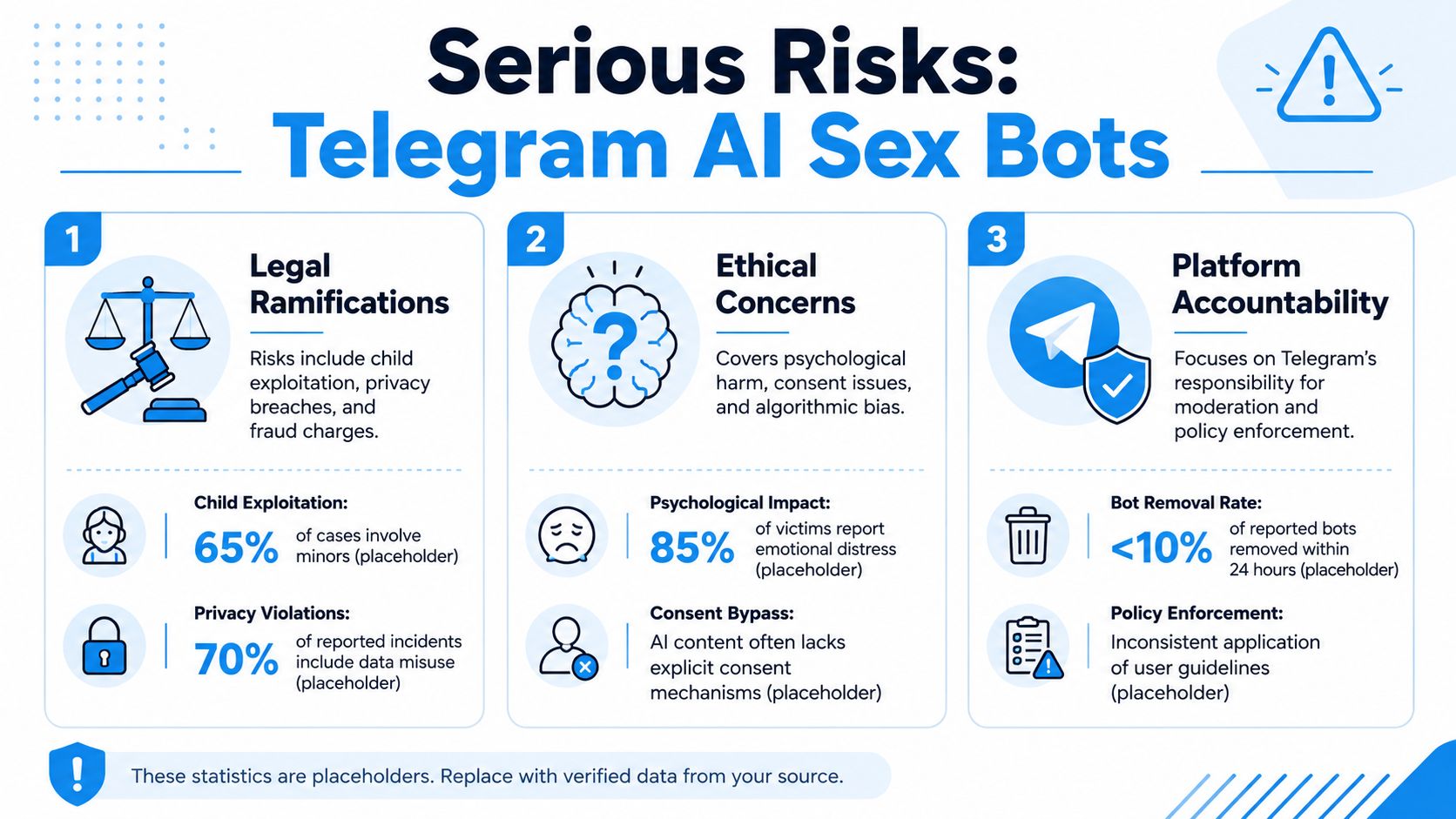
The primary legal exposure splits into three zones: non-consensual sexual deepfakes (privacy, defamation, image-based abuse), synthetic depictions of minors (a far more severe category), and channels that promote or broker access, which can carry their own liability even without operating the generator. That last zone matters for admins who assume reposting is safer than hosting — in many jurisdictions the distribution pathway still counts, since legal treatment increasingly turns on consent and identifiability rather than whether an image was "real."
The ethical failure is built into the workflow. Many of these systems are designed to bypass consent entirely. A normal image-sharing workflow starts with permission; a synthetic abuse workflow starts with extraction, turning a face or identity into raw material for a prompt chain or a monetized archive. A channel that tolerates discovery or referral posts for these bots becomes part of the pipeline. When a bot markets speed, realism, or "custom requests," those aren't neutral features — they're signs of a workflow built for evading consent.
Platform accountability is only part of the answer. Telegram's enforcement posture doesn't remove responsibility from operators, researchers, or publishers. Mitigation starts with naming the content, preserving evidence before it changes, and refusing to treat "synthetic" as lighter than "real."
How to Detect and Document AI Sexual Content
Manual review isn't enough. Telegram's architecture and policies create a permissive environment where over 50 known AI-powered abuse bots operate with relative impunity, per this analysis of Telegram's permissive NSFW environment.

Why manual review breaks down — a human moderator catches obvious phrases but struggles with edited posts and coded promotion. One channel advertises a bot directly; another uses teaser clips or vague premium language that only reads as abuse combined with prior history. Operators adapt to scrutiny, too — this breakdown of how to make AI videos undetectable is useful background, not to copy but to understand the mindset moderators face.
Signals worth watching in public channels are often behavioral, not visual:
- Repeated edits that soften wording or remove explicit claims
- Deletion spikes after complaints or moderation pressure
- Redirect patterns pointing to a new bot or backup channel
- Roleplay or custom-content language paired with payment cues
- Testimonial-style posts showing outputs or upgrade prompts
Preserve context, not just screenshots. Exporting channel history shows whether a message was isolated or part of a campaign — start with this guide on exporting Telegram chat data.
Documentation standards for researchers and moderators. A defensible record usually includes: channel identity (username, title variations, public description), message chronology, captured edits or deletions, linked entities such as bots or payment instructions, and a risk classification based on promotion, generation, distribution, or facilitation.
This doesn't remove the need for judgment, but it reduces the odds that key evidence disappears before a review team can act.
A Modern Workflow Using Statiko for Analysis
Most reporting on Telegram sex AI stops at discovery. The more useful workflow starts after: preserving change history and figuring out whether a channel is a casual mention or part of a repeat abuse network.
Monetization visibility remains an open problem. Reporting confirms some bots have over 150,000 monthly active users with payments routed via crypto, but little public breakdown exists of pricing pathways, per this Business & Human Rights Resource Centre summary. Structured analysis beats one-off screenshots.
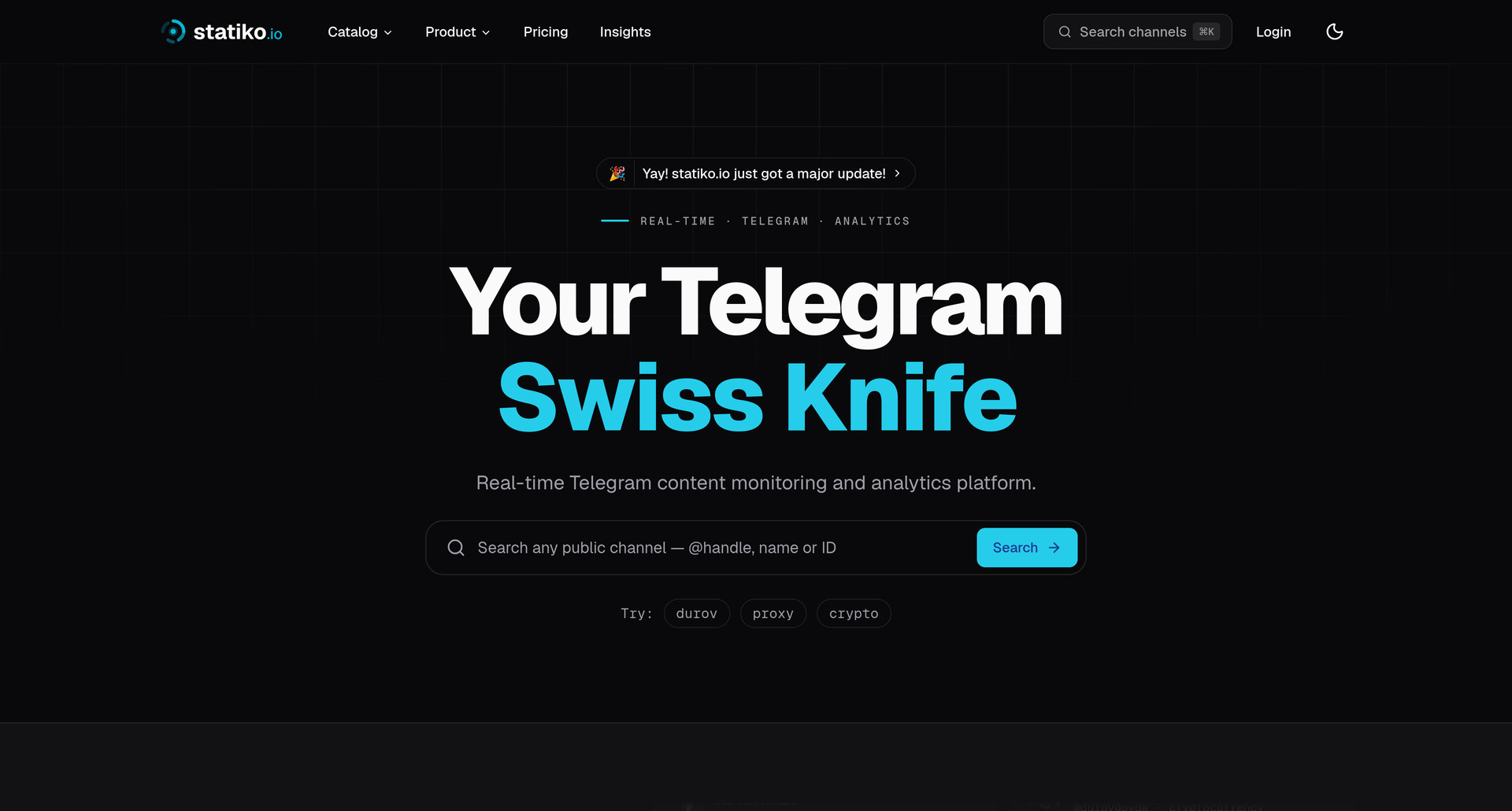
A practical research sequence starts with the public channel, not the bot — bots vanish or rotate names, but channels leave a broader trail.
- Build a seed list of public channels promoting explicit AI generation, custom requests, or "backup bot" migrations, including mirrors and language variants.
- Snapshot baseline behavior — posting frequency, growth patterns, and recurring terms, as a baseline to compare over time rather than for immediate attribution.
- Track edits and deletions. Promoters often soften wording after publication or remove posts after complaints. A preserved history shows what changed, when, and whether the pattern is routine.
- Review recap-level anomalies — AI-generated summaries help when volume is too high for line-by-line reading.
- Map adjacent entities, since outbound references to bots and payment instructions often reveal the referral logic even when the payment flow stays opaque.
Manual review tends to overweight the single most offensive post. Analysts need the less visible pattern: repeated promotion, cleanup behavior, timing. A recap tool compresses volume without hiding anomalies — a sudden shift to explicit promotions, or a wave of posts disappearing after attention, is the signal worth flagging. See this guide to AI summaries of a Telegram channel.
What to collect in each case file — recurring fields, not isolated finds:
| Evidence field | Why it matters |
|---|---|
| Channel description changes | Shows repositioning or evasive rebranding |
| Edit history on promo posts | Preserves original claims after cleanup |
| Deletion timing | Reveals reaction to scrutiny or enforcement |
| Repeated outbound targets | Helps identify core bots or brokers |
| Topic summaries over time | Distinguishes one-off mentions from stable business activity |
In Telegram investigations, the post that disappears can be more probative than the post that remains.
A note on scope and ethics. Public-channel monitoring isn't private surveillance. Stay within lawful boundaries, avoid redistributing harmful material, and focus on metadata and change history — you can build a strong evidentiary record without storing explicit outputs.
Conclusion and Best Practices for Channel Safety
Telegram sex AI is a live abuse ecosystem, not novelty tech. The documented scale, technical sophistication, and legal risk around synthetic sexual content involving minors put this squarely in the domain of trust and safety, OSINT, and digital forensics.
For channel operators, the priority is policy clarity: ban promotion of nudification bots and referral links to generator channels. Make the rules visible, apply them consistently, and preserve evidence before removing posts so decisions can be defended later.
Best practices for admins and researchers:
- Write explicit channel rules banning AI-generated sexual abuse content and referral links
- Monitor behavior, not only keywords — repeated edits and sudden backup-channel promotion are often stronger signals than any single phrase
- Document before action so timestamps and message history survive later edits or deletions
- Separate review from redistribution — log findings without recirculating harmful outputs
- Escalate with a removal plan, using a reference like this strategic guide for Telegram content removal
A safer Telegram environment comes from habits working together: clear rules, repeatable evidence collection, and a refusal to treat synthetic abuse as less serious because a model generated it.
A single screenshot proves existence. A documented history of edits and deletions proves system behavior. If a bot or channel markets explicit content involving real people without consent, treat it as abuse infrastructure.
If you monitor public Telegram channels, Statiko gives you a practical way to preserve edit and deletion history, review AI-generated channel recaps, and analyze growth and posting patterns without needing channel ownership or login access. For researchers, moderators, and channel admins, that makes it easier to move from isolated screenshots to a documented, repeatable monitoring workflow.
Related posts

Discover the telegram bots list for 2026: top directories every channel admin should bookmark to optimize bots and grow engagement.

Export telegram chat - Learn to export Telegram chat from desktop & mobile seamlessly. This guide covers JSON/HTML formats, public channel tools, and transformi

The complete guide to AI summaries, recaps and digests of Telegram channels — how they work, the four ways to get one, and seven recap formats.
Start in seconds.
Create a free account to organise channels, track activity, and get recaps delivered to you.
Real-time. Telegram. Analytics.