Telegram Anti Spam Bot: A Complete Setup Guide (2026)
Telegram anti spam bot - Protect your Telegram channel with an anti spam bot. Our guide covers setup, configuration, advanced rules, and monitoring for a

You open Telegram in the morning and the damage is already done. A raid hit overnight — comments buried under scam links, fake giveaways, and a few messages that look clean until someone taps the edited version an hour later.
A telegram anti spam bot isn't a nice-to-have at that point. It's infrastructure. But installing one and walking away rarely fixes the problem. Good spam control needs a workflow: clear rules, sensible automation, fast review, and analytics that tell you whether the bot is protecting the community or silently blocking legit members.
Proactive Defense, Not Reactive Cleanup
Most admins start in reactive mode. Someone drops a scam link, a moderator deletes it. A bot wave joins, the team bans accounts one by one. That scales fine for a small chat. It falls apart once the group grows or a bad actor decides your audience is worth targeting.

The risk isn't just clutter. It's trust erosion. Members stop clicking pinned resources because they've seen too many fake ones. New users assume the space is abandoned. Good contributors leave because every thread gets hijacked.
Spam also became a security problem. In 2022, abuse of Telegram bots in phishing campaigns surged by over 800% year-over-year, with attackers using them to exfiltrate stolen credentials, according to Cofense's analysis of Telegram bot abuse. You're not just filtering annoying promos — you're reducing the odds your community becomes a delivery channel for malicious links. The bot you add to fight spam deserves the same permission review as any other, which is covered in more depth in this guide to Telegram app security.
A proactive setup has a few layers working together: join protection, message filtering, behavior-based detection, a moderator review queue, and analytics. Muting a user after the fifth bad message is not a strategy. Blocking the first bad action often is.
Hosted vs Self-Hosted
Do you want a managed bot like Combot, or a self-hosted solution like tg-spam that you control fully? Both work. The choice depends less on features and more on who maintains it after week one.
| Factor | Hosted (e.g., Combot) | Self-Hosted (e.g., tg-spam) |
|---|---|---|
| Setup speed | Fast | Slower — you handle deployment and updates |
| Admin skill required | Lower | Higher |
| Customization | Usually enough | Best for custom rules or integrations |
| Maintenance | Vendor | Your team |
| Best fit | Busy teams needing quick protection | Technical teams with specific needs |
Hosted bots are the right starting point for most teams — quicker to deploy, easier to tune, less likely to break.
Self-hosted makes sense when moderation is tightly tied to your own workflow: custom regex, internal logging, language-specific rules. If you're deciding where to run it, this guide on managed vs unmanaged VPS hosting is worth reading. The open-source path isn't weaker by default either — the Telegram-Anti-Spam-Bot project reports 95% automated enforcement accuracy on validated rule sets.
Choose hosted if you need protection today, your moderators aren't engineers, or you want fewer moving parts.
Choose self-hosted if you need custom behavior, want rule ownership, and have someone who can maintain the service.
If you're new to the bot ecosystem, the primer on what a Telegram bot is and how it works is useful context before you pick a stack.
Installation and Core Filters
Most anti-spam failures happen in the first hour. The bot gets added without enough permissions, or it has full admin rights but no configured filters.
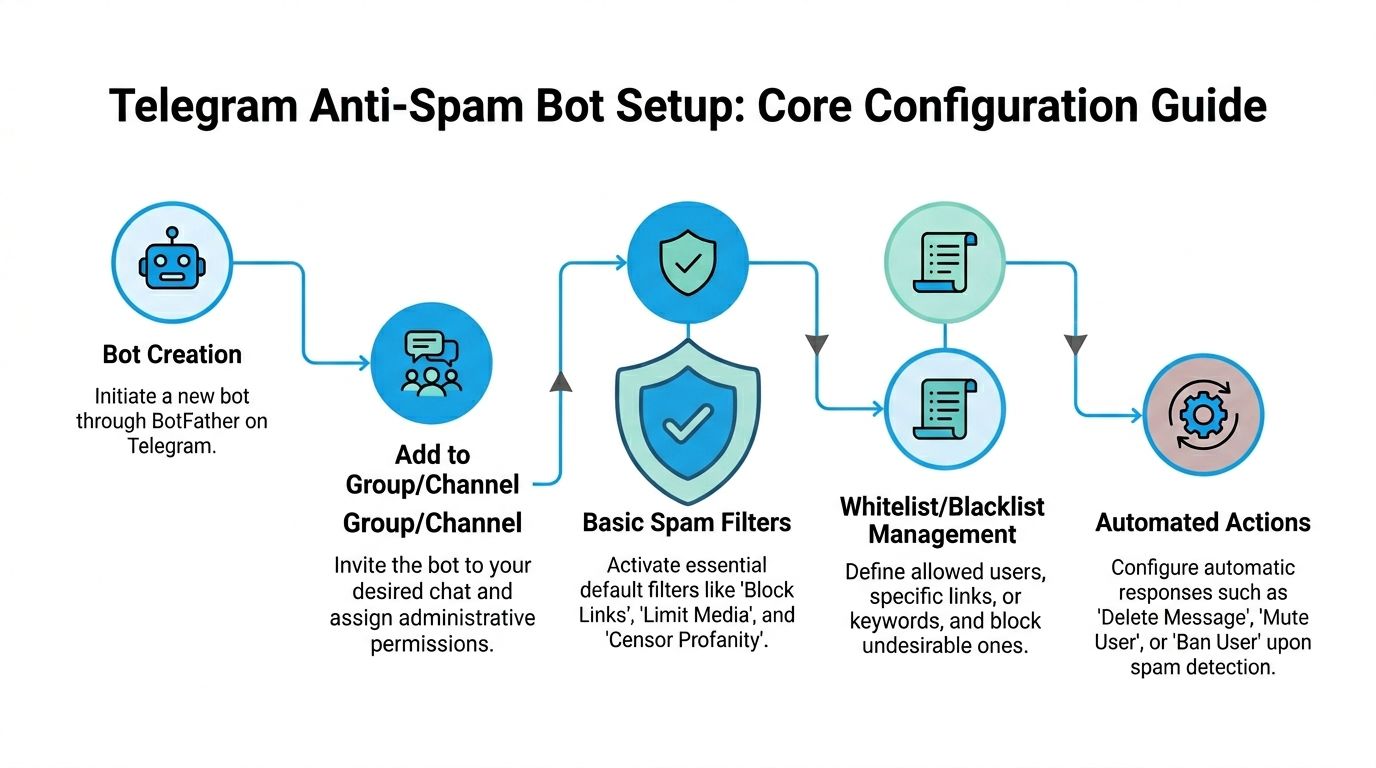
Start with permissions. A telegram anti spam bot needs at minimum:
- Delete messages — without this, detected spam stays visible
- Restrict users — needed for mutes and anti-flood responses
- Ban users — for repeat offenders and obvious raids
Then configure the filters with the biggest impact:
- Link blocking for new users — catches the most common scam pattern; let trusted users post links freely
- Flood and duplicate control — raids often repeat the same message in bursts
- Mass mention limits — cap hard; notification fatigue kills engagement
- Media restrictions for newcomers — image-based spam bypasses text filters
- Blacklisted phrase filters — useful, but don't make these your main defense
Behavior matters more than isolated words. According to Telegram Bot App's learning centre, AI models can reach up to 99% accuracy identifying fake members within seconds of joining using behavioral pattern analysis. A new account that joins, changes profile details, posts a link instantly, and mentions users is far more suspicious than someone using a risky keyword in a legitimate context.
Roll it out gradually: restrict links and media for new users first, enable duplicate deletion second, add auto-mute or ban only after watching the logs for a while.
Advanced Rules and ML
Once the core setup is stable, basic toggles stop being enough. Spam adapts — attackers rotate text, split phrases across lines, or post clean content and edit it later.
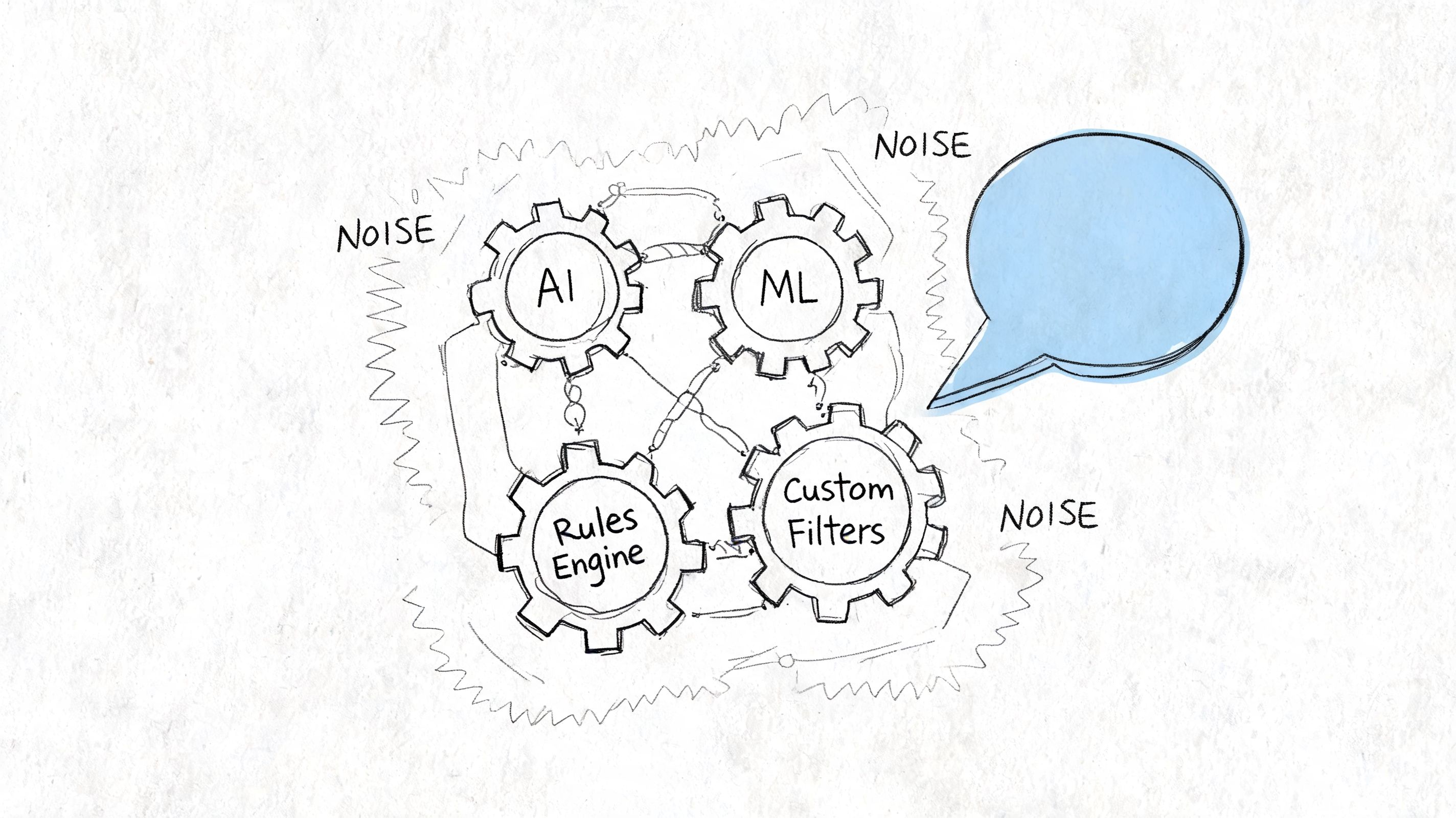
Custom rules work when spam has a repeatable shape: obfuscated links, clone promos, join-and-drop campaigns, bait-and-switch edits. Keep rules narrow — targeting patterns you've actually seen in your own logs, not broad language categories.
ML adds a second layer. The best systems evaluate profile metadata, behavioral history, chat context, and edit patterns together. The production system described in this technical breakdown of AI spam detection for Telegram reports 99.7% accuracy with near-zero false positives using preemptive profiling, real-time message analysis, and edit detection.
Each layer catches different abuse: - Preemptive profiling — catches suspicious accounts before they post - Real-time context checks — reduces false alarms on legitimate discussion - Edit detection — closes the loophole where scammers change a harmless post into a malicious one - Fingerprinting — spots repeat spammers returning with fresh accounts
Some self-hosted tools use Bayesian classification to separate spam from normal conversation. Worth exploring Naive Bayes use cases if you're building your own classifier logic. For custom bot teams, the guide on Telegram bot development workflows covers event pipelines and model-backed moderation.
A reliable stack: hard rules at entry → pattern rules for known abuse → ML scoring for edge cases → human review for appeals.
Incidents and Fine-Tuning
Every serious community needs an appeal path. Give banned or muted users one clear place to contact the team, one short format for explaining what happened, and one moderator who owns final review. You don't need a legal process. You need consistency.
When a filter misfires, change one thing at a time — one threshold, one regex, one action level — then watch what happens.
The common causes of false positives are predictable: keyword-only filters that ignore context, flood rules too tight for active chats, no trust progression for well-behaved new users, and no whitelist for team members and partners.
If moderators are constantly overriding the bot, the settings are too aggressive. If you can't explain why a user was muted, the system is too opaque. Both are fixable, but only if someone reviews incidents regularly rather than assuming automation self-corrects.
Measuring What Actually Matters
Deleted messages and ban counts are activity metrics, not outcome metrics. What you want to know is whether the community got healthier. According to moderation guidance on Telegram anti-spam limitations and analytics gaps, spam correlates with 20-30% dips in engagement — that's the gap you're trying to close.
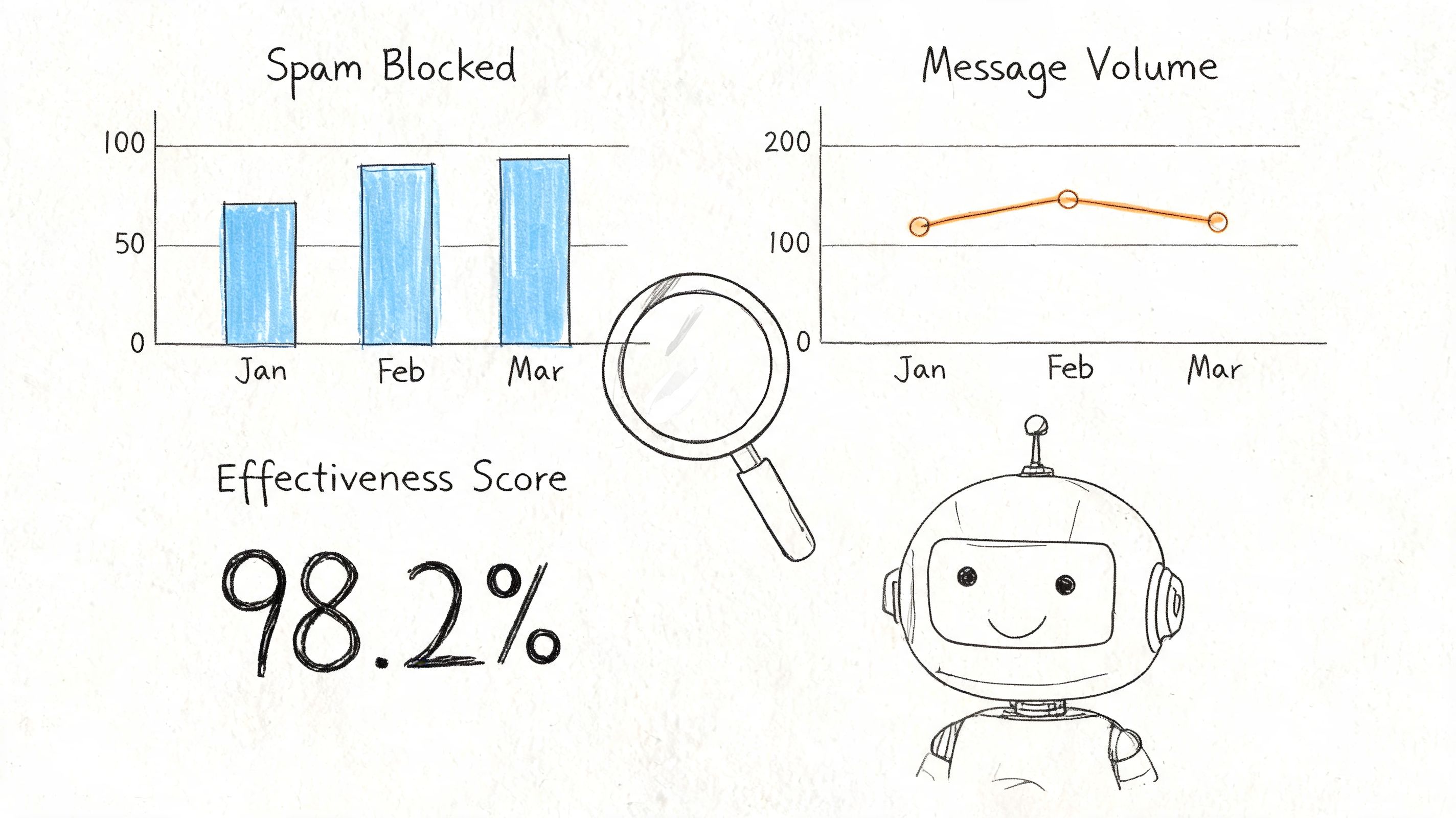
Track instead:
- Engagement stability — does interaction stop collapsing during spam waves?
- Time to containment — how quickly does chat return to normal?
- Moderator override rate — high override means the bot needs tuning
- Edit and deletion patterns — useful for spotting bait-and-switch attempts and cleanup quality
- Audience response after incidents — watch whether posting cadence and reactions normalize
For public-channel benchmarking, Telegram channel analytics help you compare trends before and after moderation changes.
If stricter settings reduce spam but conversation quality also drops, that's not a win. If spam incidents fall and engagement steadies, the setup is working.
If you want a clearer view of how moderation changes affect a public Telegram channel, Statiko gives you transparency into edits, deletions, growth snapshots, posting patterns, and content history. That makes it easier to audit spam cleanup, spot moderation side effects, and measure whether your anti-spam setup is protecting the channel without damaging normal engagement.
Related posts

Discover what is a Telegram bot and how these automated assistants work. This guide explains their power for channel management, marketing, and automation.

Learn Telegram bot development with our guide to building, deploying, and scaling secure, feature-rich bots with Python, Node.js, and TON integration.

Unlock growth with our guide to Telegram channel analytics. Learn to track key metrics, analyze competitors, and make data-driven decisions for your channel.
Start in seconds.
Create a free account to organise channels, track activity, and get recaps delivered to you.
Real-time. Telegram. Analytics.