Link Sharing Telegram Groups: A Strategic Guide (2026)
Unlock traffic with link sharing Telegram groups. This guide covers finding groups, posting effectively, tracking ROI, avoiding bans, and using analytics.

You need traffic fast. A launch is slipping, a client wants results this week. You find link sharing telegram groups — free distribution, fast exposure, real people swapping URLs.
The downside shows up a day later. Posts get buried under spam. Clicks look cheap but convert badly. Fresh accounts get throttled. Worst case, a link gets edited after the fact and nobody notices.
Used carelessly, these groups are noise. Used strategically, they help with discovery, testing, and early acquisition. The difference is selection, posting discipline, and measurement.
A shared link can be edited after you measure it.
Statiko indexes public Telegram channels and records edits and deletions with timestamps, so you can see when a posted URL changed under you. It covers public channels, not the private promo groups themselves. Browse the catalog by category.
The Promise and Peril of Telegram Link Sharing
Even promotion-focused communities can gather sizable audiences — Telemetr's overview of a Link Sharing Group shows that. For a baseline on how Telegram groups function, start with the Telegram group chat guide before treating every big member count as an opportunity.
The upside is real. A relevant group gets a new offer in front of people who already expect outbound links. Small, well-moderated groups can send better traffic than giant promo chats because the audience intent is narrower and the feed moves more slowly.
The downside: link sharing groups attract spam, fake engagement, and admins quick to restrict fresh accounts. A shared message can also be edited after posting — meaning you might be measuring clicks on one URL while the group now shows another.
Where the economics break — The common mistake is treating every click as a win. Three problems show up fast: low-intent traffic from promo-heavy chats; moderation pressure when repeated cross-posting looks automated; bad attribution when teams track raw clicks but skip UTMs and conversion events.
What still works — Groups work best as a controlled acquisition channel, not a standalone growth strategy. Use them to test headlines, compare offers, pressure-test landing pages, or get an early read on whether a topic earns clicks from a specific community. Quality beats scale. Groups with active moderation, clear posting norms, and a recognizable topic focus outperform generic "share anything" chats.
How to Find and Vet Quality Link Sharing Groups
You join a group with 40,000 members, drop a link, watch clicks for an hour. Then analytics shows weak session duration and flat conversions. Finding groups is easy. Finding groups that send usable traffic takes real screening.
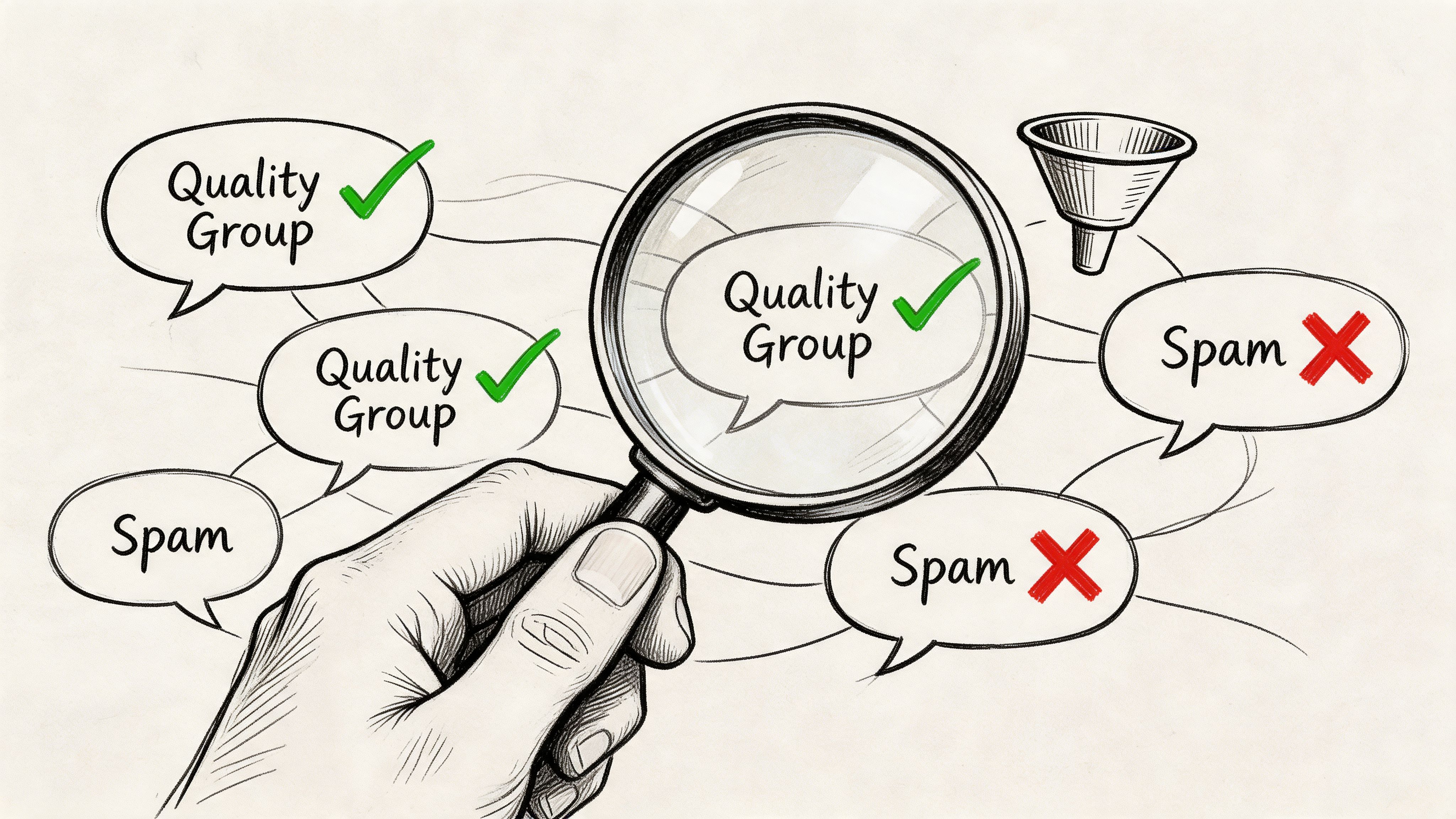
Discovery — Telegram search gives you what's easy to surface, not what's best run. Build a candidate list, then pressure-test: Google operators find older public groups and invite pages Telegram buries; tools like TGStat and Telemetr shortlist groups with visible activity patterns; watching competitors shows where similar projects get forwarded and discussed.
Vetting — Member count is a weak filter. Scroll back a few days and ask: is this group actually read by humans, or just used by people extracting traffic from each other?
Check these signals:
- Posting diversity: Several recognizable members posting, or the same few accounts dominating?
- Context around links: Short descriptions and a clear reason to click correlate with better traffic
- Moderation behavior: Scams staying up for hours means admins are absent
- Topic discipline: Niche groups often send less traffic and better conversions
- Visible interaction: Replies and follow-up questions beat raw volume
Also check whether message edits are normalized. Posts that get edited after the fact poison the feed and make performance analysis unreliable — the click source and final destination can drift apart.
Before posting, review:
- Pinned rules: Frequency limits, banned categories, self-promo requirements
- Recent outbound links: Real businesses and articles beat feeds packed with redirects
- Admin response time: One scam removed quickly is a good signal; five left up means move on
- Audience fit: A tool does better in a founder group than a generic growth chat full of other marketers posting their own links
- Evidence of reading: Reactions are fine; replies are better; repeat names who comment on each other's posts are best
Red flags:
- Every post is a bare link with no description
- Repeated bot-looking accounts dropping identical promos
- No visible rules, no pinned guidance, no admin presence
- Aggressive DM bait right after joining
If you can't explain who the group is for and why a member would click links there, don't post.
The Playbook for Posting Links Without Getting Banned
Most bans don't come from one catastrophic mistake. They come from looking automated — joining too many groups fast, posting the same copy everywhere, never engaging, and dropping links with no context.
Fresh accounts are especially fragile. Join gradually, roughly a few groups per day with some initial engagement before posting. Vetted discovery sources like @SearcheeBot can reduce ban risks significantly versus mass-joining from public lists as discussed here.
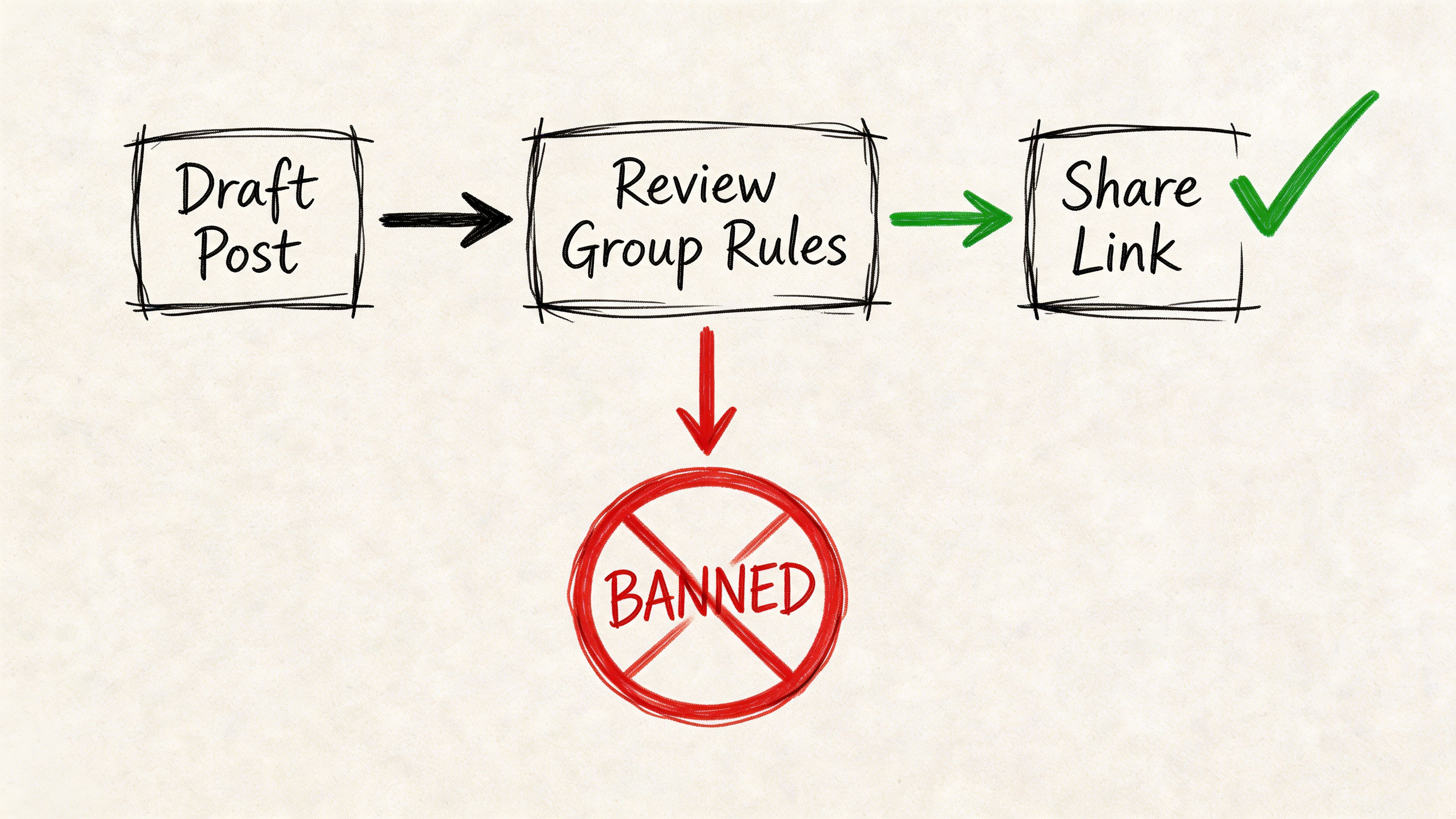
Before your first post: Join gradually. Read pinned rules. React and reply before posting anything. Complete your profile — anonymous-looking accounts invite suspicion.
Post format that works:
- Say what the link is
- Explain why this group should care
- Mention who it's for
- Invite feedback, not just clicks
Good: "Guide for Telegram admins on tracking channel performance. Useful if you're comparing posting patterns or trying to understand where views come from."
Bad: "BEST TRAFFIC METHOD!!! JOIN NOW!!! [link]"
The good version lowers suspicion because it gives context. The bad version looks disposable even if the destination is legitimate.
Don'ts:
- Don't paste the same copy everywhere — admins notice repeated formatting and hype language
- Don't post on arrival — new member, instant link, no participation gets flagged fast
- Don't ignore frequency limits
- Don't cross-post into unrelated groups — topic mismatch gets punished faster than weak copy
Templates (structures, not scripts):
Resource share: "Useful for [audience]. Covers [problem]. Sharing because this group discusses [topic]."
Launch post: "Released a new [tool/article/update] for [use case]. Looking for feedback from people working on [specific problem]."
Offer post: "For anyone focused on [niche], this might help. Short summary: [one sentence]. Happy to answer questions in-thread."
Join slowly. Observe first. Post selectively. Reply when people ask questions. Remove dead approaches fast.
Measuring What Matters: Traffic and Conversions
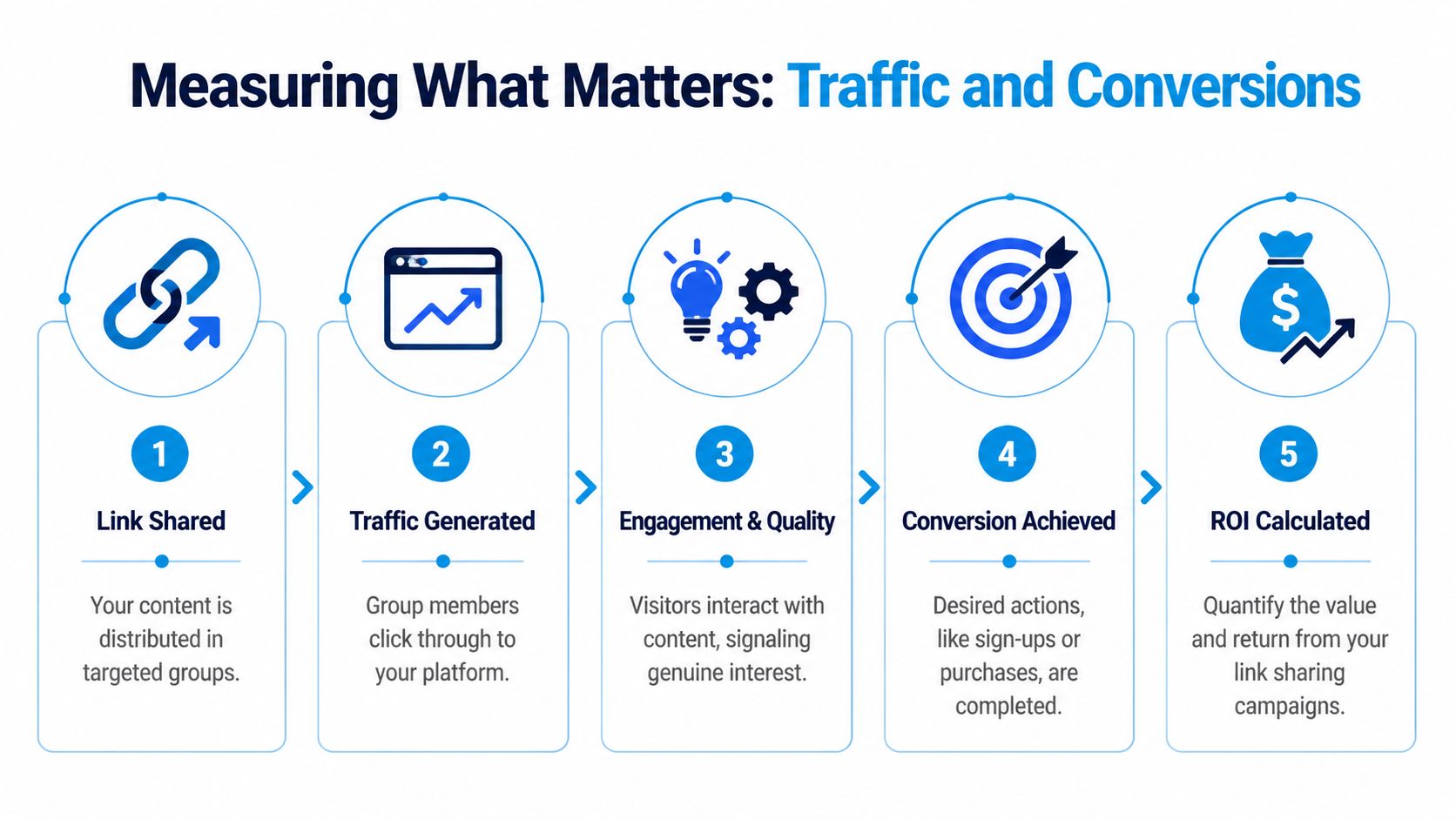
A post gets 300 clicks from three groups, someone calls it a win, and two weeks later there are no sign-ups and no revenue tied back. Click volume gave the team activity to point at, but nothing to build on.
Treat link sharing telegram groups like paid placements. Every link should identify the group, the post version, and the campaign. Judge performance by downstream behavior, not traffic volume.
UTM structure:
- Source: telegram
- Medium: group-share
- Campaign: launch or offer name
- Content: exact group or post variation
This setup answers what matters in review meetings: which group sent visitors who stayed and converted? Which copy angle produced sign-ups instead of quick exits?
What Telegram can and can't measure — Built-in analytics for larger channels show where views came from. Third-party tools like TGStat and Telemetr help with public benchmarking, as noted here. That handles distribution analysis. Your analytics stack has to handle conversion measurement.
Evaluation model:
| Signal | What it usually means | Action |
|---|---|---|
| High clicks, weak session quality | Poor audience fit | Cut or deprioritize |
| Moderate clicks, strong sign-ups | Good audience match | Keep testing |
| Low clicks, strong in-group replies | Traction exists, placement may be off | Retest with new timing |
| Strong performance from one variant only | Narrow message-market fit | Refine offer and targeting |
Track conversions per post, not just per click. Some groups send decent traffic but require so much custom posting and moderation risk that the channel isn't worth the staff time.
Metrics that waste your time: - Member counts without evidence of clicks or conversions - Raw impressions with no path to on-site behavior - One-off spikes from repost chains - Screenshots of views not tied to tagged links
If a group sends clicks but never sends outcomes after a fair testing window, replace the group instead of rewriting the post for the fifth time.
The Strategic Shift to Public Channels and Transparency
Link sharing groups are useful but unstable. You don't control the environment, adjacent posts, or the historical record of what was shared. Users can edit or delete links after posting — cybersecurity reporting points to a 40%+ surge in illicit channels using broadcast-style links for malware as described in CloudSEK's report. A specific corner of this problem is telegram mega link groups — channels built around Mega.nz file sharing that often sit at the edge of copyright abuse and malware distribution. For marketers that means trust risk. For analysts, broken attribution.
Why groups are a weak long-term asset — Groups run on borrowed attention. Your post competes with everything in the room, including junk. If moderation slips, the environment degrades fast. Public channels change the model: a branded stream where the audience expects a consistent editorial voice. You're building a property instead of chasing openings in someone else's feed.
Groups vs channels:
| Feature | Link Sharing Groups | Public Channels (with Statiko) |
|---|---|---|
| Control over environment | Low | Higher |
| Post adjacency | Unpredictable | Controlled by channel owner |
| Brand consistency | Weak | Strong |
| Spam exposure | High | Lower |
| Historical transparency | Often limited | Better for public tracking |
| Competitor benchmarking | Harder | More structured |
| Long-term audience value | Borrowed | Owned-ish within platform limits |
For a full breakdown of when to pick one over the other, see Telegram channels vs groups.
Where transparency matters operationally — A public channel creates a cleaner measurement surface. You can see what you published, when, and how content themes evolve. Statiko tracks message edits and deletions with timestamps, plus daily snapshots and AI-based pattern analysis — useful for understanding not just which channels are growing, but how their content strategy changes over time.
The strongest setups use groups tactically and channels strategically. Test hooks in groups. If a theme earns repeated attention, move it into your own channel. Build continuity instead of letting insights disappear into fast-moving threads.
Your Roadmap to Sustainable Telegram Growth
Two phases.
Phase one: Use link sharing telegram groups carefully. Join selectively. Vet hard. Track every meaningful link. Keep groups that send qualified traffic or useful feedback. Drop the rest fast. This phase is about learning where your message lands.
Phase two: Move that learning into a compounding asset. A public channel gives continuity, cleaner analytics, and a stronger brand surface. Build a feed people can return to and evaluate over time.
Phase three: Measure repeatable outcomes, not isolated spikes.
If you're monetizing access itself rather than just content promotion, a guide on selling Telegram access via Suby covers gating, payment flow, and paid community operations.
Use groups to learn. Use a channel to build. Keep measurement tight enough to know the difference.
Frequently Asked Questions About Link Sharing
Are link sharing telegram groups against Telegram rules? Not by default. The problem is behavior — spamming, misleading users, or posting in ways that look automated. Treat each group like a community with local norms.
How should I handle multiple invite links?
Use different links for different use cases. Public groups use a fixed t.me/groupname format and are searchable. Private groups use t.me/+hash links with controls like usage limits and expiration dates. Approval-gated private links reportedly yield 75% qualified joins, while public links carry a 25% spam rate according to this breakdown.
Should I use public or private links for promotion? Public links when discoverability matters. Private links when control matters more than reach. Beta groups, premium communities, and approval-based onboarding work better with private access.
How do I reduce the risk of bad joins? Start with where you share, not how often. Post in relevant places with clear descriptions. Keep invite links organized by campaign and revoke old ones. Low-quality joins usually come from lazy distribution.
What should I track for performance? Source, message variation, and conversion outcome — separately tagged per group. If you can't tie a Telegram post to a meaningful result, you don't have a growth channel. You have activity.
If you want a cleaner way to analyze public Telegram publishing, Statiko helps you inspect public channel history, including message edits and deletions, alongside growth and content pattern data. That makes it easier to move from chaotic link drops toward a transparent channel strategy you can effectively evaluate.
Watching competitors by hand doesn't scale.
Statiko Recaps monitors the public channels you choose and delivers one digest of what actually changed — new posts worth reading, edits, deletions. See how Recaps works.
Related posts

Deciding on Telegram channels vs groups? Our 2026 guide compares features, use cases, analytics, and privacy to help you make the right strategic choice.

The 10 best Telegram groups for marketers and creators, the directories to find more, and how to vet a group before you commit time to it.
Start in seconds.
Create a free account to organise channels, track activity, and get recaps delivered to you.
Real-time. Telegram. Analytics.