Advertise On Telegram: Your 2026 Success Guide
Discover how to advertise on Telegram with our 2026 guide. Learn planning, channel vetting, ad buying, & ROI measurement for peak ad performance.

Telegram can absorb budget fast. That's exactly why disciplined buyers like it.
You have two ways to buy attention: official ads and direct channel sponsorships. Both can work. Both can waste money quickly if you judge inventory by subscriber count or cheap CPM alone.
The campaigns that hold up start with better vetting. They pick a buying model based on the offer and track downstream actions instead of celebrating top-of-funnel numbers. Tools like Statiko make channel quality easier to verify before any spend goes out.
Why Telegram Works for Advertisers
Public Telegram channels generate enormous view volume. More importantly, people don't join channels at random — they subscribe to feeds on trading, AI, gaming, local news, or niche hobbies. That gives you a cleaner intent signal than broad interest buckets on most social platforms.
The environment is also visible. You can inspect a channel, review its posting style, see how ads are integrated, and assess whether the audience looks commercial or passive. That changes how smart teams buy. The advantage isn't better targeting settings — it's better pre-purchase judgment.
That's also why Telegram is still underpriced in many categories. A large share of advertisers either ignore it or enter with weak due diligence. Disciplined buyers who verify channel quality and measure post-click outcomes pick up the difference.
Choosing Your Path: Official Ads vs Direct Sponsorships
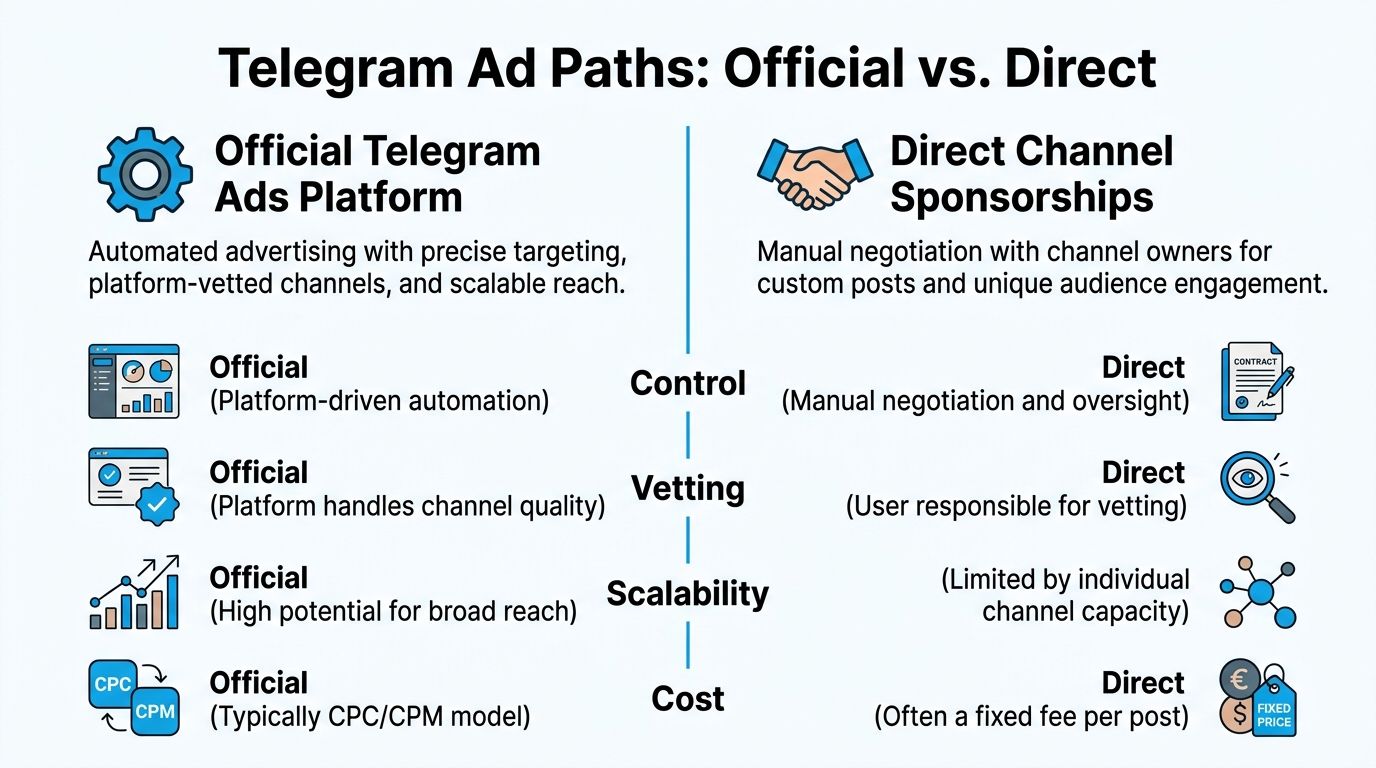
Official Telegram Ads run through Telegram's own system. Placements appear in public channels with more than 1,000 subscribers, limited to 160 characters plus a URL, targeting by language, GEO, and specific channels. You can cap views per user, bid on CPM, and build a real testing framework. Direct access has a high entry point, so most advertisers use resellers. See the full Telegram Ads platform breakdown for a comparison of 12 options.
Direct channel sponsorships are simpler in concept but messier in execution. You contact channel owners or buy through marketplaces and publish a custom post. More creative freedom — native posts, longer copy, video — but you vet channels yourself, negotiate terms, manage scheduling, and accept variable reporting quality.
| Attribute | Official Telegram Ads | Direct Sponsorships |
|---|---|---|
| Control | Platform-driven, standardized format | Manual deal-making, more creative control |
| Targeting | Language, GEO, channel-based | Channel-by-channel based on your research |
| Creative | Short text, strict limits | Native posts, richer format |
| Scalability | Better for broad reach and testing | Better for precision placements |
| Measurement | Cleaner built-in data | Depends on your links and naming discipline |
| Risk | Safer operationally | Better audience fit, higher channel-quality risk |
Use official ads when you need repeatable buying mechanics or broad contextual reach across many channels. Use direct sponsorships when your offer needs native framing and you know the niche well.
How to Vet Channels and Avoid Wasting Money
A bad sponsorship usually looks fine until after the invoice is paid. The miss starts in weak vetting.
For direct buys, channel selection is the primary targeting layer. Get it wrong and copy tweaks won't save you. Vetting is risk control — the goal is to find channels with enough transparent history to estimate delivery quality before committing budget.
Start with channel behavior. Subscriber count is the easiest metric to fake. Check the archive instead — a credible channel has a recognizable publishing rhythm, consistent topics, and post performance that moves within a believable band. Review the channel historically with transparency tools. Statiko's guide to finding Telegram channels pushes the process toward observable history instead of sales claims.
Use engagement as a filter, not a verdict. Engagement Rate Ratio is a good first pass. Look for stability across time, and check whether sponsored posts hold up against organic ones. Inflated channels often fail on pattern consistency, not on one headline metric — the full method is in the guide to checking a Telegram channel for fake subscribers.
Red flags worth walking away from: - Sharp subscriber spikes with no clear cause - Low post visibility versus total audience size - Frequent edits and deletions around sponsored content - Too many ads in the feed — audiences learn to ignore them - Engagement signals that don't match (strong reactions, flat views, or vice versa)
Green flags worth a premium: - Stable, explainable growth over time - Tight editorial focus — usually better for conversion than broad reach - Prior sponsored posts that feel native without being deceptive - Consistent post-level performance, not a single lucky spike
| Check | What to review | Why it matters |
|---|---|---|
| Growth history | Trendline, spikes, credible explanation | Filters suspicious audience inflation |
| Post archive | Topic consistency, publishing cadence | Shows whether the audience is stable |
| Edit/deletion patterns | Whether changes cluster around ads | Catches channels tidying up weak sponsorships |
| Engagement profile | View consistency, reactions vs reach | Separates real attention from manipulation |
| Sponsorship fit | How past paid posts appear in feed | Sets expectations for your ad |
Planning Budget, Targeting, and Creatives
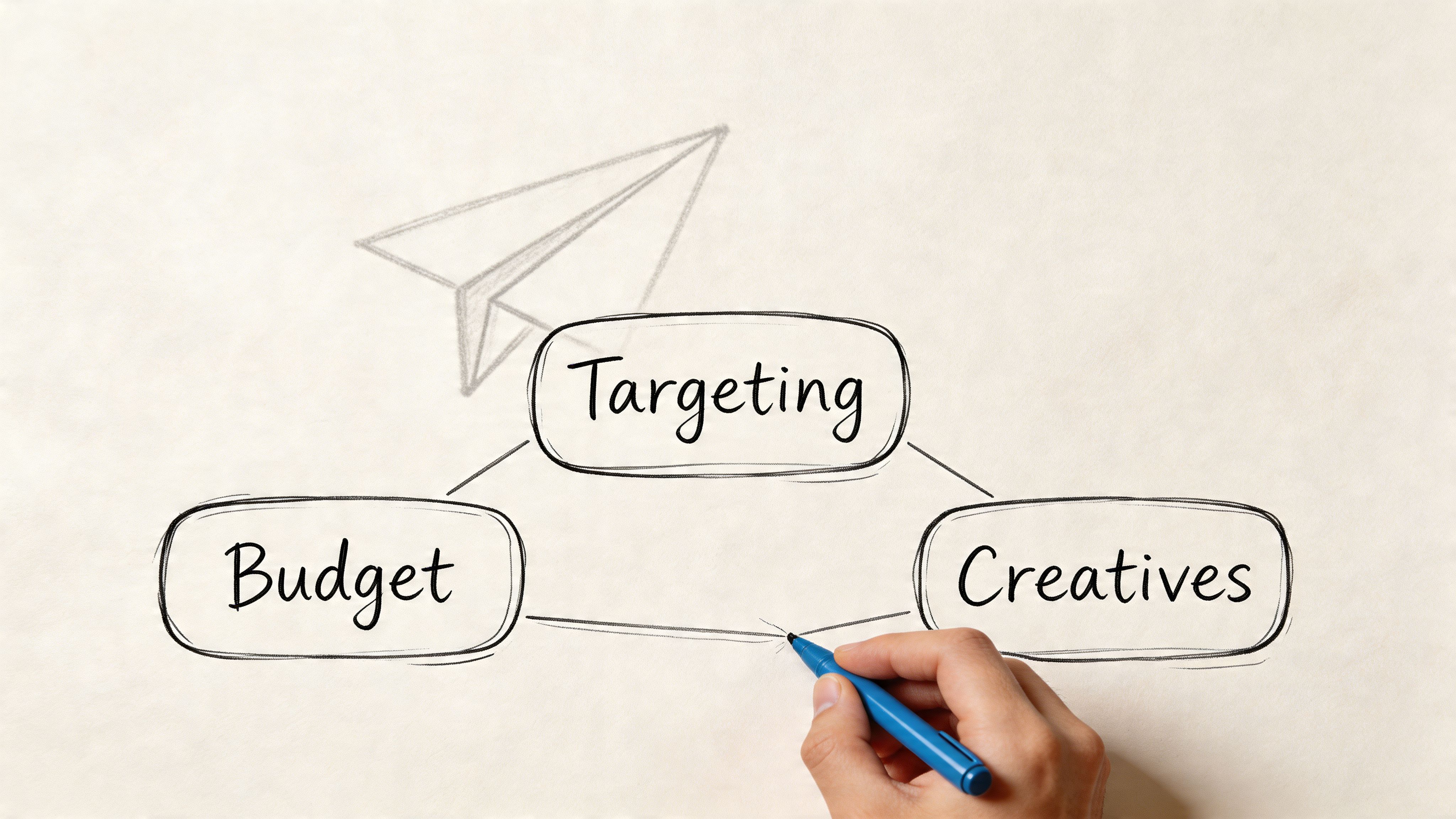
Budget, targeting, and creative need to be planned as one system. A broad target forces generic copy. Generic copy lowers click quality. Poor click quality makes channel tests look worse than they are.
Budget around the questions the spend needs to answer. For official ads, you're learning which contexts, hooks, and destinations produce qualified traffic. For sponsorships, you're testing whether a specific audience trusts the host enough to act on your offer.
- For official ads: test several targeting clusters and multiple copy angles simultaneously
- For sponsorships: spread test budget across comparable channels instead of staking it on one expensive post
- Hold back reserve budget for combinations that prove they can convert
Target by context and user intent. Channel environment matters more than a persona deck. Ask: does the audience follow adjacent problems? Does the offer fit the channel's pace and tone? Is the click coming from curiosity or real purchase intent? Use posting history and visible behavior to judge fit, then connect that to a clear measurement model.
Write ads that belong in the feed. Telegram users scroll fast and ignore copy that sounds imported from another platform.
For official ads, clarity wins. Lead with the outcome, cut brand throat-clearing, give one obvious next step. For sponsorships, longer copy doesn't fix weak positioning — the best sponsored posts feel native while still making the promotion unmistakable.
Rules that hold across both formats: - Open with a concrete benefit or problem - Match the host channel's voice and reading style - Keep claims specific and believable - Give one primary CTA - Write for scan speed, not internal approval
If timing matters, use a Telegram scheduler so creative tests go live when planned.
Destination choice changes the economics. Send to a channel when the goal is subscriber growth. Send to a bot when you need to qualify users or collect structured actions. Send to a website when the sale needs more proof or standard checkout. The destination has to complete the promise made in the ad.
Executing and Measuring Your Campaign
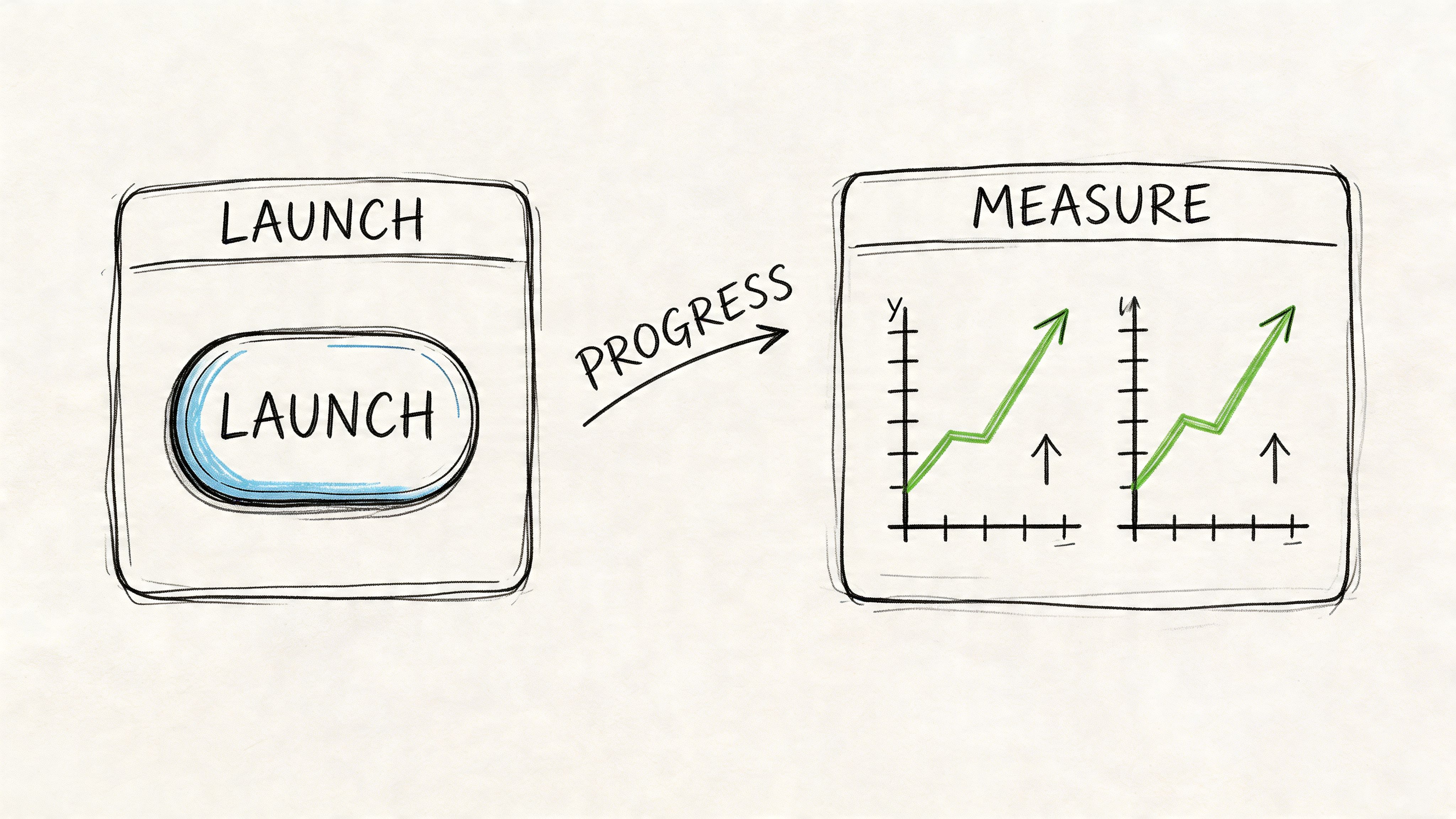
Set naming conventions, tracking links, and reporting windows before the first impression. Without that, you won't know which channel, creative, or posting time produced profitable traffic.
Launch with controlled variation. Multiple creative angles, separate audience groups, one clear success metric per test cell. If the goal is sales, track CPA or ROAS and accept that lower CTR can still win.
- Name campaigns for analysis — placement, audience, offer angle, destination, version
- Test one major variable at a time
- Set a decision window in advance — too early and you cut ads before they stabilize
- Make the destination conversion-ready before you spend
- For sponsorships, use a Telegram scheduler to keep timing consistent
Measure the whole path, not just the click. Use UTM parameters, unique invite links, bot entry parameters, promo codes, or dedicated landing pages. Subscriber campaigns need retention checks after acquisition. Lead gen needs bot completion rate and qualified lead rate. Ecommerce needs revenue mapped back to source.
| KPI | What it tells you | How to use it |
|---|---|---|
| CTR | Placement and message getting attention | Judge hook and channel fit |
| Cost per subscriber | Acquisition cost for channel growth | Only useful if new subscribers stay active |
| CPA | Cost per target action | Better than CTR for lead gen and sales |
| ROAS | Revenue returned on ad spend | Use before scaling spend |
High CTR signals curiosity. It doesn't guarantee buying intent. Broad channels can drive cheap clicks that collapse at the bot step because the audience wanted content, not the product. Niche channels produce more expensive traffic that converts well enough to justify a higher CPM. Use channel history and audience signals from Statiko to decide where to spend, then compare pre-buy assumptions against actual performance.
Troubleshooting Common Problems
Most campaigns don't fail because Telegram "doesn't work." They fail because buyers diagnose the wrong problem.
Low CTR — start with fit. If the message doesn't match the channel's context, no copy polish fixes it. Check channel-creative alignment, offer clarity, and destination expectation.
High CPA — usually the post-click path is leaking. Check bot or channel readiness, funnel continuity, and audience qualification. Broad reach produces cheap clicks that never turn into useful actions.
Performance falling after a good start — usually fatigue. Too few creative variants, same angle across channels with different cultures, winners running too long. Keep a whitelist of channels that proved they can deliver, then rotate fresh creatives into that shortlist rather than restarting from zero.
The best optimization move is often subtraction. Cut weak channels, weak destinations, and recycled copy before you raise spend.
FAQ
Should I send traffic to a channel, bot, or website? Match the destination to the action you want. Channel = audience growth, value compounds through future posts. Bot = qualify users, collect structured actions. Website = the sale needs more explanation or checkout mechanics. When unsure, bots are usually the safest middle ground for performance campaigns.
What's a realistic starting budget for a small business? Enough to fund multiple tests, not one gamble. For sponsorships, spread across several vetted channels. For official ads, support multiple creatives with enough impressions to compare them. If the budget only covers one angle and one audience, wait until you can test properly.
Direct campaign or agency/reseller? Direct if your team can handle channel research, creative iteration, and measurement. Reseller or agency when access or operational bandwidth is the bottleneck. Either way, your team still needs to understand channel quality and what success looks like before launch.
If you're trying to advertise on Telegram without guessing, use Statiko to inspect public channel behavior before you commit budget. The value isn't hype. It's visibility into growth patterns, posting history, edits, deletions, and engagement signals that help you decide whether a channel is worth testing at all.
Related posts

Discover the 12 best Telegram ads platform choices for 2026. Compare official ads, marketplaces, and networks to launch your next campaign.

Unlock growth with our guide to Telegram channel analytics. Learn to track key metrics, analyze competitors, and make data-driven decisions for your channel.
Start in seconds.
Create a free account to organise channels, track activity, and get recaps delivered to you.
Real-time. Telegram. Analytics.