Who Uses Telegram the Most? a Data-Backed Guide for 2026
Curious who uses Telegram the most? Our 2026 guide breaks down users by country, age, and profession. Get data-driven insights for marketers and creators.
India uses Telegram the most, with roughly 104.04 million monthly active users as of 2026. But if you're asking who uses Telegram the most for marketing, research, or channel growth, a country name is only half the answer.
A market of 100 million-plus users sounds broad. In practice, Telegram's audience concentrates around specific user types, and that changes how you should read the platform. The real question isn't where Telegram is biggest — it's which people inside those markets treat Telegram as a daily habit, and what that means for content and competitive strategy.
The Simple Answer and the Smarter Question
Telegram hit roughly 1 billion monthly active users in 2025, according to its founder, as cited in Statiko's state of Telegram 2025 analysis. At that scale, "who uses Telegram the most" sounds like a geography question. For strategy, it's a composition question.
Country totals tell you market size. They don't tell you which segments dominate attention or what tone and posting style will land with a given audience.
Telegram behaves less like a general social network and more like a high-concentration environment, where the active audience is often narrower than the population headline suggests.
Why the demographic layer matters more than the ranking — The common mistake is treating a top country as a mass-market shortcut. A country can rank high on Telegram usage while still being driven by a concentrated mix of younger, urban, educated users — which is why broad, generic publishing tends to underperform content built for a defined interest group.
For marketers, national scale is market access, not automatic reach across every consumer group. A stronger framing starts with concentration inside each market:
- Which demographic groups are overrepresented? Age, education, and urban concentration shape what content feels relevant.
- Which professional profiles show up repeatedly? Tech workers, traders, founders, and analysts often set the channel norms.
- Which use cases drive retention? News monitoring, specialist communities, and topic-based channels behave differently than casual social use.
A smaller national base with a tight concentration of professionals or high-intent niche communities can outperform a much larger country total on engagement and conversion quality.
Telegram's Global Footprint: A Geographic Breakdown
Telegram's map is concentrated, not evenly global. The center of gravity sits in Asia Pacific, with India as the standout market and Russia a structurally important second cluster in platform culture.
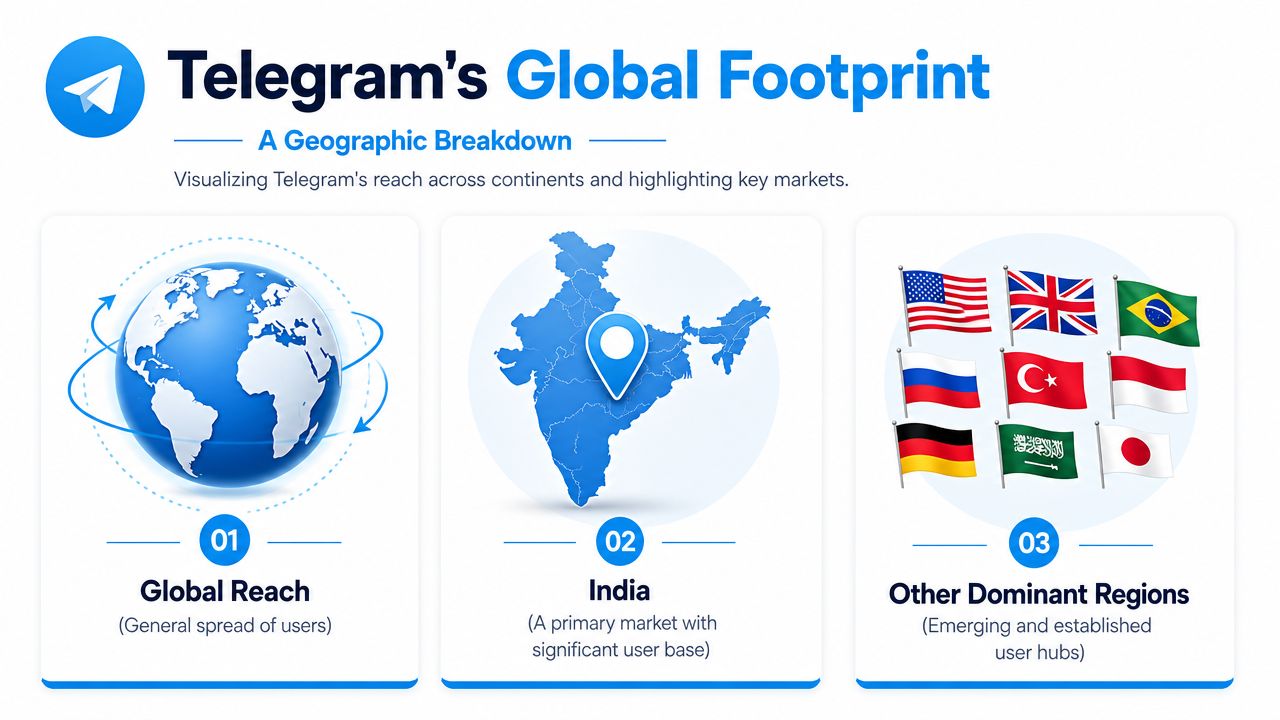
The core numbers — According to Resourcera's Telegram user data, India hosts about 104.04 million monthly active users as of 2026, the largest Telegram market in the world. The same source puts Asia Pacific at 38% of Telegram's total user base, roughly 361 million of the platform's 1 billion MAU.
| Market | Verified scale |
|---|---|
| India | 104.04 million MAU |
| Russia | roughly 38.44 million downloads |
| United States | roughly 38.16 million downloads |
| Asia Pacific | 38% of MAU, around 361 million users |
The comparison mixes MAU, downloads, and regional share because that's what the verified record provides. Even so, the pattern holds: Telegram's concentration sits more heavily in Asia than most casual observers assume.
Why the map matters less than it looks — Country rankings tell you where Telegram has enough scale to support thriving channel ecosystems. But geography is a market-sizing layer, telling you where to look, not who you'll find.
Serious analysts don't stop at country totals. They need to know whether a market's growth comes from news consumption, creator ecosystems, or migration from other platforms. The public-channel side of Telegram behaves more like an attention network than a messaging layer, which is why tools like the State of Telegram 2025 analysis beat generic social dashboards for this question.
Big countries create opportunity. Concentrated user types create strategy.
If you're choosing markets to study, India is the obvious top priority by scale. If you're trying to understand why some channels feel unusually dense or technical, regional concentration in Asia Pacific is only the start of the explanation.
Beyond the Map: The Demographics of a Typical User
Telegram strategy improves once you shift from country totals to audience concentration: which groups are disproportionately active inside those markets, not just where users are.
Verified audience research describes Telegram's base as skewing young, urban, male, and relatively well educated. That mix shapes what gets shared, what earns trust, and which topics sustain repeat attention.

What this profile changes in practice — A younger, urban, digitally fluent audience raises the information threshold. Channels perform better when they're specific, fast, and useful. Readers reward:
- High-information posts over broad lifestyle content
- Speed and utility over heavy brand packaging
- Subject expertise over generic awareness messaging
- Participation and identity over passive consumption
That's why Telegram channels often behave more like niche media products or specialist briefing lists than classic social accounts. The winning formula is relevance to a defined subgroup, not broad appeal.
The demographic gap inside top countries — India is a good example. A large user base tells you the market is worth studying, not whether your realistic audience is urban students, crypto traders, developers, or local-language community admins — very different acquisition and content problems.
For marketers, campaign planning should start with a subgroup hypothesis: which slice of the national audience is active, informed, and connected enough to spread a message inside Telegram?
Turning demographic insight into targeting — Combine platform-level patterns with your own intake data: what people click, which topics drive joins, which offers generate replies instead of silent views. This first-party data guide for marketing teams is a useful framework.
| Broad assumption | Better Telegram framing |
|---|---|
| "We want users in India" | "We want urban, educated, digitally fluent users in India interested in X" |
| "We need more subscribers" | "We need subscribers who match this niche and will return for updates" |
| "We should post for everyone" | "We should post for the segment most likely to share, save, and act" |
That shift matches how Telegram demand actually concentrates. The heaviest, most influential users aren't defined only by country — they're defined by a demographic and professional profile that affects content tolerance, trust signals, and community density.
A Hub for Professionals and Passionate Communities
Telegram's audience concentrates around people who treat information as part of their work, identity, or daily routine, and that matters more than raw national reach.
In many of Telegram's strongest channels, the active audience is a narrower slice inside a high-adoption country: builders, operators, analysts, traders, researchers, highly involved hobbyists.
Professional concentration shapes channel behavior — Technical and specialist communities tolerate dense language, expect fast updates, and reward posts that save time or improve decisions. A channel aimed at developers or market participants usually performs better with direct claims and documented examples than motivational posting. That's part of why Telegram works so well for broadcasts and niche publishing, as outlined in these core benefits of Telegram for audience building.
For marketers, this is a stronger planning input than a country ranking alone. A technical or professionally engaged subscriber base means content has to meet a higher bar for specificity.
Passionate communities create repeat attention — Telegram over-indexes toward sustained interest, not casual curiosity: crypto communities, market watchers, independent news followers, activists, open-source contributors, specialist hobby groups. These groups don't subscribe passively. They monitor.
On feed-driven platforms, content competes for intermittent attention. On Telegram, subscriptions often reflect a standing intent to receive updates, closer to an opt-in publication than a social feed. A smaller, committed audience can outperform a larger one with weak identity fit.
What to look for in a serious niche — Four signals matter more than subscriber count:
- Specialized vocabulary — stable insider language signals shared context and staying power
- Consistent update structure — recurring formats train subscribers on what signal to expect
- Clear editorial position — strong channels are explicit about what they cover and why
- Audience overlap with adjacent channels — cross-subscription patterns reveal neighboring niches
Telegram's strongest opportunities usually sit where geography and profile intersect. A country supplies the audience base, but performance comes from the younger, urban, professional, or high-commitment subgroups inside it.
Why These Specific Groups Choose Telegram
Telegram's audience profile isn't accidental. The platform solves specific problems for certain groups. In some markets that's access to information outside mainstream platform constraints. In others, it's clean one-to-many communication. In many niches, Telegram just feels less cluttered by advertising logic.
Russia is the clearest structural case — According to Posterly's Telegram guide, Russia has a 58% population penetration rate on Telegram, driven by government crackdowns on other platforms. The same source notes Android users there spend 4 hours 25 minutes monthly on the app.
That's what happens when platform choice is shaped by political and media conditions rather than app preference. When users, journalists, and communities relocate to one platform, they bring audiences, habits, and distribution routines with them — Telegram becomes a media layer, not just a messenger.
The product fits high-signal users — Several parts of the experience align with how information-dense communities operate:
- Channels support broadcast behavior — analysts and organizers reach subscribers without feed-algorithm friction
- The environment feels less ad-driven — more direct, less commercially noisy than mainstream social apps
- Public channels create persistent topic hubs — subscribe once, keep receiving updates without relying on recommendation systems
- Cross-device access supports constant monitoring — useful for professionals treating channels as live information streams
For more on this, Telegram channel benefits for communication and growth covers why the product works so well for direct audience relationships.
Telegram adoption often reflects motivation, not just convenience. Intentional users are selective — they subscribe with purpose and leave quickly when content gets vague or off-segment.
Actionable Insights for Marketers and Channel Owners
Raw country totals are a weak planning metric. The more useful question: which demographic cluster inside a large Telegram market matches your offer, your posting style, and your expected audience intent?
A country-level view tells you where Telegram is popular. It doesn't tell you whether your likely subscribers are urban professionals, technical communities, or niche interest groups expecting high-frequency specialist content — and that gap is where many channel strategies fail.
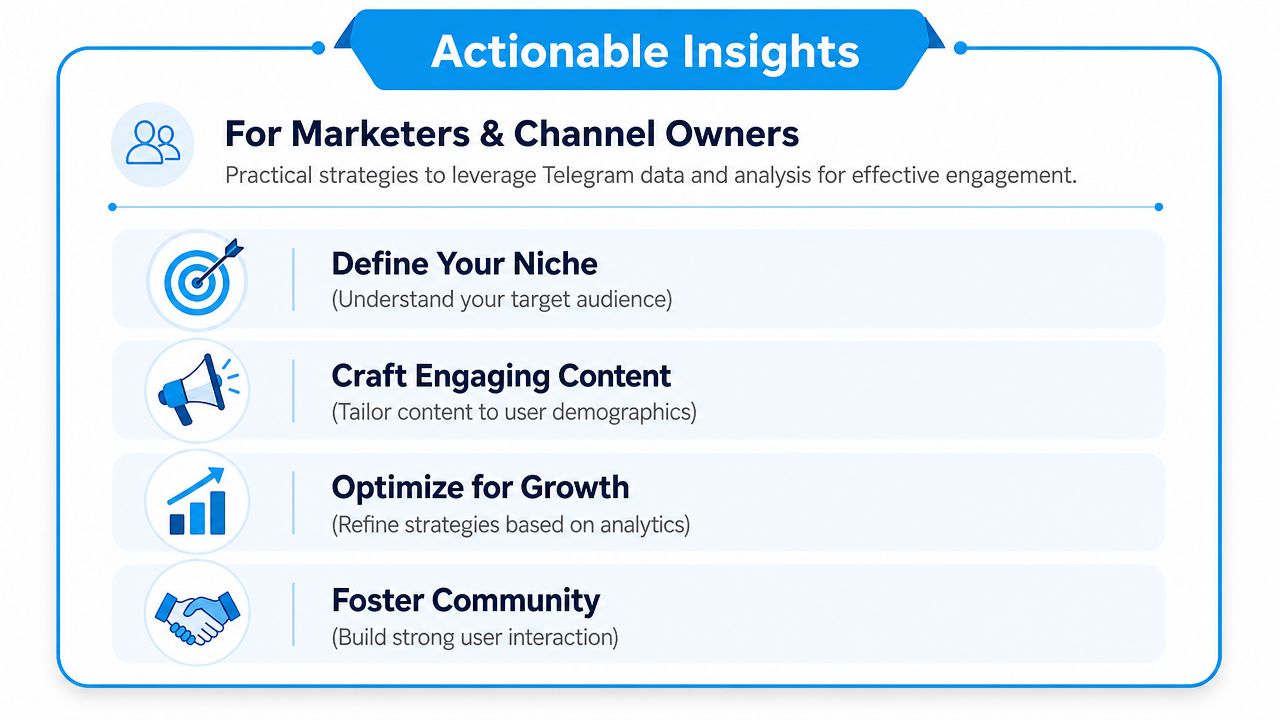
A practical operating model — If your target audience overlaps with Telegram's common high-intent profiles (younger urban users, educated professionals, traders, founders, developers, researchers, tightly defined enthusiast groups), strategy should reflect that concentration. Four decisions matter most:
- Define the audience by role and use case. "India" isn't a usable audience definition. "Indian startup operators" or "Arabic-speaking football analysts" gives you a clearer editorial target.
- Publish information that reduces effort or delay. Market summaries, workflow tips, change logs, event alerts, and curated updates fit better than broad lifestyle posting.
- Use tone to qualify the audience. Precise wording helps the right subscribers recognize themselves and filters out casual readers.
- Standardize recurring post formats. A morning briefing, weekly resource drop, or structured alert format trains subscribers on what to expect.
| If your audience is... | Your content should feel like... |
|---|---|
| Tech-oriented professionals | concise, specific, tool-aware |
| News-focused readers | timely, direct, source-conscious |
| Niche hobby or market communities | frequent, signal-rich, insider-friendly |
| Broad consumer segments | simplified, selective, less jargon-heavy |
Lead generation needs Telegram-specific design — Subscribers want repeated proof of usefulness before sharing contact details or entering a sales flow. If lead capture is part of your workflow, adapt HarvestMyData's lead generation tips for Telegram: gated briefings, niche alerts, research digests, subscriber-only resources tied to a clear use case.
Publish consistent value in-channel first, then offer a next step that feels like a logical extension, not an interruption. If the offer matches the audience's job or recurring problem, conversion friction falls.
What to stop doing — Some patterns weaken performance even when subscriber counts look healthy:
- Generic reposting rarely builds defensible attention
- Brand-first formatting underperforms when information density is low
- Geography-only targeting hides differences in profession, language, urgency, and content expectations
- Subscriber inflation thinking — audience fit matters more than top-line size
Start with a narrow demographic hypothesis inside a large market, then test whether the content earns repeat attention. A disciplined review process using Telegram channel analytics for niche and competitor research makes that easier to validate.
Using Analytics to Find and Engage Your Niche
Finding the right Telegram audience takes more than browsing a few channels. Surface impressions are misleading — you need a way to compare publishing behavior, audience overlap, and content patterns over time.
A practical workflow — Start with a seed set of channels in your category, then compare on three levels:
- Content pattern — what topics repeat, what formats recur, what language signals audience sophistication
- Publishing behavior — how often they post, when activity clusters, bursts vs. stable cadence
- Channel evolution — which themes gain emphasis over time, where edits or deletions may signal repositioning
Telegram channel analytics tools help move from anecdotal browsing to structured comparison.
Verification matters — Telegram niches include anonymous admins, repost networks, and brand-adjacent accounts that aren't always what they appear to be. Before partnering, citing, or benchmarking a channel, verify who or what you're looking at. This guide for verifying online profiles is a practical reference point.
The right analytics setup should answer:
- Which channels serve my niche, not just my broad topic?
- What posting style attracts the audience I want?
- Where are competitors differentiating through timing, framing, or editorial focus?
- Which public channels act as gateways into adjacent communities?
That's the real answer behind "who uses Telegram the most." It becomes visible when you map channels to user types, not when you stop at country totals.
If you want to study public Telegram channels with more precision, Statiko is a practical next step. It lets you analyze public channels, track edits and deletions, compare growth patterns, and use AI recaps to understand what a channel is doing without reading every post manually.
Related posts

Telegram reaches 1 billion monthly active users in 2025. Explore the latest statistics on growth, demographics, engagement, and what this means for channel transparency.

Explore the key benefits of Telegram for channel operators and analysts. Learn about privacy, bots, massive reach, and how to verify it all with data.

Unlock growth with our guide to Telegram channel analytics. Learn to track key metrics, analyze competitors, and make data-driven decisions for your channel.
Start in seconds.
Create a free account to organise channels, track activity, and get recaps delivered to you.
Real-time. Telegram. Analytics.