Find Profitable Trading Signals Telegram: Ditch Scams 2026
Ditch the scams! Learn to find, verify, & use profitable trading signals telegram in 2026 with our guide to data-driven validation.

Most guides to trading signal channels start with the wrong question: which channel looks profitable. The real question is whether it can be audited at all. If you can't inspect its history, check old calls against price, and see whether losing posts vanished, you're evaluating marketing, not a trading service.
Telegram's speed is exactly what makes it easy to post, edit, delete, and reframe trades after the fact. Treat a signal channel like any other strategy input: test it, score it, reject it if the evidence doesn't hold up.
The Reality of Telegram Trading Signals
Popular advice says profitable groups are easy to spot — testimonials, member count, fancy charts. None of that gets you close.
A Reddit discussion on Telegram forex groups found that 70-80% of signal groups display fabricated results and false statistics, hiding losses while promoting unrealistic 90%+ win rates; legitimate traders typically run 50-60% (discussion on Telegram forex groups).

Subscriber count isn't proof of skill — it can just as easily mean strong marketing. Testimonials and screenshots are weaker still: an owner cherry-picks praise the same way they cherry-pick winning trades, and a screenshot only shows what they want you to see.
Practical rule: If a provider leads with lifestyle photos, payout screenshots, and "VIP spots closing" language before showing a full trade record, treat that as a sales funnel, not a trading process.
Beginners often ask whether forex itself is fake, when the real problem is usually the middle layer of promoters and resellers — see is forex trading a scam? before handing money to a Telegram admin.
A channel earns attention only when it gives you enough raw material to verify behavior over time:
- Unbroken history — old posts still visible, not a feed that looks strangely clean
- Consistent formatting — a repeatable structure, not improvised alerts
- Loss visibility — losing trades in the same public record as wins
- No pressure tactics — urgency and "last seats" language usually signal weak substance
Traders don't lose money because Telegram signals can't help. They lose money by trusting presentation over verification.
Finding Potential Signal Channels
Don't try to pick "the best" channel on day one. Build a watchlist first — a broad pool is what exposes weak operators through comparison.
The market is concentrated around a handful of large channels. Traders Union reports ForexSignals.io at 304,000 users and FXPremiere.com at 168,000 members (overview of major Telegram trading channels).
Start with three sources: aggregator lists to map the market, Reddit and trading forums for complaints and recurring scams, and Telegram/social search for terms like "signals," "VIP," "gold signals," or "crypto entries." For a systematic approach, see this guide on how to find Telegram channels.
Keep the first pass simple with a shortlist:
| Field | What to note |
|---|---|
| Channel name | Exact brand and handle |
| Market focus | Forex, crypto, indices, gold, mixed |
| Offer type | Free only, paid only, free plus upsell |
| Signal style | Scalping, intraday, swing |
| First impression | Clean process, hype-heavy, unclear |
This keeps you from falling in love with a channel too early — you're gathering raw material, not making a commitment.
Big channels deserve inspection, not trust. Smaller channels deserve inspection too. The only difference is how much noise you'll sort through.
I'd rather review ten channels quickly than spend a week reading one promotional feed. Cut anything with obvious friction on the first pass: no public examples (results behind a paywall can't be audited), chaotic alerts (inconsistent entries make execution subjective), or brand-first behavior (selling VIP harder than posting analysis). What's left isn't a trusted list — just candidates that have earned a closer look.
How to Vet Providers and Spot Red Flags
Most signal sellers know what traders want to hear: high accuracy, fast gains, low effort. Marketing language hides poor discipline well.
An independent review of 50+ forex signal channels found an average claimed win rate of 65%, but a verified win rate of only 38% against price data — and roughly 76% had no verifiable performance logs at all (independent analysis of Telegram forex signals). "Looks good" isn't a usable standard.
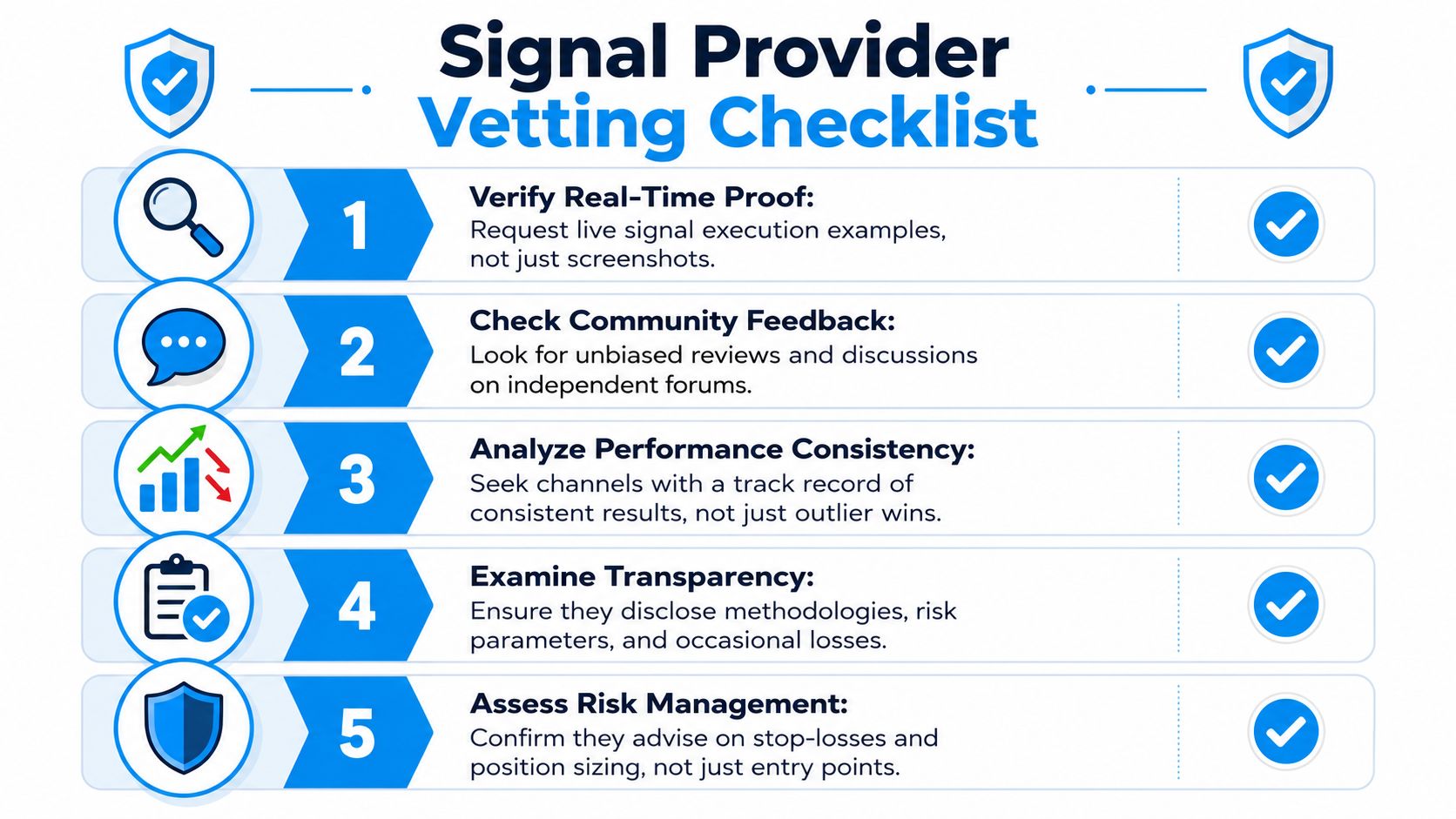
Some red flags don't need a spreadsheet: guaranteed outcome language, pressure to upgrade quickly ("price doubles tonight" is sales, not trading), no visible losses (a spotless feed is usually a manipulated one), retrospective posting (victory laps after the fact are commentary, not signals), and no risk language (entries and targets without stop-loss logic push action, not process).
Serious vetting means judging channel behavior, not claims — look for three habits in the message history.
Deleted posts are one of the oldest tricks in the space. A provider posts a loser, deletes it later, and leaves the wins visible, so new subscribers see a cleaner record than original followers did. A few deletions don't prove fraud — channels delete spam too — but clusters around bad trading days deserve scrutiny.
Edited messages can be legitimate, like fixing a typo in an entry price. They can also rewrite history: an entry range adjusted after price moved, a target reframed once the trade is safe, a stopped trade rebranded as "closed early in profit."
Selective updates are common and often missed. The entry gets posted publicly, but real-time management only follows the trades that work — losses get silence, wins get celebratory follow-ups. The raw calls stay visible; the emotional record is biased.
If a channel communicates wins loudly and losses quietly, it's still manipulating perception.
Before paying for anything, run through this checklist: review old signals against charts rather than recap posts, check whether losses stayed public, inspect edits and deletions for hidden changes, read the free feed like a prosecutor and verify timestamps and follow-ups, and check independent discussion outside the owner's own community.
For a broader trader-oriented primer, essential 2026 protection methods complements the forensic approach well. And if you want to go deeper on the investigative side, this Telegram OSINT guide treats channels as evidence sources rather than marketing pages.
Auditing Performance with Channel Analytics
Manual review catches the obvious scams. Analytics catches the subtle ones — treating a channel as a historical record of post frequency, edits, deletions, growth, and topic consistency over time. Reading the last fifty messages won't show you that.
Start with message integrity. A clean history shows normal posting behavior — alerts, updates, occasional housekeeping. A suspicious one shows repeated edits to key trade messages, deletions after sharp moves, or gaps where a follow-up should exist. Subscriber growth matters too: organic growth looks uneven but believable, while manipulated growth jumps abruptly without matching content quality or engagement.
A repeatable workflow: pull the full feed rather than judging the last week alone, separate signal posts from commentary and sales content, check edit history on entry/stop/target changes, cross-reference deletions against volatile sessions, and judge whether growth looks earned or engineered.
This guide to Telegram channel analytics covers the metrics worth monitoring in more depth.
Context is what makes deletion and edit patterns useful. One edit means little; repeated edits to signal parameters mean a lot.
| Behavior | Usually acceptable | Usually suspicious |
|---|---|---|
| Message edits | Typo fixes, formatting cleanup | Changed entry, stop, target, or result framing |
| Deleted posts | Spam, duplicate admin notes | Missing trade alerts after bad sessions |
| Growth changes | Gradual rises around active posting | Sharp jumps with weak engagement |
| Content mix | Signals plus analysis and review | Endless marketing around thin signal output |
Audit behavior, not branding. A polished logo tells you nothing. A preserved message history tells you a lot.
Good analytics tools save time by surfacing patterns worth deeper review, instead of reading every post manually. That's how you separate popular channels from accountable ones.
Using Signals with Proper Risk Management
Even a credible provider's trade has to fit your account and your rules. A good signal becomes a bad trade when size, correlation, or execution discipline is wrong.
CryptoNinjas notes that a robust signal includes the asset, direction, entry range, stop-loss, take-profit targets, and rationale. Top providers may run over 90 technical indicators, but the transparency comes from publishing full trade records — including losses — and monthly summaries of win rates and drawdowns (what strong Telegram signals should include).
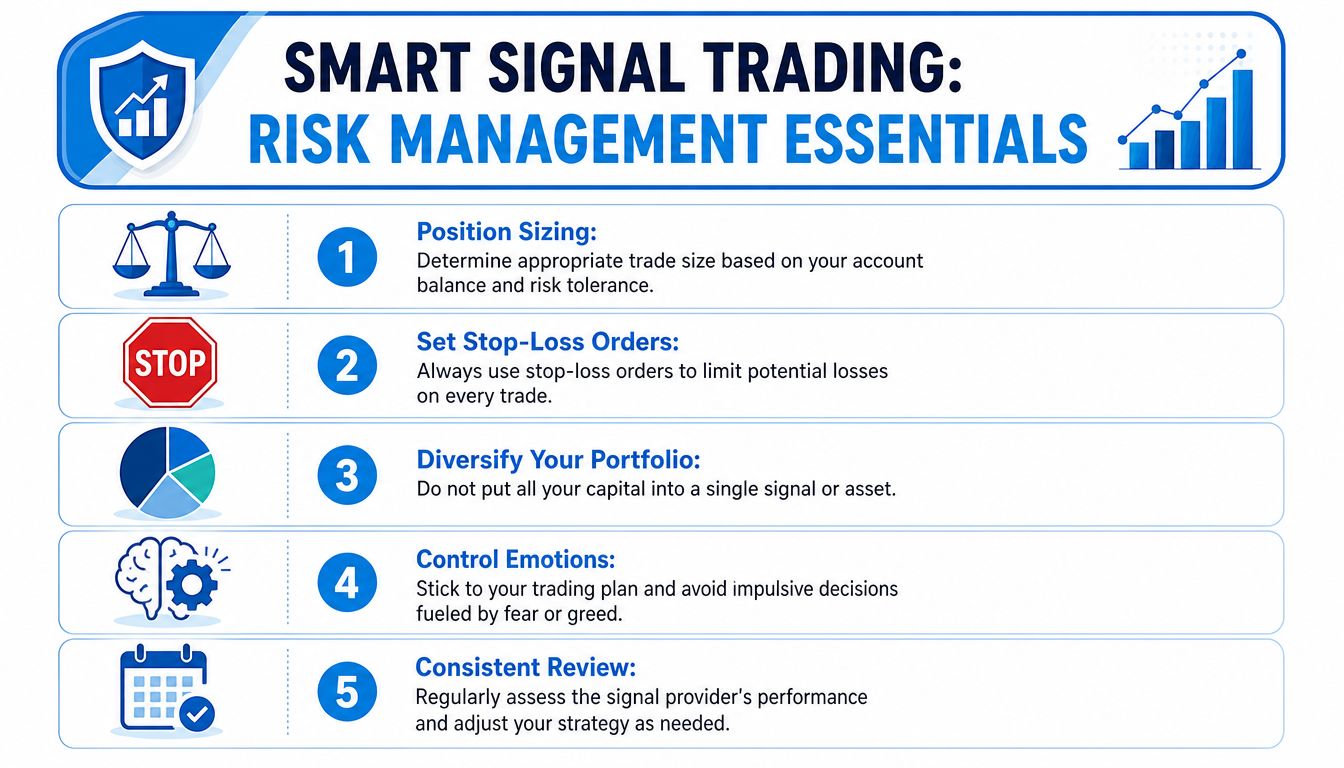
A usable signal answers the execution questions upfront: asset and direction, entry range (a defined zone, not "buy now"), stop-loss, take-profit targets, and brief rationale for the setup. Channels that skip these force discretion onto the subscriber, creating slippage between the provider's claimed result and your actual execution.
CryptoNinjas also recommends risking only 1-2% per trade and avoiding emotional adjustments — no provider avoids drawdowns, so this matters more than any single call. Traders usually go wrong the same few ways: sizing up after a loss to "get back" quickly, stacking correlated positions that are really the same trade twice, moving stops because the admin sounds confident, or following signals during major news without checking the setup still holds.
A signal is not a substitute for a plan. It's just an input.
Correlated exposure is especially dangerous here. Multiple setups tied to the same macro move just magnify one bad idea — different symbols don't mean you're diversified.
Treat signals as screened opportunities, not commands: check whether the setup still matches current price, size it with fixed risk rather than excitement, reject entries the market has already moved past, and journal provider quality separately from your own execution.
For a practical refresher, see position sizing and risk control — the part of signal trading most people neglect until it costs them.
The strongest traders don't ask how much a signal can make. They ask what happens if it's wrong.
Automating Your Strategy and Staying Safe
Automation sounds like the natural next step — why not route alerts straight into execution? Because automation amplifies whatever you feed it. A sloppy source doesn't get fixed by automating it; it gets industrialized.
Manual execution forces friction: you read the alert, compare it with price, notice if it's stale, and decide whether it fits your exposure. A copier removes that pause, which helps when the source is proven and hurts when it degrades.
Only automate after doing three things manually: verifying the provider over time, confirming the signal format is consistent, and proving the strategy fits your risk tolerance. If any are missing, stay manual — and keep supervising even after that, since providers drift and a disciplined channel can turn into a marketing machine later.
The standard for staying safe isn't finding one magic channel and relaxing. It's a repeatable loop: discover channels, audit history, test execution quality, size risk conservatively, and re-audit continuously.
That's the edge. Not hype. Not screenshots. Not a VIP badge.
If you want a faster way to investigate public Telegram channels before risking capital, Statiko is useful for checking post history, edits, deletions, growth patterns, and AI summaries in one place. For signal traders, that means less guesswork and a much clearer view of whether a channel is showing the whole record or just the flattering parts.
Related posts

Master Telegram OSINT with our 2026 guide. Learn profile discovery, channel analysis, network mapping, and the best tools for open-source intelligence research.

Unlock growth with our guide to Telegram channel analytics. Learn to track key metrics, analyze competitors, and make data-driven decisions for your channel.

In-app search only gets you so far. Use usernames, t.me links, directories, and subscriber data to find channels — then vet them before you join.
Start in seconds.
Create a free account to organise channels, track activity, and get recaps delivered to you.
Real-time. Telegram. Analytics.