Master Your Telegram Subscription Bot in 2026
Build and deploy a Telegram subscription bot from scratch. Our 2026 guide covers architecture, payments, user management, channel access, & analytics.

If you're building a telegram subscription bot, you're past the basic pitch. Put a bot in front of a private channel, collect payments, grant access, let the system run. You know that part.
What usually breaks isn't the first demo. Payments fail in edge cases, invite links get abused, expired users keep access longer than they should, and nobody can tell whether weak revenue comes from bad content, a bad bot flow, or fake subscriber growth. A subscription bot is a business system, not a side script.
Architecting Your Subscription Bot Foundation
With 700 million monthly active users and Telegram ranked fifth among global messengers, the audience is there. The operational pressure comes from retention — acquiring a new subscriber can cost five times more than retaining one, per Telechurn's subscriber analytics overview.
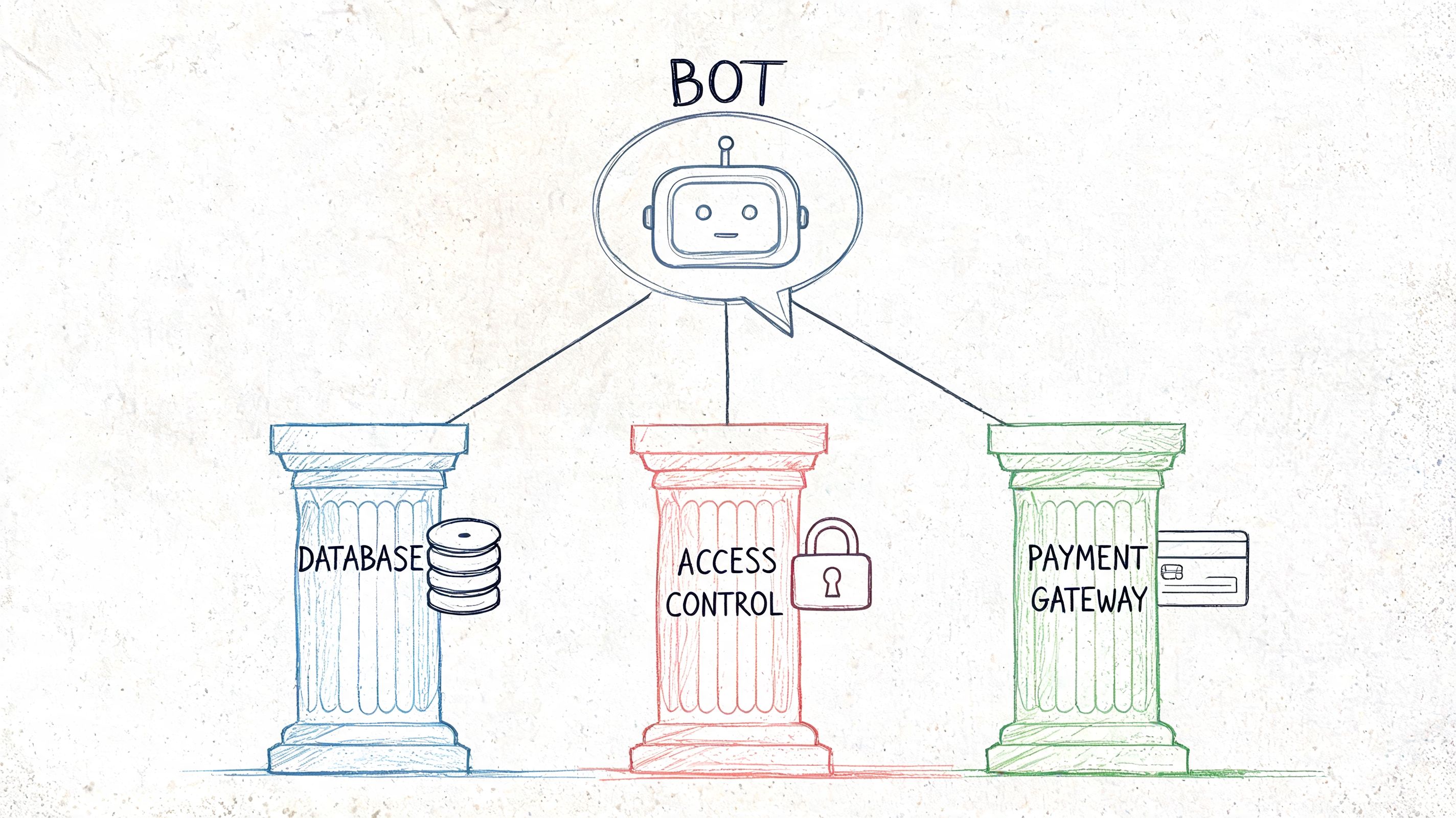
A production subscription bot has three core components:
- The Telegram bot layer — The chat interface. Handles
/start,/subscribe, renewal prompts, and payment handoff. Keep it thin: validate input, present choices, call backend services. - The backend service — Where real logic lives. Payment validation, entitlement checks, access provisioning, renewal scheduling, audit logging. If business logic lives inside bot handlers, every change becomes risky.
- The database — Stores users, subscription state, payment records, access grants, and expirations. Without clean state management, you'll eventually grant access to the wrong person or fail to revoke it on time.
Source of truth — You start at BotFather, but the database should own subscription status. Telegram is the delivery channel, not the authority on who has an active plan. That distinction matters when callbacks arrive out of order or a user contacts support after switching accounts. Design the bot as a client of your subscription system, not as the subscription system itself.
State-driven design — Most failed implementations are command-driven. Better ones model states: new visitor, pending checkout, active member, grace period, canceled, flagged. That gives you predictable behavior and aligns well with API design best practices if you expose subscription services internally.
Choosing Your Bot's Communication Method
Your first real architecture decision is how Telegram delivers updates to your bot: Long Polling or Webhooks.
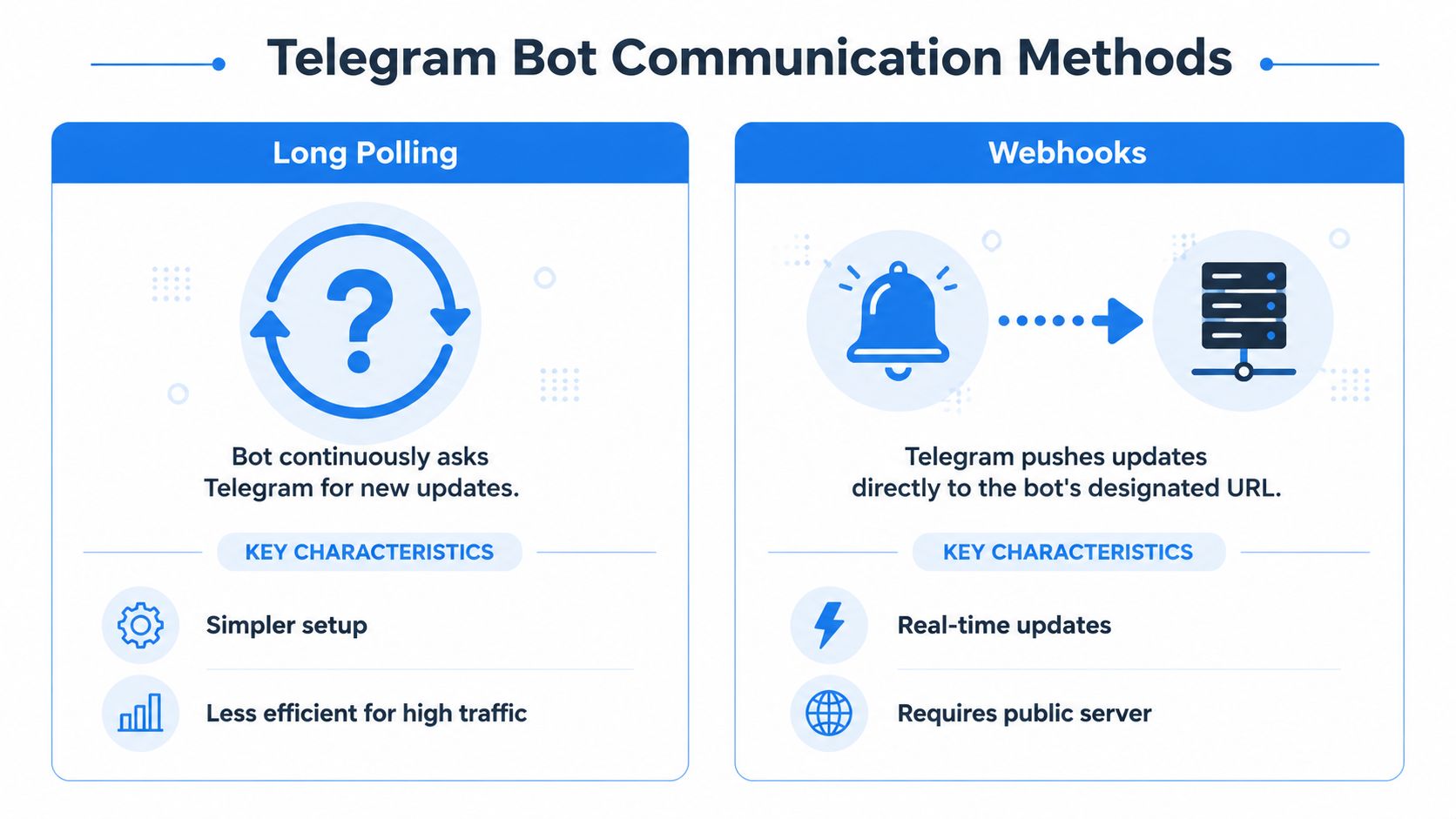
Long Polling means your app keeps asking Telegram for updates. Easy to test locally, fine for a prototype. At scale it creates avoidable waste — your server stays busy even when nothing happens. Use it for fast local setup, short-lived experiments, or while you're still shaping the flow.
Webhooks invert the pattern. Telegram pushes updates to your server as events happen. That's the right fit for subscription bots — users expect payment confirmation and access delivery without delay. You can route updates into queues, log raw events, retry failed actions, and separate inbound processing from downstream tasks.
| Method | Good at | Weak at | Best use case |
|---|---|---|---|
| Long Polling | Quick setup, easy local development | Efficiency, horizontal scaling, real-time feel | Prototypes and internal tools |
| Webhooks | Real-time updates, cleaner production flow | Requires public server and more deployment discipline | Paid bots, private access, renewals |
For any serious subscription bot, use webhooks and treat inbound Telegram updates like transactional events. Make handlers idempotent so duplicate Telegram events don't create duplicate grants. Long Polling teaches the API. Webhooks support a business.
Implementing Seamless Payment and Subscription Flows
The payment flow is where conversion lives or dies. MemberPass-powered bots convert 15-25% of link-clicks to paid subscribers by automating global payments through Stripe and crypto — they handle pre_checkout_query then use the successful_payment callback to trigger entitlement changes, as described in MemberPass's paid membership channel tutorial.
The user flow should look like this:
- User lands in the bot from a channel CTA or direct link.
/startexplains the offer in one screen.- The bot presents subscription tiers with inline buttons.
- User selects a plan and enters payment.
- Backend validates the transaction.
- Access is granted immediately after confirmed payment.
- Clear success message with next steps.
Every extra branch increases abandonment. Keep pricing, billing period, and access rules obvious before checkout starts.
Telegram Payments vs. external billing — Telegram's native flow is clean for in-app checkout. External billing is stronger when you need richer invoicing, dunning, or finance workflows.
| Feature | Telegram Payments | Third-Party Processor (e.g., Stripe) |
|---|---|---|
| Checkout location | In Telegram | Usually external or embedded |
| User experience | Native chat flow | Broader billing operations |
| Bot integration | Direct bot events | Requires backend orchestration |
| Subscription management | Works for transactional access | Better for complex billing logic |
| Operations | Simpler user path | More flexible accounting and billing logic |
For channel owners comparing revenue models, this guide on Telegram channel monetization is useful context before you lock in pricing and access design. It's also worth reviewing how mature subscription billing software handles recurring revenue outside the bot itself.
Key technical checkpoints:
- Present tiers with InlineKeyboardMarkup. Label plans by outcome, not just price.
- Validate in pre_checkout_query before confirming — reject broken carts, stale offers, invalid plan metadata.
- Treat successful_payment as a trigger. The callback enqueues your access service, records the payment, updates subscription state, sends confirmation.
- Make post-payment actions idempotent. Same event twice → one active entitlement, not duplicate records.
Three patterns create avoidable drop-off: forcing users to message support after payment, hiding pricing until late in the flow, and tying access logic to chat text. Use structured metadata, plan IDs, and backend state. The best payment flow feels small to the user and structured to the operator.
Managing Subscribers and Controlling Channel Access
Getting paid is one event. Membership is the product. If the bot doesn't manage entitlements cleanly, you'll leak revenue, create support overhead, and train users to test your edge cases.
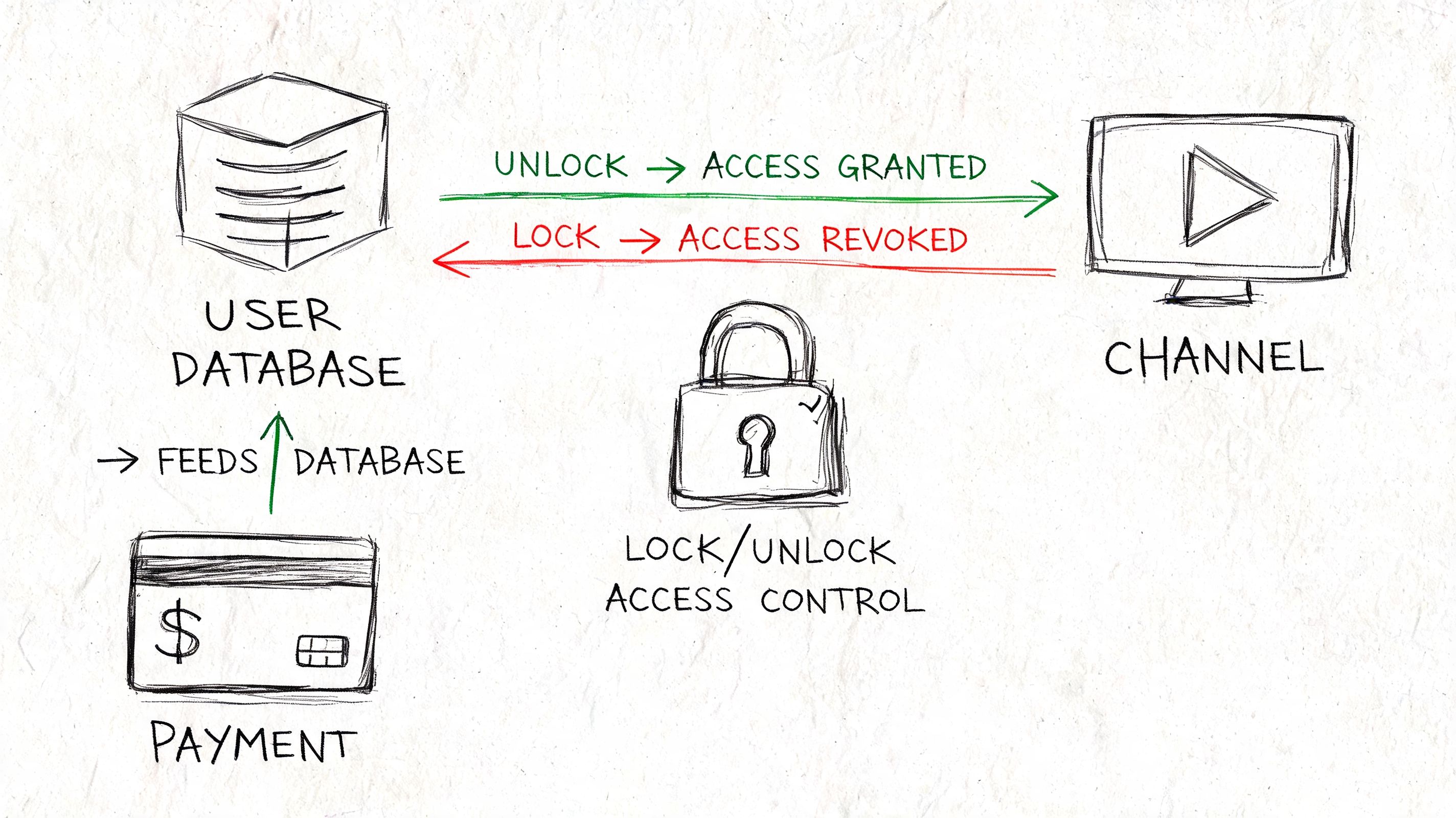
Database records — Keep separate records for users (Telegram user ID, account status, support flags), subscriptions (plan, start date, renewal state, expiration, cancellation reason), payments (provider transaction reference, status), and access grants (invite issuance, join confirmation, revocation state, channel mapping). Payment history and access history aren't the same thing. A paid user may fail to join. A canceled user may still have grace-period access.
One-time invite links — Use createChatInviteLink with limited use. Map each invite to a subscriber record and expire stale invites quickly in your system even if Telegram still considers them valid. When someone says they never received access, you can see whether the invite was generated, consumed, and whether the user joined.
For a broader implementation view, this article on building a Telegram channel bot is a useful companion if you're still tightening your channel automation model.
Revocation workflow — Don't kick users the instant a renewal hiccups. Use explicit status transitions: active → past_due → grace → canceled → revoked. A clean workflow:
- Failed renewal or cancellation event enters backend.
- Subscription state changes.
- User receives a clear message explaining next action.
- Grace logic runs if your business supports it.
- Access is revoked only when policy conditions are met.
- Audit log records who or what triggered the change.
Behavioral segmentation — High-performing bots achieve 20-30% better retention using behavioral segmentation vs. generic messages. Hashmeta's Telegram bot marketing analysis reports 20-40% of users exit after the first message. Useful cohorts: fast activators, silent payers, at-risk renewals, drop-offs. Generic bots blast the same reminders to everyone. Better bots respond to behavior.
Navigating Moderation, Privacy, and Compliance
Since mid-2025, Telegram's API updates have caused an estimated 40% of existing subscription bots to face access issues. Aggressive auto-removals can lead to 25% higher churn when they conflict with Telegram's anti-spam filters, per this analysis of Telegram bot permission changes.
Moderation — Most subscription bots need basic moderation logic: abuse of trial or invite mechanisms, repeated join/leave patterns, payment disputes tied to access attempts, accounts flagged for manual review. Don't let moderation run fully automatic. Auto-removal sounds efficient until it ejects legitimate subscribers who triggered an anti-spam condition or hit a payment edge case.
Privacy — If you collect payment state, subscription history, support interactions, and behavioral event logs, you're handling user data. Store what you need for billing, access, support, and retention. Tell users what data supports access control, what triggers subscription messages, and how to contact support.
Build for change — Telegram rules won't stay still. Keep access control, moderation, and compliance logic in configurable backend policies rather than scattered across bot handlers: isolate permission-sensitive operations, log every grant and revoke action, make removal jobs reversible, separate fraud signals from hard enforcement, and review bot permissions after platform changes, not only after incidents.
Monitoring Performance with Growth Analytics
Most bot tutorials stop at payment success. Once live, you need to know whether the bot attracts real subscribers, retains them, and converts channel attention into revenue.
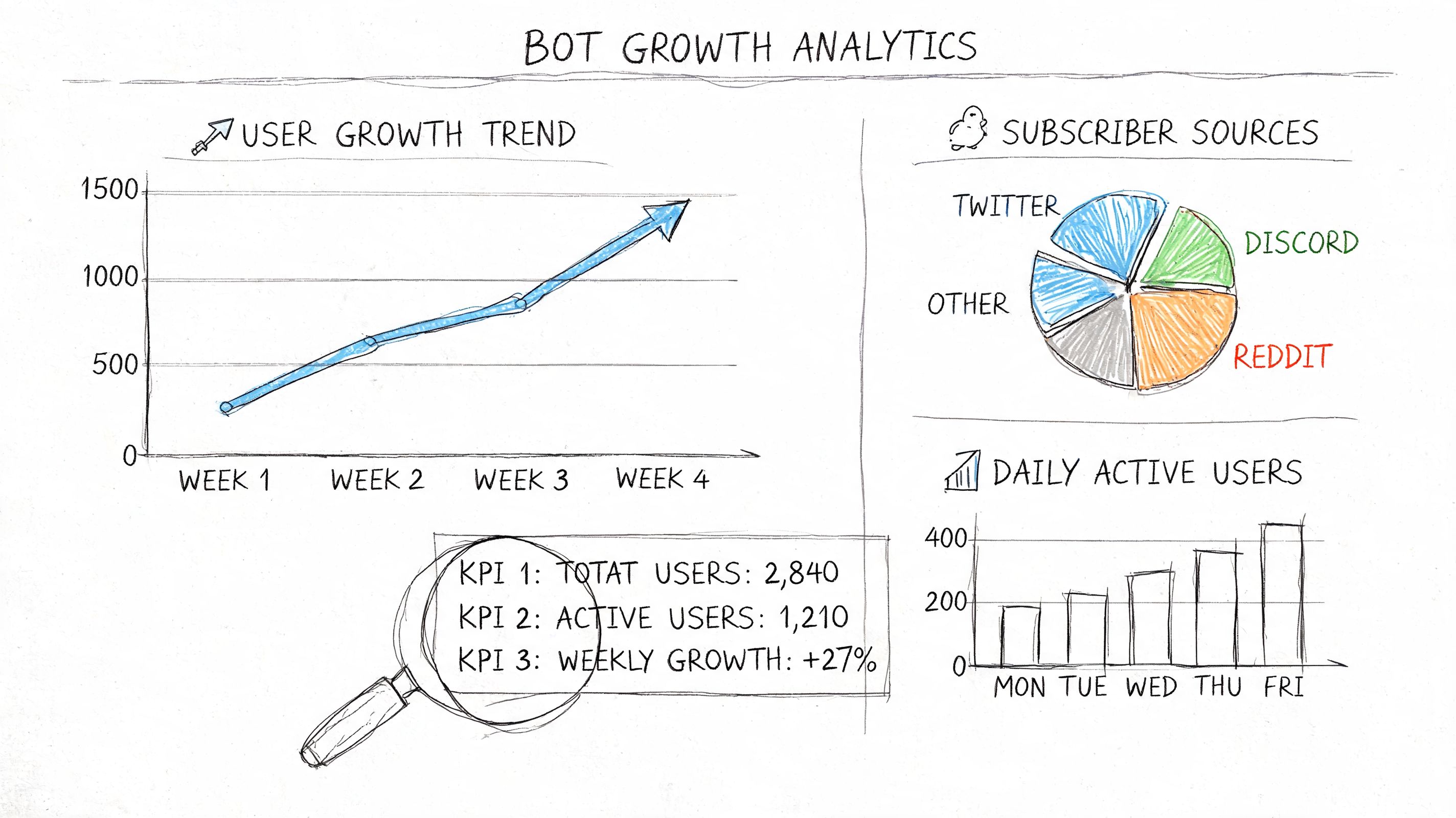
Internal metrics — Four questions to answer:
| Question | Metric to watch | Why it matters |
|---|---|---|
| Are users paying? | Conversion from click to checkout to active subscriber | Whether the offer and payment flow work |
| Are users staying? | Churn, renewal completion, grace-period recovery | Retention quality |
| Are users engaging? | Onboarding completion, message response, feature usage | Active vs. passive accounts |
| Is support load rising? | Failed payment events, access disputes, manual interventions | Operational friction |
For broader instrumentation, this guide on how to optimize chatbot effectiveness frames analytics as an ongoing product loop, not a launch checklist.
Watch the channel, not just the bot — Internal metrics tell you how the funnel behaves after the user enters. They don't tell you whether your public promotion layer is healthy. If your promo channel's subscriber line rises but post visibility doesn't move, acquisition quality may be bad. Statiko tracks exactly this — growth trends, posting consistency, and engagement patterns on public channels. If sign-ups are flat, the issue may start in the channel content feeding the bot, not the checkout flow.
The fake subscriber problem — Statiko's data shows channels using subscription bots can have unnatural growth spikes: a 50% subscriber increase without more views can indicate fake members. A 2025 arXiv study found 30% of subscription bots show suspicious activity, leading to 15-25% revenue loss from undetected churn, per this discussion of subscription bot blind spots. Track channel analytics on Statiko to spot these patterns early.
Review cadence — Daily for failed payments, access errors, and sudden engagement drops. Weekly for conversion flow changes and cohort behavior. Monthly for churn patterns, content-to-signup relationships, and acquisition quality.
Deploying, Maintaining, and Scaling Your Bot
A subscription bot earns trust in production, not staging.
Hosting progression — Start with simple platform deployment when validating the offer. Move to a managed virtual server when you need control over workers and queues. Then cloud infrastructure when you need isolation between webhook intake, billing logic, scheduled tasks, and analytics jobs. Choose based on who will maintain the system when a renewal job fails at night.
Maintenance basics — Keep secrets in environment variables, use Git for payment and access changes, add structured logs for payment callbacks and access revocations, run background jobs safely for renewals and reminders, write idempotent handlers. If you're still shaping your implementation roadmap, this overview of Telegram bot development is a good technical reference.
Scaling — Most bots fail because side effects pile up: payment callbacks, entitlement updates, access grants, support retries, and lifecycle messaging all competing for the same application path. Let inbound webhook handling stay fast. Move slower work into jobs or queues. Keep database writes explicit. Add health checks around anything tied to money and access before you optimize anything cosmetic.
Reconcile payment records against subscription state regularly. Test revocation flows, not just purchase flows. The businesses that keep a subscription bot profitable don't treat launch as the finish line.
A telegram subscription bot works best when it's supported by clear analytics, transparent channel monitoring, and reliable operational feedback. If you want visibility into public Telegram channel growth, posting history, edits, deletions, and competitive patterns around the channels feeding your bot, take a look at Statiko.
Related posts

A practical guide to Telegram channel monetization in 2026 — covering sponsored posts, affiliate marketing, paid subscriptions, pricing, and analytics.

Discover how a channel bot telegram can automate posts, moderate your community, and drive growth. Learn setup, best practices, and analytics in our guide.

Learn Telegram bot development with our guide to building, deploying, and scaling secure, feature-rich bots with Python, Node.js, and TON integration.
Start in seconds.
Create a free account to organise channels, track activity, and get recaps delivered to you.
Real-time. Telegram. Analytics.