Telegram Mini Apps: The Ultimate Channel Growth Guide 2026
Explore Telegram Mini Apps, the new frontier for channel engagement, monetization & analytics. Learn how to build and integrate them for massive growth.

Most growth plateaus on Telegram aren't content problems. They're interaction problems.
Public channels broadcast well but struggle with participation. Telegram mini apps add a layer where users can take action without leaving the app — quizzes, gated content, lead capture, product catalogs, booking flows, loyalty mechanics. That's a different surface for growth that posting alone can't provide.
Beyond Broadcasts: The New Era of Channel Engagement
Engagement stays shallow in most public channels because every interaction ends the same way: users read, react, maybe click, then disappear. Broadcast channels distribute well. They don't create depth.
Mini Apps change that. A finance channel can offer a portfolio tracker. A media channel can run a poll-driven recommendation engine. A deals channel can surface personalized offers. A coaching channel can package worksheets and session booking into one in-chat experience.
The adoption numbers back this up. The ecosystem grew from 2,200 apps in mid-2024 to nearly 5,800 by October 2025 — a 162% increase. With Telegram at 1 billion monthly active users and roughly half interacting with Mini Apps (FindMiniApp October 2025 report), this isn't a niche feature.
Why it matters for channel owners: A Mini App gives you something a post never can — a reason for users to stay in motion. Engagement gets behavior attached. Audience intent becomes segmentable. The channel becomes harder to copy, since competitors can replicate posts quickly but not a working interaction loop tied to your audience.
If a subscriber regularly needs to make a choice, submit something, unlock content, or get a tailored output — that workflow deserves a Mini App over another post thread. Utility beats novelty more often than channel owners expect.
What Exactly Are Telegram Mini Apps
A Telegram Mini App is a web app that runs inside Telegram. It's not a bot. A bot handles commands, triggers, and messaging logic. A Mini App provides a visual interface where users can browse, tap, choose, fill in, and complete tasks that plain chat can't support.
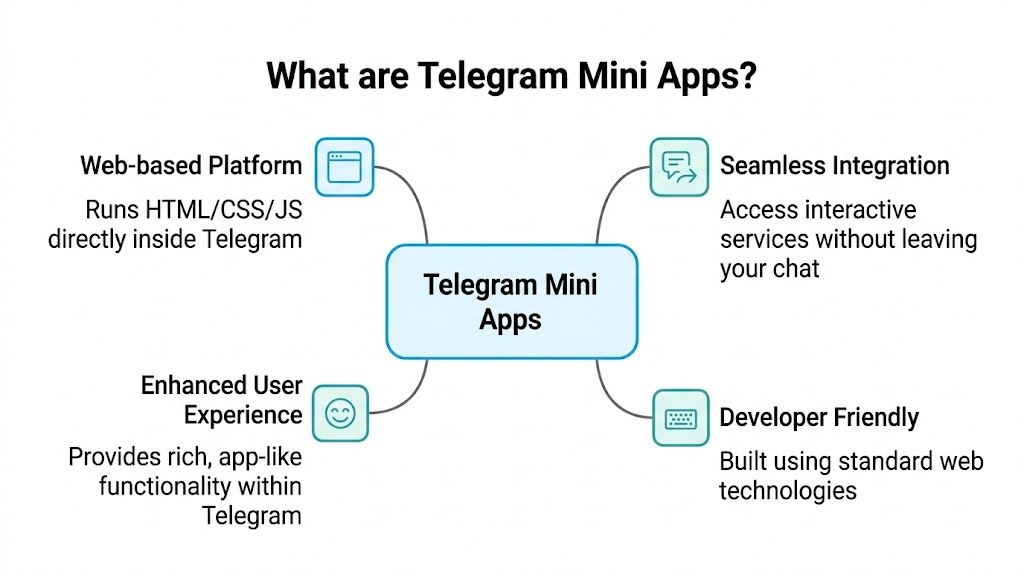
vs. bots — Bots work for structured conversation, alerts, and simple decision trees. Mini Apps take over when the interface needs to become visual and stateful — product selection, account dashboards, booking flows, gated content libraries. This guide on what a Telegram bot is is a useful baseline before scoping a Mini App.
vs. native apps — Native apps matter when you need full device access or heavy offline support. Most channel owners don't need that. They need fast access and low friction. Users don't have to install anything, learn a new interface, or leave Telegram.
| Format | Best for | Weak point |
|---|---|---|
| Bot | Simple messaging workflows | Limited interface depth |
| Mini App | In-Telegram interactive experiences | Platform constraints |
| Native app | Deep functionality and hardware access | Higher adoption friction |
A strong Mini App feels coherent with Telegram — opens fast, respects small screens, uses clear buttons, asks for the minimum needed to finish the job. A weak one treats Telegram as a cheap wrapper and forces users through a flow that should have stayed on the open web.
How Mini Apps Work Under the Hood
A Mini App is a web application running inside Telegram's WebView, with a JavaScript API bridge that gives it its in-platform behavior.
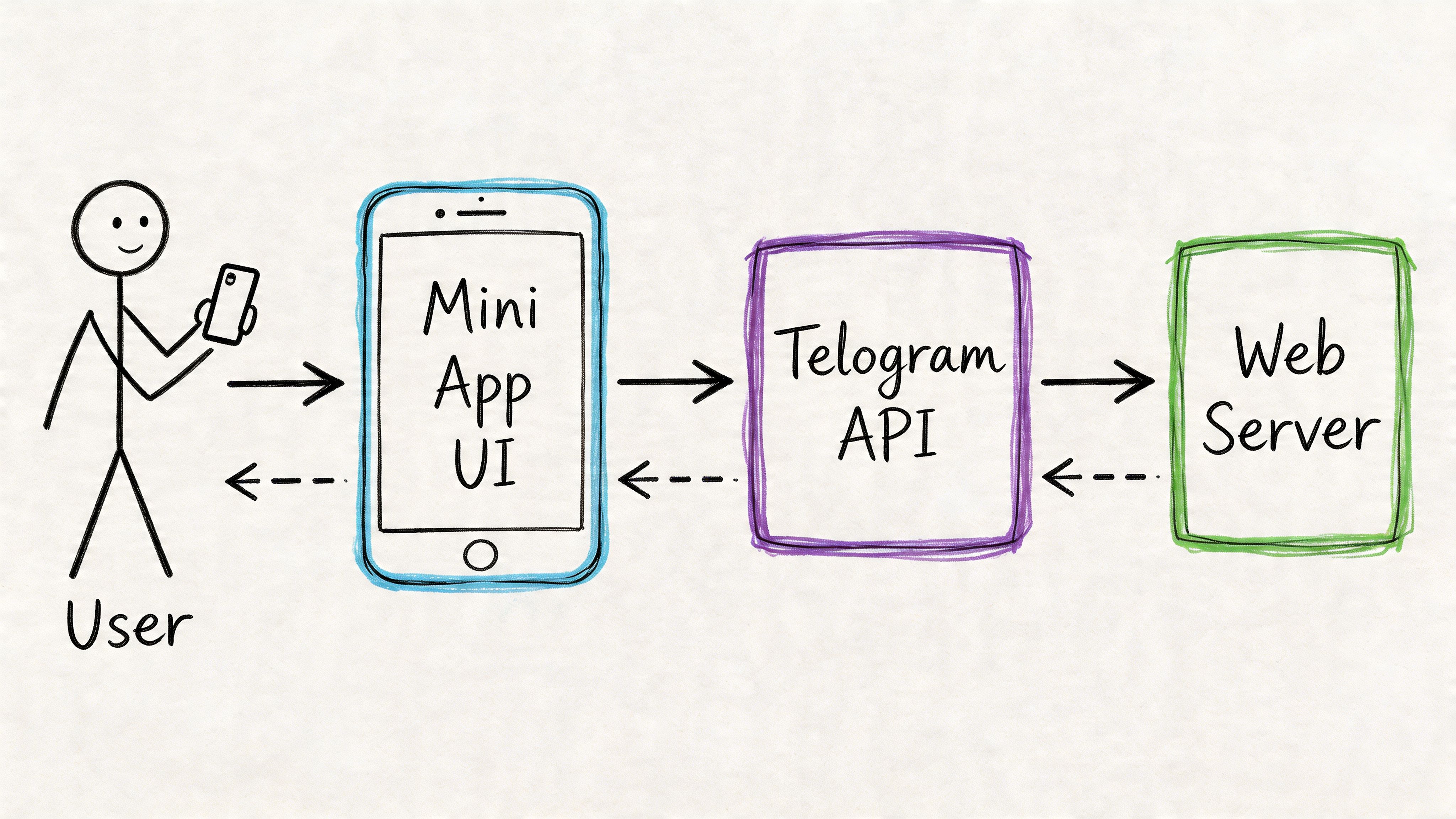
The bot is the launcher. It places the button, receives structured responses, and handles messaging logic around the app. It doesn't get replaced by the Mini App — it becomes the access and communication layer. For more on how bots fit into this, see this overview of Telegram bot development.
The app is a web product. Built with standard web technologies, which lets teams prototype in familiar frontend stacks instead of mobile-specific tooling. A useful Mini App for a channel usually does one job: qualify users, deliver a utility, capture demand, or provide premium access.
The API creates the Telegram feel. Methods like WebApp.ready() and WebApp.expand() handle smooth loading and display; WebApp.sendData() enables real-time communication back to the bot with response times under 100ms (OctaLabs guide). If developers don't handle these properly, users get lag, cramped layouts, and awkward state changes.
Channels that get real value from telegram mini apps don't try to reproduce their whole website inside Telegram. They compress one meaningful outcome into a narrow experience and let the bot, channel, and backend handle the rest.
Strategic Use Cases for Public Channels
Most public channels don't need a Mini App because it's trending. They need one because some process is getting stuck between a post and a website.
Retention is a genuine challenge. Average Day 7 retention is 8–10%, and the typical DAU to MAU ratio is 5% (Monetag). Many users show up briefly and don't form a habit. The right strategy is a narrow utility tied to a recurring need, not just any app.
Engagement — Quizzes and diagnostics turn posts into assessments. Content recommendation engines surface back catalogs. Streak tools reinforce habits tied to content themes. The goal isn't game mechanics for their own sake — it's making channel content more actionable.
Monetization — Works when the Mini App removes friction from a commercial step users were already motivated to take: paid access flows, premium content libraries, booking interfaces, product selection. A narrow commercial flow inside Telegram usually outperforms a broad storefront. If the channel promise is specific, the Mini App offer should be equally specific.
Discovery — Archives become tools. A real estate channel offers filterable listings. A crypto education channel offers a learning-path selector. A recruiting channel lets users filter by role, region, and seniority, then lands them on relevant openings.
Operations — Submission forms, application flows, and report tools reduce pressure on high-volume channels by structuring routine inputs. Pair this with a config editor so the rules behind those flows stay reviewable rather than buried in bot settings.
| Goal | Mini App Concept | Example | Primary Metric |
|---|---|---|---|
| Increase engagement | Quiz or interactive assessment | Market education channel offers investor type flow | Repeat opens |
| Improve content discovery | Archive navigator | Media channel turns old posts into topic-based pathways | Content depth per user |
| Monetize audience | Premium access hub | Creator channel unlocks members-only guides | Paid conversion quality |
| Capture leads | Booking or intake flow | Consulting channel qualifies inquiries pre-call | Qualified submissions |
| Simplify operations | Structured submission app | News channel collects tips in cleaner format | Processing speed |
Weak launches share common traits: the Mini App tries to replace the entire website, the use case is entertaining but not useful, the entry point is buried, or the team assumes one visit means long-term adoption. Public channels should treat telegram mini apps as conversion and utility layers first.
Measuring Mini App Impact and ROI
Launching without a measurement plan produces expensive theater. Opens aren't the right KPI. The question is whether the Mini App changes audience behavior in a way that improves the channel.
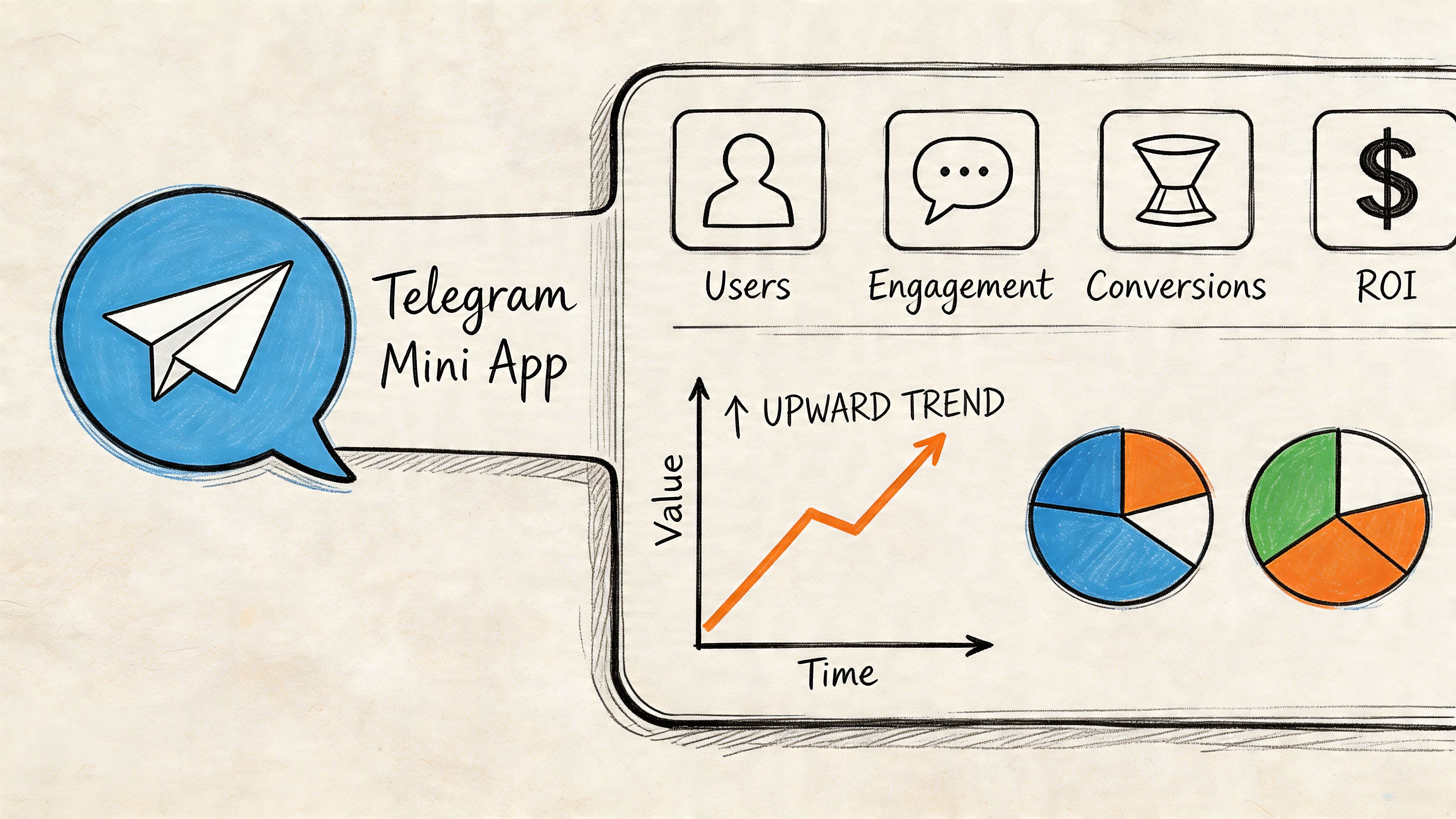
Every Mini App should connect to one primary outcome defined in advance:
- Acquisition — Does it convert subscribers into leads, members, buyers, or qualified contacts?
- Engagement — Does it increase return behavior or post interaction quality?
- Operational — Does it reduce manual handling or shorten response loops?
- Revenue — Does it influence paid conversions or average value per user journey?
The biggest reporting mistake is separating Mini App metrics from channel metrics. You need both sides together:
| Mini App behavior | Channel health |
|---|---|
| Starts | Subscriber growth trend |
| Completions | Post reach and engagement quality |
| Form submissions | Topic-level content response |
| Purchase or booking actions | Audience retention pattern |
| Return sessions | Campaign impact over time |
A high-volume Mini App may generate little strategic value if it doesn't improve subscriber quality or downstream conversion. A smaller Mini App may be far more valuable if the users it attracts behave differently across the channel.
Marketers need to answer: which posts drive the highest-quality Mini App sessions? Which calls to action produce completions? Do users who engage with the Mini App behave differently in the channel later? Mini App traffic is usually downstream of specific posts, themes, formats, and timing choices.
A month after launch, the questions that matter: Did the app strengthen the core channel strategy or distract from it? Where did users abandon the flow? Did it create a new repeat behavior or just a one-time spike? Mini Apps reward iteration — the useful ones improve because someone studies the behavior and cuts what isn't helping.
Implementation Tips for a Successful Launch
Most failed Mini Apps don't fail because the idea was impossible. They fail because teams shipped too much, too slowly, with too many assumptions. Treat the first release as an operational test.
Scope the smallest useful version. An MVP should feel almost uncomfortably narrow — one core action: submit one form, access one resource path, buy or book one offer, use one recurring tool. If the first brief contains multiple audiences, several monetization models, and a long feature backlog, the project is already drifting.
Remove friction before adding features. Apps that fail to follow technical mandates like HTTPS and official API-based payment handling can see 70–80% drop-off during onboarding. Using React with Telegram SDK tooling can improve performance — average load times of 1.2s versus 3.5s for vanilla JS (Habr analysis). Slow, awkward, or untrusted experiences waste the audience you already worked to acquire.
Launch checklist: - Fast first view — opening screen loads quickly and explains itself without a tutorial - Clear entry points — pinned posts, campaign posts, bot menus, onboarding messages - Single-screen clarity — users understand the next action from the first screen alone - Mobile-first interface — designed for Telegram's in-app environment, not a desktop browser - Payment and trust cues — keep transactions native if commerce is involved - Post-click continuity — after completion, send users somewhere meaningful
Promote with repetition, not one announcement. One launch post is rarely enough. Mini Apps need repeated framing from different angles — the problem it solves, a use case, a specific audience segment, social proof. The app doesn't become part of channel habit unless the channel teaches people when to use it.
Navigating Limitations and Future Potential
Performance is the main trade-off. The WebView model struggles on lower-end devices when the app is heavy or dashboard-dense. Hardware access remains limited — geolocation and Bluetooth are unavailable, even as motion sensor support has expanded (Solar Engine analysis).
These constraints hit hardest with complex analytics views, geo-dependent services, and rich media experiences that lag on budget phones.
Telegram mini apps reward restraint. The channels that benefit most don't ask the platform to do everything. They ask it to do one useful thing well — turning attention into action, action into insight, and insight into a better growth model. That only happens when the build is narrow, the UX is disciplined, and the team measures whether the app improves the channel around it.
If you want to understand whether your channel content is creating the right conditions for a Mini App to succeed, Statiko helps you analyze public Telegram channel performance with transparent metrics, content history, edit and deletion tracking, competitive comparison, and AI-assisted pattern analysis. It's a practical way to see which posts drive interest, where audience behavior shifts, and whether your growth strategy has enough signal to support a deeper product layer inside Telegram.
Related posts

Discover what is a Telegram bot and how these automated assistants work. This guide explains their power for channel management, marketing, and automation.

Learn Telegram bot development with our guide to building, deploying, and scaling secure, feature-rich bots with Python, Node.js, and TON integration.
Start in seconds.
Create a free account to organise channels, track activity, and get recaps delivered to you.
Real-time. Telegram. Analytics.