Your Guide to Spotting and Avoiding Bots on Grindr
Tired of bots on Grindr? Learn how to spot fake profiles, protect your data, and report scams with our complete guide for a safer experience in 2026.

The chat is going well, the profile looks promising, then something feels off. Scripted. You're not talking to a person.
Bots on Grindr are automated scripts built to scam you, steal your data, or get you to click a malicious link. They're not sophisticated — they're cheap, repeatable, and running at scale. Knowing their patterns is all you need.
Spot a Bot Before You Invest Time in a Chat
Real profiles have quirks. Bot profiles are sterile. Their only goal is to get you off Grindr and onto their own website — and they reveal themselves quickly if you know what to look for.
| Characteristic | Real User | Grindr Bot |
|---|---|---|
| Profile Photos | Candid, varied, imperfect. Might have friends or pets. | Slick, professional, model-esque. Often a single flawless headshot stolen from the web. |
| Bio | Has personality, specific interests, natural language. | Blank, gibberish, or one generic poorly-written line. |
| Conversation | Answers questions, natural pacing, sometimes slow to reply. | Ignores direct questions, vague responses, instant replies at any hour. |
| Goal | Chat, connect, meet up. | Get you to click an external link — "verification," "private cam," another app. |
How Grindr Bots Work
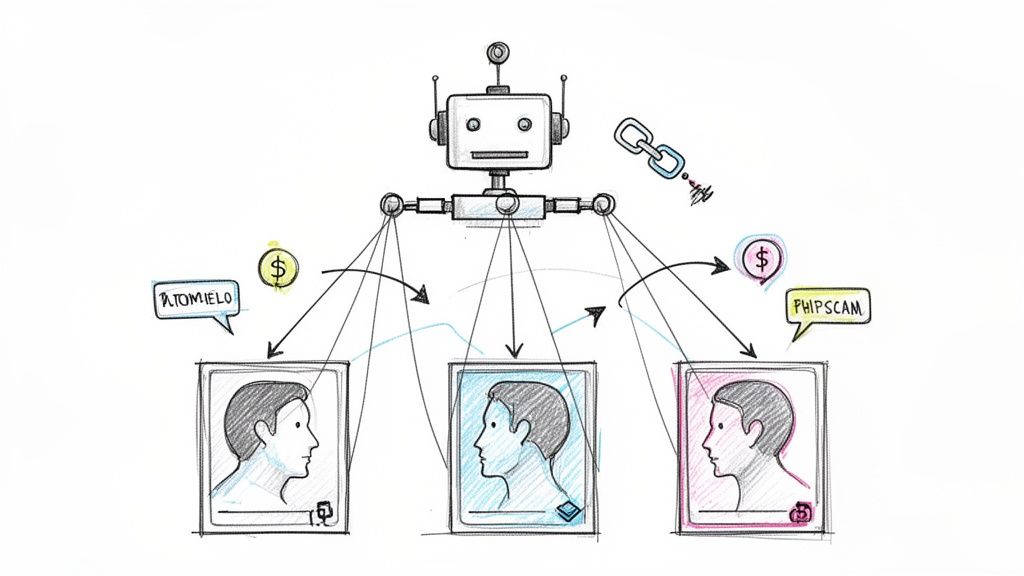
Forget sophisticated AI. These are simple scripts running a numbers game. They spin up a profile using stolen photos, blast out hundreds of generic openers, and wait for a reply. Once you bite, the script takes over — steering the conversation toward one outcome.
Mass messaging — A bot hits thousands of profiles in minutes. Pure spam.
Keyword triggers — The script isn't listening. It waits for certain words or phrases to fire the next pre-programmed line. Ask for more photos and it might jump straight to the link drop.
The link drop — The bot's entire purpose. Every conversation ends here. Back in 2015, users were already flagging huge spikes in spambots, exposing them by sending identical messages and watching canned responses repeat. The core strategy hasn't changed since.
This same automated script pattern runs across other platforms too. Our guide on what a Telegram bot is covers how these programs work for both legitimate and malicious purposes.
What do they actually want? One of three things:
- Financial scams — Cam sites asking for your credit card for a "private show" that never happens.
- Phishing — Fake login pages designed to capture your Grindr credentials or other passwords.
- Malware — Links that download spyware or ransomware to your device.
Why Grindr Is a Target
Scale is the reason. Grindr had 13.3 million monthly active users as of 2023, with 5.5 million daily users sending 111 billion chats that year. At that volume, automated spam is invisible in the noise.
The platform's culture makes it worse. Fast-paced interactions mean bots can push their link almost immediately without seeming out of place. Anonymity-friendly norms mean a sparse profile doesn't raise flags. High user turnover keeps a fresh supply of people who haven't seen these tactics before.
This same dynamic — anonymity at scale enabling bad actors — is central to Telegram's role on the dark web.
The Telltale Signs
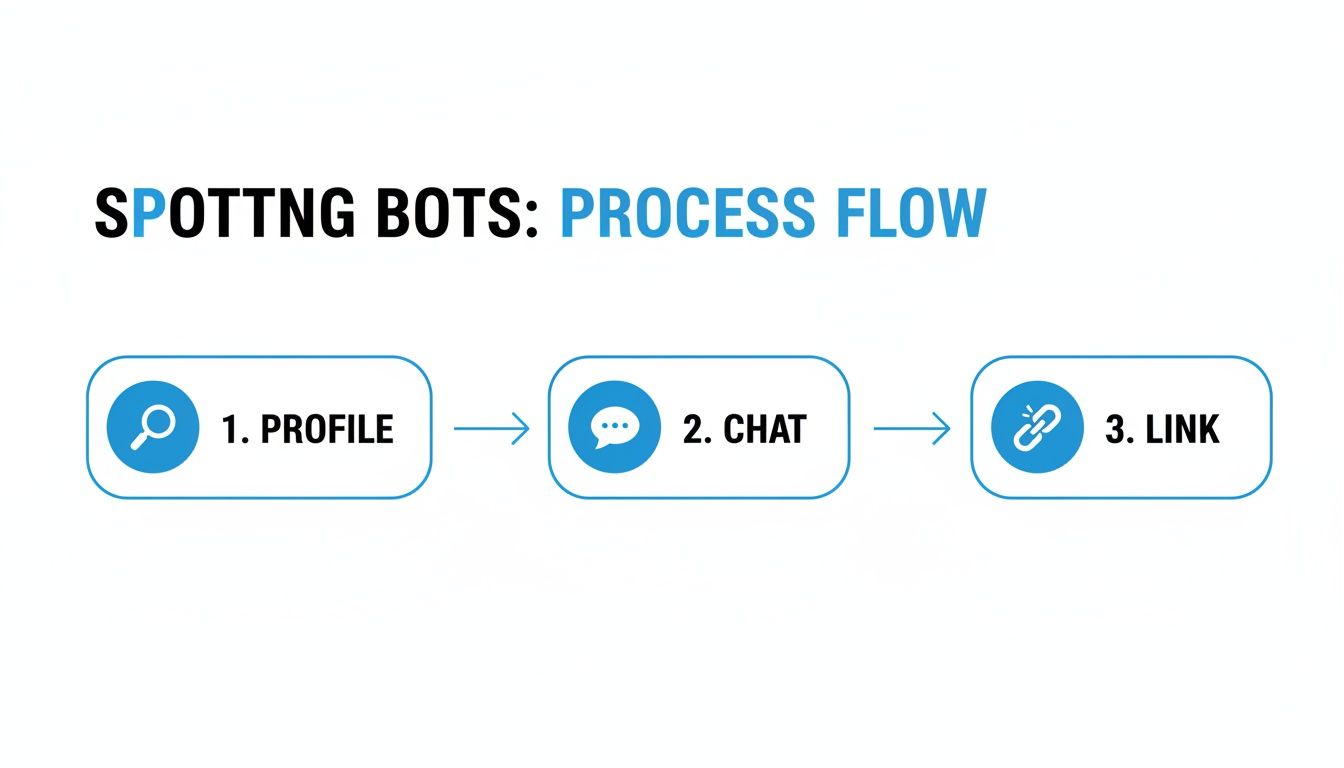
Profile red flags — Professionally lit photos with zero personal details is a warning sign. A single perfect headshot with a blank bio is worse. Real profiles have some authentic chaos: multiple angles, personality in the bio, the occasional awkward shot.
Conversation red flags — Instant replies at 3 AM regardless of timezone. Questions answered with something completely unrelated. Generic openers like "hey handsome, I want something real u?" after you've asked where they're from. The bot isn't reading your messages — it's pattern-matching. Some users report up to 90% of incoming messages feel like bots, which is why spotting them fast is a practical skill.
The link drop — This is where the mask comes off. Either they push you to WhatsApp or Telegram ("my Grindr is buggy") to grab your number and operate on an unmoderated platform, or they drop a link — "verify you're real" or "my private cam."
Never click these links. They exist to steal financial details, phish credentials, or install malware.
What to Do
Stop all engagement immediately. Don't click links, don't share personal info, and don't bother arguing — you're running against a script.
Then:
- Block the profile — Stops further contact and makes you invisible to them.
- Report the profile — Choose "Spam or Bot" or "Scam or Phishing." This is the important step.
- Add context if there's a comment field — "Sent a suspicious link" or "ignored every direct question" helps moderators act faster.
User reports are the primary input for social media monitoring systems. Every flag you submit feeds pattern detection that can shut down entire bot networks, not just one account.
Proactive hygiene — Don't put your full name, phone number, or employer in your bio. If a profile photo looks like a fitness influencer, reverse image search it in Google Images. If someone pushes you to another app within the first few messages, decline.
The Future of Bot Detection
Bots are getting harder to detect. Scammers now use basic ML to vary responses and avoid the repetitive replies that used to give them away immediately. Platforms fight back with the same tools.
Behavioral analytics — Systems flag accounts sending hundreds of identical messages in minutes, or new profiles that immediately start spamming.
Image recognition — Profile photos are checked against databases of commonly stolen images before they're even uploaded.
Link reputation analysis — Known phishing and malware domains get blocked before reaching your inbox.
Grindr has also added features like the "Taken on Grindr" photo timestamp, which verifies that an image was recently captured in-app — directly undermining one of the most common catfishing tricks. See what else they've been working on for user safety.
No technology is a complete solution. Your own awareness is the one thing bot creators can't automate around.
FAQ
Can a Grindr bot hack my phone? Not directly. The bot can't access your device through the chat window. The risk is what it tries to make you do. Clicking the link it sends could download malware or take you to a phishing page designed to capture your login credentials. The bot is the delivery mechanism — the link is the actual threat.
Does reporting bots do anything? Yes. Every report feeds Grindr's moderation and detection systems. When multiple users flag profiles with similar photos, bios, or scripts, it helps identify entire bot networks. Your reports also train automated detection for the next wave.
Are paying users safe from bots? No. Bots target everyone indiscriminately — they're running a numbers game and don't check subscription status. Plenty of Grindr Xtra and Unlimited subscribers still report the majority of incoming messages feel like bots. A subscription gets you features, not a bot shield.
Related posts

Discover what is a Telegram bot and how these automated assistants work. This guide explains their power for channel management, marketing, and automation.

Explore the Telegram dark web connection. Our guide reveals how illicit economies operate on the platform and how to use analytics for safety and research.
Start in seconds.
Create a free account to organise channels, track activity, and get recaps delivered to you.
Real-time. Telegram. Analytics.