Craft a Powerful Telegram Group Description
Write a powerful Telegram group description to attract the right members. Our guide offers templates, keyword tips, mistakes, and growth testing.

Your Telegram group is solid — posts land, regulars show up, people get value. But growth feels random: new members join, say nothing, and vanish, or nobody finds the group.
Admins usually blame promotion. The real problem is often the Telegram group description.
That short block of text decides whether your group shows up in the right searches, whether a visitor gets it in five seconds, and whether low-fit people opt out before they become a moderation headache. Treat it as a settings field, and it underperforms. Treat it as infrastructure, and it becomes one of your highest-leverage assets.
Why Your Group Description Is Your Most Important Asset
Telegram groups scale to 200,000 members, and public groups are searchable in-app. That makes the description a discovery surface, a filter, and an onboarding layer — not decoration.
A weak one is hard to find, attracts the wrong members because it sounds broad and permissive, and creates moderation drag because nobody knows the topic or norms before joining. A strong one does the opposite — it tells the right person "this is for you" and the wrong person "this isn't," in under two seconds.
It works as your front door. The best communities treat the description like a landing page headline: the first line should name the topic, the audience, and what happens inside, fast.
"Private space for SaaS founders in Berlin sharing operator advice and intros" works. "Welcome to our amazing community" doesn't.
If you also manage chat structure and member flow, pair this with our guide to Telegram group chat setup — the description only performs when the actual group experience matches it.
A description should reduce confusion before the first message is ever posted.
Poor descriptions cost you better members. The hidden cost isn't visibility, it's member quality. Generic descriptions attract generic intent — weak participation, off-topic posts, repeated questions, more enforcement. A tighter one pre-screens for people who already get the purpose, changing the room's tone before a moderator says a word. That's why admins rewrite as the group grows: what got anyone to join stops working once you need the right people to stay.
The Anatomy of a Perfect Telegram Group Description
A high-performing description isn't one clever sentence — it's a compact system where each part has a job, and skipping one softens it.
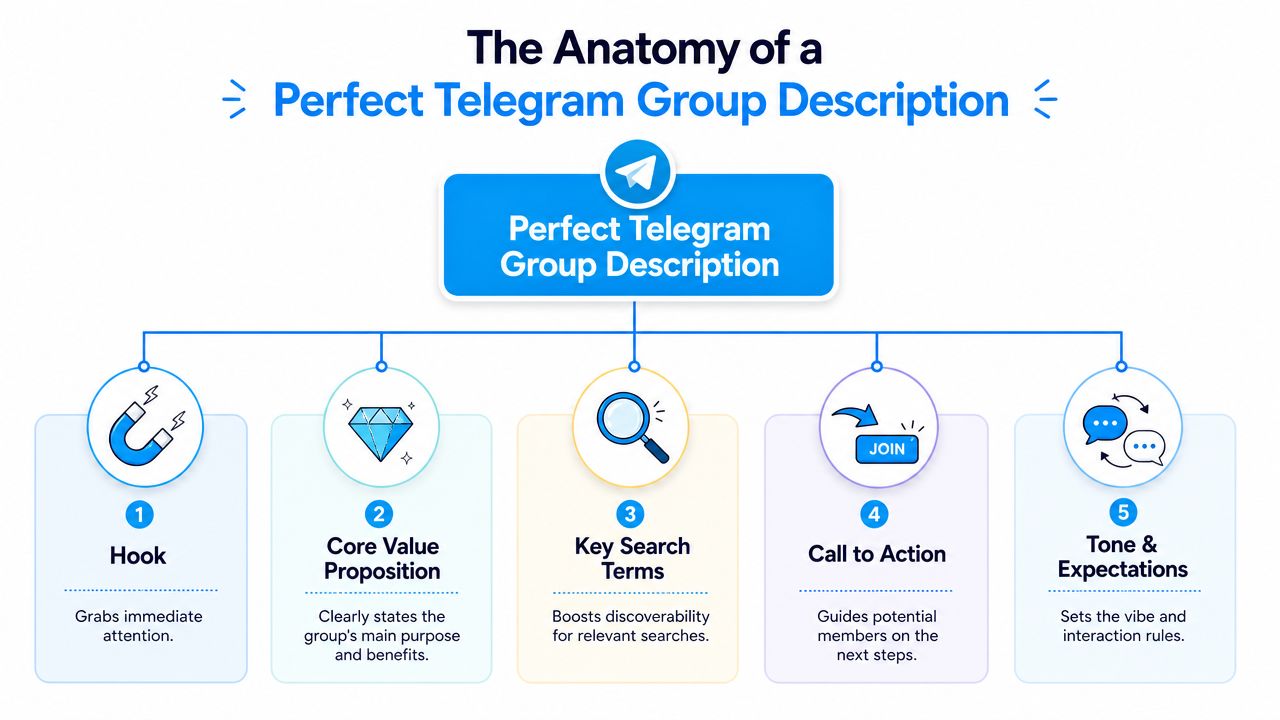
Most guides stop at "say what the group is about." As Metricgram's guide to Telegram group descriptions points out, most advice never separates discovery copy from retention copy — that's where better admins pull ahead.
The five building blocks. Here's the structure I use when rewriting a description:
- Hook — plain, searchable language for what the group is, not slogan or brand language
- Core value proposition — what members get by staying: advice, deal flow, peer review, job leads, event alerts. Pick the true value, not the flattering one
- Key search terms — the exact words a member would type: "Python developers," not "builders"
- Call to action — what to do once inside: introduce yourself, read pinned rules, post your stack
- Tone and expectations — brief rules and cultural cues that keep the room coherent
Discovery and retention need different copy
Early-stage groups should bias toward discoverability: clear topic wording, niche identifiers, location or language cues, a simple reason to join. Mature groups should bias toward fit and behavior: stronger expectations, boundaries on self-promotion, participation instructions, signals about culture and quality.
Practical rule: if your group has a spam problem, don't just tighten moderation. Tighten the description first.
A simple formula that works
| Element | What to write |
|---|---|
| First line | Topic + audience |
| Second line | Why this group is useful |
| Third line | Rules or norms |
| Last line | What a new member should do next |
That's compact and readable without turning into a wall of text.
Writing for Discoverability and Human Readability
Telegram is crowded. TGStat puts its catalog at more than 2,758,492 channels and groups, and per Popsters, users aged 25-34 make up over 31% of the platform, 18-24 another 22% — more than half the audience under 35, scanning fast.
Your description has to satisfy two readers at once: Telegram's search system, which needs clear topical language, and human visitors, who need instant clarity.
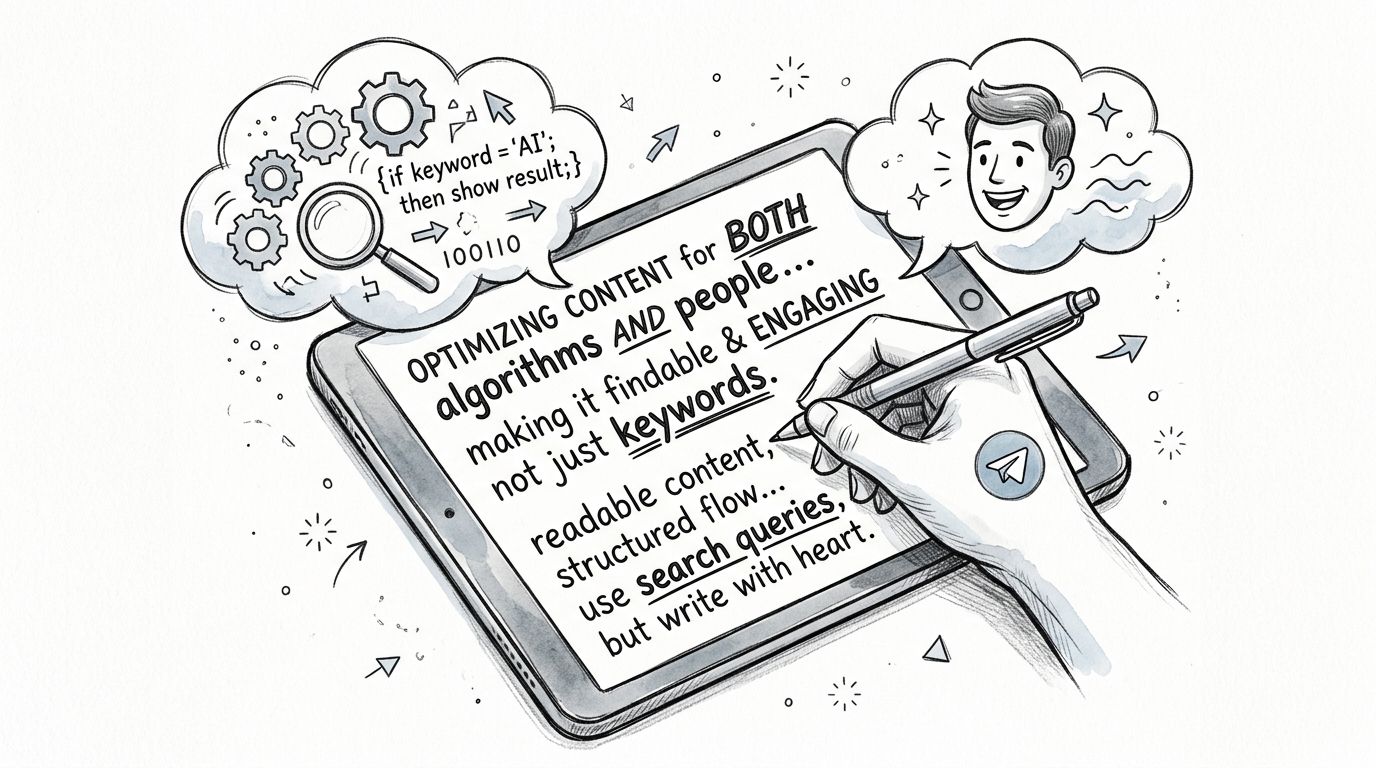
Use search language people actually type. Admins default to internal language. Members search with plain terms tied to outcomes, identities, and locations — pull yours from how members describe the group when inviting others, terms in competing groups, and phrasing like "job leads," "IELTS prep," "Solana devs," "Barcelona expats." Pick the few terms that define the group and put them early.
Write for scanning, not reading. People scan for fit, they don't read line by line. Keep lines short, one idea each. Front-load meaning — topic first, never the welcome message. Make constraints visible: language, location, rules. Match the tone: formal for professional groups, looser for social ones. Same discipline good web copy needs — OneNine's writing on skimmable copy is worth borrowing from.
Make the description sound like the room. A polished description on a casual group feels like bait. A playful one on a strict, technical group pulls in the wrong members. Tone sets the social contract, not just the mood — a crypto trading group needs firmness, a parents group needs warmth.
Quick walkthrough if you're rewriting for both search and readability:
If people need to decode your description, you've already lost them.
12+ Field-Tested Telegram Group Description Templates
Templates work best as starting points, not final copy — structure matters more than wording, and a good one bakes in purpose, audience fit, and participation cues without sounding generic.
If you also run channels, pair these with our guide on writing a description for a Telegram channel.
Templates by use case
| Group Type | Description Template |
|---|---|
| Local community | [City/Area] locals discussing events, housing, services, and daily life. Best for people living in or moving to [location]. |
| Expat group | [City] expats and bilingual locals sharing practical advice, meetups, and recommendations. Introduce yourself with neighborhood and interests. No spam. |
| Professional networking | Private group for [role/industry] professionals sharing opportunities, advice, and peer support. Strongly moderated for relevance. |
| Startup founders | For founders building real companies in [region/sector]. Operator talk, hiring questions, GTM lessons. No guru pitches. |
| Developer community | [Language/framework] developers sharing code help, architecture discussion, and practical fixes. No recruiter spam. |
| Study group | Study group for [exam/course/topic]. Revision help, accountability, resources, and practice discussion. |
| Crypto discussion | Community for [token/ecosystem/topic] discussion, research, and market commentary. Debate welcome — shilling and hype are not. |
| Trading room | [Market/style] traders discussing setups, process, and review. Disciplined discussion, not noise — post reasoning, not just entries. |
| Job seekers group | Jobs, referrals, portfolio feedback, and hiring discussion for [role/location]. No duplicate listings or unrelated ads. |
| Freelancers hub | Freelancers in [specialty] sharing leads, workflows, and client advice. Useful critique welcome, hard selling is not. |
| Hobby group | [Hobby] group for enthusiasts sharing projects, questions, and learning from each other. Beginners welcome, feedback stays constructive. |
| Gaming squad | Group for [game] players looking for teammates, strategy talk, and match coordination. Team play first, trash talk out. |
| Parents community | Parents in [location/stage] sharing practical support, recommendations, and local resources. Respect privacy, avoid judgment. |
| Project collaboration | Working group for contributors on [project name]. Updates, blockers, and quick coordination — keep it actionable. |
Why these structures work. Some lead with identity — good for groups built around profession, location, or role, where people want instant confirmation they belong. Others lead with activity — good where behavior matters more than identity, like study groups or trading rooms. A third leads with standards, useful when a niche attracts spam or hype.
How to customize without weakening it. Only add details that improve fit. Keep specific nouns (city, tool, profession, exam, game), a participation cue (introduce yourself, post context, read pinned info), and one or two guardrails (no spam, no recruiting, no hype). Cut boilerplate welcomes, empty quality claims, long mission statements, and inside jokes new members won't understand. If a template gets long, cut branding before you cut topic clarity.
Common Mistakes That Quietly Kill Group Growth
Bad descriptions rarely look bad to the admin who wrote them — they feel familiar and "good enough." From the outside, they create friction.
Mistake one: saying almost nothing. "Welcome to our group." "Be respectful." "Official community chat." None of it aids discovery — it describes that a group exists, not what it's for. Swap greetings for a concrete, searchable topic statement.
Mistake two: trying to attract everyone. Broad descriptions come from growth anxiety — admins worry specificity costs joins, so they water the message down. The opposite happens: vague copy pulls in low-intent members because nobody can tell what the standards are. State the niche, audience, and use case directly.
Broad descriptions increase volume at the cost of fit. Good communities usually can't afford that trade.
Mistake three: writing like a brochure. Brand-heavy phrases underperform. "Fostering meaningful connections in a vibrant ecosystem" says less than "Operators in e-commerce sharing retention and CRM tactics." Cut abstractions, keep operational nouns.
Mistake four: hiding the rules or overloading them. No rules invites problems; too many makes the group feel hostile before anyone joins. Put only the highest-impact rules in the description, in plain language, and move the rest to a pinned message. One short line is usually enough: language, promo policy, relevance standard.
Mistake five: never updating it. A stale description signals stale management, even in an active group. Review it when the topic drifts, low-fit joins increase, or pinned resources change. Descriptions don't break a group overnight — they just quietly erode discoverability and fit.
How to Test and Iterate Your Description with Analytics
Telegram gives admins partial visibility, not perfect. Built-in channel analytics, per Onlypult's overview of Telegram statistics, arrived in Telegram 6.0 and cover only the last seven days, for admins with more than 1,000 followers. Groups don't get this natively — you need a testing mindset built on proxies and observation.
What to measure instead. Track outcomes that reflect fit and intent:
- Join pattern: more relevant people showing up after the rewrite?
- Intro quality: new members introducing themselves in ways that match the group?
- Moderation burden: fewer irrelevant posts or repeat clarifications?
- Conversation quality: better questions, longer engagement?
These are proxy metrics, but they work — they tell you whether the description is qualifying members better.
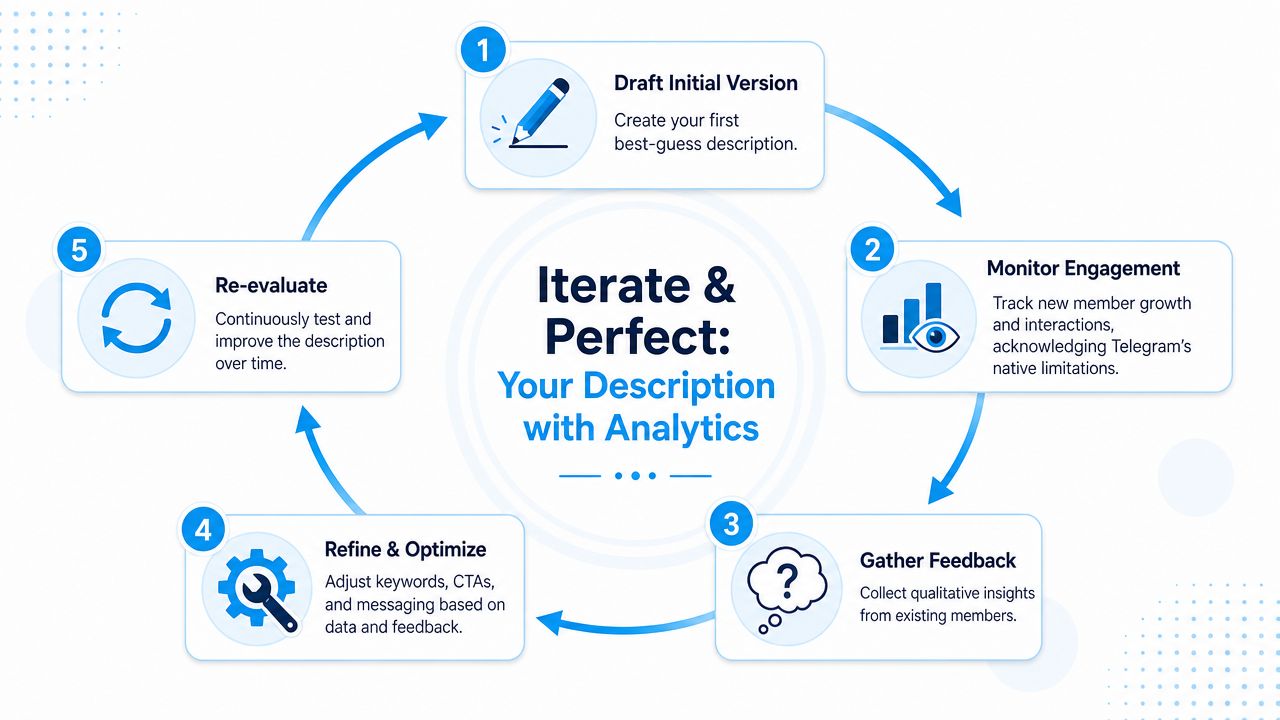
A workable testing loop. Don't change the description every few days — give it time to show a pattern.
- Draft one strong version — rewrite for one goal: search fit, fewer spam joins, or clearer expectations
- Hold other variables steady — don't change invite copy or posting cadence at the same time
- Track observations in one place — date, new copy, what changed in behavior
- Collect direct feedback — ask recent joiners what made them join
- Revise one layer at a time — opening line, then value line, then rules or CTA
Operator note: the cleanest tests focus on one problem at a time. Search failure and member-quality failure aren't always the same problem.
Use third-party tools carefully. Bots like Combot help with activity patterns and discussion volume when you want direction, not attribution. Description testing on Telegram isn't exact science — the goal is disciplined iteration, and a better description shows up as cleaner joins and healthier discussion.
Frequently Asked Questions
Should a private group use the same kind of description as a public group? No. Public descriptions prioritize discovery and filtering. Private ones prioritize qualification and onboarding — less search language, more purpose, standards, and what invited members should do once inside.
How many emojis should I use? Only if they improve scanning or match the culture. One or two can separate lines. A description packed with symbols usually lowers trust in professional, finance, or technical communities.
How often should I update my Telegram group description? Whenever the group's behavior changes — new audience mix, more off-topic joins, a topic shift, or updated pinned resources.
Should the description include full rules? No. Include only what prevents the most common problems — language, relevance, promo policy, one cultural expectation. Save the rest for pinned messages.
What matters more, keywords or tone? Both, different jobs. Keywords get you considered; tone gets you trusted. Weak keywords mean the right people never see the group. Off tone means they join and leave without engaging.
Can the description improve retention, not just joins? Yes. It prepares people for how the group works, reducing surprise and mismatch — often worth more than join volume in mature communities.
If you run public Telegram channels and want clearer visibility into content history, edits, deletions, and performance patterns, Statiko gives you a transparent way to study what's happening over time. It's built for admins, analysts, and marketers who want better decisions without guesswork.
Related posts

Transform your Telegram group chat into a thriving community. Learn expert strategies for creating, managing, and growing your group with this complete guide.

Discover 8 powerful examples of a winning description for Telegram channel. Get templates, tips, and data-driven insights to attract more subscribers today.
Start in seconds.
Create a free account to organise channels, track activity, and get recaps delivered to you.
Real-time. Telegram. Analytics.