Secret Telegram Groups: How They Work
Discover what 'secret telegram groups' are, how they operate, and the privacy risks you should know before joining.

"Secret Telegram groups" is community shorthand for private groups — the ones you can't find through search. Access is invite-only, controlled by a link that admins share.
Private groups are invisible. Public channels aren't.
Statiko tracks public Telegram channels — posting history, growth trends, edits and deletions. It can't see inside a private group, but most private communities run a public channel as their front door, and that one you can read in full. Search any public channel.
What Are Secret Telegram Groups
Telegram has two types of spaces: public and private. "Secret" isn't an official category — it's what people call private groups because of how closed-off they are.
Public channels are searchable, open to anyone, and built for broadcasting. Private groups are invite-only, hold up to 200,000 members, and are invisible to Telegram search.
The invite link is the gatekeeper. Only admins (and sometimes members) can generate one. This gives the group owner full control over who gets in.
Controlled membership — admins decide who joins, keeping spammers and trolls out.
Structural privacy — messages aren't indexed or publicly visible, even though they're not end-to-end encrypted by default.
Niche communities — ideal for paid groups, professional networks, and hobbyist circles where exclusivity is the point.
Note: private group messages are not end-to-end encrypted by default, unlike Telegram's "Secret Chats." But the invite-only architecture keeps them out of public view.
Public Channels vs Private Groups
| Feature | Public Channel | Private (Secret) Group |
|---|---|---|
| Discoverability | Searchable in Telegram and Google | Not searchable; requires invite link |
| Access | Anyone | Invite-only |
| Communication | One-way (admins post) | Two-way (all members) |
| Member Limit | Unlimited | Up to 200,000 |
| Message History | Visible to all | Admins control visibility for new members |
Growth of Private Communities
Telegram went from 35 million monthly users in 2014 to 1 billion by March 2025 — growth driven largely by privacy concerns with other platforms. 500 million new users joined since April 2020 alone. (Telegram statistics via whop.com)
Private groups grew alongside that. Three Telegram features made it possible at scale:
- 200,000-member capacity — orders of magnitude above what other apps allowed
- Advanced moderation tools — bot support, permission controls, admin roles
- Engagement features — polls, quizzes, threaded replies
These same tools serve both legitimate communities (paid courses, developer networks) and bad actors exploiting the privacy to operate without oversight.
The Dark Side
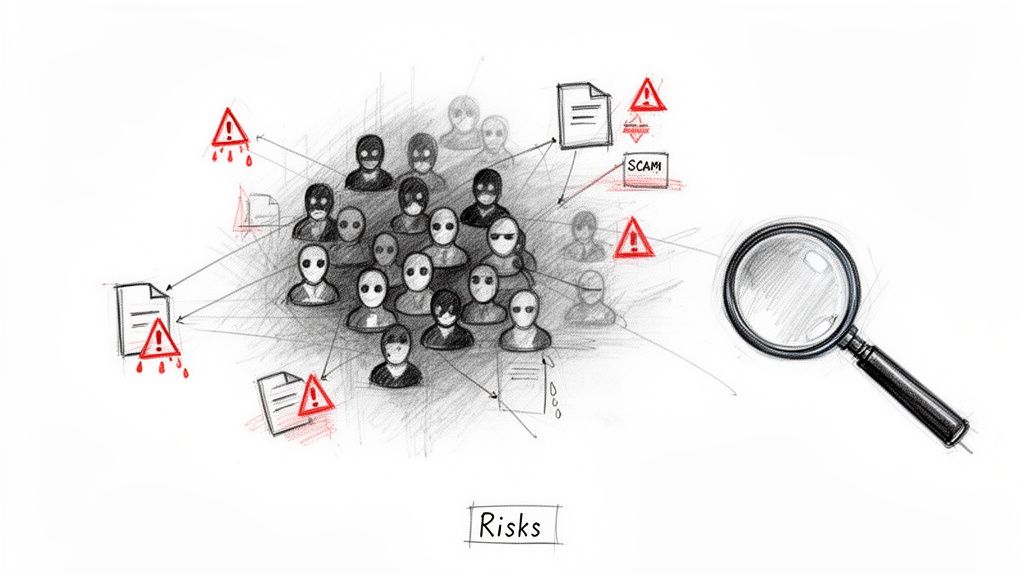
Private groups have become a functional layer of the cybercrime economy. Security researchers have documented stolen data marketplaces, phishing kit sales (from ~$230), and malware distribution all operating through private Telegram groups.
Between 2022 and 2023, fake ad scams funneled through these groups resulted in over $6.5 million in losses. Check Point tracked 130+ malware-related attacks facilitated through Telegram in the first three months of 2021 alone. (More stats via grabon.in)
The criminal appeal is simple: invite-only, no public indexing, massive user base. For a deeper look, see our post on how Telegram has become a dark web alternative.
Managing a Private Group
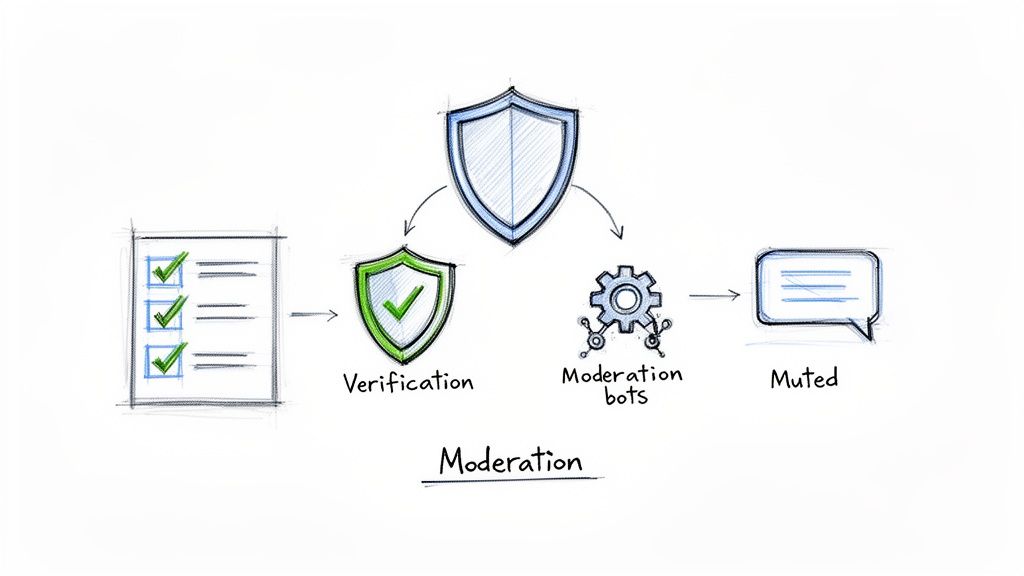
Private groups need actual structure. Without it, spammers and bad actors tend to take over as the group grows.
Set rules upfront. Pin them at the top. Cover what the group is for, expected behavior, and consequences for violations. This gives you a reference point when you need to remove someone — no arguments.
Vet new members. Don't broadcast your invite link casually. For high-trust groups, manually approve each new member. For larger ones, use a bot that requires new members to solve a captcha. That small friction cuts out most automated spam accounts.
Scale moderation. Groups of 50,000+ can't be moderated manually. Use bots like Combot or GroupHelp to enforce rules automatically. Promote trusted members as admins with specific responsibilities — and consider using anonymous admin settings to shield moderators from targeted harassment. Use Telegram's native Slow Mode to limit posting frequency during heated periods.
Groups over 100,000 members typically fight a constant spam problem. Without automation, engagement drops below 5–10% baseline quickly. (Telegram user dynamics via backlinko.com)
For more on running a healthy community, see our guide on Telegram group chat management.
Analytics: What You Can and Can't Track
Secret Telegram groups cannot be monitored by external analytics tools. Full stop.
This isn't a gap — it's intentional. Telegram's API provides no methods for an external service to access content or metadata from a private group it hasn't been invited into. Any tool claiming otherwise is not being honest.
Statiko works by analyzing publicly available data — the same way anyone can read a public channel. Private groups are invisible from the outside, so there's nothing to analyze.
The ethical line is clear: private conversations stay private. What is available is the public half of Telegram, which is substantial.
What you can track on public channels:
- Message edits and deletions — catch content revisions and scrubbed posts in real time
- Competitor content strategy — see what topics they cover, how often they post, and when
- Audience growth and engagement — daily subscriber counts, views per post, reaction trends
This is where Statiko's channel search earns its keep. You're not guessing at what competitors are doing — you're reading their public record.
For more on what public data can reveal, see our Telegram OSINT guide.
Frequently Asked Questions
Can police track secret Telegram groups? Difficult but not impossible. Authorities can request data via court order (Telegram's cooperation varies by jurisdiction), or simply obtain an invite link and join undercover.
Can you find secret Telegram groups by searching? No. Private groups are invisible to Telegram's search by design. The only way in is a direct invite link from an admin or existing member.
What's the difference between a secret group and a Secret Chat? A "Secret Chat" is a one-on-one conversation with mandatory end-to-end encryption, self-destructing messages, and no server storage. A private "secret group" holds up to 200,000 members but uses standard encryption — messages sync across devices, which isn't compatible with Secret Chat's strict security model.
Can I hide my phone number in a group? Yes. Telegram's privacy settings let you set your phone number to "Nobody." Other members only see your username and profile picture.
Found the channels. Now keep up with them.
Statiko Recaps tracks the public channels you pick and sends one digest with only what matters, so discovery doesn't turn into forty muted chats. See how Recaps works.
Related posts

Explore the Telegram dark web connection. Our guide reveals how illicit economies operate on the platform and how to use analytics for safety and research.

Master Telegram OSINT with our 2026 guide. Learn profile discovery, channel analysis, network mapping, and the best tools for open-source intelligence research.

Transform your Telegram group chat into a thriving community. Learn expert strategies for creating, managing, and growing your group with this complete guide.
Start in seconds.
Create a free account to organise channels, track activity, and get recaps delivered to you.
Real-time. Telegram. Analytics.