New Eastern Outlook: A Disinformation Outlet Explained
New eastern outlook - Discover New Eastern Outlook's role as a state-sponsored disinformation outlet. Learn about its content strategy and presence on Telegram

New Eastern Outlook looks like a niche geopolitical magazine. The verified record says it should be treated as something more consequential: a state-linked disinformation outlet that uses an academic style to mask influence activity.
That distinction matters. A propaganda site that declares itself as such is easy to dismiss. A publication staffed with ostensibly independent contributors, covering real topics, written in analytical language is operationally useful — it enters research workflows and policy discussions with far less resistance.
What Is New Eastern Outlook
NEO is published by the Institute of Oriental Studies of the Russian Academy of Sciences — a formal institutional tie documented in the Academy's own materials. The U.S. State Department's Global Engagement Center went further, identifying it as a pseudo-academic publication used to advance disinformation aligned with Russian state interests (State Dept report).
That classification isn't about bias. It's about function. NEO's method is subtler than overt propaganda: it presents regional expertise and strategic commentary, which gives hostile narratives a more credible wrapper — especially for audiences that screen out crude partisan messaging.
The right analytical frame separates NEO's three layers:
- Institutional layer: Published within the Russian state academic system
- Editorial layer: Packaged as geopolitical commentary and area studies
- Influence layer: Placed by government and independent assessments within a Russian propaganda ecosystem
Evaluate any NEO article on two tracks at once — its stated argument, and its outlet's documented role in influence operations. An outlet can look scholarly and still serve a propaganda function.
Content Strategy and Pseudo-Academic Advantage

NEO's operational strength isn't novelty — it's packaging. The publication spans politics, military strategy, historical commentary, and election coverage. That breadth lets it place messaging into multiple information streams simultaneously.
Legitimacy through contributor framing. The outlet features contributors presented as independent researchers — one cited example is Robert Smith, described as "an independent American researcher and analyst" (source). Whether every such label is false matters less than the operational effect: an outside voice makes the content easier to market as open analysis.
Topical range as flexibility:
| Content mode | Operational effect |
|---|---|
| Historical retrospectives | Builds ideological framing and civilizational narratives |
| Real-time geopolitical analysis | Lets the outlet react quickly to current events |
| Election and leadership coverage | Places influence content inside mainstream political cycles |
| Military and strategy commentary | Attracts specialist audiences who value technical framing |
Propaganda rarely works when it looks like propaganda. NEO's format lowers readers' defenses before the narrative work begins.
Role in Coordinated Disinformation
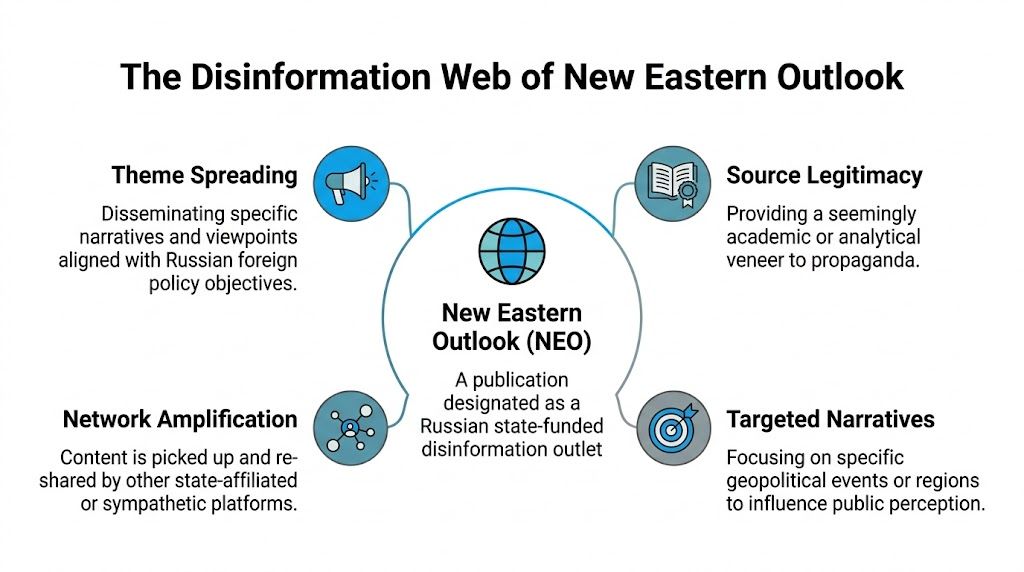
In 2021, the State Department's Global Engagement Center named NEO as one of four outlets used by Russia to mislead international audiences, including through COVID-19 vaccine disinformation (GEC special report). PolitiFact rated specific NEO claims false or mostly false. Media Bias/Fact Check classifies it as right-biased and questionable, citing pro-Russian propaganda, conspiracy content, and limited ownership transparency.
NEO's role in the broader system breaks into three parts:
- Message laundering: narratives arrive as articles with citations and bylines, making them easy to quote and recirculate
- Attribution shielding: opaque institutional ties make downstream users less likely to identify the state-linked origin
- Cross-platform portability: article-based narratives can be excerpted into posts, screenshots, and forwarded messages with little loss of persuasive framing
That third point matters most for platform researchers. Once a claim is formatted as an article, it becomes modular. A headline can travel alone. A paragraph can become a forwarded post. Provenance degrades as content is reposted, and false claims gain circulation time before context catches up.
NEO doesn't need massive direct readership. It needs content other actors can reuse. For analysts mapping those flows, a Telegram OSINT workflow for tracking channels, repost patterns, and content movement is a practical starting point.
NEO's Footprint on Telegram
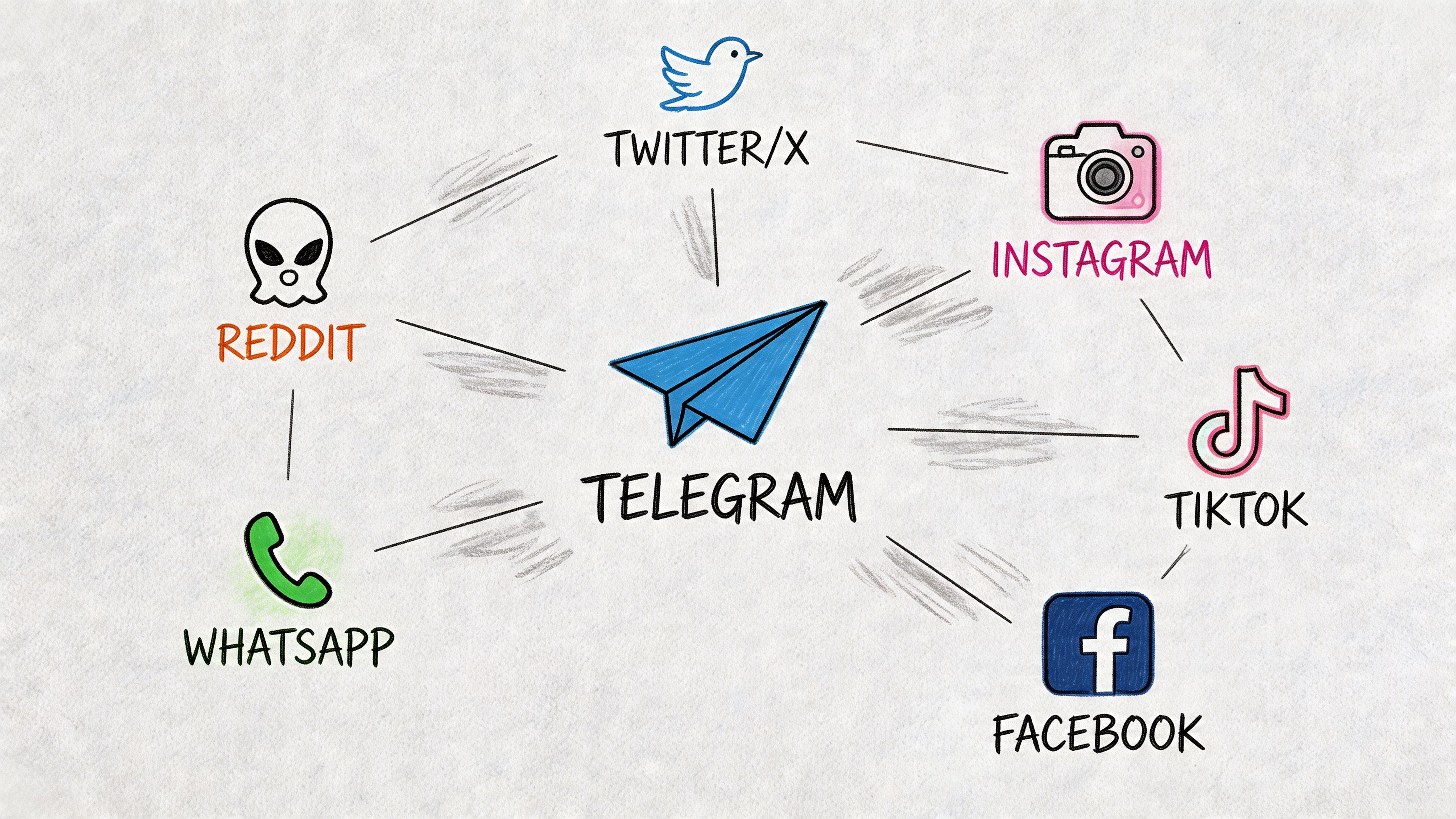
A sanctioned outlet can lose distribution on one part of the web and gain resilience on another. Telegram is where that tradeoff shows.
Verified reporting shows 15 of 18 sanctioned Russian media outlets maintain an active presence on Telegram (reference). Telegram offers persistence, direct distribution, and weaker public transparency than most open networks.
The problem isn't visibility — researchers can often read public posts. The problem is the behavioral story over time. Subscriber trends, posting frequency, edit and deletion patterns are not surfaced in the channel view.
That gap creates three concrete issues:
- Reach is hard to quantify. Presence alone doesn't reveal momentum.
- Strategic shifts are easy to miss. Without longitudinal tracking, analysts can't detect changes in tempo or messaging style.
- Narrative cleanup goes unnoticed. If posts are edited or deleted, a snapshot misses the original claim.
A sound Telegram monitoring workflow needs more than manual browsing. The Telegram OSINT guide covers how to separate channel existence from actual channel behavior. Key questions: Does posting intensify during elections or conflicts? Do Telegram posts mirror website content immediately or after reframing? Are controversial claims left intact, softened, or removed?
Access isn't understanding. A public channel can be visible every day and remain analytically opaque.
Analyzing Influence Beyond Follower Counts
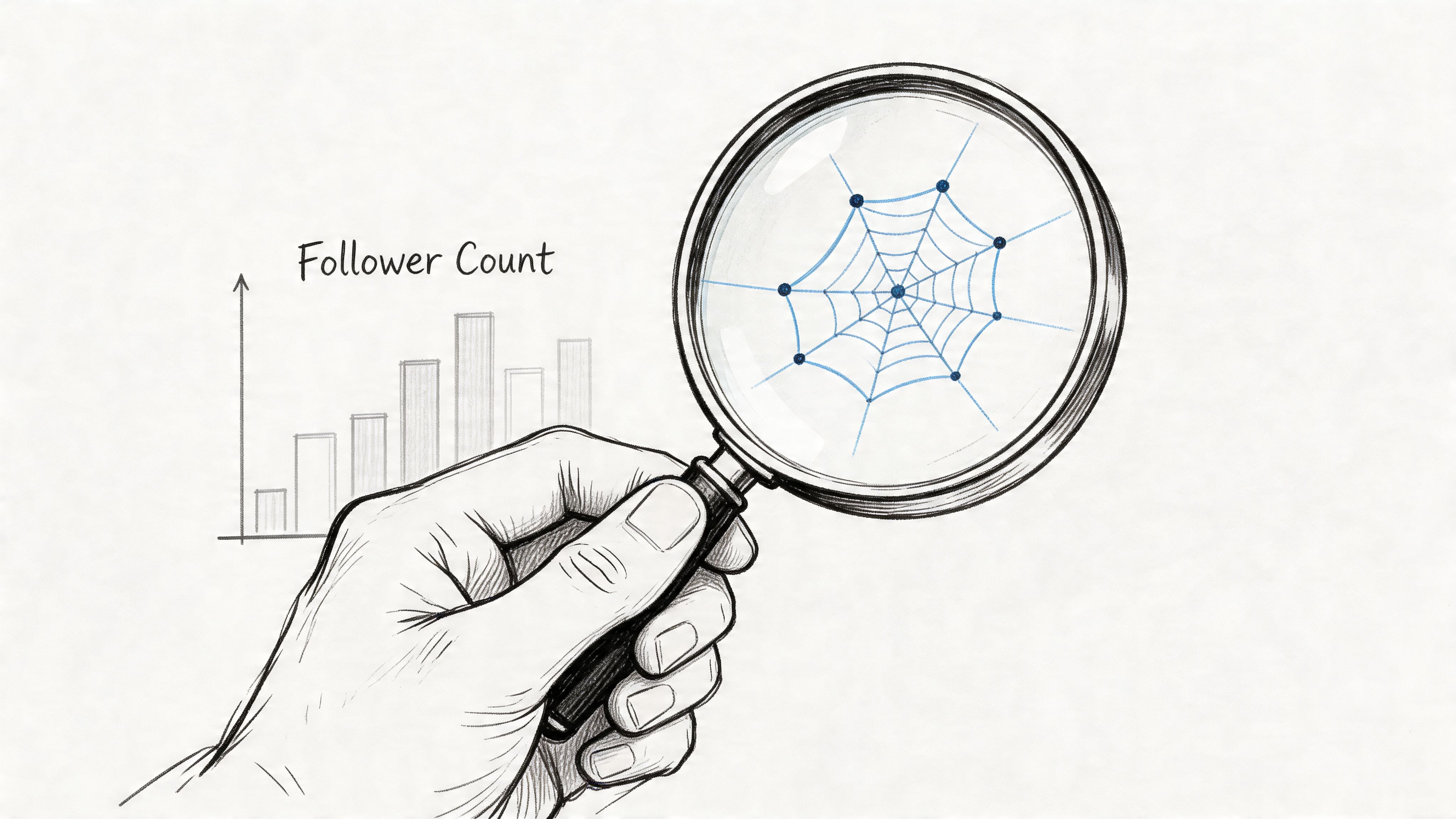
Follower counts are a weak proxy for influence in a propaganda-adjacent distribution network. The real analytical gap is mechanism, not scale. Research notes that tools tracking message edits with timestamps can reveal narrative changes that audience totals hide entirely (reference).
Follower totals don't tell you whether posts are being rewritten after publication, whether engagement clusters around geopolitical triggers, whether a channel acts as an origin point or merely a repeater, or whether recommendation systems amplify specific themes.
Better indicators for NEO-style channels:
| Signal | Why it matters |
|---|---|
| Edit history | Shows whether narratives are softened or disguised after publication |
| Deletion tracking | Reveals cleanup behavior after backlash or moderation pressure |
| Posting pattern analysis | Helps identify coordinated timing and event-driven messaging |
| Comparative channel review | Distinguishes isolated commentary from networked amplification |
Edit analysis is one of the most underused methods. Repeated edits around sensitive narratives signal active message management. This applies beyond disinformation research — the same logic shifts attention from vanity metrics to durable signals.
For channels like NEO, influence means the ability to place, adapt, and circulate narratives — not the ability to attract visible subscribers. The investigator's question isn't "How big is this channel?" It's "How does this channel behave when the narrative environment changes?"
A Working Framework for Analysts
NEO combines three features that are individually common but collectively potent: institutional ties that signal authority, a magazine format that implies legitimacy, and distribution in spaces where visibility is easier than accountability.
When evaluating similar outlets:
- Ownership and affiliation: Who publishes it, and what relationships are obscured?
- Presentation style: Does the outlet borrow academic language to lower skepticism?
- Narrative behavior: Are claims repeatedly aligned with documented state messaging objectives?
- Distribution path: Where does the content travel once it leaves the site?
A broader social media monitoring workflow answers those questions consistently — because monitoring is longitudinal analysis, not one-off observation.
State-sponsored disinformation rarely announces itself through crude falsity. It arrives as analysis, context, and commentary that looks reasonable enough to reuse. Better attribution habits, stronger content-history methods, and systematic skepticism toward outlets that market themselves as geopolitical interpreters are the countermeasures.
Statiko helps researchers, journalists, marketers, and Telegram operators analyze public channels with more transparency. If you're tracking narrative shifts, message edits, deletions, and channel behavior over time, explore Statiko to build a clearer picture of how public Telegram ecosystems work.

Start in seconds.
Create a free account to organise channels, track activity, and get recaps delivered to you.
Real-time. Telegram. Analytics.