Codes for IPTV: A Guide to Using Them Safely in 2026
Learn what codes for IPTV are, how M3U and Xtream work, the security risks involved, and how to find safe alternatives. Your complete 2026 explainer.

A lot of readers land here the same way. You see a public Telegram channel pushing "live sports" or "premium entertainment" — the post makes it sound simple: paste a code into a player app and you're done.
That instinct toward suspicion is usually right. Codes for IPTV are not magic. They're access credentials tied to a streaming system. The technology is straightforward. The ecosystem around it often isn't.
What matters in 2026 isn't just whether a code works. It's understanding what you're connecting to, who operates it, what your device is exposing, and how public communities circulate these credentials. That last part gets ignored in most guides.
The Temptation of Unlimited TV
You join a Telegram channel because someone forwarded a post promising "all channels available." The message includes a server URL, a username, a password, and maybe a screenshot of a player app full of country flags. Comments are full of short reactions: "working," "dead," "need update," "send new list."
This pattern hits three pressure points at once: free access, copy-paste setup, and social proof. If enough people repeat the same code, it feels less risky than it is.
In practice, the first experience is usually messy. One code buffers constantly. Another expires. A third requires sideloading an unknown Android app. The question shifts from "how do I watch this" to "what exactly did I just install."
If a service requires you to trust anonymous operators, unofficial apps, and recycled credentials at the same time, treat it as a security event, not a streaming shortcut.
There's also a second audience here. Researchers, journalists, and channel admins often read about codes for iptv to understand how public code-sharing communities behave — not to use them. That's a safer and more useful lens.
What Exactly Are IPTV Codes
An IPTV code is a credential that grants access to a streaming service. IPTV means television delivered over internet protocol. The code tells a player app how to authenticate to a remote service and request streams.
The remote service hosts live channels, movies, and series. Your app requests entry. The code is the keycard. If it's valid, the server responds with playlists and playable stream links.
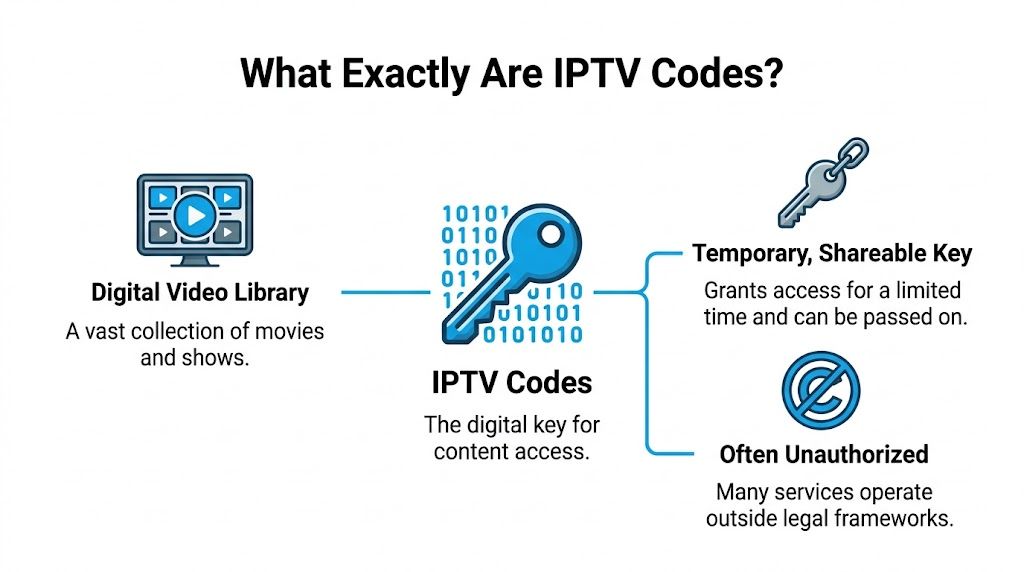
Client and server — The client is a player app on a phone, smart TV, tablet, browser, or set-top box. The server hosts playlists, metadata, and video streams. You enter credentials → the player contacts the panel endpoint → the service checks the credential → returns content → you request a stream → success or failure. A valid code doesn't guarantee stable viewing. It only gets you through the door.
Why Xtream became common — Among all formats, Xtream Codes became the most recognizable. According to a Scribd document about Xtream IPTV codes, Xtream emerged in the early 2010s, and by 2019 a single document listed 28 active codes for international content. A Europol-led shutdown in 2020 disrupted services for millions of users. Xtream made IPTV logins easy to distribute, re-enter, and repost across public platforms. For a deeper technical look, see Statiko's explainer on Xtream Code IPTV.
What people get wrong — IPTV codes are not content. They're credentials plus routing information. That's why they get revoked, rate-limited, recycled, and sold in tiers. A code can be temporary (shared today, dead tomorrow), overused (too many users hammering the same account), misleading (the login works but channels are broken), or repackaged (same backend, different branding).
The Three Main Types of IPTV Access
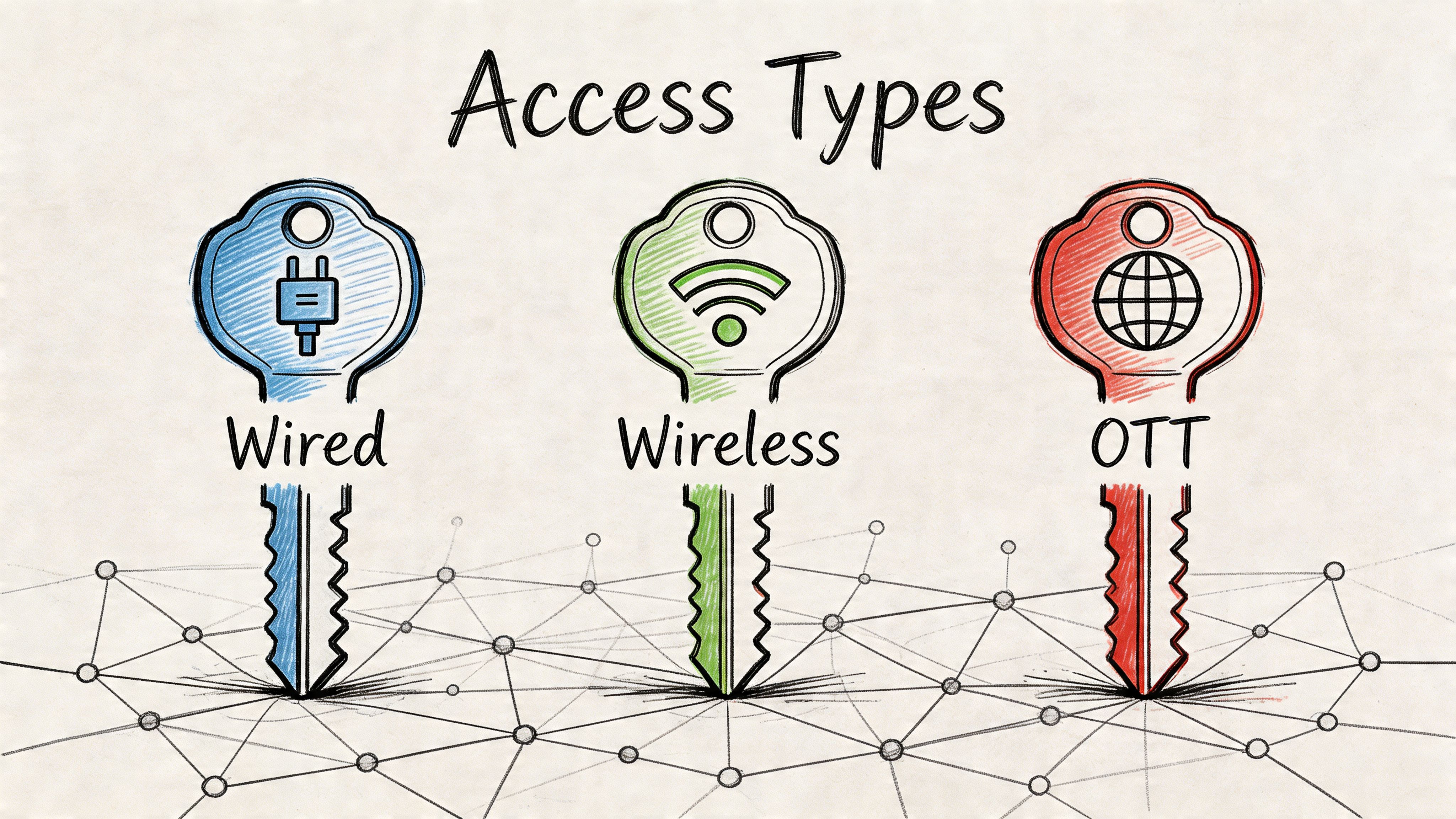
M3U and M3U8 playlists — The simplest format. Instead of logging into a panel, your player reads a text-based list of channels and stream addresses. Convenient but brittle — if the list is badly maintained or full of dead entries, the experience collapses fast.
| Format | What it contains | How a player uses it | Common weakness |
|---|---|---|---|
| M3U | Channel names, metadata lines, stream URLs | Loads a playlist view and opens listed streams directly | Broken links, duplicates, little account context |
| M3U8 | Similar concept, often tied to streaming segments | Reads adaptive or segmented stream references | Inconsistent support across apps and unstable source links |
M3U is common in repost channels because it's easy to redistribute. It's also common in "starter" posts that hook users before pushing them toward a paid tier.
Xtream login format — Built from a server URL, username, and password. The player can request categories, live TV, VOD, and series from a structured backend instead of relying on a flat playlist. Many apps prefer it because the experience feels more like a commercial streaming product. According to a CNX Software review of Xtream-Codes setup parameters, operators often limit movies to 720p and cap bitrate at 2000-3000 kbps using H.264 to reduce freezing — exceeding those limits overwhelms residential connections.
MAC address and portal activation — Ties access to a device identity through a MAC address and portal URL. Common with set-top box ecosystems. The service authorizes specific hardware rather than a username/password. Reduces casual credential sharing for the operator, but means less flexibility and more friction when devices change.
In practice: M3U works best for portability, Xtream for cleaner library structure, MAC/portal when the operator wants tight device control. The more tightly access is bound to one device, the more leverage the operator holds.
What usually fails — Huge "all-in-one" free lists, old playlists mirrored across channels, accounts already shared publicly, streams pushed above what the backend can deliver reliably. In public communities, these failures are visible fast: edits replacing dead credentials, complaints about freezes, and repost cycles where the same access package reappears with a new label.
The Hidden Dangers: Security and Privacy Risks
A free code doesn't arrive alone. It often comes attached to an unknown player app, a shortened download link, a Telegram contact asking for payment, or a "premium access" page that wants card details.

The app is the biggest trap. Users hunting for codes for iptv often leave official app stores because the promoted player or "custom APK" isn't available there. That means trusting a file from a Telegram post or unknown site with no accountability. According to a Slideshare analysis of Xtream code risks, the 2020 Xtream Codes takedown revealed servers serving 6 million users through 5,000 resellers generating over €50 million annually. 60% of freely shared codes expire within 7 days, and 1 in 3 devices using "lifetime access" scam offers are compromised by malware.
Common failure modes: - Malicious player apps — broad permissions, ad injection, device profiling - Credential harvesting — "trial" pages collecting email addresses and reused passwords - Traffic exposure — the operator can infer what you watch, when you connect, your device profile - No recourse — when a provider vanishes, there's no contract, refund path, or audit trail
If an IPTV seller says "lifetime," assume the lifetime being measured belongs to the credential, not the customer relationship.
Privacy gets ignored because people focus on whether the stream opens, not what they disclose while opening it. A login exposes your IP address. The app exposes device details. Signup exposes your email. Payment exposes billing details to an entity with no compliance posture. The user usually has no reliable way to distinguish a sloppy service from a hostile one until after something goes wrong.
If you're studying this ecosystem, keep distance between observation and participation. Watch public channels, compare repeated credentials, inspect edits, note when channels swap download links. That gives you useful intelligence without turning your device into a test environment.
Navigating the Legal Gray Area of IPTV
IPTV is legal technology. Streaming television over internet protocol is normal — licensed providers do it every day. The legal problem starts when a service distributes channels, films, or series without permission from rights holders.
Technology is neutral. Distribution isn't. Licensed IPTV services pay for distribution rights. Unlicensed services package premium channels without authorization. Code-sharing channels treat access credentials like disposable tokens, even when they point to unauthorized content. A YouTube discussion of IPTV compliance gaps notes that mainstream content largely skips legal questions, leaving channel owners with weak benchmarks for disclaimers and content moderation.
Telegram channels struggle with compliance because they often operate with mixed motives. Some frame themselves as "news" or "testing" channels. Others openly sell access. Many swing between those modes depending on user pressure or platform moderation. You can learn a lot from public behavior: how often a channel posts legal disclaimers, whether sales language changes after takedowns, whether edited posts remove direct payment instructions. This backgrounder on online content removal laws is useful context for understanding how legal pressure and platform enforcement differ across jurisdictions.
Statiko's piece on Telegram and dark web overlaps is worth reading for how public channels function as distribution surfaces without being private in the way users assume. A public Telegram channel can look informal and still create a clear record of distribution behavior.
The "gray area" in practice is less gray than advertised. If a service sells premium content at suspiciously low prices, hides operator identity, cycles domains, and depends on copied credentials, you're not looking at a clean licensing story. Low enforcement doesn't mean low risk — consequences arrive unevenly, through payment disputes, service loss, takedowns, or platform moderation.
Finding Safer and Legitimate Alternatives
Once you've seen how unstable this ecosystem is, the sensible next step isn't "find a better pirate list." It's deciding what level of risk you're willing to accept.
Legitimate options — Live TV streaming bundles, on-demand platforms, and broadcaster apps cover most of what people actually want. What you gain is boring in the best way: predictable billing, actual support, app store distribution, fewer malware surprises.
If you still evaluate lesser-known providers, use a harm-reduction checklist:
- Treat "lifetime" claims as red flags — Services built on unstable credentials rarely deserve long-term trust
- Separate identity from experimentation — Dedicated email, unique passwords, minimal personal info
- Use privacy-protective payment controls — Virtual cards, payment limits, short-lived billing instruments
- Prefer known apps over custom downloads — A custom APK from an unknown site raises risk sharply
- Use a reputable VPN if you proceed — Reduces direct exposure of your home IP, nothing more
- Watch how the provider communicates — Domain changes, disappearing support, and aggressive upsells signal weak operations
Licensed services cost more but externalize risk. Gray-market services cost less upfront and push legal, security, and operational risk back onto the user. That's the real pricing model — not the monthly fee.
How to Monitor IPTV Code Sharing on Telegram
If your interest is analytical rather than consumptive, Telegram gives you a rich public dataset. Public channels reveal timing, language patterns, repost strategies, and how quickly shared credentials burn out.
What to track — posting frequency (bursts often signal new batch acquisition), edit behavior (fast edits indicate dead codes or risk response), deletion patterns (deleted posts reveal what operators regret), engagement cues (replies expose whether codes are working or exhausted), promotion language (tone shifts when moving from free lists to paid tiers). This list of OSINT tools is a useful starting point for structuring searches and public verification.
| Signal | What it may indicate | Why it matters |
|---|---|---|
| Burst posting | New batch of credentials or aggressive promotion | Suggests acquisition or resale activity |
| High edit rate | Credentials failing quickly or sanitizing messaging | Good clue for code burnout |
| Repeated wording across channels | Reposts, reseller networks, or copy chains | Helps identify linked distribution behavior |
Public IPTV-sharing channels follow recognizable cycles: post a free teaser, gather attention, move users toward paid access, then edit or delete when a code fails or gets overexposed.
A transparent approach — use public channels only, record timestamps, compare original posts with edits, note deletion history, track when promotional language changes after a complaint wave. The most useful insight often comes from what gets edited or deleted, not the original sales pitch. Statiko's guide to Telegram OSINT focuses on this observable-behavior model. For a worked example of applying this to Russian-language entertainment communities — including how fans navigate pirate mirrors and unofficial Telegram channels — see Son of Anarchy Online RU: Watch Safely in 2026.
For tracking public channel activity at scale — edits, deletions, posting patterns, channel comparisons — Statiko is built for that.
Frequently Asked Questions
Why do IPTV streams buffer or freeze constantly? Buffering usually starts on the supply side. The provider may be overselling access or pushing streams above what the backend can handle. In Xtream-style systems, stream reliability is often tied to moderate settings (720p, H.264, 2000-3000 kbps) — exceeding those triggers playback failures.
Do I need a VPN to use IPTV safely? A VPN reduces direct exposure of your home IP to the service operator. It does not make an unlicensed service legal, and it does not protect against malware in a bad app or dishonest payment handling. One defensive layer, not a complete solution.
What is the best app for M3U or Xtream codes? No universal best. The right choice depends on device type, codec support, and format compatibility. Well-known players distributed through official app stores are safer than custom-branded apps from Telegram or file mirrors. Stability depends heavily on the provider, not just the player.
Why do free codes stop working so fast? Shared credentials get overused, revoked, replaced, or reposted after they're already dead. Public sharing burns access quickly. A code posted in a large channel often has a short useful life.
Are there any truly free and legal IPTV services? Yes, but with limits. Free and legal services offer ad-supported channels, public-interest content, or limited catalogs. They won't replicate the "everything in one place" pitch common in gray-market promotions.
Is Telegram a good place to find IPTV providers? It's a common place, not a trustworthy one. Public Telegram channels are more useful as research surfaces than shopping venues — useful for understanding patterns and promotion tactics, not for establishing trust.
What should channel admins watch for if they discuss IPTV topics? Direct sales language, repeated reposts of credentials, edited compliance language, and user comments requesting payment contacts. Public discussion can drift into facilitation faster than most admins expect.
If you need to analyze public Telegram channels discussing IPTV without touching private chats or guessing at deleted context, Statiko is built for that job. It tracks public-channel edits, deletions, posting patterns, and content history so researchers, journalists, and channel operators can study behavior transparently and keep their analysis grounded in what was posted.
Related posts

What is Xtream Code IPTV and is it safe? This guide explains how it works, the legal risks, and the legitimate alternatives available today.

Master Telegram OSINT with our 2026 guide. Learn profile discovery, channel analysis, network mapping, and the best tools for open-source intelligence research.

Explore the Telegram dark web connection. Our guide reveals how illicit economies operate on the platform and how to use analytics for safety and research.
Start in seconds.
Create a free account to organise channels, track activity, and get recaps delivered to you.
Real-time. Telegram. Analytics.